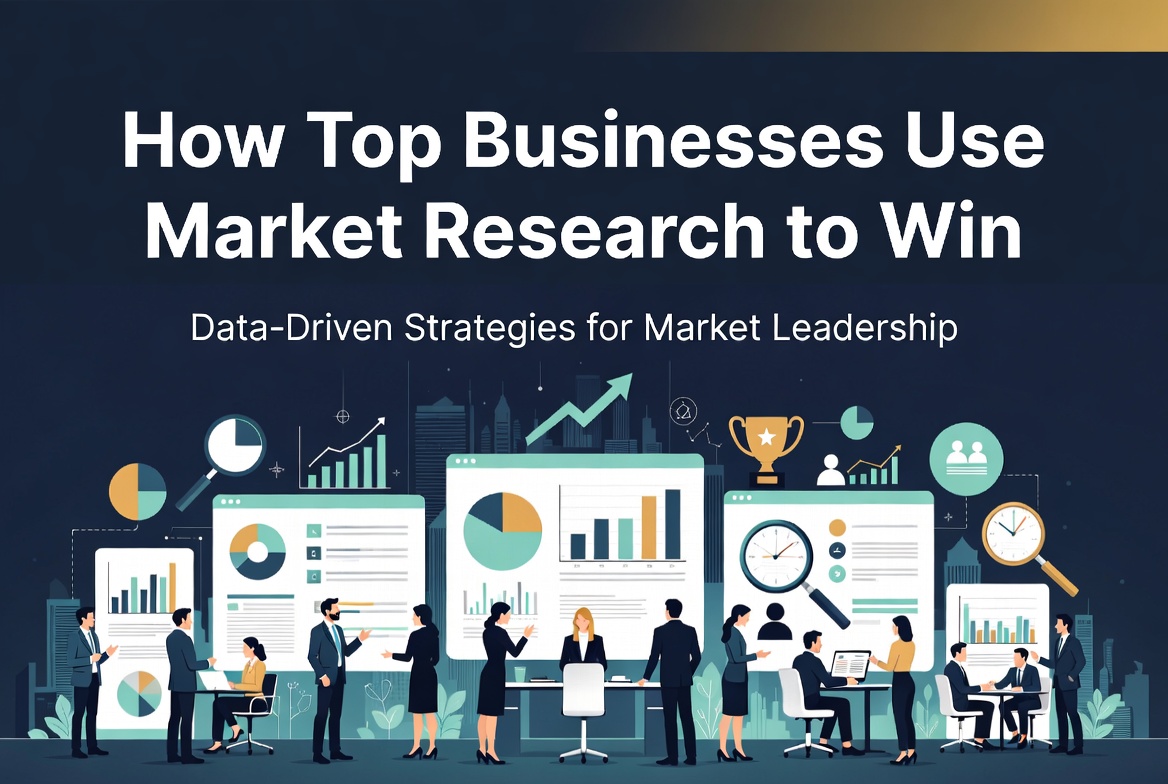
Market research is the single most powerful competitive weapon top businesses use to dominate their industries, and the companies that ignore it are out here making decisions like they dressed themselves in the dark — boldly wrong and somehow still confident about it.
The one thing that separates the winners from the losers is almost never luck, talent, or even capital. It’s knowledge. Specifically, it’s market research. The businesses that consistently win — the Nikes, the Amazons, the Apples of this world — are not guessing. They are not “going with their gut.” They are not asking their cousin Darnell what he thinks the market wants. They are researching, analysing, iterating, and then going back to research some more.
Now, I know what you’re thinking. “Market research sounds boring.” And look — I get it. The phrase does not exactly sound like a Friday night. But neither does “compound interest,” and that’ll buy you a yacht if you respect it long enough. Market research is the yacht of business strategy. Let me show you why the smartest companies on the planet treat it like oxygen — and why the ones that don’t treat it that way end up wondering why they’re selling ice to nobody in January.
What Is Market Research and Why Does It Matter?
Let’s start at the beginning. Market research is the systematic process of gathering, analysing, and interpreting information about a target market, including data about consumers, competitors, and industry trends. It’s the difference between knowing what your customers want and assuming what they want, which, in business, is the difference between profit and a very depressing Monday morning.
There are two main types of market research: primary research and secondary research. Primary research involves collecting new data directly from sources — through surveys, interviews, focus groups, and observational studies. Secondary research involves analysing data that already exists — industry reports, government statistics, academic papers, and competitor filings. Top businesses use both, because real winners don’t leave any money on the table.
Borodako et al. (2022), publishing in PLOS ONE, found that market orientation — which is built fundamentally on market research — has a statistically significant positive relationship with business performance, particularly in service sectors. The study specifically found that the combination of market orientation with strong human resource management and organisational culture amplifies these effects dramatically. In other words, companies that understand their market and organise themselves around that understanding consistently outperform those that don’t. [Source: Borodako et al., 2022 — PLOS ONE]
See, this is what I mean. That’s not me making things up. That’s peer-reviewed science. And science doesn’t lie to you — unlike that guy on LinkedIn telling you his dropshipping business made $40,000 in a month and he’ll show you how for just $997.
The Real Cost of Skipping Market Research
Let me paint you a picture. Imagine you decide to open a restaurant. You pour your heart, your savings, your aunty’s retirement money into this restaurant. You’ve got the tablecloths, the mood lighting, the menu designed by somebody who once watched a cooking show. And then you open the doors and nobody comes. Not because the food is bad. Because you opened a formal fine-dining French restaurant in a neighbourhood where everyone wants jerk chicken and plantain. You didn’t research the market. You assumed. And now you’re sitting there at your empty restaurant like, “But the ambience is immaculate.”
This is not a joke. Well — it is a bit of a joke. But it’s also the actual story of thousands of businesses every single year. According to the U.S. Bureau of Labor Statistics, approximately 20% of new businesses fail within the first year, and 45% fail within the first five years. A significant driver of this failure rate is poor market understanding. You can have the best product in the world, but if you don’t know who wants it, why they want it, how much they’ll pay for it, and where they’re going to buy it — brother, you are just burning money and calling it a bonfire.
Businesses that conduct thorough market research before launching reduce this risk exponentially. A study published in the Journal of Business Venturing found that pre-entry market research was one of the strongest predictors of new venture survival and performance. The data does not care about your feelings. The data just wants to know if you did your homework.
Case Study 1: Nike — The Art of Listening Before Leading
Nike is not just a shoe company. It is a masterclass in market research. From the very beginning, Nike’s co-founder Bill Bowerman literally embedded researchers within sports teams to observe athletes in action. Not survey them from a comfortable office. Watch them train. See where their shoes failed. Identify the unmet needs that no product on the market was addressing. That is primary research in its most raw and committed form.
As documented in Park and Kincade’s historical analysis published in the Journal of Global Fashion Marketing, Nike consistently repositioned itself across four decades by responding to market data rather than internal assumptions. In the 1970s it was about performance and imports. In the 1980s it was about innovation — resulting in the Air Max technology. In the 1990s it was about cultural relevance — signing Michael Jordan and transforming a shoe into a cultural symbol. Each pivot was research-driven. [Source: Park & Kincade, 2010 — Journal of Global Fashion Marketing]
Nike’s Nike+ app alone has generated billions of data points about how consumers run, train, and move. This data feeds directly back into product development, marketing strategy, and customer engagement. A 2024 study analysing Nike’s digital marketing strategies through the 4Ps framework concluded that Nike’s ongoing dominance is directly attributable to its ability to generate and respond to consumer insights in near real-time. [Source: Shan, Y. (2024) — Highlights in Business, Economics and Management]
You know what Nike essentially did? They looked at the market, said, “We see you. We hear you. We know exactly what you want before you even finish asking,” and then charged you £150 for it. And you said thank you. Because that’s what good market research does — it creates products people actually want, at prices they’re willing to pay, in ways that feel personal.
Now compare that to brands that have crashed out because they didn’t do the work. Remember when companies assumed everyone wanted the same thing regardless of culture, geography, or context? I once saw a brand launch a product with a name that translated to something deeply offensive in the local language of their target market. They didn’t research the language. They didn’t research the culture. They just translated the logo with Google Translate and hit publish. That’s not a business strategy. That’s a prayer — and not even a good one.
The Five Core Types of Market Research Top Businesses Use
Let’s get specific, because the best traders I know are specific. Vague strategies lose money. Precise strategies make it. Here are the five core types of market research that top businesses actually use:
1. Customer Segmentation Research
This is where you figure out exactly who your customer is. Not “adults aged 18–65 who like things.” That is not a customer profile. That is a description of most humans. Apple, for instance, has used customer segmentation research to identify not just demographic groups but psychographic ones — people who value simplicity, status, and seamless experience. This allowed them to price at a premium while maintaining fierce loyalty. Research in the Journal of Marketing consistently shows that businesses with clearly defined customer segments outperform those without in both revenue growth and customer retention rates.
2. Competitive Intelligence Research
You need to know what your competitors are doing. Not so you can copy them — that’s a follower strategy, and followers don’t win trophies. You need to know what they’re doing so you can identify where they’re falling short, where the gaps are, and how you can position yourself to fill them. I’m out here on these trading floors reading competitor filings, earnings reports, and market positioning documents like they’re scripture. Because they kind of are. The truth is always in the numbers.
3. Product/Service Fit Research
Before you build it, find out if anyone actually wants it. This sounds so obvious that you’d think nobody skips it. But people skip it constantly. They fall in love with their own idea — which is honestly one of the most expensive love stories in business history — and skip straight to launch without validating the concept. Lean startup methodology, popularised by Eric Ries and grounded in academic research on entrepreneurial learning, argues that validated learning through market testing is the fundamental unit of startup progress. You’ve got to test before you invest.
4. Pricing Research
Pricing is where a lot of businesses leave a staggering amount of money on the table. They either price too low because they’re scared — which attracts customers who will leave the moment someone offers a lower price — or they price too high with no value justification, which repels the very customers who could become loyal advocates. Research by Borodako et al. in PLOS ONE demonstrated that market-oriented businesses, which use research to guide pricing decisions, achieve significantly better financial performance than non-market-oriented counterparts. [Source: Borodako et al., 2022]
Pricing research tells you the exact point where perceived value meets willingness to pay. That sweet spot is where profit lives. And if you’re not researching your way to it, you’re just guessing — and I’ve seen too many people guess their way right out of business.
5. Brand Perception Research
You might think your brand is one thing. Your customers might think it’s something entirely different. Brand perception research closes that gap. It tells you how your company is actually seen in the market, what emotions it triggers, what associations it carries. Zhu et al. (2022), publishing in Frontiers in Psychology, found that companies that align their market orientation with customer emotional satisfaction significantly outperform those that do not in international business contexts. [Source: Zhu et al., 2022 — Frontiers in Psychology]
If customers think your brand is arrogant and overpriced when you’re trying to be premium and exclusive, that’s a perception gap — and perception gaps cost revenue. Research identifies them. Strategy closes them.
Case Study 2: Amazon — When Data Becomes a Competitive Moat
If Nike is the poster child for qualitative market research done right, Amazon is the poster child for quantitative research taken to its logical extreme. Amazon does not guess. Amazon does not hope. Amazon does not even really feel. Amazon measures.
Amazon’s recommendation engine — which drives an estimated 35% of the company’s total revenue — is built entirely on market research in its most algorithmic form: the continuous collection, analysis, and application of consumer behavioural data. Every click, every purchase, every search, every time you look at a product and then decide not to buy it — Amazon is tracking all of it. They use it to predict what you want before you know you want it. That’s not magic. That is market research at industrial scale.
Amazon also pioneered the use of customer reviews as primary research. Before spending millions developing a product category, Amazon analyses existing reviews in adjacent categories to identify what customers love, hate, and wish existed. They look for patterns of unmet need. They find the sentences in reviews where customers say things like “I wish this product had…” and they build those wishes into new products. This is systematic, rigorous, and deeply research-driven — and it has made them one of the most profitable companies on the planet.
A landmark study on big data analytics published in arXiv (Mikalef et al., cited within) found that businesses that utilise big data analytics capability as a dynamic resource achieve five to six percentage points higher returns compared to competitors who do not. [Source: Big Data Analytics-Enabled Dynamic Capabilities and Market Performance, arXiv]
Amazon understood this before most. They treated data not as a byproduct of operations but as a strategic asset. Every transaction was a data point. Every data point was a research finding. Every research finding was an opportunity. That mindset — which is fundamentally a market research mindset — is why Amazon went from an online bookshop operating out of a garage to a $2 trillion empire.
Now look — I’m a trader, and even I can sit here and say: if you are running a business and you are not treating your customer data as a research goldmine, you are essentially walking past a pile of free money every single day and saying, “Nah, I’m good.” That is the business equivalent of not claiming your tax return because the form looks complicated. Do not be that person.
How Market Research Drives Financial Performance: The Evidence
Let me get into the numbers, because numbers are where I live. The evidence linking market research investment to financial performance is overwhelming, and it has been consistently validated across industries, geographies, and business sizes.
Pauwels and Reibstein, in their seminal work on return on marketing investment — which is widely cited across the field — established that marketing spend which is grounded in research-driven strategy generates measurably superior returns compared to spend that is not. Their research, widely disseminated through the Marketing Science Institute and referenced extensively in subsequent peer-reviewed work, showed that accountability and measurement in marketing — which begins with research — directly improves shareholder value. [Source: Pauwels & Reibstein, 2010 — as cited in ResearchGate on Return on Marketing Investment]
The implications are staggering for businesses of every size. You do not have to be Amazon to benefit from research-driven strategy. A local business that conducts even basic customer surveys before launching a new product line is making a fundamentally more intelligent decision than one that launches purely on intuition. The return on investment from market research is not just statistically significant — it is, in many cases, transformational.
Furthermore, a 2024 study in the Journal of Risk and Financial Management examining ROI measurement methodologies across 2,805 Portuguese companies confirmed that companies which integrate systematic data-gathering processes — including market research — into their financial planning consistently demonstrate superior performance across multiple profitability indicators. [Source: J. Risk Financial Manag., 2024 — https://doi.org/10.3390/jrfm17070266]
Let me put that in language even the most numbers-averse business owner can appreciate. Market research is not a cost. It is an investment with demonstrably positive returns. It is, as a trader would say, a high-probability trade. And you know what traders love? High-probability trades. You stack enough of those and suddenly you’ve got something that looks a lot like success.
Case Study 3: Apple — Research Behind the Illusion of Intuition
Steve Jobs famously said that consumers don’t know what they want until you show it to them. People have interpreted this as evidence that Apple doesn’t do market research. Those people are wrong. What Apple actually did — and continues to do — is conduct sophisticated market research that goes beyond asking consumers to describe their ideal product and instead focuses on understanding the deep emotional and behavioural needs that drive purchase decisions.
Apple studied how people felt about technology — specifically, the frustration, anxiety, and complexity that most people experienced with computers in the late 1990s and early 2000s. They studied workflow, they studied aesthetics, they studied the emotional relationship between humans and their devices. They did not ask people what they wanted. They researched why people were frustrated. And then they built products that eliminated those frustrations in ways consumers hadn’t imagined to ask for.
This approach is grounded in what researchers call “jobs-to-be-done” theory — the idea that customers don’t buy products, they hire them to do a specific job in their life. Understanding the job requires research. Not surveys asking “Would you buy a phone with a touchscreen?” but deep ethnographic and observational research asking, “What is this person actually trying to accomplish, and what is getting in their way?”
Apple’s internal research teams, coupled with extensive consumer psychology research by academic partners, produced insights that led to the iPod, the iPhone, the App Store, and every subsequent product that changed consumer technology. Each of these products was not a gut feeling. Each was a deeply researched answer to a clearly identified market problem.
And you know what? Sometimes I think about companies that looked at the early iPhone and said, “Nobody wants a phone without a keyboard.” They were not stupid people. They just weren’t doing the right research — or weren’t asking the right questions of the research they had. In business, the question you ask determines the answer you get. That’s why how you conduct market research matters just as much as whether you conduct it.
The Digital Revolution in Market Research
We are living in the golden age of market research, and a lot of businesses are completely missing it. Between social media analytics, consumer sentiment tools, A/B testing platforms, CRM data, e-commerce behavioural analytics, and machine learning models trained on purchase history — there has never been more data available to businesses at lower cost. The only excuse for not doing market research in 2026 is “I didn’t feel like it,” and as a trader, I can tell you that feelings are the most expensive commodity in business.
Akter and Wamba (2016), as cited in subsequent academic research on big data analytics and market performance, showed that businesses using big data analytics into their strategies see five to six percentage points higher returns. Five to six percentage points might not sound like much until you’re talking about a business with £10 million in revenue. Then it’s £500,000 to £600,000 in additional profit — every single year — simply from using the data you already have. [Source: Big Data Analytics-Enabled Dynamic Capabilities, arXiv 2024]
Social listening — the practice of monitoring social media for consumer sentiment, emerging trends, and competitor mentions — has become one of the most cost-effective forms of primary research available to businesses of any size. Companies that deploy social listening tools and feed the insights into strategic decisions are operating with a real-time pulse on the market that simply was not available twenty years ago.
I want to be very clear about something: you do not need a research department with a £2 million budget to do this. You need curiosity, consistency, and the willingness to actually look at what the data is telling you — even when it’s telling you something you don’t want to hear. Because here’s the thing about data: it has no loyalty. It does not care about your feelings. It does not care about the name you put on your business plan. It just tells you what’s true. And truth, in business, is the most valuable thing there is.
How Small Businesses Can Use Market Research to Win
Now look — I know some of you reading this are not running multinational corporations. Maybe you’re running a small business, a side hustle, a startup that’s still operating out of a spare bedroom. And you might be thinking, “This market research stuff is for the big boys. I don’t have the time or the money.”
I hear you. And I’m going to tell you that you’re wrong — politely, respectfully, but absolutely wrong.
Here are practical, low-cost ways small businesses can conduct market research that will directly improve their results:
Customer surveys: Tools like Google Forms and Typeform are free or near-free and can gather invaluable customer feedback in days. A simple five-question survey sent to your existing customers will tell you more about your business than three months of guessing.
Social media analytics: Every major platform — Instagram, Facebook, TikTok, LinkedIn — provides free analytics showing who is engaging with your content, what they care about, and what is driving them toward or away from purchase. This is free primary research. Use it.
Competitor analysis: Regularly reviewing competitor websites, social media, pricing, and customer reviews is competitive intelligence research that costs nothing but time. If your competitor has 400 one-star reviews all complaining about the same problem, that is your market research telling you exactly what to do better.
Google Trends and Google Search Console: These free tools show you what people are searching for in real time, which is arguably the most direct expression of consumer intent available. If search volume for a product or service you offer is growing, that is a market signal worth responding to.
Industry reports and academic research: Bodies like the Office for National Statistics, trade associations, and academic institutions publish enormous amounts of free market data. The businesses that read these reports and incorporate them into strategy have a genuine edge over those that don’t.
The point is this: market research is not a privilege of the wealthy. It is a discipline of the diligent. And in a competitive market, diligence is the edge.
Common Market Research Mistakes — and How to Avoid Them
Now, since I’m in a generous mood, let me also tell you what not to do. Because doing market research badly is almost as dangerous as not doing it at all. Almost. Nothing is quite as dangerous as not doing it at all — but bad research can lead you to wrong conclusions with a dangerous amount of confidence, and wrong conclusions with confidence are how businesses drive straight off the cliff while humming a happy tune.
Mistake 1: Confirmation Bias Research
This is when you conduct research designed to confirm what you already believe, rather than to discover what is actually true. You survey people who already love your brand. You ask leading questions. You ignore the data points that challenge your hypothesis. I’ve seen traders do this with stocks and I’ve seen business owners do this with products — and in both cases, the market eventually corrects that delusion, usually at considerable financial cost.
Mistake 2: Too Small a Sample
You surveyed twelve people. Twelve people you know personally. And now you’re making a £200,000 business decision based on what your mate Gary and his wife thought. Gary is a lovely man, but Gary is not a statistically representative sample. Good market research requires statistically significant sample sizes. The exact number depends on your market, your margin of error tolerance, and your confidence interval requirements — but twelve is not it.
Mistake 3: Researching the Wrong Question
As mentioned in the Apple case study — the question you ask determines the answer you get. If you ask, “Would you use our app?” most people will say yes because people are polite and they don’t want to hurt your feelings. If you ask, “Would you pay £9.99 per month for this app?” you get a much more revealing answer. Research should be designed to generate actionable insights, not comfortable reassurances.
Mistake 4: Conducting Research and Then Ignoring It
This one hurts me personally. I’ve seen businesses commission expensive research reports and then make decisions that directly contradict the findings because the CEO had a feeling. Look — I respect intuition. Intuition built on years of experience and pattern recognition is genuinely valuable. But intuition built on ego and the refusal to hear inconvenient truths is just expensive stubbornness dressed up in a suit.
Mistake 5: Treating Market Research as a One-Time Event
Markets change. Consumer preferences shift. Technology disrupts. Competitors emerge. What was true about your market two years ago may be significantly less true today — and what’s true today may be obsolete in another two years. Market research is not a box you tick once and then file away. It is an ongoing discipline. The businesses that win consistently are those that have embedded research into their regular operating rhythm, not just into their launch planning.
The Trader’s Verdict: Why Market Research Is the Best Trade You’ll Ever Make
Let me bring this home with the perspective I know best. As a trader, every decision I make is a bet — on a company, a sector, a currency, a commodity. And the best bets are the ones that are informed by the most accurate, current, and comprehensive information available.
That is exactly what market research does for a business. It improves the information quality of your decisions. And better information means better decisions. And better decisions — over time, consistently — mean better outcomes. That is not complicated. That is just how the world works.
The businesses I back with confidence — the ones I’d put real money on — are the ones that know their market cold. They know who their customers are, what those customers need, what they’re willing to pay, who else is competing for that customer, and where the market is heading next. They didn’t discover these things by accident. They researched them. Systematically, continuously, and with genuine intellectual humility — the willingness to let the data challenge their assumptions rather than simply validate them.
Babu et al. (2026), publishing in PLOS ONE, examined the relationship between strategic market practices and organisational performance across environmental, economic, and social dimensions. Their findings, based on 303 respondents, confirmed that businesses which integrate rigorous market analysis into their strategic planning outperform those that rely on intuition alone across every performance dimension measured. [Source: Babu et al., 2026 — PLOS ONE]
If there is one thing I want you to take from this article — one single, actionable, life-changing insight — it is this: market research is not optional for businesses that want to win. It is not a luxury, not a nice-to-have, not something you get around to eventually. It is the foundation. It is the intelligence operation that precedes every successful campaign. It is the reason the biggest companies in the world are still the biggest companies in the world.
They know what you want. They know exactly when you want it. They know precisely what you’ll pay for it. And they knew all of that before they ever built a single thing.
You should too. Go.
Conclusion: Research First, Win Second
Let’s recap what we’ve covered in this article. Market research — the systematic collection, analysis, and application of information about markets, consumers, and competitors — is the defining strategic advantage that separates top businesses from struggling ones. Nike built a $50 billion empire by listening to athletes before it built for them. Amazon built a $2 trillion business by treating every customer interaction as a data point and every data point as a research finding. Apple appeared to defy market research while actually practising it at its most sophisticated — researching not what consumers said they wanted but what they actually needed at an emotional and behavioural level.
The academic evidence is unambiguous. Market orientation — which is fundamentally built on market research — correlates positively and significantly with business performance across sectors, geographies, and business sizes. Businesses that invest in research before decisions consistently outperform those that don’t. The return on investment from market research is not hypothetical. It is documented, peer-reviewed, and replicated across decades of academic literature.
For small businesses: start simple. Surveys, social analytics, competitor reviews, industry reports, Google Trends. The tools are available, most are free, and the insights they generate are invaluable.
For larger businesses: invest in the infrastructure. Not just the tools, but the culture — the organisational commitment to letting data guide decisions rather than simply confirm them. The companies that do this build what traders call a structural edge — an advantage that compounds over time because it is built into the way they operate, not just the products they sell.
And for everyone, everywhere, at every stage of business: stay curious. The market is always talking. The question is whether you’re listening.
As for me? I’m going back to my charts — because in trading, just like in business, the best trade you will ever make is always the one you made after doing your homework thoroughly.
References
- Borodako, K., Berbeka, J., Rudnicki, M., Łapczyński, M., Kuziak, M., & Kapera, K. (2022). Market orientation and technological orientation in business services: The moderating role of organizational culture and human resources on performance. PLOS ONE. https://doi.org/10.1371/journal.pone.0270737
- Zhu, L., Gao, Y., Chen, W., & Ren, H. (2022). Consumer satisfaction-oriented emotional marketing in foreign trade. Frontiers in Psychology. https://doi.org/10.3389/fpsyg.2022.960042
- Park, H., & Kincade, D. H. (2010). Historical analysis of apparel marketer’s strategies: Evidence from a Nike case. Journal of Global Fashion Marketing, 1(3). https://doi.org/10.1080/20932685.2010.10593070
- Shan, Y. (2024). Analyzing the impact of marketing strategy: A case study of Nike Air Max 1. Highlights in Business, Economics and Management, 39, 163–168. https://doi.org/10.54097/krcwww07
- Pauwels, K., & Reibstein, D. (2010). Challenges in measuring return on marketing investment: Combining research and practice perspectives. Marketing Science Institute. https://www.researchgate.net/publication/235293050
- Dos Santos, M. J., Laureano, R. M. S., & Laureano, L. M. (2024). Does the way variables are calculated change the conclusions to be drawn? A study applied to the ratio ROI. Journal of Risk and Financial Management, 17(7), 266. https://doi.org/10.3390/jrfm17070266
- Babu, M. A., Rouf, M. A., Islam, M. R., et al. (2026). Examining the impact of green marketing practices on business performance: A synergistic application of resource-based view and triple bottom line theory. PLOS ONE. https://doi.org/10.1371/journal.pone.0333026
- Akter, S., & Wamba, S. F. (2016). Big data analytics in E-commerce: A systematic review and agenda for future research. Electronic Markets, as cited in: Big Data Analytics-Enabled Dynamic Capabilities and Market Performance. arXiv, 2024. https://arxiv.org/pdf/2407.15522
- Journal of Marketing Research — Sage Journals. Peer-reviewed bimonthly journal, included in the Financial Times Top 50 Research Rankings. https://journals.sagepub.com/home/mrj
- Dhesi, A. (2021). Sustaining digital transformation in the post-COVID era: Nike case study. MIT Management Sloan School. https://dspace.mit.edu/bitstream/handle/1721.1/139396/
Disclaimer: This article is for educational and informational purposes. It does not constitute financial or investment advice.
Leave a Reply
You must be logged in to post a comment.