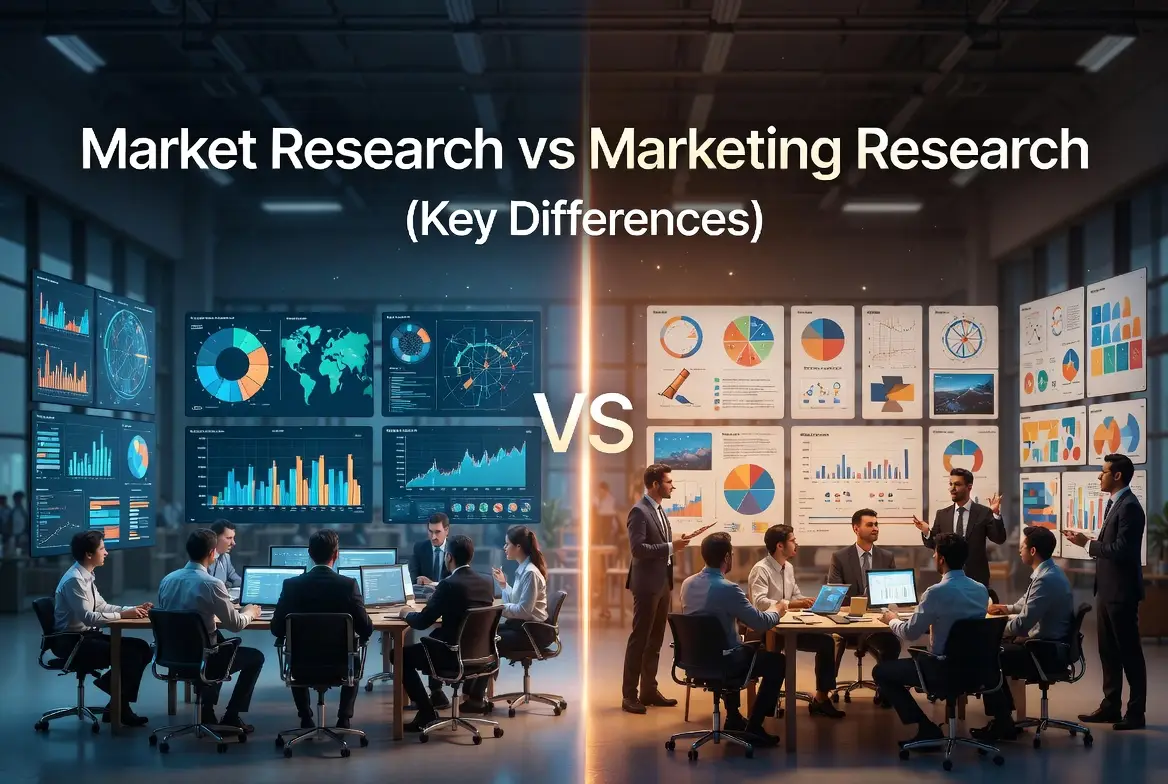
Although market research and marketing research are often used interchangeably, they represent distinct disciplines with different objectives, scopes, and applications in the business world. Understanding the key differences between market research and marketing research is essential for companies that want to make smarter strategic decisions, develop effective marketing campaigns, and gain a true competitive advantage. This article breaks down the core distinctions, methodologies, and practical use cases of each, helping business owners, marketers, and analysts choose the right approach to drive growth and maximize ROI.
What Is Market Research? (Let’s Start Here, Stay With Me)
Market research is the process of gathering, analysing, and interpreting information specifically about a market — its size, its customers, its competitors, and the broader dynamics that shape it. Think of it as the reconnaissance mission before you charge into battle.
As ScienceDirect summarises it, market research consists of both academic treatises and practical approaches to the collection, analysis, interpretation, and use of data — with practitioners aiming to predict the behaviour of market participants so that managerial decisions can be made more effectively and efficiently (ScienceDirect, 2023).
So in plain English: market research tells you who is in the market, what they want, and whether the market is even worth entering.
Now here’s where I have to pause and be honest with you — because I once spent three weeks doing “market research” that turned out to be just me scrolling competitor websites at midnight while eating biscuits. That is not market research. That is procrastination with good WiFi.
Market research typically covers:
- Market size and growth rates — Is the market growing, shrinking, or just standing there awkwardly at a party nobody organised?
- Customer demographics and behaviours — Who are your customers? What do they want? Why do they do what they do?
- Competitor analysis — Who else is in this space, and are they doing it better than you?
- Industry trends — Where is the market heading in the next three to five years?
According to Yallop, Baker, and Wardle (2022) in their significant study Market Research and Insight: Past, Present and Future, published in the International Journal of Market Research, the role history plays in adding context has long been established as significant in our understanding of market research development and contemporary research practices (Yallop, Baker & Wardle, 2022). In other words, understanding where market research came from tells us a lot about where it’s going — and where you should be taking it.
What Is Marketing Research? (Because It’s Not the Same Thing, I Promise)
Marketing research is the broader discipline. If market research is reconnaissance, marketing research is the entire military strategy.
It doesn’t just look at the marketplace — it examines every element of the marketing mix: product development, pricing strategy, promotional effectiveness, distribution channels, branding, customer journeys, and more.
As Lewis (2022) notes in the International Journal of Market Research, marketing research “addresses a broader set of questions than market research — going beyond simply looking at the marketplace and considering pricing, product features, positioning, go-to-market strategy, channels, branding, and customer journeys.” (Lewis, I., 2022, International Journal of Market Research)
So if you’re a trader like me sitting across from a potential investment, market research tells me: “Is this market healthy and worth playing in?” Marketing research tells me: “Is this company’s whole approach to reaching customers even working? Are their ads landing? Is their brand respected? Is their pricing driving people away or pulling them in?”
The difference is scope. One is a spotlight. The other is stadium lighting.
And look — I know what some of you are thinking. “These sound so similar, why does this even matter?” I hear you. I once told my accountant the same thing about profit and revenue. He didn’t find it funny. Neither did the tax man. The distinctions matter because the wrong type of research leads to the wrong type of decisions.
The Key Differences: A Side-by-Side Breakdown
Let’s get into the meat of this. Here are the core distinctions between market research and marketing research, and why every serious business person and trader needs to understand them:
1. Scope and Focus
Market research is narrowly focused on the market itself — its structure, size, demographics, and competitive landscape. It answers: Who is in this market, and is it viable?
Marketing research is broadly focused on the entire marketing function. It answers: How effectively are we reaching, engaging, and converting customers across every touchpoint?
Think of it this way: market research is asking whether the neighbourhood is a good place to open a restaurant. Marketing research is asking whether your menu, your prices, your branding, your Instagram page, your staff uniforms, and your loyalty programme are all working together to fill those tables.
I once consulted with a small retail brand — we’ll call them Brand X — who had done extensive market research and knew exactly how big their target market was. They knew the demographics. They knew the spend. They even knew competitor pricing. But they had done zero marketing research. So they launched with the right product, in the right market, to the right audience — and then ran advertisements so confusing that customers genuinely thought they were selling something entirely different.
All that market research. Wasted. Because they didn’t ask: “Is our marketing actually working?”
That’s the cost of confusing the two.
2. Purpose and Objectives
Market research is typically used to:
- Determine whether a new market is worth entering
- Understand the size and value of an existing market
- Identify unmet customer needs
- Assess competitive positioning
- Evaluate market timing
Marketing research is typically used to:
- Test new product concepts before launch
- Measure advertising effectiveness
- Evaluate brand perception and awareness
- Optimise pricing strategies
- Assess the performance of marketing campaigns
- Understand the full customer journey
Ramos, Rita, and Vong (2024) in a bibliometric study published in the Spanish Journal of Marketing – ESIC analysed 100 of the most influential marketing academic papers published between 2018 and 2022. Their findings confirmed that artificial intelligence, live streaming, and emerging digital channels have fundamentally expanded what marketing research covers — affirming that the discipline is far wider than just market-level enquiry (Ramos, Rita & Vong, 2024).
In other words, marketing research keeps getting bigger. And if you think you can skip it, you’re basically showing up to a Formula 1 race in a Ford Fiesta and wondering why you’re losing.
3. Methods Used
Market research typically uses:
- Surveys and questionnaires
- Focus groups
- Secondary data analysis (government reports, industry databases)
- Ethnographic studies
- Observation research
Marketing research typically uses all of those plus:
- A/B testing of advertisements
- Conversion rate optimisation analysis
- Customer lifetime value modelling
- Attribution modelling across marketing channels
- Social listening and sentiment analysis
- Brand equity measurement
- Digital analytics (SEO, PPC, email performance)
As SimilarWeb explains, “Marketing research analyses at the micro level — reviewing specific or multiple marketing channel activity including PPC, SEO, referral, advertising, and campaign efficacy — looking for opportunities to drive ROI on the marketing budget.” (SimilarWeb, 2025)
In other words, marketing research is where data meets creativity and asks the very important question: “Why did we spend £50,000 on this campaign and get three sales?”
4. Timeframe and Application
Market research tends to be conducted before entering a market — it’s strategic and forward-looking. It informs go-or-no-go decisions. It’s the intelligence gathering phase.
Marketing research is conducted continuously — before, during, and after campaigns. It’s operational. It’s the ongoing monitoring of whether your marketing machine is firing on all cylinders.
Here is something that should terrify every business owner who has ever just “launched and hoped for the best”: a study published in the TEM Journal (Volume 11, Issue 2, 2022) found that companies that fail to continuously update their marketing research frameworks are effectively navigating with a map that’s already out of date (TEM Journal, 2022, DOI: 10.18421/TEM112-59). Market conditions change. Consumer behaviours shift. Digital algorithms evolve. And the businesses doing market research once every three years while never doing ongoing marketing research are basically trying to drive a car using last year’s sat-nav update and praying the roads haven’t changed.
Spoiler: the roads have absolutely changed.
5. Who Conducts Each Type
Market research is often conducted by:
- Strategy teams
- Business development professionals
- Investment analysts (hello, that’s me)
- Consultants evaluating market entry
- Entrepreneurs assessing business viability
Marketing research is typically conducted by:
- Marketing departments
- Brand managers
- Digital marketing analysts
- Advertising agencies
- Consumer insights teams
This distinction matters for one key reason: the wrong team doing the wrong type of research will give you answers to questions nobody asked. Imagine asking your digital marketing analyst whether your market is big enough to sustain your business, or asking your market entry consultant whether your last email campaign had a good click-through rate. Neither conversation goes well.
Case Study 1: Netflix — When Market Research and Marketing Research Work Together
Let’s talk about Netflix. Because if there’s a company that understood both market research and marketing research better than almost anyone, it’s Netflix in its expansion phase.
Before expanding into international markets, Netflix conducted rigorous market research: identifying the size of each streaming market, the availability of broadband infrastructure, the regulatory environment, the competitive landscape (was cable television dominant? Were local streaming services entrenched?), and the cultural preferences of viewers.
But Netflix didn’t stop there. Once they entered those markets, they deployed continuous marketing research: testing which thumbnails drove the highest click-through rates (yes, they literally A/B test their thumbnail images), measuring how different promotional messages performed across demographics, tracking churn rates against specific content categories, and using customer data to inform what content to produce next.
The result? Netflix grew its international subscriber base from around 23 million in 2016 to over 200 million globally by 2021. They didn’t just pick good markets (market research). They relentlessly optimised how they spoke to customers in those markets (marketing research).
The lesson here is not that Netflix is perfect — we could have a whole separate conversation about their password-sharing crackdown, which I’ll describe charitably as a bold strategic decision and less charitably as “well, that was brave.” But the lesson is that both types of research were essential to their growth. One without the other would have left money on the table.
Case Study 2: Coca-Cola’s New Coke Disaster — A Market Research Without Marketing Research Cautionary Tale
Let me tell you about one of the most legendary business failures in history, and it has “I should have done more research” written all over it.
In 1985, Coca-Cola — after conducting extensive market research that showed customers preferred the taste of Pepsi in blind taste tests — reformulated their product and launched New Coke. The market research was thorough. The taste tests were rigorous. The data was real.
But what Coca-Cola catastrophically underestimated — because they had not done deep enough marketing research — was the emotional brand attachment customers had to original Coca-Cola. Their marketing research into brand equity, customer sentiment, and the psychological significance of the product in people’s daily lives was woefully inadequate.
The backlash was swift, ferocious, and deeply personal. Customers felt betrayed. They weren’t just losing a drink. They felt like someone had removed a piece of their cultural identity. Within 79 days, Coca-Cola reversed the decision and brought back Classic Coke.
The market research said: “People prefer this taste.” The marketing research would have said: “But this brand means more than taste.” Coca-Cola learned that lesson the hard way, in front of the entire world, with a product launch so disastrous it became a business school case study that is still being taught today.
Case Study 3: Airbnb and the Power of Both
When Airbnb was scaling into new cities, they used market research to identify which urban markets had housing supply constraints (high hotel prices, poor availability during peak periods, large tourism inflows). This told them where to grow.
But Airbnb’s marketing research was equally sophisticated: they studied how different types of hosts responded to different onboarding messages, tested pricing recommendation tools to see which copy drove higher host adoption, measured which guest-facing marketing messages reduced cancellation rates, and continuously tracked Net Promoter Scores across both sides of their marketplace.
According to a detailed analysis published by the International Journal of Research in Marketing, platforms like Airbnb that deploy mixed-methods marketing research — combining quantitative data with qualitative consumer insights — consistently outperform competitors who rely on either alone (IJRM, ScienceDirect, 2024).
Airbnb is now valued at over $75 billion. Coincidence? I don’t think so. Unless you believe billion-dollar valuations fall out of the sky like confetti — which, as a trader, I can confirm they do not.
The Relationship Between the Two: They Are Not Enemies
Here’s something that trips a lot of people up: market research and marketing research are not in competition. They are complementary. They serve different stages of the same business journey.
Think of it like building a house. Market research is the land survey — you need to know if the ground is solid, if the location is viable, if planning permission is possible, and if the neighbourhood has demand. You would not skip the land survey. You would not look at a patch of land and go, “Nah, it looks fine, let’s start building.” Unless you want your house to sink.
Marketing research is everything that comes after the foundations — the ongoing quality checks as the house goes up, testing the plumbing, assessing whether the kitchen layout works for residents, measuring whether the heating system is efficient. It’s continuous, iterative, and operational.
You need both. Anyone who tells you otherwise is selling something — and they haven’t done their market research on whether you want it.
Common Confusions (And Why They Matter)
Let’s address the most common points of confusion I encounter, because I’ve seen these mistakes cost businesses real money.
Confusion 1: “We did market research, we’re good.”
No. You did the reconnaissance. You still need the ongoing intelligence operation. Market research without marketing research is a one-time photo of a moving target. By the time you’ve acted on it, the target has moved.
Confusion 2: “Marketing research is just measuring our ads.”
No. Marketing research covers the entire marketing mix — the Four Ps: Product, Price, Place, and Promotion. As YourCX notes, “the analysis of the Four Ps is vital for marketing research — enabling organisations to make better decisions by combining qualitative and quantitative insights.” (YourCX, 2025)
If you’re only measuring your ads, you’re measuring one quarter of the picture. Imagine a doctor who only checks your blood pressure and says, “You’re fine.” You’d want them to check a few more things. Marketing research is the full medical check-up, not just one vital sign.
Confusion 3: “These are the same thing with different names.”
I cannot stress this enough — they are not. One is about the market. One is about your entire marketing system. They overlap, yes. But they have different scopes, methods, teams, objectives, and applications. Calling them the same thing is like calling a hammer and a power drill the same thing because they both work with wood. Technically adjacent. Practically very different. Use them interchangeably on a job site and someone gets hurt.
How Traders Think About This (Hint: Better Than Most)
As a trader, I live and breathe research. Every position I take is backed by data. And I’ll be honest — the first time someone explained the difference between market research and marketing research to me, I had a small but meaningful financial epiphany.
Because as a trader evaluating whether to invest in a company or sector, I’m doing market research: What’s the addressable market? What’s the competitive landscape? Is the industry growing or contracting? What are the macroeconomic forces at play?
But when I evaluate whether a specific company within that market is well-positioned, I’m doing marketing research thinking: Is their brand strong? Is their customer acquisition cost sustainable? Is their messaging resonating with their target demographic? Are their marketing channels delivering ROI?
Both lenses are necessary for a complete picture. A great market with a company that can’t market itself is like a gold mine run by people who’ve forgotten to bring shovels. The gold is real. The execution is the problem.
Market Research in Practice: The Step-by-Step Process
For all the traders, entrepreneurs, and business-minded readers in the room who appreciate structure — because I know some of you are sitting there going, “Okay, but how do I actually do this?” — let me walk you through how each type of research works in the real world.
A Typical Market Research Process:
Step 1: Problem Identification. Define what you’re trying to find out. Are you asking whether there is demand for a new product? Whether a market is growing or shrinking? Whether customers in a particular city are underserved? Good market research starts with a laser-focused question — not a vague sense of curiosity. Curiosity is great in a bookshop. In business, you need a question.
Step 2: Secondary Research. Before you spend a penny on primary data collection, mine secondary sources — government statistics, industry reports, academic journals, trade publications. Most business owners skip this step because it requires patience, and patience is apparently the rarest commodity in modern business. More valuable than Bitcoin, and significantly less volatile.
Step 3: Primary Research. This is where you collect data that doesn’t already exist. Surveys, interviews, focus groups, observational studies. The quality depends almost entirely on how well you designed your questions — and how honest your respondents are. Survey respondents are not always honest. They tell you what they think you want to hear, then go home and do the exact opposite. This is called social desirability bias, and it is the bane of every researcher’s existence.
Step 4: Analysis. You’ve got the data. Now what does it mean? This is where statistical analysis, thematic coding, and interpretive frameworks come in. Good analysis separates signal from noise. Bad analysis finds patterns in chaos and presents them as strategy. If your analysis says “our data suggests that 100% of customers love our product,” your sample was your mum and three colleagues who didn’t want to upset you.
Step 5: Reporting and Decision-Making. The research only has value if it informs a decision. A report that sits in a folder and never gets acted on is not research — it’s expensive filing. The goal of market research is to reduce uncertainty in strategic decision-making, not to create the world’s most detailed document that nobody reads.
A Typical Marketing Research Process:
Marketing research follows a similar logical framework but applies it to the marketing function specifically. You start by identifying a marketing problem: Why is our customer acquisition cost rising? Why are conversions dropping? Why is our brand awareness low in a key demographic?
Then you design a mixed-methods approach — combining quantitative data (website analytics, campaign metrics, conversion data) with qualitative insight (customer interviews, focus groups, social sentiment analysis). You run the research continuously — not as a one-off project — and you use the findings to iterate and improve your marketing in real time.
The key word there is continuously. Marketing research is not a project. It is a system. And like any good system, it only works if someone is actually running it properly.
The Role of Technology: AI, Big Data, and the Future of Both
We need to talk about the elephant in the room — or more accurately, the algorithm in the room — because technology has fundamentally transformed how both market research and marketing research are conducted, and the pace of that transformation is not slowing down.
Artificial intelligence is now being used to analyse consumer sentiment from millions of social media posts in real time, giving marketing researchers insight that would have taken months of focus groups to generate a decade ago. Natural language processing tools can scan customer reviews, forum discussions, and social commentary to identify emerging market trends faster than any human analyst.
Predictive analytics allows market researchers to model future market scenarios with a degree of accuracy that was previously impossible. Instead of saying “we think the sustainable food market will grow,” researchers can now say “based on current trajectory and demographic shift data, the sustainable food market in the UK will be worth £X billion by 2028, with these three sub-segments driving 70% of that growth.” That level of precision changes the quality of strategic decisions.
Real-time digital dashboards have transformed marketing research by giving teams instant visibility into campaign performance, customer behaviour, and channel attribution. The question is no longer “how did last quarter’s campaign perform?” — it’s “how is this campaign performing right now, and what do I need to adjust in the next 24 hours?”
As Ramos, Rita, and Vong (2024) noted in the Spanish Journal of Marketing – ESIC, artificial intelligence and live streaming have been identified as the fastest-growing research areas in marketing scholarship between 2018 and 2022 — confirming that the discipline is evolving faster than most practitioners can keep up with (Ramos, Rita & Vong, 2024).
The businesses that will win in the next decade are the ones building research capabilities that are tech-enabled, data-informed, and human-interpreted. Because data without human interpretation is just numbers. And numbers without context are just a very expensive screensaver.
What Happens When You Skip the Research? (A Story From the Trading Floor)
I want to get personal for a second, because this is important and I think it lands better with a real example.
Early in my trading career, I watched a colleague — genuinely smart, genuinely confident — make a significant position in a consumer goods company based purely on the fact that he liked the product. He used the product. He thought it was great. He assumed the rest of the market agreed with him.
He had done zero market research. He hadn’t checked the addressable market size, analysed the competitive landscape, or looked at industry growth trajectory. And he had certainly done zero marketing research — no assessment of whether the company’s brand was resonating, whether their customer acquisition costs were sustainable, or whether their marketing efficiency was improving.
The company’s sales were declining because a newer, more digitally savvy competitor had entered the market. A functional marketing research team would have flagged that their demographic was ageing, that younger consumers didn’t recognise the brand, and that their social media presence was practically historical.
He held the position for six months, hoping it would turn around. It didn’t. The lesson cost him real money and something harder to quantify: confidence in his own judgment.
That’s what bad research — or no research — does. It’s not dramatic. It doesn’t announce itself. It just quietly erodes your position until you’re sitting there wondering what happened.
Do the research. Both kinds. Every time.
The Academic vs Practitioner Divide: Why It Matters
One thing that rarely gets discussed in articles like this is the tension between how academics define these research disciplines and how practitioners actually use them in the field.
Academically, the Journal of Marketing Research (JMR), published by the American Marketing Association and rated among the top 50 research journals by the Financial Times, covers “the entire spectrum of research in marketing, ranging from analytical models of marketing phenomena to descriptive and case studies.” (JMR / Sage Journals). This is a broad academic remit that doesn’t always map neatly onto what a marketing manager in Bradford is doing on a Tuesday afternoon.
Practitioners tend to be more fluid with the terminology — using “market research” as a catch-all for any external data gathering, and treating “marketing research” as what happens when they look at their campaign dashboards. Neither of these is technically accurate, but both are understandable given the pressures of day-to-day business life.
The gap matters because when practitioners don’t distinguish between the two, they often end up under-investing in one or the other. They’ll do extensive market analysis before launching a product and then never conduct meaningful ongoing marketing research — leaving them flying blind on campaign performance. Or they’ll obsess over campaign metrics without ever stepping back to ask whether they’re in the right market in the first place.
Bridging the academic-practitioner divide means taking the best of both worlds: the rigour and definitional clarity that academic research provides, combined with the practical, action-oriented mindset of business professionals who need insights they can use by next Friday.
The Digital Age Has Changed Everything — But Not the Distinction
One of the most important things to understand is that the digital revolution has expanded both types of research enormously, but it has not dissolved the distinction between them.
Big data, AI-powered analytics, social listening tools, and real-time consumer tracking have given both market researchers and marketing researchers more powerful tools than ever before. Ramos, Rita, and Vong (2024) in the Spanish Journal of Marketing – ESIC confirmed that artificial intelligence and live streaming are among the fastest-growing research areas in modern marketing scholarship, reshaping how both market and marketing research are conducted (Ramos, Rita & Vong, 2024).
But more data doesn’t mean more clarity — not unless you’re asking the right questions. And the right questions depend on whether you’re doing market research or marketing research.
If you’re asking: “Is there demand for sustainable packaging in the UK consumer market, and how large is that demand?” — that’s a market research question.
If you’re asking: “Are our social media ads about our sustainable packaging actually reaching eco-conscious consumers, and are they converting?” — that’s a marketing research question.
Same company. Same product. Entirely different type of research. And both matter.
Practical Framework: Which One Do You Need Right Now?
Here’s a quick decision framework I use. Ask yourself these questions:
You need Market Research if:
- You are considering entering a new market or launching a new product
- You want to understand the size, growth rate, and viability of a market
- You need to understand your competitive landscape before making strategic decisions
- You are a trader or investor evaluating whether a sector is worth capital allocation
- You are a startup asking whether there is sufficient demand for your idea
You need Marketing Research if:
- You are already in a market and want to optimise your performance
- You want to know whether your current marketing campaigns are working
- You need to understand how customers perceive your brand
- You want to improve conversion rates, customer retention, or lifetime value
- You are evaluating whether your pricing strategy is effective
- You want to understand the full customer journey from awareness to purchase
You need both if:
- You are a business that takes itself seriously.
Because ultimately, the companies that win are the ones who know the market before they enter, and then relentlessly study their own marketing performance once they’re in it. The ones who do only one or neither are the ones generating fascinating case studies in business school classrooms about what not to do.
The Budget Question: How Much Should You Spend on Each?
This is where it gets real. Because research costs money. And if you’re a small business owner, a startup founder, or a trader evaluating opportunities with limited capital, you need to prioritise.
Here’s my honest take:
If you haven’t entered the market yet: Spend more on market research. The cost of entering the wrong market — building a product nobody wants, in a space that’s overcrowded, for customers without budget — is catastrophically higher than thorough upfront market research. Skimping here is how businesses die in their first year.
If you’re already in the market: Invest in continuous marketing research. You know the market is viable. Now the question is whether your marketing is working. Small, consistent investments in measuring and optimising marketing performance compound over time into significant competitive advantages.
According to a 2022 industry overview, marketing analytics services accounted for approximately 50% of total market research industry revenue globally, while traditional market research brought in around 35%. The industry itself is moving toward ongoing marketing measurement. The money follows the intelligence that drives results. (Quora / Market Research Industry Overview, 2022)
Final Thoughts: Two Different Tools, One Shared Goal
At the end of all this, here’s what I want you to take away:
Market research and marketing research are two distinct disciplines with distinct purposes, methods, and applications. Confusing them leads to misallocated budgets, bad decisions, and — as Coca-Cola will forever remind us — catastrophically unnecessary product launches.
Market research tells you whether the game is worth playing. Marketing research tells you whether you’re playing it well. Both questions are essential.
As a trader, I would never invest in a sector I hadn’t researched. And I would never assume a company’s marketing is working without looking at the data. Both layers of research form the foundation of informed, intelligent decision-making.
The businesses that understand this distinction — that use market research to choose their battles and marketing research to win them — are the ones still standing five, ten, and twenty years later. The ones who wing it are generating content for someone else’s article about what not to do.
And with that, I’ll leave you with this: go do your research. Both kinds. All of it. Because the only thing worse than not knowing is thinking you know when you don’t.
You’ve been warned. By a trader who learned this the entertaining way.
References
- Yallop, A. C., Baker, J. J., & Wardle, J. (2022). Market Research and Insight: Past, Present and Future. International Journal of Market Research, 64(1). https://journals.sagepub.com/doi/full/10.1177/14707853221080735
- Lewis, I. (2022). Viewpoint: The future of market research. International Journal of Market Research. Cited in: Market Research as the Architect of Informed Marketing Planning. British Journal of Management Studies. https://eajournals.org/bjms/wp-content/uploads/sites/7/2024/09/Market-Research-as-The-Architect-of-Informed-Marketing-Planning.pdf
- Ramos, R., Rita, P., & Vong, C. (2024). Mapping research in marketing: trends, influential papers and agenda for future research. Spanish Journal of Marketing – ESIC, 28(2), 187–206. https://doi.org/10.1108/SJME-10-2022-0221
- TEM Journal. (2022). An Innovative Technique to Define Marketing Research. TEM Journal, 11(2), 955–963. https://doi.org/10.18421/TEM112-59
- ScienceDirect. (2023). Market Research – Overview. Elsevier. https://www.sciencedirect.com/topics/social-sciences/market-research
- International Journal of Research in Marketing. (2024). Elsevier. https://www.sciencedirect.com/journal/international-journal-of-research-in-marketing
- YourCX. (2025). Market Research vs. Marketing Research — What’s the Difference? https://yourcx.io/en/blog/2025/01/market-research-vs-marketing-research-whats-the-difference/
- SimilarWeb. (2025). Market Research vs. Marketing Research. https://www.similarweb.com/blog/research/market-research/market-vs-marketing/
- Journal of Marketing Research (JMR). (2020). Sage Journals / American Marketing Association. Impact Factor: 5.000. https://journals.sagepub.com/home/mrj
- Nunan, D., & Yallop, A.C. (2019). Contemporary market research practices and policies. Cited in Yallop, Baker & Wardle (2022). International Journal of Market Research. https://journals.sagepub.com/doi/full/10.1177/14707853221080735
© 2026. Written from the desk of a trader who has made enough research mistakes to fill a whole other article. Don’t be that person. Do your research — both kinds.
Leave a Reply
You must be logged in to post a comment.