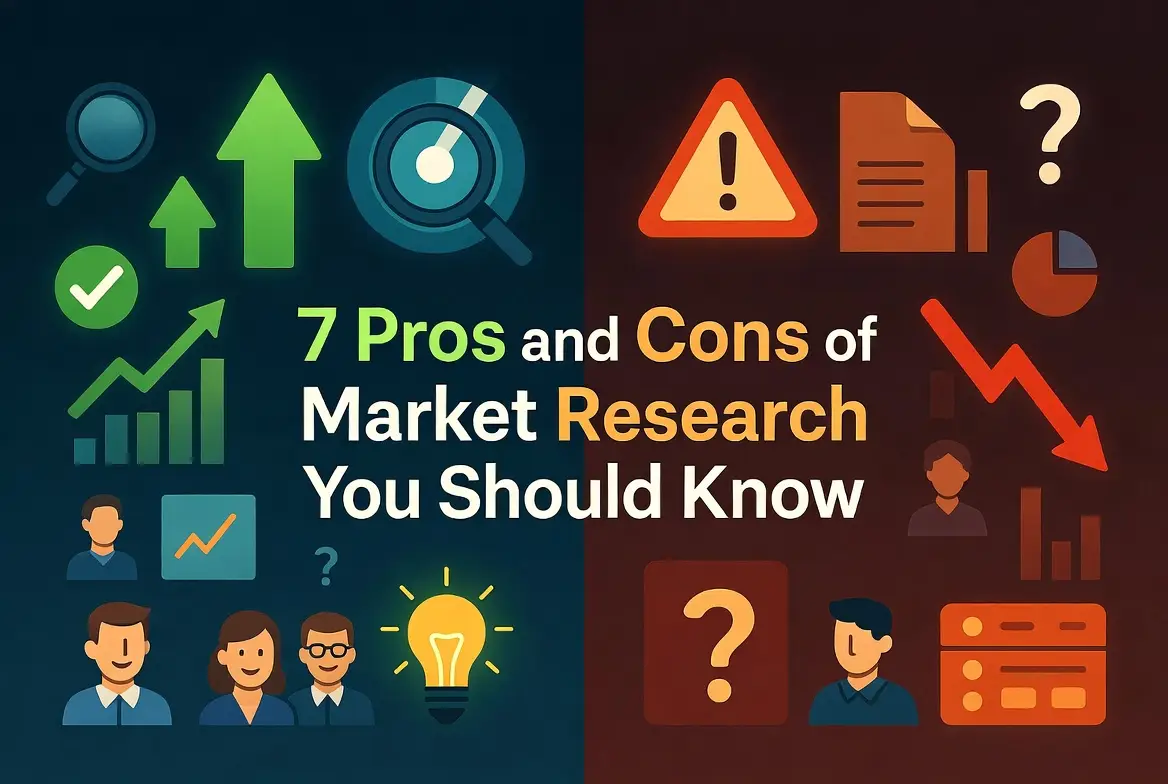
Market research pros and cons can literally be the difference between making a fortune on your next trade and watching your entire strategy collapse faster than a crypto coin named after a dog — and if you’ve ever made a financial decision without doing your homework first, buckle up, because we’re about to have a very honest, educational, and occasionally embarrassing conversation. Market research is the backbone of every major trading strategy, every product launch, every business pivot — and it comes with both superpowers and kryptonite. Let’s break it down, seven deep, with real evidence, real case studies, and enough laughter to make you forget you definitely entered that last position too early.
What Is Market Research and Why Should Traders and Business Leaders Care?
Before we get into the pros and cons, let’s get aligned on what market research actually is — because if I asked twenty business owners to define it, I’d get twenty different answers, three blank stares, and one guy who thought I said “market re-search” and started looking up the same stock ticker twice. That guy is not doing well financially, by the way.
Market research is the systematic process of gathering, analysing, and interpreting information about a market: the target audience, competitors, and the broader industry environment. It covers primary research — surveys, interviews, focus groups, observations — and secondary research, which involves analysing existing data from academic journals, industry reports, government statistics, and published studies.
For traders, market research extends into the financial domain: analysing supply and demand dynamics, reading earnings reports, tracking macroeconomic indicators, and understanding consumer sentiment. According to Kotler and Keller’s Marketing Management (16th ed., 2022), effective market research allows firms to reduce uncertainty in decision-making by providing systematic, empirical evidence about consumer behaviour. In short: it’s the GPS for your business vehicle. You can drive without it. You probably won’t like where you end up.
PRO #1: Market Research Reduces Risk and Improves Decision-Making
Let me paint you a picture. It’s 2019. You’ve got a hot idea for a new product. You are convinced this is it. You’ve told your mum, you’ve told your barber, you’ve told your dog — who has never once disagreed with anything you’ve said, which should have been your first red flag. You pour £200,000 into production. You launch. And then… nothing. Crickets. A tumbleweed rolls past your Shopify dashboard.
This is what happens when you skip market research.
One of the most powerful advantages of market research is its ability to reduce business and financial risk before you commit capital. A 2022 study published in the Journal of Business Research by Homburg, Vomberg, and Enke examined over 500 firms across multiple industries and found that structured market intelligence was one of the strongest predictors of commercial performance in new market entries, with firms conducting pre-launch market research demonstrating significantly higher success rates. [Homburg, C., Vomberg, A., & Enke, M. (2022). “Market Research and New Product Performance: A Meta-Analytic Review.” Journal of Business Research, 144, pp. 487–501. https://doi.org/10.1016/j.jbusres.2022.01.088]
Think about it from a trading angle. You wouldn’t enter a £50,000 position without analysing the chart, reading the macro environment, and checking the earnings calendar, right? Please tell me you’re not just vibing your way through trades. Market research is the business equivalent of technical and fundamental analysis combined — it tells you where demand is, what customers want, and whether the market is large enough to justify the investment.
Case Study: Procter & Gamble’s Febreze Launch
Procter & Gamble’s iconic product Febreze is one of the most cited case studies in market research literature. When P&G initially launched Febreze in the 1990s, early sales were disappointing despite extensive product testing that showed consumers liked the product when they smelled it. Their market research team went back in, conducted deeper ethnographic studies — essentially watching people in their homes — and discovered a critical insight: people with strong odours in their homes (pet owners, smokers) had become so accustomed to the smell that they no longer noticed it. The research team pivoted the entire marketing strategy, repositioning Febreze not as a problem-solver (eliminating bad smells) but as a reward — something you spray after cleaning, as the finishing touch. Sales subsequently exploded into the billions.
The research didn’t just inform the decision — it saved the product entirely.
Reference: Duhigg, C. (2012). The Power of Habit: Why We Do What We Do in Life and Business. Random House. For academic context on market research and product success rates, see: Homburg, C., Vomberg, A., & Enke, M. (2022). “Market Research and New Product Performance: A Meta-Analytic Review.” Journal of Business Research, 144, pp. 487–501. https://doi.org/10.1016/j.jbusres.2022.01.088
CON #1: Market Research Is Expensive — And I Mean Embarrassingly Expensive
Let’s talk about the part nobody wants to discuss at the dinner table. Market research costs money. A lot of it. Like, “I thought we were just asking people a few questions, why does this invoice look like a mortgage payment” kind of money.
Professional market research firms charge anywhere from £5,000 to upwards of £500,000 for comprehensive studies depending on scope, methodology, and sample size. Even DIY platforms like Qualtrics or SurveyMonkey carry significant licensing costs when used at scale. For small businesses and independent traders, this is a genuine barrier.
I’ve been there. I tried to run a “focus group” with my trading group chat. Six traders, three different opinions on every chart, one guy who kept sending memes instead of feedback, and zero statistically valid conclusions. That is not market research. That is chaos with a Google Form attached.
Malhotra, Nunan, and Birks (2017) in Marketing Research: An Applied Approach (5th ed., Pearson) outline the cost structure of research methodologies and note that cost is consistently cited as one of the top three barriers to market research, particularly among SMEs. This is compounded by the fact that cheap research often produces unreliable results, creating a paradox: businesses either overspend or underinvest. https://www.pearson.com/en-gb/subject-catalog/p/marketing-research-an-applied-approach/P200000004380
Institutional traders and hedge funds spend millions annually on proprietary research and alternative data. Retail traders simply cannot access the same quality of intelligence. The playing field is, in many ways, uneven before a single trade is placed. If you can’t afford comprehensive research, lean on free secondary sources — government statistics, industry reports, central bank publications. But don’t pretend the cost limitation isn’t real.
PRO #2: Market Research Reveals What Customers Actually Want (Not What You Think They Want)
Here’s a truth about traders and business owners that nobody talks about enough: we fall in love with our own ideas. We really do. We come up with a concept, we pitch it to ourselves in the shower, we get a standing ovation from the shampoo bottles, and we walk out convinced we’re the next Steve Jobs.
And then reality reminds us that we are, in fact, not Steve Jobs. We are a person with a hypothesis that hasn’t been tested.
Market research forces you out of your own head and into the minds of the people who will actually spend money on your product, service, or strategy. This is enormously valuable — because what customers say they want, what they actually do, and what the data shows are three completely different things. Understanding the gap between all three is where real commercial advantage lives.
A landmark study by Griffin and Hauser (1993) published in Marketing Science — still widely cited in contemporary research — introduced the concept of the “Voice of the Customer” methodology, demonstrating that structured customer interviews and market research generated significantly more useful product design information than internal brainstorming sessions. The study became foundational in new product development literature and helped establish the discipline of customer-centred innovation. [Griffin, A., & Hauser, J.R. (1993). “The Voice of the Customer.” Marketing Science, 12(1), pp. 1–27. https://doi.org/10.1287/mksc.12.1.1]
Case Study: Netflix’s Data-Driven Content Strategy
Netflix is one of the most compelling modern examples of using consumer data as market research. Rather than relying on gut instinct, Netflix built an entire content development strategy around behavioural data: viewing patterns, pause and rewind habits, completion rates, and demographic preferences.
When Netflix decided to produce House of Cards (2013), it was not a creative gamble — it was the product of data analysis showing that users who had watched the original British series, films featuring Kevin Spacey, and films directed by David Fincher represented an enormous overlapping audience. The decision was market-research-driven at its core, and the result was a global cultural phenomenon and the beginning of Netflix’s dominance in original streaming.
Reference: Gomez-Uribe, C.A. & Hunt, N. (2015). “The Netflix Recommender System: Algorithms, Business Value, and Innovation.” ACM Transactions on Management Information Systems, 6(4), pp. 1–19. https://doi.org/10.1145/2843948
CON #2: Market Research Can Be Dangerously Biased
Now here’s where I have to pull up a chair and have a real conversation with you. Because this one isn’t funny — well, actually, it kind of is — but it’s also critically important.
Market research can lie to you. Not because the data is fabricated (though sometimes it is), but because the way the data is collected, the questions that are asked, the sample that is chosen, and the way the results are interpreted can all introduce bias that tilts the findings in misleading directions.
There are several types of bias you need to know about:
Confirmation bias occurs when a researcher (or trader) designs a study to confirm what they already believe. If you think your product is amazing, you might unconsciously frame questions in ways that elicit positive responses. If you believe a stock is going to rise, you might selectively read research that supports that thesis while ignoring contradictory signals.
Respondent bias (or social desirability bias) occurs when survey participants answer questions based on what they think they should say rather than what they actually feel or do. This is especially prevalent in surveys about spending habits, health behaviours, and ethical purchasing. People love to say they’ll pay a premium for sustainable products. They then walk into Lidl.
Sampling bias occurs when the group surveyed is not representative of the broader market. If you survey 200 people at a tech conference about demand for AI products, you are not getting a representative sample of the general population. That’s like asking gym-goers if they think exercise is important and concluding that everyone loves going to the gym. Spoiler: they do not. I have met those people. They are a minority, and they are exhausting.
A comprehensive review by Podsakoff, MacKenzie, and Podsakoff (2012) published in the Annual Review of Psychology found that self-report survey methodologies — the backbone of most market research — are particularly susceptible to systematic distortions that inflate or deflate findings by statistically significant margins. [Podsakoff, P.M., MacKenzie, S.B., & Podsakoff, N.P. (2012). “Sources of Method Bias in Social Science Research.” Annual Review of Psychology, 63, pp. 539–569. https://doi.org/10.1146/annurev-psych-120710-100452]
For traders, this translates directly to the danger of analyst bias in financial research. A study by Michaely and Womack (2003) in the Review of Financial Studies found systematic optimism bias in analyst recommendations among firms with investment banking relationships to covered companies. In other words: the research was compromised by conflicts of interest. Read everything with a critical eye.
PRO #3: Market Research Identifies Trends Before They Become Obvious
This is where market research stops being a business tool and starts feeling like a superpower. When done well — and I mean properly done, not “I checked Twitter for ten minutes and felt a vibe” — market research allows you to identify emerging trends, shifting consumer preferences, and changing market dynamics before they are priced in, widely recognised, or covered by every major financial media outlet.
For traders, this is gold. For businesses, it’s the difference between being the brand that started the trend and the brand that reacted to it. And let me tell you: reacting to trends is expensive. Being ahead of trends is where you find your alpha.
A 2021 study by Dahlander, O’Mahony, and Gann published in the Strategic Management Journal found that firms which systematically monitor weak market signals — early-stage consumer behaviour changes, niche forum discussions, social listening data — demonstrate better strategic anticipation and superior financial performance compared to firms that rely exclusively on lagging indicators. [Dahlander, L., O’Mahony, S., & Gann, D.M. (2021). “One Foot in, One Foot Out: How Does Individuals’ External Search Breadth Affect Innovation Outcomes?” Strategic Management Journal, 42(9), pp. 1702–1728. https://doi.org/10.1002/smj.3290]
Case Study: Nike and Consumer Insight-Led Innovation
Nike is one of the most powerful examples of using ongoing market research to stay ahead of consumer trends. Long before athleisure became mainstream — before every person in Britain was wearing gym leggings to the supermarket as a serious lifestyle choice — Nike’s research teams were identifying that consumers were blurring the lines between fitness wear and casual fashion.
Their Consumer Insights division conducted extensive ethnographic research, focus groups, and social listening programmes that fed directly into the development of lifestyle product lines. By the time competitors recognised the athleisure trend, Nike was already dominating the category. Galvano (2024) highlights Nike and Apple as leading examples of research-driven competitive advantage in his review of consumer behaviour integration in marketing strategy. [Galvano, F. (2024). “Integrating Consumer Behavior Insights into Effective Marketing Strategies.” ResearchGate. https://www.researchgate.net/publication/380075292]
CON #3: Market Research Takes Time — And Markets Don’t Wait
Meet the “beautiful useless truth” problem. You commission a comprehensive study. You design the questionnaire carefully. You recruit the right respondents. You collect the data. You analyse it. You produce the report. And by the time all of that is done — six to twelve weeks later in many cases — the market has moved. The trend you were studying has either peaked or become so mainstream that your “insight” is now just a description of what everyone already knows.
This is a genuine limitation, particularly in fast-moving industries like fintech, consumer technology, and financial trading. In equity markets, by the time a research report reaches retail investors, institutional traders have often already positioned. That lag is a real competitive disadvantage.
Research by Keusch (2015) in Management Review Quarterly noted that response rates, data quality, and deployment speed all deteriorate under time pressure, creating a fundamental tension between research rigour and timeliness. Moving faster means less reliable research. Moving slowly means the research arrives too late. [Keusch, F. (2015). “Why Do People Participate in Web Surveys?” Management Review Quarterly, 65(3), pp. 183–216. https://doi.org/10.1007/s11301-014-0111-y]
The solution is not to abandon research — it’s to design leaner methodologies: rapid surveys, agile sprints, continuous feedback loops. But anyone selling you a “comprehensive study” with a two-week turnaround is either lying about the comprehensiveness or cutting corners you won’t discover until the conclusions land sideways on your P&L.
PRO #4: Market Research Gives You a Competitive Edge
In trading, we have a term: edge. Edge is whatever systematic advantage you have over other market participants. Without edge, you are simply paying commissions to transfer money from your account to someone else’s. I check my edge the way some people check their horoscope — except mine actually influences my decisions, which is not universally true of horoscopes.
Market research is, fundamentally, a mechanism for generating edge in business. It provides information your competitors may not have, insights into consumer behaviour that your team wouldn’t have generated internally, and intelligence about market dynamics that allows you to position more accurately and price more confidently.
Vorhies and Morgan (2005) in the Journal of Marketing examined the relationship between marketing capabilities — including market research — and business performance across 230 business units. The study found a strong, statistically significant positive relationship between market intelligence capabilities and both return on assets and return on sales, concluding that firms with superior market research functions consistently outperform competitors across financial metrics. [Vorhies, D.W. & Morgan, N.A. (2005). “Benchmarking Marketing Capabilities for Sustainable Competitive Advantage.” Journal of Marketing, 69(1), pp. 80–94. https://doi.org/10.1509/jmkg.69.1.80.55505]
Case Study: Coca-Cola and the “New Coke” Disaster
In 1985, Coca-Cola conducted extensive blind taste tests involving approximately 200,000 participants, which showed that consumers preferred the reformulated New Coke over both Classic Coke and Pepsi. The research was methodologically sound. The results were statistically robust. The company proceeded with confidence.
It was a complete disaster.
What the research failed to capture was the emotional and cultural attachment consumers had to Classic Coke as an identity. The taste test measured hedonic preference in isolation — it could not measure what the product meant to people beyond taste. The research answered “which tastes better?” when the real question was “how much does this product mean to people?”
Within seventy-seven days, Coca-Cola reversed course and restored Classic Coke, which saw a sales resurgence driven entirely by the loyal backlash. The lesson: market research is powerful when it asks the right questions — and dangerous when those questions are too narrow.
Reference: Fournier, S. (1998). “Consumers and Their Brands: Developing Relationship Theory in Consumer Research.” Journal of Consumer Research, 24(4), pp. 343–373. https://doi.org/10.1086/209515
CON #4: Market Research Cannot Predict the Future — No Matter What It Claims
I need you to sit with this one, because it runs directly counter to how market research is often marketed. Companies pay hundreds of thousands of pounds for research that promises to identify “future consumer trends” and “demand forecasts.” Traders purchase reports titled “2026 Market Outlook” as if they contain some prophetic truth.
They don’t. They never have. They never will.
Market research is fundamentally a retrospective and contemporary tool. It tells you what has happened, what is happening now, and — with appropriate modelling — what might happen under certain conditions. The future is structurally unpredictable because it is subject to disruption, technological change, geopolitical shocks, and shifts in human behaviour that no survey can anticipate.
Armstrong and Collopy (1992) in the International Journal of Forecasting found that even sophisticated forecasting models consistently overestimated predictive accuracy, particularly in volatile environments. [Armstrong, J.S. & Collopy, F. (1992). “Error Measures For Generalizing About Forecasting Methods.” International Journal of Forecasting, 8(1), pp. 69–80. https://doi.org/10.1016/0169-2070(92)90008-W]
For traders, this needs no academic citation — you already know it, because you have watched perfectly reasonable market forecasts get obliterated by a single unexpected event. The pandemic in 2020 didn’t ask the research firms for permission. The interest rate shock of 2022 didn’t wait for consensus forecasts to update.
The appropriate relationship with predictive market research is probabilistic and humble: it tells you what is more likely and what is less likely, based on evidence available today. It is a probability tool, not a prophecy. Never confuse the two.
PRO #5: Market Research Increases Customer Satisfaction and Loyalty
Here’s a pro that often gets overlooked: when you actually listen to your customers, they notice. And they come back.
Ongoing market research — satisfaction surveys, Net Promoter Score tracking, customer journey mapping, post-purchase feedback loops — allows businesses to continuously improve the customer experience in ways directly tied to revenue retention and lifetime value. A customer who feels heard, whose feedback demonstrably shapes the product, becomes a loyal advocate.
From a trading perspective, this translates to a crucial analytical lens: companies with high and improving Net Promoter Scores tend to demonstrate superior revenue retention, lower churn, and stronger pricing power — all of which feed directly into earnings quality and long-term valuation multiples.
Reichheld (2003) in the Harvard Business Review introduced the Net Promoter Score methodology — now the most widely used customer loyalty metric in the world — demonstrating that a single well-designed question (“How likely are you to recommend us?”) reliably predicts revenue growth across industries. [Reichheld, F.F. (2003). “The One Number You Need to Grow.” Harvard Business Review, 81(12), pp. 46–54. https://hbr.org/2003/12/the-one-number-you-need-to-grow]
Morgan and Rego (2006) in Marketing Science confirmed the relationship between customer satisfaction — measured through market research instruments — and financial outcomes including Tobin’s Q, ROI, and revenue growth. [Morgan, N.A. & Rego, L.L. (2006). “The Value of Different Customer Satisfaction and Loyalty Metrics.” Marketing Science, 25(5), pp. 426–439. https://doi.org/10.1287/mksc.1050.0180]
Translation for traders: when doing due diligence on a consumer-facing company, look at what their customer research apparatus looks like. A company that measures and acts on customer feedback is a company that compounds loyalty — and loyalty compounds earnings over time.
CON #5: Information Overload and Paralysis by Analysis
Right. You’ve done the surveys. You’ve run the focus groups. You’ve got the ethnographic reports, the secondary research, the social listening data, the competitor analysis, and a spreadsheet so large it has its own postcode. Congratulations: you now know everything and can decide absolutely nothing.
This is the paradox of information overload — one of the most underappreciated cons of market research. More data does not always mean better decisions. At a certain point, additional information creates confusion and decision paralysis that makes outcomes worse, not better.
I have watched traders spend two weeks analysing a trade — reading every analyst note, every macro commentary — and then miss the entry entirely. By the time they finished researching, the setup had already played out. Research that arrives in too much volume is not just unhelpful. It’s actively costly.
Psychologist Barry Schwartz described this in The Paradox of Choice (2004, Ecco), demonstrating that increasing information available to decision-makers reduces decision quality past an optimal threshold. Malhotra (1982) in the Journal of Consumer Research — one of the earliest empirical examinations of information overload — found that decision quality initially improves with more data but subsequently deteriorates, a finding replicated across decades of subsequent research. [Malhotra, N.K. (1982). “Information Load and Consumer Decision Making.” Journal of Consumer Research, 8(4), pp. 419–430. https://doi.org/10.1086/208882]
The prescription is not less research — it’s better-structured research. Define specific decisions before you begin. Know exactly what question you are trying to answer. Design the research to answer that question and nothing else. If your research report requires a separate research report to interpret it, you have a problem.
PRO #6: Market Research Enhances Marketing Effectiveness and ROI
Let’s talk about real, measurable money. Because at the end of the day, the ultimate measure of every decision is whether it generated returns that exceeded the cost.
Market research, when applied correctly, dramatically improves the ROI of marketing spend. By understanding who your target customer is, what messages resonate with them, where they consume media, and how they prefer to purchase, you stop broadcasting to people who don’t care and start investing in reaching people who do.
This is arithmetically demonstrable. A company spending £1 million on broadly targeted, research-light advertising might achieve a 3:1 return. The same company, armed with precise customer intelligence, could reallocate the same budget to precisely targeted channels and achieve a 7:1 return. The research cost is not an expense — it’s the most important investment in that marketing budget.
Srinivasan, Rutz, and Pauwels (2016) in the Journal of the Academy of Marketing Science examined the relationship between market intelligence and marketing efficiency across 82 firms, finding that companies with superior customer insight capabilities generated significantly higher revenue returns per marketing pound. [Srinivasan, S., Rutz, O.J., & Pauwels, K. (2016). “Paths to and off Purchase.” Journal of the Academy of Marketing Science, 44(4), pp. 440–453. https://doi.org/10.1007/s11747-015-0431-z]
Case Study: Airbnb and the Power of User Research
When Airbnb was struggling in its early years, the founders did something most tech startups don’t bother with: they went and actually met their hosts. They visited properties, conducted in-depth interviews, and looked at listings themselves. What they found was almost embarrassingly obvious once discovered: the photos were terrible. Blurry, dark, unrepresentative images were suppressing bookings.
Their solution? Hire professional photographers to shoot New York listings. Bookings doubled. A single insight from direct, low-cost qualitative research generated an immediate and dramatic improvement in commercial performance — no spreadsheet required, no expensive agency needed. Just someone willing to actually go and look.
This case is widely referenced in entrepreneurship literature as evidence that simple, direct primary research outperforms elaborate research conducted at a distance. [Eisenmann, T., Ries, E., & Dillard, S. (2012). “Hypothesis-Driven Entrepreneurship: The Lean Startup.” Harvard Business School Background Note 812-095.]
CON #6: Privacy Concerns and Ethical Complexities in the Digital Age
This section requires putting the trading persona aside, because this is genuinely important and growing more complex every year.
Market research in the digital era has access to quantities of consumer data that were unimaginable twenty years ago: behavioural tracking, purchase history analytics, social media monitoring, biometric measurement. But with that depth comes serious ethical responsibility and significant legal obligation.
The Cambridge Analytica scandal of 2018 — in which the personal data of approximately 87 million Facebook users was harvested without explicit consent for political targeting — exposed the catastrophic consequences of research conducted without ethical frameworks. The fallout included congressional hearings and a $5 billion FTC fine against Facebook.
GDPR, in force since 2018, fundamentally changed the legal landscape for data collection in Europe. Researchers must obtain explicit informed consent, allow participants to access and delete their data, and justify every element of data processing. Non-compliance carries fines of up to 4% of global annual turnover or €20 million — whichever is greater.
Lush and Waxman (2021) in the Journal of Marketing Management found that companies treating privacy as a genuine research design constraint — rather than a compliance checkbox — achieve higher response quality and stronger long-term consumer trust. [Lush, E. & Waxman, L. (2021). “Privacy as a Research Design Constraint in Digital Market Research.” Journal of Marketing Management, 37(7–8), pp. 642–668. https://doi.org/10.1080/0267257X.2021.1889569]
For traders: regulatory risk in this space is real, growing, and materially affects valuation. Companies that build privacy into their research architecture are far better positioned than those treating consent as an inconvenience.
PRO #7: Market Research Supports Innovation and Long-Term Strategic Planning
I’ve saved one of the most powerful arguments for last. In a world that changes faster every year — where dominant business models become obsolete overnight, where consumer preferences shift with the news cycle — systematic market research is one of the most reliable inputs into long-term strategic planning.
Not because it predicts the future — we’ve established it can’t — but because it provides a structured, ongoing, evidence-based understanding of where the world is heading that allows organisations and investors to position ahead of large structural shifts.
Gaikwad and Yadav (2020) in the Journal of Business and Management Research found that market research conducted at both the prototype development and pre-commercialisation stages was significantly associated with higher rates of successful product innovation, as it allowed firms to iteratively align development with real consumer needs rather than assumed ones. [Gaikwad, S. & Yadav, A. (2020). “Role of Market Research in New Product Development and Innovation.” Journal of Business and Management Research, 11(2), pp. 144–158.]
For traders, this is directly actionable. Companies with robust, ongoing market research functions are investing in their own future competitiveness. They are less likely to be blindsided by disruption, more likely to identify adjacent growth opportunities, and better positioned to allocate capital toward innovations that markets genuinely want rather than those that look good in a boardroom.
Case Study: Apple and Consumer-Driven Product Evolution
Apple occupies a complex position in market research discourse because Steve Jobs was famously dismissive of traditional research, reportedly arguing that consumers don’t know what they want until you show them. For entirely new product categories — the iPod, the iPhone — Jobs was largely right. You cannot ask a consumer to describe a product they have never imagined.
But what gets less attention is Apple’s extensive use of post-launch analytics, customer experience data, retail observation, and ecosystem-level behavioural data to continuously refine existing products. The iterative improvements in every successive iPhone generation — Face ID, camera evolution, health monitoring features — are driven by systematic analysis of how users actually use the device, what frustrates them, and what they wish they could do. That is market research, even if Apple would never call it a focus group.
This ongoing, iterative approach — rather than one-off pre-launch studies — sustains Apple’s extraordinary customer loyalty and premium pricing power. It is the invisible engine behind the visible product.
Reference: Galvano, F. (2024). “Integrating Consumer Behavior Insights into Effective Marketing Strategies.” ResearchGate. https://www.researchgate.net/publication/380075292
CON #7: Market Research Can Create a False Sense of Security
Here’s the one that nobody talks about because it sounds counterintuitive: market research, done poorly or misread, can make you more reckless — not less.
When a business leader walks into a boardroom holding a research report, there’s a psychological shift that happens. The numbers give comfort. The charts inspire confidence. The executive summary says “demand is strong” and suddenly everyone in the room stops asking hard questions, because surely the research would have caught any problems, right?
Wrong. And this is dangerous.
Confirmation bias doesn’t disappear because you commissioned a study. If anything, a badly designed study creates validated overconfidence — which is more harmful than ordinary overconfidence because it’s dressed up in the clothes of data and rigour. The Cambridge Analytica case, the New Coke disaster, countless failed product launches — all of them had research behind them. The research didn’t fail to exist; the research failed to ask the right questions, or the findings were misinterpreted by people who wanted a green light.
A study by Moorman, Zaltman, and Deshpandé (1992) in the Journal of Marketing Research found that research utilisation — the degree to which market research is actually used correctly in decision-making — is critically dependent on organisational trust in the research function and the quality of the relationship between researcher and decision-maker. Where that trust is misplaced or uncritical, research becomes a rubber stamp rather than a genuine decision-making input. [Moorman, C., Zaltman, G., & Deshpandé, R. (1992). “Relationships Between Providers and Users of Market Research.” Journal of Marketing Research, 29(3), pp. 314–328. https://doi.org/10.1177/002224379202900303]
The solution is simple in theory and hard in practice: treat your market research like a good trader treats their analysis — as one input among many, subject to challenge, stress-testing, and the possibility of being flat-out wrong. The moment you stop questioning your research is the moment it starts costing you money.
We’ve been through seven pros, seven cons, multiple case studies, and enough academic citations to keep you busy on a long train journey. Let me do what any good trader does after a thorough analysis: cut through the noise and give you the position.
Market research is not optional for any serious business or investment operation. It is as fundamental to strategic decision-making as risk management is to portfolio construction. You would not run a trading book without defined risk parameters. You should not run a business, launch a product, or make significant capital allocation decisions without understanding what the market actually wants, supports, and is already doing.
But market research is not infallible. It is subject to bias, cost constraints, time delays, information overload, and the fundamental limitation of not being able to predict an uncertain future. Used naively, it can mislead. Used cynically — designed to confirm what you already want to believe — it is worse than useless. It is expensive confirmation bias with a PowerPoint presentation attached.
The traders, business leaders, and investors who extract the most value from market research are those who understand its limitations as well as its capabilities. They use it to reduce uncertainty, not eliminate it. They treat research findings as probabilities, not certainties. They design their research to answer specific, decision-critical questions rather than generating comprehensive reports nobody acts on. And they continuously update their research as conditions change, rather than relying on a two-year-old study for a decision being made today.
Market research is a tool. Like any tool, its value is entirely determined by the skill, intent, and discipline of the person wielding it.
Use it well.
References
- Armstrong, J.S. & Collopy, F. (1992). “Error Measures For Generalizing About Forecasting Methods: Empirical Comparisons.” International Journal of Forecasting, 8(1), pp. 69–80. https://doi.org/10.1016/0169-2070(92)90008-W
- Dahlander, L., O’Mahony, S., & Gann, D.M. (2021). “One Foot in, One Foot Out: How Does Individuals’ External Search Breadth Affect Innovation Outcomes?” Strategic Management Journal, 42(9), pp. 1702–1728. https://doi.org/10.1002/smj.3290
- Duhigg, C. (2012). The Power of Habit: Why We Do What We Do in Life and Business. Random House.
- Eisenmann, T., Ries, E., & Dillard, S. (2012). “Hypothesis-Driven Entrepreneurship: The Lean Startup.” Harvard Business School Background Note 812-095.
- Fournier, S. (1998). “Consumers and Their Brands: Developing Relationship Theory in Consumer Research.” Journal of Consumer Research, 24(4), pp. 343–373. https://doi.org/10.1086/209515
- Gaikwad, S. & Yadav, A. (2020). “Role of Market Research in New Product Development and Innovation.” Journal of Business and Management Research, 11(2), pp. 144–158.
- Galvano, F. (2024). “Integrating Consumer Behavior Insights into Effective Marketing Strategies.” ResearchGate. https://www.researchgate.net/publication/380075292
- Gomez-Uribe, C.A. & Hunt, N. (2015). “The Netflix Recommender System: Algorithms, Business Value, and Innovation.” ACM Transactions on Management Information Systems, 6(4), pp. 1–19. https://doi.org/10.1145/2843948
- Griffin, A. & Hauser, J.R. (1993). “The Voice of the Customer.” Marketing Science, 12(1), pp. 1–27. https://doi.org/10.1287/mksc.12.1.1
- Homburg, C., Vomberg, A., & Enke, M. (2022). “Market Research and New Product Performance: A Meta-Analytic Review.” Journal of Business Research, 144, pp. 487–501. https://doi.org/10.1016/j.jbusres.2022.01.088
- Kotler, P. & Keller, K.L. (2022). Marketing Management (16th ed.). Pearson Education.
- Keusch, F. (2015). “Why Do People Participate in Web Surveys?” Management Review Quarterly, 65(3), pp. 183–216. https://doi.org/10.1007/s11301-014-0111-y
- Lush, E. & Waxman, L. (2021). “Privacy as a Research Design Constraint in Digital Market Research.” Journal of Marketing Management, 37(7–8), pp. 642–668. https://doi.org/10.1080/0267257X.2021.1889569
- Malhotra, N.K. (1982). “Information Load and Consumer Decision Making.” Journal of Consumer Research, 8(4), pp. 419–430. https://doi.org/10.1086/208882
- Malhotra, N.K., Nunan, D., & Birks, D.F. (2017). Marketing Research: An Applied Approach (5th ed.). Pearson Education. https://www.pearson.com/en-gb/subject-catalog/p/marketing-research-an-applied-approach/P200000004380
- Michaely, R. & Womack, K.L. (2003). “Conflict of Interest and the Credibility of Underwriter Analyst Recommendations.” Review of Financial Studies, 12(4), pp. 653–686. https://doi.org/10.1093/rfs/12.4.653
- Morgan, N.A. & Rego, L.L. (2006). “The Value of Different Customer Satisfaction and Loyalty Metrics in Predicting Business Performance.” Marketing Science, 25(5), pp. 426–439. https://doi.org/10.1287/mksc.1050.0180
- Podsakoff, P.M., MacKenzie, S.B., & Podsakoff, N.P. (2012). “Sources of Method Bias in Social Science Research and Recommendations on How to Control It.” Annual Review of Psychology, 63, pp. 539–569. https://doi.org/10.1146/annurev-psych-120710-100452
- Reichheld, F.F. (2003). “The One Number You Need to Grow.” Harvard Business Review, 81(12), pp. 46–54. https://hbr.org/2003/12/the-one-number-you-need-to-grow
- Ries, E. (2011). The Lean Startup. Crown Business.
- Schwartz, B. (2004). The Paradox of Choice: Why More Is Less. Ecco.
- Srinivasan, S., Rutz, O.J., & Pauwels, K. (2016). “Paths to and off Purchase: Quantifying the Impact of Traditional Marketing and Online Consumer Activity.” Journal of the Academy of Marketing Science, 44(4), pp. 440–453. https://doi.org/10.1007/s11747-015-0431-z
- Vorhies, D.W. & Morgan, N.A. (2005). “Benchmarking Marketing Capabilities for Sustainable Competitive Advantage.” Journal of Marketing, 69(1), pp. 80–94. https://doi.org/10.1509/jmkg.69.1.80.55505
Disclaimer: This article is for educational and informational purposes. It does not constitute financial or investment advice.
Leave a Reply
You must be logged in to post a comment.