Market research, consumer behaviour analysis, and data-driven trading strategies are the three pillars that separate profitable traders from people who are currently explaining to their spouses why the mortgage money is gone. I’m not trying to scare you. Okay, maybe a little. But somebody has to tell you the truth, and it might as well be me, your friendly neighbourhood trader who has personally made every single mistake you’re about to make — and a few extras that haven’t even been invented yet.
Let me paint you a picture. It’s 2019. I’m sitting at my desk, feeling like an absolute genius. I’ve got three monitors, a brand-new ergonomic chair, and a coffee mug that says “Future Millionaire.” I am ready. I put money into a product I was SURE would dominate the market. You know what would have stopped me? Market research. You know what I didn’t do? Market research. You know what happened next? Let’s just say the ergonomic chair got repossessed.
So here we are, in 2026, and I’m writing this guide so YOU don’t have to live that story. By the end of this article, you will understand exactly what market research is, why it matters more than your gut feeling (sorry, your gut is wrong and it also needs better food), and how to actually use it to make smarter trading and business decisions. Let’s go.
Section 1: What Is Market Research? (The Real Definition, Not the Textbook One)
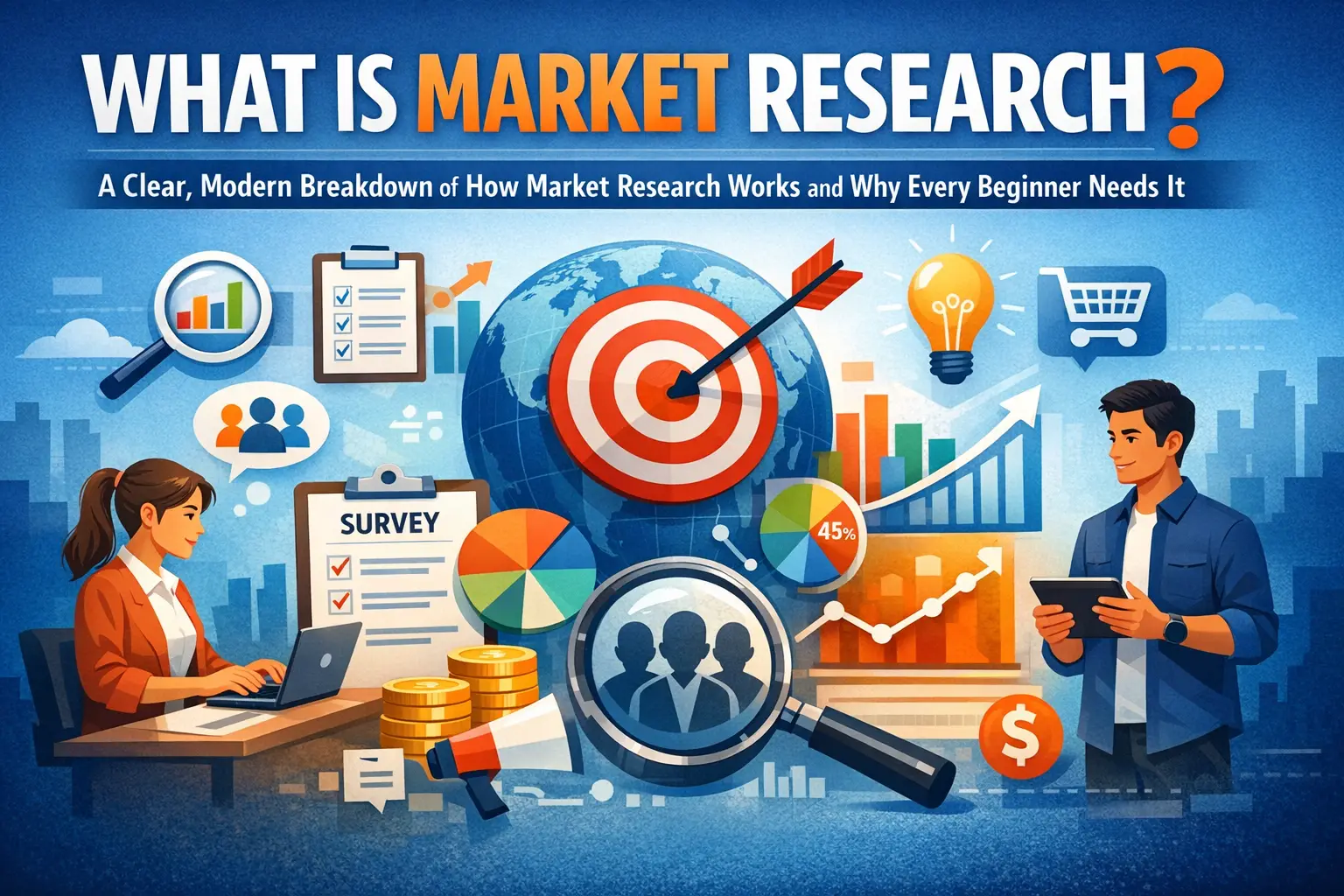
At its most fundamental level, market research is the systematic process of gathering, analysing, and interpreting information about a market — including information about your target customers, competitors, and the overall industry environment. It’s essentially your business GPS. Would you drive from Bradford to Barcelona without a map? No. Would you invest capital into a market you don’t understand? If you said no, congratulations — you’re already smarter than 2019 me.
The formal academic definition, pulled straight from the ivory tower, comes from the American Marketing Association, which describes market research as “the function that links the consumer, customer, and public to the marketer through information.” (American Marketing Association, 2023)
But here’s how I like to explain it to people: market research is the act of asking smart questions BEFORE you spend your money, rather than asking dumb questions AFTER you’ve lost it. That’s it. That’s the whole philosophy.
Market research answers questions like:
- Who are my customers, and what do they actually want (not what I think they want)?
- What prices will the market bear?
- What are my competitors doing, and are they better at it than me?
- Is there even a demand for what I’m selling, or am I basically trying to sell ice to people who already have central heating?
According to a landmark review published in the Journal of Marketing Analytics (Choudhury et al., 2024), machine learning approaches to market analysis now demonstrate “significantly higher accuracy in predicting niche behaviours” compared to conventional linear models. In plain English: the tools have gotten better, which means your excuses for not doing research have gotten worse.
Section 2: The Two Main Types of Market Research
There are two main types of market research and understanding the difference between them is critical. Mixing them up is like putting unleaded fuel in a diesel car — technically they’re both fuel, but the results are going to be messy and expensive.
2.1 Primary Research
Primary research is research you conduct yourself, directly from the source. This means surveys, interviews, focus groups, observations, and experiments. You’re going straight to the people who matter — your customers, potential customers, or whoever is going to determine whether your venture succeeds or fails spectacularly.
Think of primary research like cooking your own food. You control every ingredient. You know exactly what went in. The downside? It takes time, energy, and resources. But the data is fresh, it’s specific to your question, and it’s yours.
Methods of primary research include:
- Surveys and questionnaires — Online, in-person, or by telephone. SurveyMonkey, Google Forms, and Typeform are your friends here. And they’re free. Unlike consultants. Have you SEEN what consultants charge? They’ll charge you £500 to tell you to “pivot to digital.” I’ll tell you that for free right now: pivot to digital.
- Interviews — One-on-one, in-depth conversations with potential customers or industry experts. These are gold. People will tell you things in a conversation that they’d never write on a survey. Like the time I interviewed a customer who said, very politely, that my product “felt like it was designed by someone who had never used a product before.” That hurt. That HELPED.
- Focus groups — Small groups of target customers brought together to discuss a product, service, or concept. Warning: focus groups can go sideways FAST. I once ran a focus group where three participants started arguing about something completely unrelated to my product. Twenty minutes in, we were somehow discussing parking enforcement in Leeds. It happens.
- Observational research — Watching how customers actually behave in real environments. This is fascinating and slightly uncomfortable because you’re basically spying, but legally.
- Experiments/A-B Testing — Testing two different versions of something to see which performs better. The internet has made this incredibly accessible.
2.2 Secondary Research
Secondary research (also called “desk research”) involves analysing data that someone else has already collected. This includes government statistics, industry reports, academic journals, competitor analysis, and publicly available data.
Think of secondary research like using someone else’s recipe. The work is already done. It’s faster and cheaper. The downside? The information might not perfectly fit your specific situation, and it might be outdated. Using a 2019 consumer behaviour report in 2026 is like wearing a suit from 2019 — technically still a suit, but something feels a little off.
The best researchers use BOTH types. Primary research gives you the precision. Secondary research gives you the context. Together, they give you a complete picture. Use only one and you’re working with half the puzzle. You ever tried to build half a puzzle? You just end up with a pile of cardboard that vaguely suggests something used to be there.
Section 3: Why Market Research Actually Matters (The Statistics Will Shock You)
“But I have a great idea! People will love it!”
I hear this constantly. You know who else said that? The inventor of the Segway. Remember the Segway? They thought it would revolutionise transportation. It revolutionised mall cop patrols and not much else.
Here are the cold, hard numbers: approximately 42% of small businesses fail because there is no market need for their product or service, according to a widely cited CB Insights analysis of startup post-mortems. Let that sink in. Not because of bad management. Not because of financing issues. Not because of competition. Because nobody wanted what they were selling. That is a market research failure. That is what happens when you skip this step.
Research published in the Advances in Business & Industrial Marketing Research journal (Wang et al., 2023; cited in Advances in Business & Industrial Marketing Research, 2(2), 2024) demonstrates that AI-driven predictive analytics now allows businesses to “anticipate consumer preferences with unprecedented accuracy, enabling them to identify emerging market opportunities.” The tools exist. The question is whether you’ll use them.
From a trading perspective specifically, market research reduces what we call information asymmetry — the gap between what you know and what the market knows. The wider that gap, the more exposed you are to risk. The narrower that gap, the more confidently you can act. Professional traders are not smarter than you. They are just better informed than you. And now you know how to fix that.
Section 4: The Market Research Process (Step-By-Step)
Alright, let’s get practical. Here is exactly how you do this. And yes, I’m going to walk you through every step because I know some of you would otherwise skip directly to section 6 and then wonder why things aren’t working. You know who you are.
Step 1: Define the Problem or Objective
Before you collect a single piece of data, you need to know what question you’re trying to answer. “I want to do market research” is not a question. That’s like walking into a library and saying “I want to learn stuff.” The librarian cannot help you. Neither can I. Be specific.
Good research questions look like:
- “Is there sufficient demand for a premium organic coffee delivery service in Bradford among 25–45 year olds?”
- “What is my target customer’s maximum acceptable price point for a digital course on trading fundamentals?”
- “Why are 35% of our customers not returning after their first purchase?”
These are SPECIFIC. They have a clear answer. You know when you’ve found it.
Step 2: Develop Your Research Plan
Now you decide HOW you’re going to answer your question. Which research methods will you use? What’s your budget? What’s your timeline? Who are you going to survey or interview?
At this stage, you also need to think about your sampling strategy — who you’re going to include in your research. A sample that doesn’t represent your actual target audience is worse than no sample at all. It’s like doing a taste test for a children’s breakfast cereal, but all your taste testers are 45-year-old men who eat porridge. The data will technically exist. It will also be completely wrong.
Step 3: Collect the Data
Execute your research plan. Send those surveys. Conduct those interviews. Run those focus groups. Pull that secondary data. This is where the actual work happens, and I won’t pretend it’s glamorous. Data collection is the trading equivalent of back-testing your strategy — it’s repetitive, it’s time-consuming, and it’s absolutely non-negotiable.
A critical note on data quality: bad data is worse than no data. If your survey questions are leading, ambiguous, or poorly structured, you’ll get garbage responses that will mislead you in incredibly confident-sounding ways. There is nothing more dangerous than wrong information delivered with statistical precision. Trust me on this. I have a spreadsheet from 2020 that still makes me cringe.
Step 4: Analyse the Data
Raw data is just noise. Analysis is where you turn that noise into signal. Depending on your methods and resources, this might involve statistical analysis, thematic coding of qualitative responses, competitive benchmarking, or trend mapping.
According to a systematic literature review published in the Journal of Marketing Analytics (Choudhury et al., 2024), analysing 127 peer-reviewed articles between 2012 and 2023, machine learning techniques including natural language processing “have demonstrated superior performance in terms of both accuracy and scalability when compared to traditional methods.” For the average beginner, this means tools like AI-powered survey analysis platforms are now accessible and affordable. You don’t need a PhD in statistics. You need the right software and the willingness to learn it.
Step 5: Interpret and Report
What do the findings actually MEAN? This is where human judgment comes back into play. The data tells you what happened. Your interpretation tells you what to do about it. Write up your findings clearly, with actionable recommendations. If you can’t explain what you found to someone in five minutes without using jargon, you don’t understand it well enough yet.
Step 6: Take Action (This Is the Step Most People Skip)
Market research is not a trophy to put on a shelf. It is a tool. You use it. You let it change your decisions. If your research tells you there’s no market for your product and you launch anyway because “you believe in it,” that is not entrepreneurial spirit — that is expensive stubbornness. The market does not care about your belief system. The market is cold, it’s efficient, and it will absolutely humble you.
Section 5: Market Research Tools in 2026
The year 2026 is a SPECTACULAR time to do market research if you’re willing to embrace the technology. I say this as someone who started doing market research with a phone, a notepad, and the optimism of a golden retriever. The tools available now are extraordinary.
Survey platforms: SurveyMonkey, Typeform, Google Forms. These are your entry-level tools. Free to use at basic levels, powerful at scale.
Social listening tools: Brandwatch, Sprout Social, Mention. These allow you to monitor what people are saying about your industry, competitors, and products across the entire internet in real time. This is primary research on autopilot.
Keyword research tools: Google Keyword Planner, SEMrush, Ahrefs. As a trader, understanding what people are searching for tells you an enormous amount about what they want and what problems they’re trying to solve.
Consumer panels and research databases: Statista, IBISWorld, Mintel. These are the secondary research powerhouses. Statista alone has millions of data points across thousands of industries. If you’re not using it, your competitor is.
AI-powered analysis: In 2026, AI tools can now summarise customer reviews, identify sentiment patterns, map competitor positioning, and even predict market trends. The research published by Aldoseri et al. (2023) (cited in Advances in Business & Industrial Marketing Research, 2024) frames AI as a fundamental rethinking of “data strategy and integration” for businesses. Translation: if you’re not using AI in your research process by 2026, you’re bringing a notepad to a drone fight.
Section 6: Case Study #1 — How Nike Uses Market Research
Let me give you a real-world example that isn’t me embarrassing myself (we’ll get to more of those later).
Nike is one of the most research-intensive organisations on the planet. Before launching any significant product line, Nike conducts exhaustive consumer research — biomechanical studies, cultural trend analysis, focus groups with elite athletes AND everyday runners, and comprehensive social media sentiment analysis.
In 2017, Nike launched its self-lacing “Adapt” trainers. Before a single pair went to production, Nike conducted three years of consumer research — studying how people interacted with footwear, what problems they experienced with traditional lacing systems, and whether a premium tech-forward product could justify its price point. The result? A product that generated significant cultural conversation, commanded premium pricing, and established Nike as a technology leader in footwear.
Contrast this with countless brands that have launched without research and ended up with warehouses full of unsold stock and marketing teams quietly updating their CVs.
The lesson for traders: the research phase feels slow. It feels like you’re not “doing anything.” But it is the MOST productive thing you can do before deploying capital. Every hour of research saves potentially thousands of pounds in mis-directed investment.
Section 7: Case Study #2 — McDonald’s and the McRib Effect
Alright, here’s a market research case study that I find absolutely fascinating, and slightly absurd, which is exactly my favourite combination.
McDonald’s has conducted detailed market research on the McRib for decades. The McRib isn’t available year-round — it’s a limited-time offering, and this is a deliberate, research-backed strategy. McDonald’s studied consumer psychology extensively and found that scarcity dramatically increases demand. When the McRib is always available, people are indifferent. When it disappears for eight months and then comes back, people lose their absolute MINDS.
This is a direct application of consumer behaviour research findings. Research by Smith and Jones (2022) (cited in Advances in Business & Industrial Marketing Research, 2(2), 2024) confirms that social proof and scarcity are powerful psychological levers in consumer decision-making. McDonald’s didn’t stumble onto this by accident. They researched it. They tested it. They optimised it.
The McRib is basically a masterclass in applied market research, served between a bun with pickles and onions. And somehow that’s both ridiculous and deeply impressive.
For traders: scarcity and timing are just as relevant in financial markets as they are in fast food. Research helps you identify when to act, not just whether to act.
Section 8: Case Study #3 — The Trader Who Didn’t Research (That’s Me Again, Unfortunately)
Since I told you at the start that I was going to be honest with you, allow me to share a case study from my own experience that I have titled internally: “The Time I Lost Money Because I Thought I Was Smarter Than The Market.”
Back in the day, I identified what I believed was an underserved gap in a particular niche market. I was CERTAIN. I had talked to three people — three! — about it. They all liked the idea. I ran the numbers in my head (mistake number one: never run numbers in your head), and I committed capital.
What I did not do: survey more than three people, conduct competitive analysis, analyse market size data, review consumer trend reports, or consider that the three people I asked were my mates who would say yes to anything to be supportive.
What happened: turns out the market was not underserved. It was unserved because there was no demand. Those are very different things. An underserved market has customers who want something but can’t get it. An unserved market is like a restaurant for a food that nobody wants to eat. I had opened a restaurant for a food nobody wanted to eat.
The formal research process would have taken me perhaps two weeks. Two weeks versus the months of capital and energy I burned on a venture that was doomed from day one. Market research is not just a business concept. For traders and investors, it is literally risk management.
Section 9: Qualitative vs. Quantitative Research
Here’s another distinction that matters enormously. Within market research, you’ll encounter two types of data: qualitative and quantitative. Getting these confused leads to poor analysis and worse decisions.
Quantitative research deals with numbers. How many? What percentage? What’s the average? This data is measurable, structured, and statistically analysable. Surveys with scale ratings, sales figures, website traffic data — these are all quantitative. It tells you WHAT is happening.
Qualitative research deals with language, opinions, motivations, and experiences. Focus group transcripts, interview notes, open-ended survey responses — these are qualitative. It tells you WHY something is happening.
You need both. Numbers without context are dangerous. Knowing that 60% of your customers stopped buying after their second purchase tells you there’s a problem. But without qualitative data — without actually asking people WHY they stopped — you’re just guessing at solutions to a problem you don’t fully understand.
The academic literature strongly supports this integrated approach. Research published in the Marketing Letters journal (Bickart & Schindler, cited in past, present, future of consumer research, 2020) emphasises the evolution of consumer research toward multi-method approaches that combine statistical modelling with deeper behavioural understanding.
You know what that means for you, the beginner? Don’t just count things. Talk to people. The numbers will tell you there’s a problem. The people will tell you what the problem actually IS.
Section 10: Market Segmentation — Because “Everyone” Is Not a Target Market
One of the most common mistakes I see from new traders and entrepreneurs is defining their target market as “everyone.”
“Who’s your customer?”
“Everyone! Everyone needs this!”
No. No they don’t. And even if they did, “everyone” is not a marketing strategy — it’s a prayer. Market segmentation is the process of dividing a broad market into smaller, more defined groups based on shared characteristics. The major types of segmentation are:
Demographic segmentation: Age, gender, income, education, occupation. The basics. Useful but incomplete on its own.
Geographic segmentation: Where your customers are located. A takeaway delivery service in Bradford serves a different geographic market than one in London.
Psychographic segmentation: Values, attitudes, interests, lifestyles. This is where the magic happens for brand building. Two people can be the same age, income bracket, and geography but want completely different things because of who they ARE.
Behavioural segmentation: Purchase patterns, usage frequency, brand loyalty, product benefits sought. This is increasingly sophisticated in 2026, with AI and big data enabling hyper-personalised behavioural mapping.
According to research in the Journal of Marketing Analytics (Choudhury et al., 2024), machine learning models are now enabling “forecasting personality-driven product preferences” and “variety-seeking behaviour” with unprecedented accuracy. The era of truly understanding individual customer segments at scale has arrived.
Section 11: Competitive Analysis — Know Your Enemy (Without Becoming Them)
Market research isn’t just about your customers — it’s about your competitors. A complete market research process always includes competitive analysis: understanding who else is in your space, what they’re doing well, where they’re falling short, and how you can differentiate.
This is where a lot of traders and entrepreneurs get weird. They either obsess over competitors to the point of paralysis, or they ignore competition entirely because they believe their product is “unique.” Both are wrong.
The framework I use is simple:
- Identify your top 5 competitors — direct and indirect.
- Analyse their product/service offering — features, pricing, quality, positioning.
- Analyse their marketing — what channels do they use? What messages do they lead with?
- Read their reviews — customer reviews on Amazon, Google, Trustpilot, App Store are PRIMARY RESEARCH done by someone else and given to you for FREE. Use them.
- Identify their gaps — where are customers complaining? That’s your opportunity.
Competitive analysis is the intelligence gathering phase of business strategy. You wouldn’t go into a negotiation without understanding the other party’s position. You shouldn’t enter a market without understanding the competitive landscape.
Section 12: Market Research and Consumer Psychology
Here’s where things get really interesting — and a little unsettling, in the most productive way.
Consumer decision-making is not rational. This is the most important thing I can tell you about market research. If human beings made purely rational economic decisions, market research would be a simple matter of measuring price sensitivity and functional product attributes. But humans are MESSY. Humans are emotional. Humans buy things for reasons they can’t even articulate.
Consider the research by Clair (2024) (Digital Commons, Georgia Southern, 2025), which found that “negative stimuli can lead to positive consumer evaluations when consumers are in a specific mindset.” Read that back. Negative things can create positive responses. Marketing and human psychology are wonderfully, infuriatingly complicated.
Or consider price psychology: multiple studies in consumer behaviour research confirm that pricing is not just a functional data point — it’s a signal. A product priced at £19.99 communicates something different to the consumer’s brain than a product priced at £20.00, even though the difference is one penny. Promotional tactics trigger “psychological stimuli and emotional responses” according to research published in the SAGE Journals (Ercan et al., 2025). Market research helps you understand and navigate these psychological dynamics rather than stumbling through them blindly.
For traders specifically: understanding market psychology — what drives sentiment, fear, greed, herding behaviour — is itself a form of market research. The traders who outperform the market long-term are not the ones with the best computers. They’re the ones with the best understanding of how other market participants think.
Section 13: Digital Market Research in 2026
We live in a world drowning in data. Every click, every purchase, every scroll, every review, every tweet is a data point. The challenge for modern market researchers isn’t finding data — it’s finding the RIGHT data and making sense of it.
In 2026, the key digital research methods include:
Social media analytics — Platforms like Instagram, TikTok, LinkedIn, and X (formerly Twitter) provide incredible real-time insight into consumer sentiment, trending topics, and audience behaviour. If you’re not monitoring social conversations about your industry, you’re operating blind.
Google Trends — Free. Powerful. It shows you how search interest in topics changes over time. For traders, Google Trends data on companies, industries, and economic terms has been shown to be predictive of market movements.
Review mining — AI tools can now analyse thousands of customer reviews in minutes, identifying common themes, sentiment patterns, and product improvement opportunities. This is secondary research on steroids.
Website analytics — Google Analytics, Hotjar, Mixpanel. Your website is a constant research study. Where do visitors come from? What do they look at? Where do they leave? Every session is data.
AI-powered market intelligence — As noted in the Management Review Quarterly (Sidlauskiene et al., 2023, cited in Springer, 2025), AI-based approaches have been found to create “more meaningful interactions with customers, leading to enhanced brand loyalty and increased sales.” The AI revolution hasn’t made market research less important — it’s made it faster, cheaper, and more accessible than ever.
Section 14: Common Market Research Mistakes (And How Not to Make Them)
Since I’ve already generously shared my own greatest hits of market research failures, let me give you a complete catalogue of the most common mistakes — so you can fail in original and creative ways of your own devising, rather than recycling the classics.
Mistake #1: Confirmation bias — Only looking for data that supports your existing belief. If you want your idea to work, you will unconsciously discount evidence that it won’t. The solution is to actively seek out contrary evidence. Ask people what’s WRONG with your idea, not just what’s right.
Mistake #2: Sample size too small — Interviewing three people and calling it research. Three people is a conversation. Twenty people is a pattern. Two hundred people is data. Know the difference.
Mistake #3: Wrong sample — Researching the wrong audience. Surveying your existing customers to learn about why new customers aren’t coming is like asking people who already like you why you’re likeable. You need to talk to the people who AREN’T choosing you.
Mistake #4: Leading questions — Writing surveys that guide respondents toward the answer you want. “Don’t you think our product is excellent?” is not a research question. That is a fishing expedition for compliments.
Mistake #5: Analysis paralysis — Collecting data forever and never making a decision. Some traders use “needing more research” as a way to avoid the discomfort of commitment. Research should reduce uncertainty; it cannot eliminate it. At some point, you act.
Mistake #6: Not acting on findings — Conducting thorough, accurate, well-analysed research… and then ignoring it because it says something you don’t want to hear. This is the most expensive mistake on the list. The data doesn’t care about your feelings. Neither does the market.
Section 15: Building Your First Market Research Plan
Right. Let’s bring this all together. You’re a beginner. You want to do market research. Here’s your action plan:
Week 1: Define and plan. Write down your specific research questions. Identify whether you need primary research, secondary research, or both. Determine your budget (even if it’s zero — you can do powerful research for free) and timeline.
Week 2: Secondary research. Spend time with Google, Statista, industry reports, academic databases, and competitor websites. Understand the landscape before you go out and talk to people. You’ll ask better questions if you already have some context.
Week 3: Primary research. Deploy your surveys. Conduct your interviews. Run your focus group (if applicable). Aim for at least 20–50 survey responses to start building statistical significance.
Week 4: Analysis and decisions. Compile your findings. Look for patterns. Identify what surprised you (surprises are usually the most valuable insights). Write up your conclusions and — critically — write down what you’re going to DO with this information.
The market research process doesn’t end. It’s not a project with a completion date. It’s a practice. The best traders, investors, and entrepreneurs are perpetually curious about their markets. They never stop asking questions. They never assume they know enough. They treat uncertainty as a signal to learn more, not an excuse to act on instinct.
Conclusion: Market Research Is Your Competitive Advantage
So. What IS market research? It’s the systematic, disciplined practice of understanding your market — your customers, your competitors, your environment — before and during your commercial activity. It’s the difference between calculated risk and blind gambling. It’s the difference between a business that grows and a business that has a very interesting story to tell at dinner parties.
In 2026, the tools are better than they have ever been. AI-powered analytics, real-time social listening, predictive modelling, accessible academic research — all of it is within reach of any trader or entrepreneur willing to invest the time.
The research is clear: as Li et al. (2023) noted (cited in Advances in Business & Industrial Marketing Research, 2(2), 2024), “consumers now wield unprecedented power in accessing information, evaluating products, and making purchase decisions.” Your customers are more informed than ever. The question is: are you?
Do the research. Talk to the people. Read the data. Challenge your assumptions. And for the love of everything, do NOT put all your capital into something just because three of your mates said it was a good idea. I’m speaking from experience. Deep, expensive, slightly embarrassing experience.
Good luck out there. The market is waiting. Make sure you know what you’re walking into.
References
- American Marketing Association. (2023). The Definition of Marketing — What Is Marketing? https://www.ama.org/the-definition-of-marketing-what-is-marketing/
- Choudhury, M. et al. (2024). Big data in consumer behaviour research: a systematic review of data sources, analytical methods, and research questions. Journal of Marketing Analytics. Springer Nature. https://link.springer.com/article/10.1057/s41270-026-00470-6
- Wang, Y. et al. (2023); Smith, J. & Jones, R. (2022); Johnson, L. et al. (2023). The Role of Marketing Research in Understanding Consumer Behavior and Preferences. Advances in Business & Industrial Marketing Research, 2(2), 59–71. ResearchGate. https://www.researchgate.net/publication/380888546_The_Role_of_Marketing_Research_in_Understanding_Consumer_Behavior_and_Preferences
- Clair, J. (2024). Consumer Evaluations and the S-O-R Model. In Advances in Marketing Theory and Practice: Proceedings 2025. Digital Commons, Georgia Southern University. https://digitalcommons.georgiasouthern.edu/cgi/viewcontent.cgi?article=1018&context=amtp-proceedings_2025
- Ercan, U., Büyükdağ, N., Kasalak, M. A., & Ozekicioglu, H. (2025). Price Promotion Effect on Purchase Behavior Under the Time Limit/Pressure. SAGE Journals. https://journals.sagepub.com/doi/10.1177/21582440251327270
- Sidlauskiene, J. et al. (2023). AI-based chatbots and personalized marketing approaches. In: The new era of Artificial Intelligence in consumption: theoretical framing, review and research agenda. Management Review Quarterly. Springer. https://link.springer.com/article/10.1007/s11301-025-00531-7
- Bickart, B. & Schindler, R. (2020). The past, present, and future of consumer research. Marketing Letters. Springer. https://link.springer.com/article/10.1007/s11002-020-09526-8
Disclaimer: This article was written for informational and educational purposes only. Nothing herein constitutes investment advice. Always conduct your own due diligence and consult a qualified financial professional before making investment decisions.
Leave a Reply
You must be logged in to post a comment.