
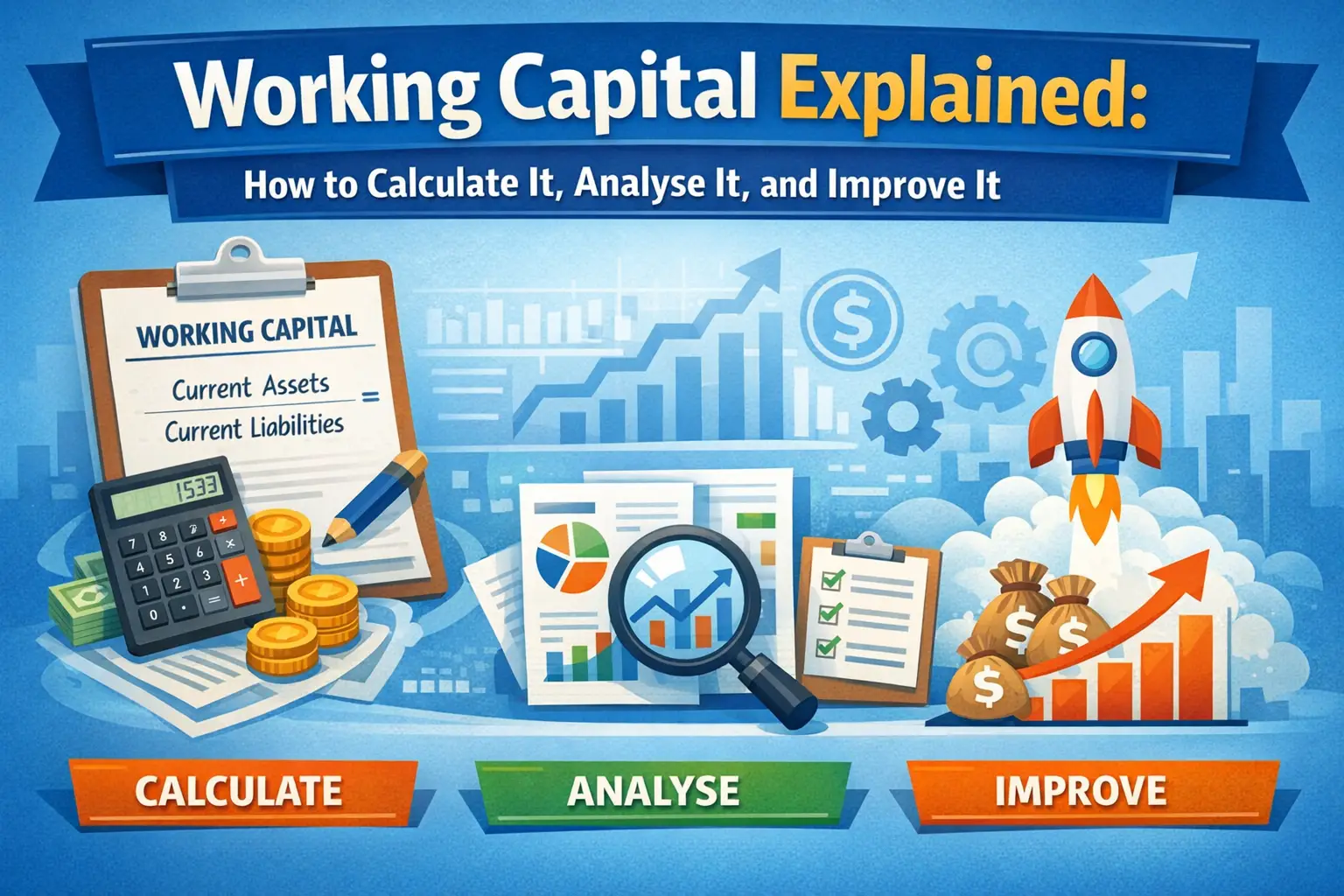
Working capital management, cash flow analysis, and current ratio optimisation are not just things that accountants mutter about over lukewarm coffee. They are the oxygen your business breathes. Right now, somewhere in the world, a perfectly profitable company is filing for bankruptcy because it ran out of working capital. Profitable. Bankrupt. At the same time. That is not a paradox — that is just bad financial management, and today, we are going to fix that together.
Now, I know what you’re thinking: “I don’t need another finance lecture.” Relax. I’m a trader, not an accountant. I’ve been in rooms where money was made, money was lost, and someone’s Excel spreadsheet was somehow both optimistic and catastrophically wrong at the same time. So buckle up, because this is the working capital guide they should have taught you in school — if school had been honest about how scary cash flow really is.
According to Prasad et al. (2019), the academic literature on working capital management spans over 50 years of rigorous research, yet the number of businesses that mismanage their short-term liquidity remains stubbornly high [1]. That is like knowing exactly how to avoid a pothole for five decades and still driving right into it. Let’s not be that driver.
What Is Working Capital? (And Why Should You Care?)
Working capital — sometimes called net working capital or NWC — is the difference between a company’s current assets and its current liabilities. That’s it. Simple, right? Well, yes and no. The formula is simple. The implications are enormous.
Working Capital = Current Assets − Current Liabilities
Current assets include cash, accounts receivable (money owed to you), and inventory — essentially, everything you expect to convert to cash within twelve months. Current liabilities include accounts payable (money you owe to others), short-term loans, and accrued expenses — basically, everything that is going to demand money from you within twelve months.
If the result is positive, congratulations! Your business can theoretically pay its short-term bills. If the result is negative, then I hate to be the one to tell you this, but your business is living like that friend who keeps “forgetting” their wallet every time the restaurant bill arrives. Everybody notices. It’s not cute.
Boisjoly, Conine, and McDonald (2020) conducted a landmark study examining working capital trends from 1990 to 2017 and found that efficient working capital management is directly associated with higher return on invested capital and improved equity valuations [2]. In other words, companies that manage working capital well are literally worth more money. And companies that don’t? Well, let’s just say the market has a way of expressing its feelings.
Why Working Capital Is Not the Same as Cash
Here is a mistake that even experienced operators make: confusing working capital with cash. Your business might have plenty of working capital on paper while being completely cash-broke in practice. How? Because working capital includes inventory that hasn’t sold yet, and receivables from customers who haven’t paid yet.
Imagine you’re a clothing retailer. You bought £500,000 worth of Christmas jumpers in September (because your buyer is either a genius or has watched too many holiday films). November arrives, and technically, you have massive working capital — inventory on the shelves! But your suppliers want paying in October. Your landlord wants their November rent. Your staff want their salaries — and they absolutely should get them, because they’ve already seen the Christmas jumpers and they deserve hazard pay.
This gap between when you spend money and when you receive it is the essence of the working capital challenge. And it is precisely why the Cash Conversion Cycle (CCC) is one of the most powerful analytical tools in a trader’s arsenal — but we’ll get there.
How to Calculate Working Capital: The Numbers Don’t Lie (But They Do Exaggerate Sometimes)
Let’s get into the mathematics. I promise it’s less painful than it sounds. If I can calculate working capital after three cups of bad conference coffee at a trading floor that smelled like stress and last year’s ambitions, you can absolutely do this.
The Basic Working Capital Formula
Net Working Capital (NWC) = Current Assets − Current Liabilities
But most financial professionals also track the Current Ratio and Quick Ratio for deeper analysis:
Current Ratio = Current Assets ÷ Current Liabilities
Quick Ratio = (Current Assets − Inventory) ÷ Current Liabilities
Net Working Capital Ratio = Net Working Capital ÷ Total Assets
What Do These Ratios Mean in Practice?
| Ratio | What It Tells You |
|---|---|
| Current Ratio > 2.0 | Generally healthy — you have twice the assets to cover liabilities |
| Current Ratio 1.0–2.0 | Functional but potentially tight — watch cash flow closely |
| Current Ratio < 1.0 | Danger zone — you cannot cover current liabilities with current assets |
| Quick Ratio > 1.0 | Can meet short-term obligations without selling inventory |
| Quick Ratio < 0.5 | Serious liquidity concern — time to have some difficult conversations |
Naz et al. (2022) demonstrated that working capital management, when combined with strong corporate governance, has a statistically significant positive impact on firm performance. Their study of agency theory confirmed that oversight of short-term liquidity decisions is not optional — it is a core governance responsibility [3].
Now, here is the part where I need to warn you about ratios. Ratios are like horoscopes — they can tell you something useful, but if you make major life decisions based solely on them, you’re going to have a bad time. A current ratio of 3.0 might sound fantastic until you realise that most of those current assets are sitting in a warehouse full of goods nobody wants to buy. Ask any retailer who bet heavily on NFT merchandise in 2022. Actually, don’t ask them — they’ve been through enough.
The Cash Conversion Cycle: The Real Pulse of Your Business
The Cash Conversion Cycle (CCC) measures how long it takes for money invested in operations to come back as cash. It is arguably the single most important metric for understanding the operational health of a business, and it was first formalised by Richards and Laughlin in 1980 [4].
CCC = Days Sales Outstanding (DSO) + Days Inventory Outstanding (DIO) − Days Payable Outstanding (DPO)
Breaking this down:
- DSO — How long it takes your customers to pay you. If this number is high, your customers are basically getting an interest-free loan from your business. Nice for them. Terrible for you.
- DIO — How long inventory sits before it’s sold. High DIO means money is locked up in stock. That stock is not paying your electricity bill.
- DPO — How long you take to pay your suppliers. Higher is actually better here (within reason and good relationships) — it means you hold onto cash longer.
A lower CCC means your business converts investments back to cash quickly — a sign of efficient operations. A higher CCC means money is stuck in the pipeline, which is a liquidity risk. I had a supplier once tell me their CCC was “90 days, give or take.” Give or take what? A lawsuit? An intervention? Their dignity?
How to Analyse Working Capital: Reading the Tea Leaves Without Making Things Up
Calculating working capital is step one. Analysing it intelligently is step two. Many business owners stop at step one, look at the numbers, nod seriously as if they understand, and then go back to doing whatever they were doing before. That is not analysis. That is the financial equivalent of checking your temperature and then ignoring the thermometer because you don’t like what it says.
Benchmarking Against Industry Standards
Working capital requirements vary massively by industry. A technology company might operate with a CCC of 30–60 days. A grocery supermarket might actually have a negative CCC — they collect cash from customers before they pay their suppliers. A construction firm might have a CCC of 150+ days because project timelines are long and customers pay in stages.
Filbeck and Krueger (2005) conducted an extensive cross-industry analysis of working capital management and found statistically significant differences between sectors — meaning that comparing your retail business’s current ratio to a software company’s is about as useful as comparing apples to a satellite [5]. Know your benchmark. Know your sector.
| Industry | Typical Current Ratio Range |
|---|---|
| Grocery / Supermarkets | 0.5 – 1.0 (negative CCC common) |
| Manufacturing | 1.2 – 2.0 |
| Retail (non-grocery) | 1.2 – 1.8 |
| Construction | 1.3 – 2.5 |
| Technology / SaaS | 1.5 – 3.0 |
| Healthcare | 1.5 – 2.5 |
Trend Analysis: Your Business Is Telling You a Story
Looking at working capital at a single point in time is like watching one frame of a film and trying to describe the plot. You need a trend. Pull working capital figures for the last 12–24 months and ask these questions:
- Is the current ratio trending up or down? A downward trend over several quarters is a warning sign.
- Is DSO increasing? That means customers are taking longer to pay — either your payment terms are too loose, your collections are weak, or your customers are in financial trouble themselves.
- Is DIO rising? That means inventory is sitting longer — either demand is falling, you’ve overbought, or your product mix needs reviewing.
- Is DPO shrinking? That could mean you’re paying suppliers faster than necessary, burning through cash you could have kept longer.
The Interplay Between Working Capital and Profitability
Here is where things get philosophically interesting, and I promise I won’t go full academic on you. There is a documented inverted-U relationship between working capital and profitability. That is to say: too little working capital is dangerous (you can’t operate), but too much is also suboptimal (you’re tying up money inefficiently in assets that aren’t generating returns).
Aktas, Croci, and Petmezas (2015) published landmark research in the Journal of Corporate Finance demonstrating that there is an optimal level of working capital investment, and deviating from it — in either direction — destroys firm value [6]. Think of it like seasoning in cooking. Too little salt and the dish is bland and miserable. Too much salt and you’re calling an ambulance. The sweet spot exists, and finding it is your job as a financial manager.
Real-World Case Studies: Learning From Other People’s Expensive Mistakes
Nothing clarifies financial theory like watching other businesses make spectacular errors with their working capital. Let’s look at some instructive real-world examples. Don’t laugh. Or do — just learn from it too.
Case Study 1: Toys ‘R’ Us — The Inventory Nightmare That Broke a Giant
Few working capital horror stories are as instructive as the decline of Toys ‘R’ Us. At its peak, the company operated thousands of stores globally and was synonymous with childhood joy. But beneath the surface, the working capital structure was an absolute catastrophe in slow motion.
The company carried enormous inventory — because, obviously, toy stores have toys — but its Days Inventory Outstanding ballooned as competition from Amazon and online retailers decimated sales velocity. DIO stretched to over 90 days in some reporting periods. Meanwhile, debt service obligations (a current liability) were enormous due to the leveraged buyout in 2005. The result was a company that was simultaneously sitting on billions of dollars of stock while being strangled by its current liabilities.
In 2017, Toys ‘R’ Us filed for bankruptcy. Not because toys stopped being popular. Not because Christmas was cancelled. But because working capital management failed catastrophically. The lesson? Even iconic brands are not immune to liquidity crises. Working capital doesn’t care about your nostalgia.
Case Study 2: Apple Inc. — The Negative Working Capital Master Class
Now for a happier story. Apple Inc. has, at various points in its history, operated with negative net working capital — and made it look not just acceptable, but aspirational. How?
Apple collects cash from customers immediately (or through financing arms), often before it pays its component suppliers. It maintains extremely lean inventory through its Just-In-Time supply chain model. And it negotiates aggressive payment terms with suppliers, extending its DPO to 60–90 days. The result is a negative CCC: Apple receives money before it spends it on production. The entire operation essentially runs on other people’s money — suppliers and, indirectly, customers.
This is a masterclass in active working capital management. Of course, Apple has the brand strength, purchasing power, and market dominance to achieve these terms. Your small manufacturing business in Birmingham may not get the same deal from suppliers. But the principles are replicable at any scale: shorten collection times, optimise inventory, and extend payables within healthy relationship limits.
Case Study 3: SMEs and the Working Capital Gap — Evidence From Chile
Not all case studies involve household names. Gallegos Mardones et al. (2024) conducted an empirical study of Chilean small and medium-sized enterprises, finding that poor working capital management was one of the primary drivers of business failure among SMEs in an emerging economy [7]. The study found that companies with efficient receivables management and optimised inventory turnover demonstrated significantly higher ROA (Return on Assets) and ROE (Return on Equity).
The findings are globally relevant. Whether you’re running a manufacturing firm in Manchester or a food distribution company in Melbourne, the fundamentals of working capital management apply universally. The tragedy is that most SME owners are too busy running their businesses to sit down and run these numbers. They’re like someone driving a car and never looking at the fuel gauge. The journey feels fine right up until you’re on the hard shoulder wondering where it all went wrong.
Case Study 4: Inventory Management in Retail — The Fast Fashion Whiplash
The fast fashion industry provides another fascinating working capital study. Brands like Zara (Inditex) have built their entire competitive advantage around an ultra-compressed supply chain that dramatically reduces DIO. Zara’s model — designing, producing, and delivering new collections in as little as two weeks — means inventory is sold quickly, cash is collected rapidly, and the CCC remains impressively short.
Compare this to traditional fashion brands ordering six months in advance based on forecasts (which are basically very expensive guesses dressed in spreadsheet clothing). When fashion trends shift — as they inevitably, humiliatingly do — those brands are left holding £20 million worth of clothing nobody wants. DIO explodes. Working capital deteriorates. Markdowns destroy margin.
The lesson: inventory management is not a supply chain problem. It is a working capital problem. Every day a product sits unsold is a day working capital is unnecessarily constrained.
How to Improve Working Capital: Practical Strategies That Actually Work
Alright, we’ve covered the theory, we’ve cried about Toys ‘R’ Us, we’ve admired Apple from a respectful distance, and now it’s time to do something about YOUR working capital. Because knowing the problem is half the battle. The other half is actually doing something about it — which is the half most people skip.
Strategy 1: Accelerate Accounts Receivable
Every day a customer owes you money is a day you’re funding their business for free. You are not a charity. Unless you are a charity, in which case, first of all, thank you for your service, and second of all, you still need working capital management — maybe even more so.
- Invoice immediately upon delivery or completion of service. Not “when you get around to it.” Immediately. Like, right now.
- Offer early payment discounts (e.g., 2/10 net 30 — 2% discount if paid within 10 days, full amount due in 30). Research shows this can significantly reduce DSO.
- Implement clear credit policies. Not everyone who wants to buy from you on credit should be allowed to. Screening customers is not rude — it’s responsible.
- Consider invoice factoring or accounts receivable financing as a bridge tool, though be mindful of costs.
- Use automated accounts receivable software to chase overdue invoices. Because chasing invoices manually is approximately the most demoralising task in business.
Strategy 2: Optimise Inventory Management
Inventory is working capital in a coma. It’s yours, technically, but it’s not doing anything useful while it sits in a warehouse accruing storage costs and existential dread.
- Implement ABC analysis: focus tight management on your highest-value items (A), moderate management on mid-tier items (B), and simplify ordering for low-value items (C).
- Introduce Just-In-Time (JIT) principles where possible — order inventory closer to when you need it to reduce storage time and carrying costs.
- Regularly review slow-moving and dead stock. Clearing these with discounts is better than holding them at full cost in a warehouse where they’re quietly judging you.
- Use demand forecasting tools. “Gut feeling” is not a forecasting methodology. It is a risk factor.
Zimon and Zimon (2020) demonstrated in a study of Polish SMEs participating in group purchasing organisations that quality management systems had a measurable positive effect on working capital efficiency [8]. Structured operational processes translate directly into better cash flow outcomes. Who knew that having a system might actually work?
Strategy 3: Extend Accounts Payable (Strategically)
Paying your suppliers early when you don’t have to is essentially giving them an interest-free loan. Like lending money to someone who didn’t even ask for it. Maximise your payment terms — if your supplier gives you 60 days, take 60 days. But here’s the critical caveat: do not blow up supplier relationships in the process. A supplier who suddenly stops trusting you because you’ve stretched payments too far is a working capital problem you cannot calculate.
- Negotiate longer payment terms with key suppliers — especially when volumes are high or relationships are strong.
- Use supply chain finance programmes where available: platforms that allow suppliers to get paid early (at a small discount) while you maintain your longer payment cycle.
- Avoid paying before due date unless you’re earning a discount that mathematically justifies it.
Strategy 4: Maintain a Working Capital Reserve
Seasonality will destroy unprepared businesses. Retail businesses need cash in October/November to build Christmas inventory. Agricultural businesses need cash at planting season. Construction firms face cash troughs between projects. If you have not mapped your seasonal working capital requirement and built a reserve or credit facility accordingly, you are essentially hoping that everything goes well. Hope is not a financial strategy.
Tarighi et al. (2024) studied working capital management strategies under COVID-19 conditions and found that firms with conservative working capital buffers demonstrated significantly greater resilience during the crisis compared to those operating with aggressive, lean strategies [9]. In uncertain environments, liquidity is not just about efficiency — it is about survival.
Strategy 5: Cash Flow Forecasting — Your Crystal Ball (Except It Actually Works)
You cannot manage what you cannot see. A 13-week rolling cash flow forecast is the single most powerful working capital management tool available to any business, regardless of size. It shows you:
- When you will have cash surpluses (opportunity to pay down debt or invest)
- When you will face cash shortfalls (opportunity to arrange facilities before the panic sets in)
- The impact of different collection and payment scenarios on your liquidity position
A business without a cash flow forecast is like a pilot flying blind through clouds, cheerfully telling passengers that everything is fine. It might be fine. But also, it might absolutely not be fine, and you’d have no way of knowing until the turbulence started. Forecast. Always forecast.
Strategy 6: Improve Working Capital Through Better Governance
Naz et al. (2022) found that corporate governance quality is a significant moderator of working capital management outcomes [3]. In plain English: businesses with proper oversight, clear financial accountability, and well-structured decision-making processes manage working capital better than those where “the boss decides everything on a feeling.” Implement clear financial reporting cycles. Have monthly working capital reviews. Make someone responsible — not just aware.
The Trader’s Quick-Reference Working Capital Checklist
Before I let you go, here is your practical checklist. Print it out. Stick it somewhere visible. Maybe on your monitor, your fridge, your forehead — wherever decisions about money get made.
| Working Capital Health Check | Status (Complete Honestly) |
|---|---|
| Have you calculated your current ratio this month? | ☐ Yes ☐ No |
| Do you know your CCC and is it improving? | ☐ Yes ☐ No |
| Are your invoices sent within 24 hours of delivery? | ☐ Yes ☐ No |
| Do you have a clear credit policy for customers? | ☐ Yes ☐ No |
| Are you actively managing slow-moving inventory? | ☐ Yes ☐ No |
| Are you using supplier payment terms fully? | ☐ Yes ☐ No |
| Do you have a 13-week rolling cash flow forecast? | ☐ Yes ☐ No |
| Have you benchmarked against industry peers? | ☐ Yes ☐ No |
| Is someone specifically accountable for WC management? | ☐ Yes ☐ No |
| Do you review working capital trends monthly? | ☐ Yes ☐ No |
If you answered “No” to more than three of those, congratulations — you have just discovered exactly why you’re reading this article. The good news: every one of those “No” answers is an opportunity. The bad news: opportunities don’t convert themselves. You have to do the work.
Conclusion: Working Capital Is Not Boring — It’s the Difference Between Success and a Devastating Phone Call From Your Bank
Let’s bring it home. Working capital management — the calculation, analysis, and active improvement of the relationship between your current assets and current liabilities — is not optional. It is not a nice-to-have. It is not something you can delegate to an accountant you see once a year and forget about. It is the circulatory system of your business.
We’ve covered the fundamentals: net working capital, current ratios, quick ratios, and the cash conversion cycle. We’ve seen how to analyse these figures intelligently — not just as snapshots, but as trends that tell a story about business health. We’ve studied real companies, from the fall of retail giants to the precision of world-leading supply chain operators. And we’ve walked through six practical strategies that can genuinely move the needle.
The academic evidence is unambiguous. Boisjoly et al. (2020) showed that disciplined working capital management improves firm valuation [2]. Aktas et al. (2015) demonstrated the existence of an optimal working capital level that, when achieved, maximises profitability [6]. And Panigrahi (2024) confirmed that working capital strategies are a causal driver of financial performance, not merely correlated with it [10].
More recently, the systematic literature review by Bashir (2024) on dynamic working capital management in Southeast Asia reinforced that the field remains critically relevant in emerging and developed markets alike — and that businesses which adapt their working capital strategies to operating conditions outperform those that apply rigid, static approaches [11].
Here’s my final trader’s truth for you: the most sophisticated trading strategy in the world is worthless if the business running it doesn’t have enough working capital to keep the lights on. The most brilliant product idea won’t save you if you run out of cash between invoicing and collecting. The most talented team won’t stick around if you can’t make payroll.
Working capital is not sexy. It doesn’t get TED Talks. No one at a dinner party says “Oh, tell me more about your days payable outstanding.” But in the quiet, unglamorous machinery of business success, working capital management is what separates the companies that last from the companies that become a cautionary tale in someone else’s finance article.
And nobody wants to be the cautionary tale.
References
[1] Prasad, P., Narayanasamy, S., Paul, S., Chattopadhyay, S., & Saravanan, P. (2019). Review of literature on working capital management and future research agenda. Journal of Economic Surveys, 33(3), 827–861. https://doi.org/10.1111/joes.12299
[2] Boisjoly, R. P., Conine, T. E., & McDonald, M. B. (2020). Working capital management: Financial and valuation impacts. Journal of Business Research, 108, 1–8. https://doi.org/10.1016/j.jbusres.2019.09.025
[3] Naz, M. A., Ali, R., Rehman, R. U., & Ntim, C. G. (2022). Corporate governance, working capital management, and firm performance: Some new insights from agency theory. Managerial and Decision Economics, 43(5), 1448–1461. https://doi.org/10.1002/mde.3549
[4] Richards, V. D., & Laughlin, E. J. (1980). A cash conversion cycle approach to liquidity analysis. Financial Management, 9(1), 32–38. https://doi.org/10.2307/3665227
[5] Filbeck, G., & Krueger, T. M. (2005). An analysis of working capital management results across industries. American Journal of Business, 20(2), 11–20. https://doi.org/10.1108/19355181200500009
[6] Aktas, N., Croci, E., & Petmezas, D. (2015). Is working capital management value-enhancing? Evidence from firm performance and investments. Journal of Corporate Finance, 30, 98–113. https://doi.org/10.1016/j.jcorpfin.2014.12.008
[7] Gallegos Mardones, J. A., Moraga-Flores, H., Navarrete-Oyarce, J., & Araya-Castillo, L. (2024). Effects of working capital management on small and medium-sized enterprises: A case study of Chilean companies. Interciencia, 49(9). https://doi.org/10.18235/0010539
[8] Zimon, G., & Zimon, D. (2020). Quality management systems and working capital SMEs in GPO: A case of Poland. Administrative Sciences, 10(4), 1–13. https://doi.org/10.3390/admsci10040095
[9] Tarighi, H., Zimon, G., Sheikh, M. J., & Sayrani, M. (2024). The impact of firm risk and the COVID-19 crisis on working capital management strategies: Evidence from a market affected by economic uncertainty. Risks, 12(4), 1–33. https://doi.org/10.3390/risks12040060
[10] Panigrahi, A. (2024). Working capital management strategies and financial performance: A cause-and-effect analysis. Journal of Management Research and Analysis, 11(1), 3–11. https://ssrn.com/abstract=4749810
[11] Bashir, R. (2024). Determining the nexus between dynamic working capital management and operational efficiency in emerging Southeast Asia. Journal of Finance and Business Research. https://doi.org/10.35609/jfbr.2024.9.1(4)
Disclaimer: This article is for educational and informational purposes only and does not constitute financial advice.
Leave a Reply
You must be logged in to post a comment.