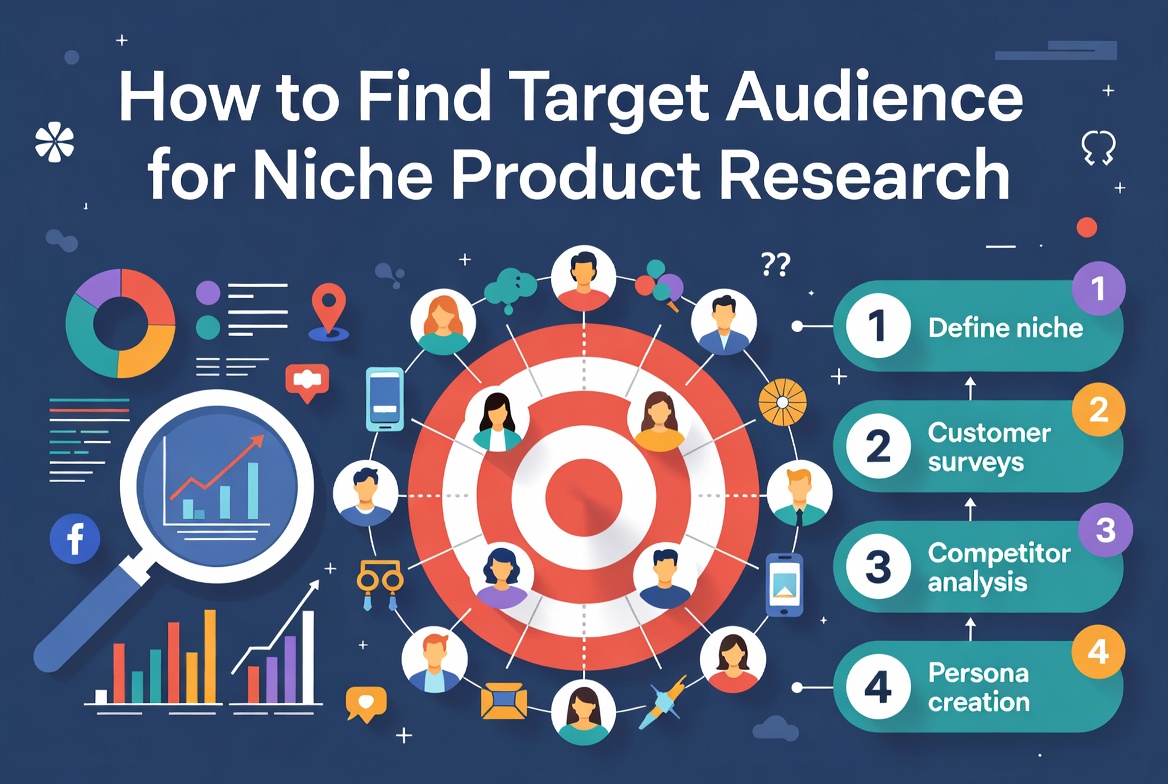
To find your target audience for niche product research, start by identifying a specific, underserved pain point, then use forums, search data, reviews, and small validation tests like crowdfunding to confirm real people already want it solved.
If you want to know how to find target audience for niche product research, sit down, because I’m about to save you eighteen months of your life and a frightening chunk of your savings account. I’m a trader. I find mispriced things for a living — stocks, sneakers, attention, vibes — and the single most mispriced asset in the entire online business world is “I’ll just post it and see who buys it.” That’s not a strategy. That’s a lottery ticket with extra shipping costs.
Let me paint the picture. Somewhere right now, a person is sitting in their kitchen at 1:47 a.m., lit only by the blue glow of a laptop, convinced they’ve invented the next big thing — a fanny pack for cats, a candle that smells like “Tuesday,” a subscription box of artisanal hot sauce shaped like state capitals. Glorious. Visionary. Completely doomed, because they have not the faintest idea who is supposed to buy it.
(Voice A: I had a plan.) (Voice B: The plan was “vibes.”)
That’s the whole problem with niche products, the one nobody warns you about. The product part is the easy 20%. The audience part — finding the actual humans who will hand you actual money — is the other 80%, and it’s the part nobody wants to do because it involves spreadsheets instead of dopamine. Today we fix that. We’re going to walk through exactly how professional researchers, marketers, and yes, traders like me, identify a target audience using actual peer-reviewed methodology — not vibes, not “my cousin said it was a good idea,” and definitely not a Ouija board. I will also be making jokes the entire way through, because if I have to read one more dry, beige, sleep-inducing “marketing guide” written like a tax form, I will personally combust. Buckle in. This is going to be loud.
Why Most Niche Products Die Before They Ever Had a Chance
Here’s an uncomfortable truth dressed up as small talk: most niche products don’t fail because the product is bad. They fail because the founder fell in love with the idea before falling in love with the evidence. It’s the business equivalent of marrying someone because you liked their profile picture. Sometimes it works out. Mostly you end up explaining to your family why you have 4,000 unsold ergonomic standing desks for guinea pigs in a storage unit you’re now emotionally attached to.
The academic literature backs this up with considerably less sarcasm than I just used. Niche marketing scholarship has been mapping this terrain since the 1990s, and the core finding hasn’t changed: the businesses that win in narrow markets are the ones that identify a specific, underserved segment before building, not after. According to a foundational review of niche marketing research that traced the field back to its origins, niche strategy success depends on businesses correctly identifying specialization opportunities and matching their capability to a precisely defined segment, rather than assuming demand will simply appear because the founder is excited about it (Niche Marketing Research: Status and Challenges).
Translation, for those of us who didn’t do a marketing PhD: the market does not care how passionate you are. The market cares whether you found the sixty people on Earth who have been quietly praying for a left-handed garlic press.
(Voice A: I believed in my product.) (Voice B: The market believed in absolutely nothing, because the market had never heard of it, because nobody told the market it existed.)
And that’s the gag. You can have the single greatest idea since sliced bread — possibly literally a new way to slice bread — and if you don’t know who wants it, you’re just an inventory problem with a Shopify subscription.
Step One: Stop Asking “Who Might Like This?” and Start Asking “Who Already Has This Pain?”
The biggest mistake amateur researchers make is starting from the product and working outward. They build the candle, then ask “who likes candles?” Wrong order. Completely backwards. It’s like buying a wedding ring before you’ve met anyone you’d want to marry — technically possible, deeply unsettling to witness.
Professional target-audience research flips the sequence. You start with a pain point or an unmet need, and you work toward the people who feel that pain most acutely. Strategic marketing literature consistently frames this as identifying segments where need intensity is high and competitive saturation is low — in other words, find the people who want something badly and aren’t already being served by six other companies screaming for their attention (Marketing Strategy: Segmenting, Targeting, and Positioning for Digital Business). The same body of work notes that market segments with lower competitive rivalry give smaller businesses more room to grow and capture profitability without getting flattened in a pricing war with bigger players who have approximately one billion more dollars than you do.
So here’s the actual exercise. Forget your product for a second — I know, I know, it’s your baby, but put the baby down for a moment — and ask:
- Who is currently solving this problem badly, expensively, or not at all?
- Who complains about this loudly and often, ideally in places you can read for free, like Reddit, forums, or the comments section of a YouTube video about garlic presses (yes, that’s a real rabbit hole, and yes, people have opinions)?
- Who would feel genuine relief, not mild interest, if this problem disappeared?
Genuine relief is the threshold. “Mild interest” buys nothing. Mild interest looks at your product, says “oh, neat,” and continues scrolling toward a video of a raccoon washing a grape. Genuine relief opens their wallet before you’ve finished your sentence.
(Voice A: I wanted everyone to want my product.) (Voice B: “Everyone” is not a customer. “Everyone” is a population statistic that has never once bought anything from anybody.)
Step Two: Use Segmentation Like a Professional, Not Like You’re Guessing at a Carnival Game
Once you’ve identified a pain point, it’s time to segment — meaning you slice the broader population into groups based on shared characteristics so you can figure out exactly which slice is hungriest for your solution. This isn’t a vibe-based exercise. There’s actual rigor here, the kind academics have been refining since before some of you were born (no offense, but some of this literature predates your existence, and it still works better than your Instagram poll).
A widely cited review on market segmentation strategy lays out the core variables researchers use: demographic (age, income, location, occupation), psychographic (values, lifestyle, personality), behavioral (purchase habits, brand loyalty, usage frequency), and geographic factors, and it emphasizes that combining multiple variables produces sharper, more profitable segment definitions than relying on just one (Market Segmentation Strategies: Analysis, Practice, and Marketing Implications). A separate review of niche marketing constructs found something genuinely useful here too: when researchers tested demographic segmentation against psychographic segmentation for predicting actual brand preference, combinations of multiple demographic variables performed just as well as psychographic data — meaning you don’t always need an expensive personality-profiling tool to find your audience; sometimes good old age-income-location data, used properly, gets you most of the way there (The Niche Marketing Strategy Constructs and Its Characteristics).
What does this mean practically? It means you don’t need a six-figure research budget to find your audience. You need to be specific. “Women who like wellness” is not a segment, that’s basically half of Pinterest. “Women aged 28–40, training for their first half-marathon, who have already bought a foam roller and complained about shin splints in a public Facebook group” — now we’re talking. That’s a segment. That’s a person I can find, target, and sell a very specific niche product to, like a shin-splint recovery sleeve shaped like absolutely nothing embarrassing, I promise.
(Voice A: My target audience was “people who like nice things.”) (Voice B: So is every human being who has ever lived. Congratulations, you’ve targeted the species.)
Case Study One: The Smart Bike Helmet That Knew Exactly Who It Was For
Let’s talk about a real example, because I promised evidence, not just me yelling into a microphone about garlic presses (though don’t worry, we’re coming back to that).
A documented case study of crowdfunded product launches highlights a smart bicycle helmet integrated with LED lighting for visibility — a genuinely niche product, because most people do not think about bicycle helmets at all until the exact moment they desperately need one. The campaign launched with a funding goal of $125,000. It raised over $1.3 million. The team didn’t get there by marketing “to cyclists” broadly. They built around urban night cyclists specifically — commuters worried about visibility and safety in low light — and leaned heavily into partnerships with cycling organizations and community-based outreach to reach exactly that segment, while using backer feedback to refine the design after launch (Crowdfunding Success Stories: Case Study Analysis).
That’s the move. They didn’t try to sell bike helmets to “people who own bikes,” a category that includes my uncle who hasn’t ridden his since 2014 and uses it as a coat rack. They sold visibility-and-safety relief to a specific, anxious, identifiable group of night commuters who were already worrying about this exact problem before the product existed. They found the pain first. The audience came pre-attached to the pain, like a customer base with a bow on it.
(Voice A: “Target the cycling community.”) (Voice B: My uncle’s bike has not moved since the Obama administration. The “cycling community” is doing just fine without us; find the people who are scared of dying in the dark.)
Step Three: Mine the Internet Like It Owes You Money (Because It Kind Of Does)
Here’s where the actual legwork happens, and here’s where I get to be useful instead of just funny, although honestly I refuse to choose between the two.
Forums and online communities. Reddit, niche Discord servers, specialty Facebook groups — these are goldmines of unfiltered, unprompted complaint data. People don’t hold back in these spaces. They say exactly what’s wrong with the products they already own, what they wish existed, and what they’d pay for if someone built it. This is free market research conducted by people who don’t even know they’re doing market research, which is the best kind, because nobody’s performing for a survey, they’re just venting like the rest of us do at 11 p.m. about whatever’s bothering them that day.
Search behavior. What are people typing into search engines? Long-tail keyword research — phrases like “best knee brace for trail running with arthritis” rather than just “knee brace” — tells you exactly how specific and how desperate someone’s need is. The more specific the search, the closer that person is to pulling out their card and buying something. Broad searches are window-shoppers. Long, oddly specific, almost confessional searches are buyers.
Existing reviews and complaint sections. Go read the one-star and two-star reviews of every product that’s adjacent to yours. Not the five-star reviews — those just confirm what already works. The one- and two-star reviews tell you the gap. They tell you exactly what’s missing, what’s annoying, and what people were willing to pay for even though it disappointed them, which means they’re willing to pay for the better version too.
Crowdfunding platforms. This one is criminally underused. Crowdfunding doesn’t just raise money — it generates real, observable proof of demand before you’ve manufactured a single unit. Academic research on crowdfunding describes this directly: a successful campaign demonstrates demand for a product, which increases the likelihood of further investment and signals genuine market interest beyond the initial backer pool (Crowdfunding for Innovation: A Comprehensive Empirical Review). Even more interesting, research published in the Journal of the Academy of Marketing Science found that products which successfully completed crowdfunding campaigns were about seven times more likely to actually launch than products from failed campaigns, and that backers function as a genuine early-adopter segment whose behavior helps predict mainstream consumer interest once the product hits the broader market (Navigating Post-Crowdfunding Commercialization).
So if you want to test whether your audience is real before betting your rent money on inventory, a small crowdfunding test isn’t just a funding mechanism — it’s a research instrument. It’s basically a focus group that pays you instead of the other way around. Name one other research method that flips the bill like that. I’ll wait. (I won’t wait long, I have a flight to catch, but I will wait briefly out of respect.)
(Voice A: I spent four months building a beautiful prototype before asking anyone if they wanted it.) (Voice B: Bold strategy. Very romantic. Financially, it’s the equivalent of proposing marriage to someone you haven’t met yet.)
Step Four: Build the Profile So Specific It’s Almost Uncomfortable
Once you’ve gathered evidence from forums, search data, reviews, and any test campaigns, it’s time to assemble an actual audience profile. Not a vague description. A profile so specific it borders on invasive, in a totally legal, completely ethical, slightly funny way.
Here’s the framework I use, and yes, I am a trader explaining marketing methodology to you, deal with it, my Bloomberg terminal has a “vibes” column too and I never trust it:
- The specific pain. Not “they want convenience.” What, specifically, takes too long, costs too much, or causes embarrassment right now?
- The current workaround. What duct-tape solution are they already using? This tells you your real competition, which is rarely “the other niche product” and usually “doing nothing” or “suffering in silence,” which, frankly, is undefeated as a competitor.
- The trigger moment. What specific event makes someone start searching for a solution? (Injury, life event, seasonal shift, social embarrassment, a group chat roast that finally broke them.)
- The budget reality. What have they already spent trying to solve this? If they’ve spent $40 on three failed solutions, they’re not price-sensitive about a $45 product that actually works — they’re relieved-sensitive.
- Where they already gather. Which specific online communities, hashtags, or forums already host this exact conversation?
When you fill in all five of those with real evidence — not assumptions — you don’t have a “target market.” You have a wanted poster. You know exactly who you’re looking for, and more importantly, you know exactly where they already are, which means you don’t have to convince the internet your product exists. You just have to walk into the room where these people are already standing around complaining, and hand them the thing they’ve been describing in detail for the last eighteen months.
(Voice A: “My target audience is millennials.”) (Voice B: There are over 70 million millennials in the United States alone. Unless you’re launching a national currency, narrow it down.)
A Quick Word on Why Narrow Beats Broad (Even Though Every Bone in Your Body Will Resist This)
I get it. Narrowing your audience feels like leaving money on the table. It feels like you’re voluntarily shrinking your potential customer pool, and every instinct screams “but what if I’m excluding buyers?” This is the single most common psychological trap in niche product research, and it is, almost universally, wrong.
Strategic research on niche targeting explains the logic clearly: narrowing focus doesn’t shrink opportunity, it expands it, because it reduces direct competition and lets a business build specialized expertise that acts as a moat against larger, broader competitors who simply cannot compete on relevance (Niche Market Strategy: The Complete Approach to Dominating Your Segment). In other words, you’re not losing customers by narrowing your focus — you’re losing the wrong customers, the ones who were never going to buy anyway, while becoming irresistible to the right ones.
Think of it like fishing. You can stand on a beach and cast a line into the entire ocean, hoping something bites eventually, surrounded by a thousand other people doing the exact same thing with the exact same bait. Or you can find the one specific, slightly hidden cove where the fish are practically begging to be caught because nobody else bothered to look there. Same ocean. Wildly different results. One of those approaches also doesn’t involve standing next to nine hundred other people, which, frankly, should be reason enough.
(Voice A: I want to appeal to everybody.) (Voice B: Tap water appeals to everybody. Nobody’s excited about tap water. Be the small-batch, slightly-too-expensive sparkling water that one specific group of people will defend in arguments.)
Step Five: Validate Before You Manufacture — Because Returns Don’t Pay for Themselves
This is the step people skip because it feels like delay, and delay feels like failure when you’re excited. But validation is the difference between a calculated bet and a hopeful one, and as a trader, I can tell you that hope is not a position size.
Validation can be cheap and fast:
- Landing page tests. Build a single page describing the product, drive a small amount of targeted traffic to it, and measure how many people try to buy something that doesn’t exist yet (you refund them immediately, obviously, this is a test, not a heist).
- Pre-sale or waitlist campaigns. If strangers will hand over a deposit before you’ve made anything, that’s about as real as evidence gets.
- Small-batch crowdfunding. As covered above, this validates demand and raises capital simultaneously, which is the kind of two-for-one deal that almost never exists in business, so use it.
- Direct outreach in the communities you found in Step Three. Post in the forums, mention the idea, ask what they’d want changed. People in niche communities are often shockingly generous with feedback, mostly because they’ve been complaining about this exact gap for years and finally someone’s listening.
Crowdfunding research adds another layer of nuance worth knowing here: success isn’t only measured in dollars raised. A study published in the Journal of Innovation & Knowledge examining environmental and sustainability-focused crowdfunding campaigns found that the number of backers — not just total funds — served as a better proxy for genuine community support and future market demand, and that the absence of overly monetary, sales-heavy language in campaign messaging was actually a necessary condition for stronger backer engagement (Redefining Success in Innovative Crowdfunding Projects). Translation: people can smell a hard sell from a mile away, and they back projects that feel like a shared mission, not a pitch deck wearing a trench coat.
(Voice A: “I’ll just build it and they will come.”) (Voice B: That phrase works in baseball movies. It has a 0% success rate in inventory management.)
Case Study Two: When a Niche Audience Builds the Product For You
Here’s a case that should be tattooed on the inside of every aspiring niche founder’s eyelids. Research on reward-based crowdfunding examined how backer-oriented behavior — meaning founders who actively engage with, listen to, and incorporate feedback from their potential audience during the campaign — directly influenced funding success. Using a large dataset from one of the largest reward-based crowdfunding platforms in China, the study found that founders who behaved in genuinely backer-oriented ways, treating early supporters as collaborators rather than customers, saw measurably stronger fundraising outcomes, because backers’ trust and engagement increased the more they felt heard and involved in shaping the product (Investigating Crowdfunding Campaign Value Capture Strategy).
This matters enormously for niche products specifically, because niche audiences are usually smaller, tighter-knit, and far more vocal than mass-market audiences. They talk to each other. They compare notes. If you treat them like a focus group with feelings instead of a wallet with legs, they will not only buy from you — they’ll tell you exactly what to build next, and then defend your product in comment sections you didn’t even know existed.
(Voice A: I don’t want feedback, I know what I’m doing.) (Voice B: Sir, your “perfect” prototype has a charging port located in a place no sane person would ever plug anything in. Take the feedback.)
The Diffusion Curve: Why Your First Customers Aren’t Your “Real” Audience (And That’s Fine)
There’s a concept in innovation research, going back decades, that every niche founder needs tattooed somewhere more visible than their eyelids this time: the adoption curve. It breaks consumers into groups based on how quickly they adopt something new — innovators, early adopters, early majority, late majority, and laggards, a framework established in classic diffusion-of-innovation research and still actively used in current marketing science scholarship (Navigating Post-Crowdfunding Commercialization: Launch Decision, Market Sales, and Product Survival).
What this means for you: your first buyers — the ones you find through forums, crowdfunding, and waitlists — are early adopters. They are weirdos, in the best possible sense. They love trying new things, they’re forgiving of rough edges, and they talk loudly about discoveries. They are not representative of the eventual mainstream market, and that’s perfectly fine, because you don’t need the mainstream market yet. You need these specific, slightly obsessive early believers to prove the concept, generate word-of-mouth, and create the social proof that eventually pulls in the more cautious early majority later.
If your niche product feels like it’s only reaching a small, intense group of true believers in the beginning, that’s not a failure signal. That’s the system working exactly as designed. The mistake is panicking and trying to broaden your messaging too early to chase a bigger audience that isn’t ready for you yet.
(Voice A: “Only 200 people bought it, this is a disaster.”) (Voice B: Those 200 people are your evangelists. Treat them right and they’ll recruit the next 2,000 for free while you sleep.)
Common Mistakes That Will Quietly Sabotage Your Research (And Your Bank Account)
Let’s run through the greatest hits of self-sabotage, the ones I see over and over, the ones that don’t announce themselves loudly, they just slowly drain your runway like a phone left on screen brightness 100% with location services on.
Mistake one: Researching your friends instead of your market. Your friends love you. They will tell you your idea is amazing because they value the friendship more than they value telling you the truth. Friends are a terrible focus group. Strangers on the internet who don’t know you and have nothing invested in your feelings are a much better focus group, because they have absolutely no reason to lie to you, and frequently no filter either.
Mistake two: Confusing interest with intent. A poll, a like, a comment saying “omg I need this” is not a sale. It is the internet equivalent of saying “we should hang out sometime” — technically true in the moment, statistically meaningless in practice.
Mistake three: Sampling only the loudest voices. The person who comments forty times in a niche forum is not necessarily representative of the silent hundreds who lurk, read, and eventually buy without ever posting. Don’t build your entire strategy around one extremely online superfan; build it around patterns across many quieter signals.
Mistake four: Skipping the “why now” question. Even a great audience match fails if the timing’s wrong. Why does this audience need this now, as opposed to two years ago or two years from now? If you can’t answer that, you might be early, which in startup terms is just a slower, more expensive way of being wrong.
Mistake five: Treating audience research as a one-time task. Audiences shift. Behaviors evolve. The forum that was thriving in January can go quiet by July because everyone migrated to a new platform, the way an entire generation abandoned one social network for another roughly every eighteen months like clockwork, for reasons no one has ever fully explained and possibly never will.
(Voice A: “I did my research, I’m done.”) (Voice B: Research isn’t a chore you cross off a list once. It’s more like flossing — annoying, easy to skip, and you will absolutely regret skipping it later, usually at the worst possible moment, like right before a big launch.)
Bringing It All Together: A Repeatable Process You Can Actually Use
Let’s compress everything into a process you can run for any niche product idea, whether it’s a candle, a cat fanny pack, or genuinely anything else that’s currently living rent-free in your head at 1:47 a.m.
- Start with pain, not product. Identify a specific frustration before you fall in love with a solution.
- Segment using real variables. Combine demographic, behavioral, and psychographic data rather than guessing at a single category.
- Mine free evidence. Forums, search terms, one-star reviews, and existing crowdfunding campaigns will tell you more than any survey you could pay for.
- Build a specific profile. Pain, workaround, trigger moment, budget reality, and gathering place — fill in all five with evidence, not assumption.
- Validate cheaply before manufacturing expensively. Landing pages, waitlists, and small crowdfunding tests prove demand before you commit real capital.
- Treat your earliest buyers as collaborators, not just customers. They’re early adopters, not the mainstream market, and their feedback is worth more than their first purchase.
- Repeat the research periodically. Audiences move. Stay close enough to notice when they do.
None of this requires a marketing degree, a six-figure agency retainer, or a Ouija board. It requires patience, a willingness to read uncomfortable one-star reviews about products that aren’t even yours, and the discipline to fall in love with evidence instead of falling in love with your own idea before it’s earned that affection.
(Voice A: “But I just want to build something cool.”) (Voice B: Build something cool for someone specific. “Cool for everyone” is how warehouses end up full of unsold inventory and how founders end up explaining storage unit invoices to people at dinner parties for years afterward.)
The “Boring” Data Sources Nobody Brags About (But Everybody Should Use)
I want to slow down for a second on something nobody puts in their highlight reel, because nobody’s filming a slow-motion hero shot of themselves reading a spreadsheet. But this is where the actual money lives, so we’re doing it anyway.
Search trend tools. Free, public, and underused. If search interest in your category has been climbing for two years, you’re early to a wave. If it spiked once during a single viral moment and has flatlined since, you might be chasing a ghost that already left the building.
Platform-native analytics on niche marketplaces. Etsy, Depop, and specialty subreddits with their own internal search quietly tell you what’s already selling in adjacent categories, what’s trending up, and what’s saturated to the point of being a graveyard. If twelve sellers are already doing your exact idea and only three have more than two reviews, that’s not necessarily bad news — it might mean the category’s validated and the execution bar is low. Mediocre competitors are an opportunity, not a deterrent.
Customer service transcripts of competitors, where publicly visible. Some companies post FAQ pages, support forums, or public chat logs. Read them. Every recurring complaint is a feature request wearing a disguise.
Demographic census and labor data. Sounds painfully dry, I know, my eyes nearly rolled out of my own skull writing that sentence, but population-level data on income, age, and regional density tells you whether your dream audience of “left-handed competitive yo-yo enthusiasts in rural Idaho” numbers in the thousands or the dozens. Sometimes that audience is statistically smaller than a community theater cast list, and it’s better to know that before ordering four thousand units of custom yo-yo string.
(Voice A: “I don’t need data, I have intuition.”) (Voice B: Intuition told a lot of people that fidget-spinner shaped phone cases were the future. Intuition has a worse track record than my fantasy football team, and that’s saying something genuinely embarrassing.)
One Last Case Study, Because I Promised Receipts and I Keep My Word
Crowdfunding research that mapped the multidisciplinary literature on this entire field points out something founders chronically underestimate: highly innovative products entering genuinely new markets carry enormous uncertainty about what consumers actually want, and crowdfunding functions as a low-risk way to gather proof of concept and gauge real demand before committing serious capital (Crowdfunding: A Theory-Centered Review and Roadmap). That’s the entire game in one sentence. You’re not raising money first. You’re buying information first, and the money is a delightful side effect of having found the right people to ask.
This is precisely why a trader’s brain fits here. I don’t fall in love with a position because it feels exciting. I fall in love with a position because the evidence supports it, and I’m willing to exit fast if the evidence changes. Apply that same discipline to your audience research and you’ll outperform most founders manufacturing first and Googling “how do I find customers” second, which is, professionally speaking, backwards.
Final Thoughts From the Trading Desk
I trade because I like finding value before everyone else notices it’s there. Finding your target audience for a niche product is the exact same instinct, just pointed at people instead of price charts. The opportunity is rarely “create demand out of thin air.” The opportunity is almost always “find the demand that already exists, quietly, in a forum thread with eleven replies, and be the first person smart enough to show up and solve it properly.”
So close the tab where you’re designing logo number seventeen. Go read the one-star reviews. Go lurk in the forum. Go find the sixty, six hundred, or sixty thousand people who have been waiting, sometimes for years, for exactly what you’re about to build — and then go build it for them, specifically, on purpose, with receipts.
That’s how you find your target audience for niche product research. Not vibes. Not guessing. Evidence, narrowed on purpose, aimed at people who were already asking for it.
Now go close some doors. The right ones open louder anyway.
Frequently Asked Questions
Q1: What does it mean to find a target audience for niche product research?
It means identifying a specific, well-defined group of people who share a clear, unmet need that your product solves, rather than assuming a broad, general market will buy it.
Q2: Why do most niche products fail even when the idea is good?
Most niche products fail because founders build the product first and search for buyers afterward, instead of confirming real demand exists before manufacturing anything.
Q3: What’s the difference between a target audience and a target market?
A target market is the entire potential customer base for a product category, while a target audience is the specific, narrowly defined segment within that market you’re actively trying to reach.
Q4: How do I start researching my niche audience without a big budget?
You can start for free by reading niche forums, one-star reviews of competing products, and long-tail search queries to see exactly what people are already complaining about and searching for.
Q5: Is it better to target a broad audience or a narrow one for a niche product?
A narrow, well-defined audience is almost always better because it reduces competition, builds specialized credibility, and converts at a much higher rate than vague mass-market targeting.
Q6: Can crowdfunding really help me find my target audience?
Yes, crowdfunding platforms let you test real demand and gather direct feedback from genuine early adopters before you commit money to manufacturing.
Q7: What’s the difference between demographic and psychographic segmentation?
Demographic segmentation groups people by traits like age, income, and location, while psychographic segmentation groups people by values, lifestyle, and personality traits that influence buying behavior.
Q8: How do I know if my audience is large enough to be profitable?
You can estimate audience size using search volume data, niche marketplace listings, and demographic or census data to confirm enough people exist within reach of your marketing.
Q9: Should I trust feedback from friends and family about my niche product idea?
No, friends and family tend to give overly positive feedback because they care about your feelings more than they care about giving you objective market truth.
Q10: What’s the biggest mistake people make when searching for their target audience?
The biggest mistake is starting with the product and asking “who might like this?” instead of starting with a real pain point and asking “who already needs this solved?”
References
- Niche Marketing Research: Status and Challenges — https://www.researchgate.net/publication/263719760_Niche_marketing_research_Status_and_challenges
- Marketing Strategy: Segmenting, Targeting, and Positioning for Digital Business (Literature Review) — https://www.researchgate.net/publication/396325030_Marketing_Strategy_Segmenting_Targeting_and_Positioning_for_Digital_Business_Literature_Review
- Market Segmentation Strategies: Analysis, Practice, and Marketing Implications, Journal of Applied Business and Economics — https://articlegateway.com/index.php/JABE/article/view/7177
- The Niche Marketing Strategy Constructs (Elements) and Its Characteristics: A Review of the Relevant Literature — https://www.researchgate.net/publication/317032344_The_Niche_Marketing_Strategy_Constructs_Elements_and_Its_Characteristics_-_A_Review_of_the_Relevant_Literature
- Niche Market Strategy: The Complete Approach to Dominating Your Segment — https://www.thestrategyinstitute.org/insights/niche-market-strategy-the-complete-approach-to-dominating-your-segment
- Crowdfunding for Innovation: A Comprehensive Empirical Review, Future Business Journal (Springer Nature) — https://link.springer.com/article/10.1186/s43093-024-00387-5
- Navigating Post-Crowdfunding Commercialization: Launch Decision, Market Sales, and Product Survival, Journal of the Academy of Marketing Science (Springer Nature) — https://link.springer.com/article/10.1007/s11747-025-01128-y
- Redefining Success in Innovative Crowdfunding Projects: Empirical Evidence of Effective Mindful Consumption Promotion in Kickstarter, Journal of Innovation & Knowledge — https://www.sciencedirect.com/science/article/pii/S2444569X24000970
- Investigating Crowdfunding Campaign Value Capture Strategy from the Consumer-Based Perspective, British Journal of Management (Wiley) — https://onlinelibrary.wiley.com/doi/10.1111/1467-8551.12815
- Unique Crowdfunding Success Stories: A Case Study Analysis of Innovative Product Launches — https://www.socialtargeter.com/blogs/unique-crowdfunding-success-stories-a-case-study-analysis-of-innovative-product-launches
- Crowdfunding: A Theory-Centered Review and Roadmap of the Multidisciplinary Literature, Journal of Management (SAGE) — https://journals.sagepub.com/doi/10.1177/01492063251328267
Disclaimer: This article is for educational and informational purposes. Always conduct your own due diligence before making strategic business decisions — and for the love of everything, update your competitive research more than once a decade. The market waits for no one. Neither do your competitors. But now, neither do you.
Leave a Reply
You must be logged in to post a comment.