

The UK business dynamics is a vital indicator of the nation’s economic health, innovation capacity, and entrepreneurial spirit. Recent data from the Office for National Statistics (ONS) reveals a business environment that remains resilient despite economic uncertainty, inflationary pressures, and changing market conditions. The latest figures show that the UK continues to create more businesses than it loses, highlighting the enduring strength of entrepreneurship across the country.
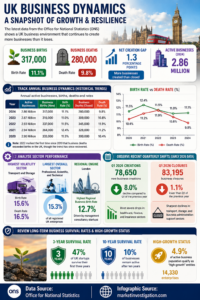
The inforgraphic below shows the business dynamics of the United Kingdm (UK):
A Positive Balance of Business Creation
According to the most recent annual ONS Business Demography data, the UK recorded 317,000 business births and 280,000 business deaths in 2024. This resulted in a business birth rate of 11.1% and a death rate of 9.8%, creating a positive net gap of 1.3 percentage points. In practical terms, this means that more businesses were established than ceased trading during the year.
The UK had approximately 2.86 million active registered businesses in 2024. While this represented a slight decline from the 2.87 million active businesses recorded in 2023, the continued positive balance between births and deaths suggests that the business ecosystem remains dynamic and capable of renewal.
Historical Trends in UK Business Demography
Examining the past five years provides valuable insight into the evolving business environment. In 2020, the UK had 2.90 million active businesses, with 333,000 new businesses created and 300,000 closed. The following year saw a surge in entrepreneurial activity, with business births reaching 364,000 and the birth rate climbing to 12.4%.
However, 2022 marked a significant turning point. For the first time since 2010, business deaths exceeded business births. During that year, 337,000 businesses were created, but 345,000 closed, producing a death rate of 11.9% compared with a birth rate of 11.5%. This reversal was largely attributed to the lingering effects of the pandemic, rising energy costs, supply chain disruptions, and broader economic challenges.
Encouragingly, the trend recovered in 2023 and strengthened further in 2024. Business births once again outpaced deaths, demonstrating the adaptability of UK entrepreneurs and the capacity of the economy to regenerate after periods of stress.
Sector Performance: Winners and Challenges
Not all sectors experience business creation and closure at the same rate. The Transport and Storage industry is the most volatile sector in the UK economy. It records the highest business birth rate at 15.6%, but also the highest death rate at 16.5%. This suggests a highly competitive environment where new entrants frequently emerge, but many struggle to achieve long-term sustainability.
In contrast, the Professional, Scientific, and Technical sector remains the largest business category in the UK, accounting for 15.3% of all registered enterprises. This sector includes management consultants, engineers, architects, scientific researchers, and technology firms. Its dominance reflects the UK’s transition toward a knowledge-based economy driven by professional services and innovation.
Regionally, London continues to be the strongest engine of business creation. The capital recorded the highest regional business birth rate at 12.7%, supported by strong growth in management consultancy, technology startups, and financial services. London’s concentration of talent, investment capital, and international connectivity remains a powerful advantage for entrepreneurs.
Recent Quarterly Developments
While annual figures provide a broad overview, quarterly data offers a more immediate picture of economic conditions. In the first quarter of 2026, the ONS reported 78,650 new business creations, representing an 8.0% decline compared with the same quarter a year earlier. The sharpest reductions occurred in the healthcare, finance, and insurance sectors.
At the same time, 83,195 business closures were recorded in Q1 2026, which was 1.1% lower than the previous year’s equivalent quarter. The transport, storage, and business administration support sectors experienced the largest declines in closures, suggesting some stabilization in industries that had previously faced significant turnover.
These quarterly movements indicate that while entrepreneurial activity remains substantial, businesses are becoming more cautious in response to economic uncertainty and changing consumer demand.
The Challenge of Long-Term Survival
Perhaps the most striking aspect of UK business dynamics is the gap between startup creation and long-term survival. ONS longitudinal studies show that only 47% of UK startups survive their first three years of trading. The picture becomes even more challenging over a longer horizon: just 10% of businesses remain active after ten years.
These statistics highlight the importance of resilience, access to finance, effective management, and the ability to adapt to changing market conditions. Many businesses fail not because of a lack of ideas, but due to cash flow problems, competitive pressures, or insufficient strategic planning.
Among the active business population, only 4.9%—equivalent to 14,330 enterprises—qualify as high-growth businesses based on rapid employment expansion. Although this is a relatively small proportion, these firms contribute disproportionately to job creation, productivity growth, and innovation within the UK economy.
Conclusion
The latest UK business demography data paints a picture of an economy that is both dynamic and challenging. Business creation remains strong, with births once again exceeding deaths after the setback experienced in 2022. Key sectors such as professional services continue to drive growth, while London remains the country’s leading entrepreneurial hub.
At the same time, the high rates of business turnover and the low long-term survival rates underscore the difficulties faced by entrepreneurs. The UK business environment rewards innovation and adaptability, but sustaining success over many years remains a significant challenge.
Overall, the data suggests that the UK retains a vibrant entrepreneurial culture capable of generating new enterprises and economic opportunities. The task for policymakers, investors, and business leaders is to create conditions that not only encourage startups but also improve their chances of surviving and thriving in the long term.
Disclaimer: This article is for educational and informational purposes. Always conduct your own due diligence before making strategic business decisions — and for the love of everything, update your competitive research more than once a decade. The market waits for no one. Neither do your competitors. But now, neither do you.
Leave a Reply
You must be logged in to post a comment.