
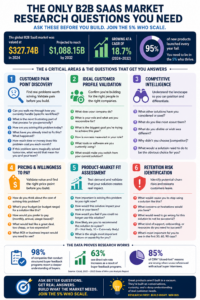
The B2B SaaS product market research questions you must ask cover six critical areas: customer pain point discovery, ideal customer profile validation, competitive intelligence, pricing and willingness-to-pay, product-market fit assessment, and retention risk identification. Ask these questions — in structured interviews, surveys, and ongoing feedback programmes — before you build, and you move from the 95% who fail into the 5% who scale.
If you are building a B2B SaaS product without asking the right market research questions, you are essentially lighting your runway money on fire and then posting a LinkedIn article about the lessons you learned.
There. I said it. Welcome to the most important article you will read this week — and probably the most entertaining one too, because your narrator is a trader who has seen more product launches crash and burn than a SpaceX test flight from 2018. I have watched founders pour eighteen months of blood, sweat, and questionable Red Bull consumption into SaaS products that the market received with the energy of a wet paper towel. Why? Because they never asked the right questions before they built.
The global B2B SaaS market was valued at USD $327.74 billion in 2024 and is projected to reach USD $1,088.15 billion by 2032, growing at a CAGR of 18.7% (Verified Market Research, 2025). That is a lot of money. And yet, research consistently shows that 95% of new products launched every year fail. Let that sink in. Ninety-five percent. If this were a basketball team, they would not even be invited to the gym.
This article is your definitive guide to the B2B SaaS product market research questions that separate the 5% who thrive from the 95% who write retrospective blog posts about pivoting. We are going to cover every category of research question — from customer discovery to competitive intelligence, pricing validation to churn prediction — backed by peer-reviewed research, real-world case studies, and the kind of straight talk that saves you months of wasted development.
Buckle up. The market does not care about your feelings, but I do — and I am going to make sure you get to the other side of this thing in one piece.
The inforgraphic below gives a summary of this article:
Why B2B SaaS Market Research Questions Are Non-Negotiable in 2025 and Beyond
Let me paint you a picture. You have an idea. You are convinced it is genius. Your mum thinks it is great. Your co-founder thinks it is great. Your dog — well, your dog does not understand SaaS but he seems supportive.
Here is the problem: your mum, your co-founder, and your dog are not your customers.
B2B SaaS market research is the structured process of gathering intelligence about your potential buyers, their workflows, their pain points, their budgets, and the competitive landscape — before you commit resources to building. According to Clozd’s Definitive Guide to Product Research for B2B SaaS, the most powerful product research starts at the source: direct and unbiased buyer feedback. Not CRM data, not gut feeling, not what your most vocal investor believes the market needs.
The 2025 State of Win-Loss Analysis Report found that 98% of companies that conduct structured buyer feedback programs report a deeper understanding of buyers, and 63% see direct win-rate increases as a result (Clozd, 2025). Sixty-three percent. That is not a rounding error. That is an enormous competitive advantage being left on the table by everyone who skips research and goes straight to building.
And here is the kicker — the same research reveals that CRM “closed-lost” reasons are wrong 85% of the time when cross-referenced with actual buyer interviews. Eighty-five percent wrong. Your CRM has been lying to you like a used-car salesman with a good smile. You have been making product decisions based on data that is factually incorrect the vast majority of the time.
This is why we ask questions. Good, sharp, structured questions. The kind that actually reveal what is happening in your market. And in the sections that follow, I am going to give you every single one of them.
Section 1: Customer Discovery Questions — Finding the Pain Before You Prescribe the Painkiller
The single biggest mistake B2B SaaS founders make is assuming they know the problem their customers have. I call this “founder-brain syndrome.” The symptoms include using phrases like “I just know the market needs this,” ignoring contradictory user interviews, and spending $300,000 building a product for a problem that nobody will pay to solve.
Customer discovery is about ruthlessly validating the problem before you invest in the solution. Here are the essential questions to ask.
Pain Point Discovery Questions
“Can you walk me through how you currently handle [specific workflow]?”
This is your opening gambit. It is open-ended, non-leading, and gives your prospect the floor to reveal their actual process — not the one they think you want to hear about. Listen for friction. Every “and then we have to manually…” is a gift. Every “this takes about three hours but we’ve just accepted it” is a potential product feature. Do not interrupt. Do not suggest solutions. Just listen like your runway depends on it, because it does.
“What is the most frustrating part of that process for you personally?”
Notice the word “personally.” You are asking about their emotional experience, not just their operational one. B2B buying decisions are made by humans, and humans have emotions. A VP of Operations who loses sleep over data reconciliation errors is a far more motivated buyer than one who considers the same problem a minor inconvenience. Emotional intensity predicts willingness to pay.
“How are you solving this problem today?”
This question is deceptively powerful. The answer tells you about your real competition. Half the time, your competition is not another SaaS product — it is a spreadsheet, a manual process, or a combination of five different tools held together by prayer and one employee who has been there since 2011. If they say “we’re not solving it at all,” congratulations: you may have found a real gap. If they say “we tried a tool and stopped using it,” your next question is priceless.
“Why did you stop using [previous solution]?”
This is where fortunes are made and lost. The answer to this question is your product roadmap, your onboarding strategy, and your retention playbook all rolled into one. Was it too complex? Too expensive? Missing a specific feature? Did the champion who bought it leave the company? Every answer reveals something vital about the category, not just that one vendor.
“On a scale of 1 to 10, how urgent is this problem for your business right now?”
Anything below a 7 is a problem you cannot build a business on. I do not care how elegant your solution is. If your target customer rates their pain as a 4 out of 10, they are not going to initiate a procurement process, get budget approval, onboard your tool, and change their workflows for it. They will nod politely during your demo and then go back to doing nothing. Which is exactly what they were doing before you called.
Section 2: Ideal Customer Profile (ICP) Research Questions — Know Your People
Here is a joke for you: a founder walks into a market and says “our target customer is any business with more than 10 employees.” The market says nothing, because the market does not speak to people who have not done their ICP research.
Truly understanding your Ideal Customer Profile is the foundation of every go-to-market decision you will ever make. Obility’s guide to B2B SaaS market research highlights that one of the main characteristics of the B2B world is its long sales cycle and multi-stakeholder decision process. This means your ICP work needs to go far beyond “who has the problem” and into “who feels the pain, who has the budget, who makes the decision, and who can block the deal.”
ICP Qualification Questions
“What is your company’s annual revenue range, and how many employees are on your team?”
Company size has enormous implications for product complexity, pricing sensitivity, and sales motion. A 15-person startup and a 2,000-person enterprise have completely different procurement processes, feature requirements, and willingness to pay — even if they face the same surface-level problem. If your product requires an IT security review, a 15-person startup might not even have an IT department. Meanwhile, an enterprise might have a procurement process so complex it makes applying for a home loan look breezy.
“What industry are you in, and are there specific compliance or regulatory requirements you deal with?”
Vertical specificity is increasingly valuable in B2B SaaS. According to ProductLed’s State of B2B SaaS 2025 Report, companies that develop strong self-serve revenue capabilities and focus on understanding their users’ specific context consistently outperform competitors. Industry compliance requirements — HIPAA in healthcare, SOC 2 in technology, GDPR across Europe — can either be your biggest barrier to entry or your most powerful differentiator. Know which one applies to you.
“Who else is involved in decisions like this at your company?”
This question maps your stakeholder landscape. In B2B SaaS, the person who feels the pain is rarely the person who controls the budget, and neither of them may be the person who ultimately signs the contract. Research shows that the average B2B buying decision now involves 6 to 10 stakeholders (Gartner, referenced across multiple sources). You need to know who they are, what they care about, and how they communicate with each other. Ignore a key stakeholder and you will lose deals you thought were closed. Every time.
“What does your current technology stack look like, and how easily can you integrate new tools?”
Integration friction is one of the top reasons B2B SaaS purchases stall or churn. If your product cannot connect to Salesforce, HubSpot, Slack, or whatever the backbone of your prospect’s operation is, you will spend six months in a pilot that never converts. Ask this early. Ask it directly. And if you hear “our IT team has a six-month review process for any new software,” adjust your sales cycle expectations accordingly — and bring snacks.
Section 3: Competitive Intelligence Research Questions — Know Your Enemies (And What They Are Getting Wrong)
Sun Tzu said know your enemy. Sun Tzu also did not have to compete in a SaaS market with 400 tools in every category and a new AI-powered entrant launching every Tuesday, but the principle stands.
Competitive intelligence research is not about copying your competitors. It is about understanding where they are failing your shared potential customers — and building your positioning around those gaps.
Competitive Positioning Questions
“What tools or products do you currently use to address this challenge?”
Your competitor is whoever your prospect names in response to this question. Not whoever you list on your G2 profile. Not whoever your investors say you are competing with. Whoever your prospect is paying money to right now. That is your competition, and you need to understand it intimately.
“What do you like most about your current solution?”
This is not a trick question and it is not uncomfortable to ask. The answer tells you the minimum viable bar your product needs to clear. If your prospects love that their current tool has a specific reporting feature, and your product does not have that feature, you either need to build it or position your product as superior in ways that outweigh that gap. Knowing what works in the market is as valuable as knowing what does not.
“What are the top three things you wish your current tool did differently?”
This is gold. This is the whitespace. These three things are your product roadmap differentiators. They are what your sales team leads with in competitive demos. They are what your content marketing speaks to. Research by Pangea Global Services on B2B Market Research Methodologies highlights how JTBD (Jobs to Be Done) interviews that explore why customers switch from competitor tools frequently reveal feature gaps that no one has yet addressed — the foundation of genuine competitive advantage.
“If your current solution disappeared tomorrow, what would you do?”
This question measures switching motivation. A prospect who says “we’d be looking for an alternative immediately — it’s critical to our operations” is a warm lead. A prospect who says “honestly, we’d probably just use spreadsheets for a while” is either not your target customer or has not yet experienced enough pain to motivate change. Both answers are valuable. One saves you months of chasing a deal that was never going to close.
Section 4: Pricing and Willingness-to-Pay Research Questions — Where Dreams Meet Reality
I love watching founders price their SaaS products. Some of them approach it with the casual confidence of someone who has done zero research and just added a zero to whatever number felt comfortable in the shower. Others are so terrified of pricing too high that they undercharge by 300% and then wonder why their unit economics look like abstract art.
Pricing research is not optional. It is the difference between a business model that works and one that runs out of runway while acquiring customers who do not generate enough value to cover your CAC.
Pricing Validation Questions
“What is your current budget for tools in this category?”
Directness works. Most buyers in a B2B context will give you a genuine budget range if you ask professionally. This is not a consumer negotiation. This is a business-to-business conversation between professionals. If they tell you their budget is $200 per month and your product costs $2,000 per month, that is important information. Either they are not your customer, or there is a significant value communication problem to solve.
“How does your company evaluate ROI on software investments like this?”
This question surfaces the decision criteria that will make or break your close. Some companies measure ROI purely in time savings. Others focus on revenue impact. Others require cost displacement (i.e., your tool needs to replace something they are already paying for). Knowing the ROI framework before you build your business case means you can tailor your pitch to the metrics that actually move the needle for your buyer’s finance team.
“At what price point would this feel expensive but still worth it?”
This is the Van Westendorp Price Sensitivity model in conversational form. You are searching for the upper bound of perceived value — the number where they wince but still see the value. According to 24M Technologies and pricing research compiled by Efficient Capital Labs, craft a pricing strategy that balances revenue goals with market penetration by uncovering how much customers are willing to pay and assessing price sensitivity through direct research. You cannot find that number by looking at what your competitors charge. You find it by asking.
“Would you prefer a per-seat, usage-based, or flat-fee pricing model, and why?”
Pricing model fit matters as much as price point. A per-seat model is a barrier to adoption in large organizations where budget gatekeeping is tight. A usage-based model creates anxiety for finance teams who cannot forecast costs. A flat-fee model removes friction but may leave significant money on the table as accounts grow. Ask what your buyer’s preference is and understand the reasoning behind it. That reasoning is your pricing structure.
Section 5: Product-Market Fit Validation Questions — The Moment of Truth
Product-market fit is not a destination. It is a continuous, iterative state that you earn, lose, re-earn, and defend for the entire life of your company. The famous Sean Ellis PMF test — “how would you feel if you could no longer use this product?” — has a well-known threshold: if more than 40% of users say “very disappointed,” you likely have product-market fit. Below that, you have product-market hope, which is a different and considerably less bankable thing.
PMF Assessment Questions
“How would your team’s work change if this product were taken away from you tomorrow?”
This is the qualitative companion to the Sean Ellis metric. Listen for urgency and specificity. “We’d be devastated — it saves us 15 hours a week across the team” is a very different answer from “we’d figure something out.” The specificity of the impact description tells you how deeply embedded your product is in their actual workflow.
“What single feature would you miss the most?”
This identifies your core value driver — the feature that is truly load-bearing in your value proposition. This is critical for product roadmap prioritisation. Everything else you build should deepen this core value or expand it to adjacent use cases. Building features that are not connected to the thing people would miss most is how products become bloated, confusing, and expensive to maintain.
“Have you recommended this product to anyone else in your industry?”
Word-of-mouth is the most reliable signal of genuine product-market fit. Not NPS scores (though they are useful). Not retention rates (though they matter enormously). The actual, specific act of a customer telling a colleague in their industry that they need to try your product. ProductLed’s 2025 State of B2B SaaS research found that companies with strong self-serve revenue — which is deeply connected to genuine PMF — achieved nearly twice the profitability rate compared to those without. Organic referral is the leading indicator of that kind of growth.
“What would make you stop using this product?”
This is your churn risk diagnostic. The answers to this question build your retention playbook before you even have a churn problem. Peer-reviewed research published in PLOS ONE by Kotan et al. (2025) — A Novel Methodological Approach to SaaS Churn Prediction — confirms that customer churn remains a critical concern in the SaaS sector, with the B2B landscape presenting distinct dynamics compared to B2C. Identifying churn triggers during your research phase means you can architect your product and customer success processes to remove them before they become expensive problems.
Section 6: Customer Journey and Buying Process Research Questions
If you think the B2B buying journey is linear — awareness, consideration, decision — I have good news and bad news. The good news is that you are not alone in this misconception. The bad news is that the actual buying journey looks less like a funnel and more like a bowl of spaghetti.
Buyer Journey Questions
“How did you first become aware that you had this problem?”
Understanding the trigger event that initiates a buying journey is enormously powerful for content marketing strategy. If most of your buyers first recognised their problem when they hit a specific growth milestone, that milestone is your content hook. If they first recognised it after a painful incident — a compliance failure, a data loss event, a customer complaint — that incident type is your category-creation narrative.
“How many solutions did you evaluate before making a decision?”
This tells you the typical evaluation intensity in your market. In low-consideration categories, buyers may evaluate two or three options. In high-stakes categories — security, financial infrastructure, HR systems — they may evaluate seven or eight. This directly impacts your required investment in sales enablement, proof of concept support, and security documentation. Underpreparing for an evaluation-heavy market is one of the most common reasons good products lose to inferior ones.
“What almost stopped you from buying?”
This is your objection handling goldmine. Every buying journey has a near-miss — a moment where doubt almost won. When your prospect shares that moment, they are giving you the script for your objection-handling playbook. They are telling you exactly what your sales team needs to be prepared to address, what your case studies need to speak to, and what risk-reduction elements (free trials, POCs, phased implementations) your go-to-market needs to include.
“Who had to sign off on the final decision, and what did they need to see?”
Mapping the approval chain is how you shorten your sales cycle. If the CFO needs a total cost of ownership analysis, build one. If the CTO needs a security whitepaper, write one. If the CEO needs a ten-minute executive summary, create it. Every layer of the approval chain is a potential deal stall, and you remove those stalls by researching them in advance and building the right collateral.
Case Study: How Slack Used Market Research Questions to Build a $27 Billion Business
Let us talk about Slack — because if there was ever a case study that deserved a standing ovation, it is this one.
Slack did not begin as a standalone communications product. It was born from the internal communication tool used by a gaming company called Tiny Speck. When the game they were building (Glitch) failed, founder Stewart Butterfield and his team noticed something extraordinary: the tool they had built to communicate internally was genuinely beloved by people who used it. They asked their users deeply specific questions about what they loved, what they were replacing, and how they would feel if the tool disappeared.
The answers were unambiguous. Teams hated email for internal communication. They hated the context-switching of existing tools. They wanted something that integrated with the software they already used and reduced the volume of inbox noise.
As Efficient Capital Labs documents in their B2B SaaS Go-to-Market case study, Slack’s growth strategy was built around a fundamental understanding of how teams actually communicate — knowledge gained through structured customer discovery before a dollar of product marketing budget was spent. By 2025, Slack was processing tens of millions of messages per day and had been acquired by Salesforce for $27.7 billion. The research questions they asked in those early days were not incidental to that outcome. They were foundational.
The lesson: ask the questions before you build the product. Not after.
Case Study: HubSpot’s Research-Driven Market Expansion
HubSpot is another case study in the power of deliberate market research. In its early years, HubSpot conducted extensive research among small and medium-sized businesses to understand the pain points around managing customer relationships. The insights they gathered were not abstract.
SMBs told them they were struggling with disconnected tools, complex CRM systems built for enterprise, and a lack of visibility into which marketing activities were actually generating leads. They told HubSpot they needed simplicity, integration, and actionable data — not another piece of enterprise software that required six weeks of onboarding and a dedicated admin.
As highlighted in Userpilot’s guide to product market research, those insights helped shape HubSpot’s all-in-one inbound marketing, sales, and service platform — a product that became integral to the daily operations of hundreds of thousands of businesses. HubSpot went public in 2014 and reached a market capitalisation north of $30 billion at its peak. Market research questions built that.
Section 7: Retention and Churn Research Questions — Keeping What You Win
Winning a customer is expensive. Losing them is more expensive. And yet, most B2B SaaS companies invest far more in acquisition than they ever invest in understanding why customers leave.
Recent data is alarming on this point. Research published in PLOS ONE (Kotan et al., 2025) confirms that churn prediction remains a critical challenge in the SaaS sector, with B2B environments presenting distinct dynamics that require specific research methodologies — you cannot simply borrow churn models from consumer software (doi.org/10.1371/journal.pone.0319998). Meanwhile, Benchmarkit’s 2024 SaaS Performance Metrics report found that companies with ACVs under $5K experience the highest ARR churn rates — a direct signal that research into buyer intent and use-case depth matters most at the lower end of the market (Benchmarkit, 2024).
Retention Research Questions
“How often does your team use this product, and in what contexts?”
Usage frequency is one of the strongest predictors of retention. Daily active use creates habit loops that make churn psychologically difficult. Weekly or monthly use creates a fragile dependency that evaporates the moment a budget review comes around. Knowing the actual usage patterns of your retained customers helps you define the engagement benchmarks your customer success team should be protecting.
“Has your team adopted all the features you initially planned to use?”
Feature adoption gaps are silent churn risks. A customer who subscribed to use features A, B, and C but has only ever used feature A has a retention problem waiting to happen. They are paying for value they are not receiving, and at renewal time, the ROI calculation does not add up. These customers need proactive success outreach — not a renewal reminder email sixty days before the contract ends.
“What would need to change for this to become more valuable to your team?”
This question turns every existing customer into a product research asset. The answers tell you where to invest your roadmap next, what onboarding improvements to make, and what customer success interventions deliver the highest retention impact.
“How has your company’s use case changed since you first started using us?”
B2B companies change. Teams grow, strategies shift, priorities evolve. A tool that was perfectly positioned for your customer’s needs eighteen months ago may no longer map to their current reality. Asking this question surfaces expansion opportunities and churn risks simultaneously — and doing it proactively, rather than at a cancellation call, is what separates companies with 90%+ gross retention from those watching ARR drip away.
Section 8: The Meta-Research Questions — What You Ask Yourself
Here is the thing nobody tells you about market research: the most important questions are the ones you ask yourself about the research you are conducting. Your methodology, your sample, your framing — all of these introduce bias that can corrupt even the most carefully designed research program.
“Am I asking leading questions that confirm what I already believe?”
Confirmation bias is the enemy of useful market research. If your questions are structured to generate agreement, your data will show agreement — and your product will be built for a market that does not exist in the way you imagined it. Review every question for leading language before you field it.
“Is my sample representative of my target market or just the people I can easily reach?”
Your existing network is not your market. Your existing customers are not your market. They are a subset of your market — a subset that is already biased toward finding value in your offering. AdvanceB2B’s guide to customer research warns explicitly that research should focus on ideal customers — not the C-suite or internal stakeholders — and that the only audience that matters is the actual buyer. Build your sample deliberately, not opportunistically.
“Am I conducting enough interviews to identify patterns versus outliers?”
Five interviews is not enough to draw product strategy conclusions. Neither is seven. The rule of thumb in qualitative B2B research is that themes typically emerge around the 12-15 interview mark, and the research continues until you are hearing the same themes repeated without new information emerging — a state known as data saturation. Cutting research short because you think you already know the answer is how you end up building the wrong product with great conviction.
Section 9: AI and Technology Stack Research Questions — The 2025 Imperative
We cannot have an honest conversation about B2B SaaS market research in 2025 without talking about AI. Your buyers are not just evaluating whether your product solves their problem — they are evaluating whether your product is keeping pace with a market being radically transformed by artificial intelligence.
Growth.cx’s B2B SaaS Trends report highlights that by 2025, 85% of business applications are expected to be SaaS-based, with AI integration now a baseline expectation rather than a differentiator in many categories. This raises a new generation of market research questions that founders and product leaders must be asking.
“How is your team currently using AI tools in your daily workflow?”
Understanding AI adoption in your target customer base tells you where expectations have already shifted. If your prospects are routinely using AI for data analysis, content creation, or workflow automation in adjacent areas, they will expect your product to meet or exceed that capability standard. An AI gap in your product is increasingly a competitive disadvantage.
“What concerns do you have about AI-powered tools in terms of data privacy and accuracy?”
This question surfaces the barriers to AI adoption in your specific vertical. Healthcare, finance, and legal buyers have explicit regulatory concerns about AI data handling. SMBs may have accuracy concerns rooted in early bad experiences with hallucinating language models. Understanding these concerns shapes your product positioning, your trust-building communication strategy, and your security documentation requirements.
“If your ideal version of this product existed, what role would AI play in it?”
This question is not about feature-level AI requests. It is about understanding how your buyers conceptualise the role of intelligence in their workflow. Some will want AI as an analyst — surfacing insights they did not know to look for. Others want AI as an automator — removing repetitive tasks without requiring their oversight. Others are AI-sceptical and want human control retained at every step. Knowing your market’s AI disposition shapes your product roadmap and your messaging simultaneously.
Structuring Your Research Programme: A Practical Framework
All right, look — you now have a comprehensive library of B2B SaaS product market research questions. But questions without a process are just a really organised form of procrastination. Here is how to structure your research programme for maximum impact.
Phase 1: Exploratory Research (Weeks 1–4) Conduct 15–20 open-ended discovery interviews with prospective buyers who represent your target ICP. The goal is to identify the themes, language, and emotional intensity of the problems you are investigating. Do not pitch. Do not demo. Just listen.
Phase 2: Hypothesis Validation (Weeks 5–8) Take the top 5 themes from Phase 1 and build structured surveys to test their prevalence at scale. A sample of 80–150 respondents from your target segment gives you statistically meaningful directional data. According to Pangea Global Services’ research methodology guide, be careful with small samples in B2B research — you need enough volume to separate signal from noise.
Phase 3: Competitive and Pricing Analysis (Weeks 9–12) Conduct 10–15 targeted interviews specifically focused on competitive context and pricing. Use win-loss analysis frameworks to understand where existing solutions are failing your market. Build your pricing structure based on willingness-to-pay data, not benchmarking.
Phase 4: Ongoing Feedback Programme Research is not a one-time event. The 2025 State of Win-Loss Analysis Report found that ongoing feedback programmes — not one-time research sprints — are what drive the 63% win-rate improvement that structured buyer research delivers. Build quarterly touchpoints with customers and lost prospects into your calendar permanently.
The Numbers That Make the Case
Let us close the argument with the scoreboard, because traders live and die by the numbers.
- 95% of new B2B SaaS products fail to achieve sustainable market traction — with inadequate market research as a primary driver (Axis Intelligence, 2025)
- 85% of CRM closed-lost data is inaccurate compared to actual buyer feedback (Clozd, 2025)
- 98% of companies conducting structured buyer research report improved buyer understanding (Clozd, 2025)
- 63% see direct win-rate increases from ongoing feedback programmes (Clozd, 2025)
- 68% of companies with self-serve revenue are profitable, versus 36.4% without it — a gap explained largely by the customer understanding that research enables (ProductLed, 2025)
- $1.08 trillion projected B2B SaaS market by 2032, meaning this is not a market to enter under-researched (Verified Market Research, 2025)
That last number deserves a moment of silence. A trillion-dollar market. And 95% of people who try to get a piece of it will fail because they did not ask enough questions of enough of the right people.
Do not be in the 95%.
Final Word From the Trader
Here is the truth — and I say this with every bit of directness that comes from watching good ideas die from preventable causes: the best product in the world cannot save you from building for a market that does not care. Market research is not a box-ticking exercise. It is not something you do to satisfy a requirement in a pitch deck. It is the single most risk-reducing investment you can make before you commit capital, time, and reputation to a product.
The questions in this article are not hypothetical. They are battle-tested, research-validated, and anchored in what actually separates the SaaS companies that make it to Series B from the ones that are writing case studies about what they learned from failure.
You now have the questions. You have the framework. You have the data.
The only thing left is to go ask them.
Frequently Asked Questions
Q1. What are B2B SaaS product market research questions?
They are structured questions asked of target buyers to validate pain points, pricing, competitive gaps, and product-market fit before committing to building.
Q2. Why is market research critical before building a B2B SaaS product?
Because 95% of new SaaS products fail, and the primary cause is building for a problem the market does not prioritise or will not pay to solve.
Q3. How many customer discovery interviews should I conduct?
You should conduct a minimum of 12–15 interviews, continuing until you reach data saturation — the point where no new themes are emerging.
Q4. What is the most important question to ask in a B2B customer discovery interview?
“How are you solving this problem today?” — because the answer reveals your real competition and the minimum bar your product must clear.
Q5. How do I validate willingness to pay for a B2B SaaS product?
Ask prospects directly what budget they allocate to tools in this category and what price point feels expensive but still worth it.
Q6. What is product-market fit and how do I test for it?
Product-market fit is the state where your product deeply solves a real market need, tested by whether over 40% of users would be “very disappointed” if it disappeared.
Q7. How do I identify my Ideal Customer Profile (ICP) through research?
By asking about company size, industry, tech stack, stakeholder structure, and compliance requirements to find the buyer segment where your value lands hardest.
Q8. What research questions help reduce B2B SaaS churn?
Asking customers what would make them stop using your product, and whether they have adopted all planned features, surfaces the retention risks before they become cancellations.
Q9. How do competitive intelligence questions improve my product positioning?
They reveal what your competitors are failing to deliver, giving you the specific whitespace your messaging, roadmap, and sales team should lead with.
Q10. How often should B2B SaaS companies conduct market research?
Market research should be an ongoing programme — with quarterly touchpoints — not a one-time sprint, because buyers, competitors, and market conditions continuously evolve.
References
- Verified Market Research. (2025). B2B SaaS Market Size, Scope, Growth, Opportunities & Forecast. https://www.verifiedmarketresearch.com/product/b2b-saas-market/
- Clozd. (2025). The Definitive Guide to Product Research for B2B SaaS. https://www.clozd.com/blog/the-definitive-guide-to-product-research-for-b2b-saas-unveiling-market-insights
- Kotan, M., Seymen, Ö. F., Çallı, L., Kasım, S., Çarklı Yavuz, B., Över Özçelik, T., Mohamed, A., & Jayasena, P. N. (2025). A novel methodological approach to SaaS churn prediction using whale optimization algorithm. PLOS ONE. DOI: 10.1371/journal.pone.0319998. https://journals.plos.org/plosone/article?id=10.1371%2Fjournal.pone.0319998
- ProductLed. (2025). State of B2B SaaS 2025 Report. https://productled.com/blog/state-of-b2b-saas-2025-report
- Axis Intelligence. (2025). B2B SaaS Go-to-Market Framework 2025: The Systematic Approach to $10M ARR. https://axis-intelligence.com/b2b-saas-go-to-market-framework-2025-guide/
- Obility. (2023). How B2B SaaS Companies Can Conduct Effective Market Research. https://www.obilityb2b.com/blog/how-b2b-saas-companies-can-conduct-effective-market-research/
- AdvanceB2B. (2024). Your Step-by-Step Guide to Better B2B SaaS Customer Research. https://www.advanceb2b.com/blog/customer-research-guide-b2b-saas
- Pangea Global Services. (2025). Market Research Methodologies Complete Guide for B2B. https://pangeaglobalservices.com/market-research-methodologies-complete-guide-for-b2b/
- Benchmarkit. (2024). 2024 SaaS Performance Metrics Benchmarks. https://www.benchmarkit.ai/2024benchmarks
- Efficient Capital Labs. (2025). B2B SaaS Go To Market Strategy in the US. https://www.ecaplabs.com/blogs/b2b-saas-go-to-market-strategy
- Userpilot. (2024). The Ultimate Guide to Effective Product Market Research in SaaS. https://userpilot.com/blog/product-market-research/
- Growth.cx. (2026). B2B SaaS Trends That Will Drive the Industry in 2025. https://growth.cx/blog/b2b-saas-trends/
- Powered by Search. (2026). B2B SaaS Marketing Statistics, Studies, and Trends. https://www.poweredbysearch.com/learn/b2b-saas-marketing-stats/
Disclaimer: This article is intended for informational and educational purposes only. The prompt templates provided are research frameworks to guide structured market inquiry and should always be validated against primary sources, direct customer discovery interviews, and real-world commercial testing before informing major strategic or financial decisions.
Leave a Reply
You must be logged in to post a comment.