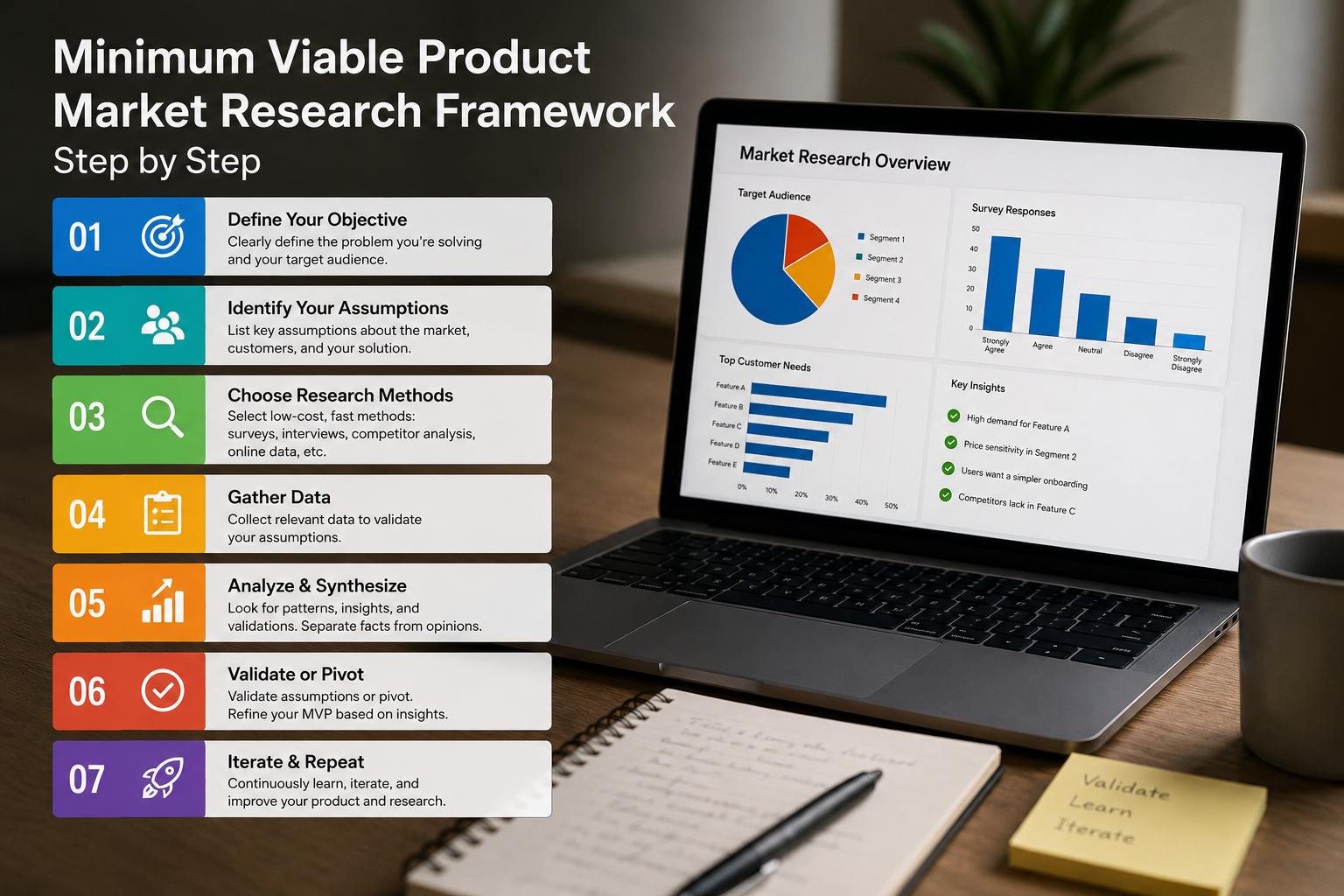
Every year, 42% of startups fail not because they built badly, but because they built the wrong thing — and a rigorous Minimum Viable Product market research framework step by step is the only proven way to validate demand, isolate your early adopter, and reach product-market fit before you waste a single pound of runway. This guide walks you through four battle-tested phases — from value hypothesis to continuous feedback loops — so your MVP ships with evidence behind it, not just optimism.
At the end of this article, there is an MVP Research tool you can start using from now. Enjoy!
If you want to avoid flushing six months of your life and your life savings down the drain, your Minimum Viable Product market research framework step by step starts right here, right now — before you write a single line of code.
Look, I’ve seen founders walk into the market with their chests puffed out, absolutely convinced they had the next billion-dollar idea — and then watch their product flop so hard it left a crater. You know what that reminds me of? When you dress up real nice for the gym, buy all the gear, get the protein shaker, the wristbands, the motivational playlist — and then you get on the treadmill, do eight minutes, and go home. The energy was there. The research was not.
This guide exists to make sure that doesn’t happen to you.
The statistics are brutal and they don’t care about your feelings. According to CB Insights research on post-mortem startup analyses, 42% of startups fail because there was no market need for their product — not because they lacked funding, not because the tech was bad, but because nobody actually wanted what they built. That number should wake you up faster than your Monday alarm.
But here’s the good news: you can fix this before you build anything. The Minimum Viable Product market research framework step by step laid out in this guide is your unfair advantage. It’s the cheat code — and unlike the ones your cousin used in video games, this one actually works.
Introduction: Why Traditional Product Market Research Fails Lean Startups
Let’s be real about something. Traditional market research was designed for corporations that have marketing departments with actual budgets and the patience to wait six months for a PowerPoint deck that says “the market opportunity is significant.” You, a lean startup founder, do not have six months. You barely have six weeks.
The MVP Dilemma is this: move too fast and you build the wrong product; move too slow and the market window closes while you’re still conducting focus groups. It’s like trying to catch a flight when you’ve already spent 45 minutes in the airport food court. You can run, but whether you make it — that’s another story.
The solution isn’t to abandon research. The solution is to make your research agile, scrappy, and ruthlessly validation-focused. This guide gives you a step-by-step Minimum Viable Product market research framework built for founders who need answers fast — not theory, not fluff, not a 200-page report that collects digital dust.
Here’s what you’ll learn across four phases: how to define and stress-test your value hypothesis; how to run quantitative demand tests with almost no budget; how to conduct qualitative deep dives that expose the real truth; and how to build a continuous feedback loop that keeps you locked onto product-market fit in real time.
Buckle up. Let’s get into it.
Phase 1: Define Your Value Hypothesis to Anchor Your Product Market Research
Deconstruct the Problem Space
Every great product starts with a problem that genuinely hurts. Not a “mildly annoying” problem. A bleeding neck problem — the kind where people are actively losing time, money, or sanity right now, today, and they need relief.
Your first job is to document the critical inefficiencies, financial losses, and frustrations that your target users are experiencing. Be surgical about this. “People find project management hard” is not a problem statement — that’s a bumper sticker. “Freelance designers spend an average of 6.3 hours per week on invoicing, client follow-up, and admin tasks that generate zero revenue” — now that’s a problem statement.
Map what existing alternatives look like. How are users solving this problem right now? Spreadsheets? Manual processes? Duct-tape combinations of three different SaaS tools stitched together with prayers and API connectors? Understanding current workarounds tells you exactly how high the bar is that your MVP needs to clear — and how much room exists for disruption.
Research published in the Journal of Business Venturing (Gruber, MacMillan & Thompson, 2012) [1] found that the market domain choices made in the earliest stages of venture development were among the single strongest predictors of startup performance. Translation: getting the problem right before you build is not optional. It is the foundation.
Once you’ve mapped the problem and the workarounds, define the quantifiable value your MVP intends to deliver. “Save 5 hours per week.” “Reduce customer churn by 20%.” “Cut onboarding time from 3 days to 3 hours.” Specificity here is everything. Vague value propositions are like vague directions — “it’s around the corner, kind of near the big tree” — and everybody ends up lost.
Formulate a Testable Persona for Smarter Product Market Research
Here’s where a lot of founders go wrong: they try to build for everyone. “Our target market is anyone who uses software.” My friend, that is not a target market — that is a prayer. And prayers don’t convert.
You need to isolate your early adopter. This is the specific subset of people who feel the pain most acutely, right now, and who are already looking for a better solution. They’re not waiting for you to convince them that the problem exists. They already know. They stay up at night thinking about it. These are your people.
Shift your persona profiles from basic demographics — “25-to-35-year-old male, college-educated” — to behavioral profiles. What tools are they already using? What’s their daily workflow? What communities do they belong to? What would they Google at 11pm on a Tuesday when the problem is driving them crazy?
Then, before you do anything else, build a feedback pool. You want 30 to 50 ideal users who you can reach out to immediately for interviews, surveys, and product tests. These people are gold. Treat them like it. If you don’t know 30 to 50 people who fit your ideal user profile, that’s the first thing to fix — not the product, not the landing page, not the logo.
Think about it this way: you wouldn’t open a barbershop and then try to find people who need haircuts afterward. You’d figure out where people with bad haircuts are already walking around before you sign a lease.
Craft the Core MVP Value Proposition for Product Market Research Validation
Your value proposition needs to be communicable in a single sentence, to a stranger, in under fifteen seconds. If you can’t do that, you don’t understand your own product yet — and if you don’t understand it, your customers definitely won’t.
Use the structured framework: “We help [X] do [Y] by [Z].” For example: “We help freelance designers get paid faster by automating invoice follow-ups and late-payment nudges.” Clean. Clear. Immediately useful.
Then do something hard: strip away every feature that isn’t absolutely essential to delivering that core value. Kill your darlings. That AI-powered dashboard you’ve been excited about? Gone — for now. The integrations with 12 platforms? Unnecessary — for now. The only thing that matters at the MVP stage is whether your single core utility solves the single core problem well enough that people will pay for it.
Academic research supports this lean approach. A systematic mapping study on MVP definitions by Lenarduzzi & Taibi (2016), published via IEEE and available on ResearchGate [2], found that MVP implementations most consistently succeed when the product is tightly scoped around a single validated hypothesis rather than a collection of speculative features.
Finally, define what success looks like before you launch your MVP. “Users sign up” is not a success metric. “30% of users who sign up complete the core action within the first session” is a metric. “5 out of 10 interview subjects confirm this would replace their current workaround” is a metric. If you can’t measure it, you can’t manage it — and if you can’t manage it, you’re just guessing with extra steps.
Phase 2: Quantitative Demand Testing via Low-Fidelity Product Market Research
Deploy Smoke Tests to Gauge Search Demand in Product Market Research
Smoke tests are the fastest, cheapest way to find out if anyone actually wants your thing — and the best part is they require zero product. None. You don’t need code. You don’t need a backend. You need a landing page, a value proposition, and a call-to-action button.
Build a focused landing page — ultra-simple, zero distractions — that communicates one thing: the core value your product delivers. Then add a “fake door” CTA. This could be a “Get Early Access,” “Join the Waitlist,” or “Start Free Trial” button. The button doesn’t have to go anywhere meaningful yet. What you’re measuring is whether people click it.
Click-through rates on smoke test landing pages can be a powerful signal. A well-crafted MVP landing page targeting the right audience should realistically achieve a 20-40% email signup rate from warm traffic (people who already have the problem). If you’re getting 2%, one of three things is true: your targeting is off, your messaging is weak, or there’s less demand than you thought. All three are things you need to know before you build.
Case Study — Dropbox: Before building the full product, Drew Houston posted a simple explainer video describing what Dropbox would do. Overnight, signups went from 5,000 to 75,000. He validated that massive latent demand existed before writing the full codebase. That video cost almost nothing. The validated learning it produced was worth millions. As ProductPlan documents, this type of low-fidelity demand validation is now considered a canonical MVP approach [3].
The lesson? Don’t build the restaurant before you know people are hungry. Set up a folding table, hand out samples, and count how many people ask where the restaurant is.
Leverage Search Intent and Keyword Data for Product Market Research
Here’s a free source of market research that most founders completely ignore: the search bar. Every time someone types a query into Google, they’re telling you exactly what problem they have, in their own words, with zero social desirability bias. Nobody lies to Google at 1am.
Use keyword research tools — Google Keyword Planner, Ahrefs, SEMrush, or even free tools like Ubersuggest — to identify high-intent search phrases. You’re looking for keywords that signal someone is actively hunting for a solution, not just learning about a topic. Phrases like “best software for X,” “how to automate Y,” “alternative to [competitor]” — these are buying signals.
Analyse competitor traffic. Which keywords are already driving traffic to your competitors? How much of that traffic exists? If your closest competitor is pulling 80,000 visits per month from a particular search cluster, that’s a quantified market signal you can put in your investor pitch and use to shape your own messaging.
Map long-tail informational queries too. These are the “how do I,” “what is the best way to,” and “why does X keep happening” questions that reveal the peripheral anxieties of your target user. These queries become the backbone of your onboarding content, your FAQ pages, and your early SEO strategy.
Run Micro-Budget Ad Campaigns to Validate Product Market Research Hypotheses
You don’t need a big ad budget to get meaningful signal. You need a targeted one. Set up highly specific ad campaigns on Google, Meta, or LinkedIn (depending on your audience) aimed directly at your early adopter persona. Keep the total spend at £100-£300. This isn’t about scaling — it’s about signal.
Run two to three headline variations and measure which one gets clicked more. That’s not just an ad test — it’s a message test. The headline that wins tells you which framing of your value proposition resonates fastest with your target audience. That insight is worth far more than the ad spend.
Calculate your early cost-per-click (CPC) and, if possible, cost-per-email-signup. These numbers, even at small scale, give you early benchmarks for modelling customer acquisition costs down the road. A founder who enters a seed round knowing their estimated CAC is already more credible than 90% of the competition.
Research in the Journal of Marketing Research by Srinivasan, Lilien & Rangaswamy (2002) [4] on technological opportunism demonstrated that early-stage demand sensing — including search and advertising signal testing — consistently provides higher-validity demand estimates than traditional survey-based forecasting in digital product markets.
Phase 3: Qualitative Deep Dives in Product Market Research
Conduct Problem Discovery Interviews for Bulletproof Product Market Research
Right, so here’s the part where founders mess up the most. They do interviews, but they ask the wrong questions. They sit down with a potential user, pitch their idea — eyes wide, voice full of hope — and then ask, “Would you use something like this?” And the kind human being across from them says, “Oh yeah, absolutely, that sounds really useful!” And the founder goes home elated, thinking they’ve validated the idea.
They have validated nothing. They’ve just validated that people are polite.
The antidote is the “Mom Test” framework, popularised by Rob Fitzpatrick in his book of the same name. The principle is this: ask about past behavior, not future intention. “How do you currently handle this problem?” “How much time did you spend on it last week?” “What was the last thing you tried that didn’t work?” These questions can’t be answered with flattery. They demand truth.
During your interviews, uncover the true budgetary constraints. Find out exactly what users currently pay — in time, money, or frustration — to deal with this problem. If someone is paying £500/month for a clunky enterprise solution they only use 10% of, that’s a massive commercial opportunity. If someone is solving the problem in 10 minutes with a free spreadsheet and they’re perfectly happy? That’s a red flag the size of a stadium.
Document the emotional language your users use. Write down the exact words they reach for when they describe the frustration. This isn’t just empathy research — it’s copywriting gold. The phrases your users use to describe their pain are the phrases that should appear in your landing page, your ads, and your onboarding. When your messaging sounds like the inside of their head, conversion rates go up. It’s almost unfair. Almost.
Case Study — Superhuman: CEO Rahul Vohra described in a landmark First Round Review article [5] how Superhuman conducted structured qualitative interviews alongside the Sean Ellis survey to identify their most passionate user segment. They didn’t just count the 40% — they dug into why those users loved the product and what they would lose. That qualitative layer is what allowed them to build focused, high-retention growth instead of just chasing signups.
A quick note on sample size: you do not need hundreds of interviews to get directional signal. Research by Nielsen Norman Group consistently finds that five to eight user interviews will surface approximately 80% of the major usability and problem-space themes. You’re not writing a doctoral dissertation here — you’re figuring out if your problem hypothesis is real, who feels it hardest, and whether your solution points in the right direction. Twenty well-run interviews are enough to make confident decisions.
When it comes to compensating participants, don’t overthink it. A £25 gift card gets you the calendar time you need — less than the cost of the latte you’ll drink while telling yourself you’ll “do the interviews next week.” Schedule them. Do them. The data will not collect itself.
One final thing nobody tells you about qualitative interviews: the best insight rarely comes from answers to your questions. It comes from the moment of hesitation before the answer, the digression mid-sentence, or the thing mentioned casually while wrapping up. Great interviewers listen more than they talk. If you’re talking more than 30% of the time, you’re telling people what to think instead of learning how they think. Zip it, lean forward, and take notes.
Analyse Competitor Weaknesses Using Review-Mining Product Market Research
This one is sneaky in the best possible way. You don’t need your own users to do competitive intelligence research — you can use your competitors’ users. And the most honest users are the angry ones who left reviews.
Go to G2, Capterra, Trustpilot, the App Store, Google Play — wherever your competitors have reviews — and filter for two-star and three-star reviews. These are the goldmines. One-star reviews are often pure rage (“this app ruined my life, DO NOT DOWNLOAD”); five-star reviews are often fake or overly general. Two-and-three-star reviews are the people who wanted to love the product but couldn’t. They’ll tell you exactly why.
Look for patterns. If you see the same complaint appearing in 40 different reviews — “the interface is confusing,” “the reporting is terrible,” “there’s no way to do X” — that’s a market gap with your name on it. Your MVP doesn’t have to be better than the competitor in every way. It just needs to be dramatically better at the one thing they consistently get wrong.
Also map pricing gaps. Reviews often reveal that enterprise products are wildly over-priced for freelancers and small teams. If the market leader charges £800/month and the complaints are full of “I wish there was a simpler, cheaper version,” congratulations — you just found your positioning.
Think of it like this: your competitors spent years and millions of dollars collecting user feedback. They put it all in one-star reviews on the internet. The least you can do is read them.
Run Targeted Community Listening as Passive Product Market Research
One of the most underrated sources of authentic market research is the internet’s habit of complaining loudly and publicly. Forums, Reddit, Discord communities, LinkedIn groups, Slack workspaces, Quora threads — these are places where your target users voluntarily describe their problems in graphic detail, with zero incentive to exaggerate or be polite.
Monitor the active subreddits relevant to your industry. Use Reddit’s search function to look for threads containing phrases like “frustrated with,” “looking for alternative to,” “anyone know a tool that can,” and “why is it so hard to.” What you’ll find is an unfiltered catalogue of real pain points, stated in real language, that no amount of formal surveying could replicate.
Set up Google Alerts for your key problem space. Monitor competitor brand names alongside words like “alternative,” “problem,” “issue,” and “disappointed.” Create a simple tracking spreadsheet and log recurring themes weekly.
The objective is to categorise recurring complaints and questions into themes that can directly inform your feature priority list. If the same question appears 15 times across three different communities in one month, that question should probably be answered by your MVP’s core functionality.
Research published by Mukherjee & Liu (2012) on online review analysis and market intelligence [6] confirmed that systematically mining community content provides consistently high-validity insights into unmet market needs, often surpassing traditional primary research in terms of authenticity and behavioral accuracy.
Phase 4: Build the Minimal Viable Research Protocol (MVRP) for Ongoing Product Market Research
Design a Continuous Feedback Loop for Real-Time Product Market Research
Here’s the trap a lot of founders fall into: they treat market research as a pre-launch activity. They do the interviews, run the smoke tests, ship the product — and then stop researching. They figure they’ve done their homework.
That’s like preparing really hard for the first day of school and then refusing to learn anything after that.
Market research isn’t a phase. It’s a permanent operating mode. The best founders treat feedback collection as part of the product itself.
Embed frictionless in-app surveys directly into the user workflow. Single-question micro-surveys — “Was this useful?” “Did you find what you needed?” — take two seconds to answer and generate a continuous stream of signal. Tools like Typeform, Hotjar, and Sprig make this embarrassingly easy to set up.
Schedule recurring feedback calls with your most active beta users — even just 20 minutes per week with three users produces insights that no analytics dashboard can match. And track feature usage metrics obsessively. Not just which features users visit but which ones they use repeatedly, which ones they abandon after one try, and which ones they never touch despite being prominently placed. Usage patterns are votes — the silent referendum your users are constantly casting.
Implement the Sean Ellis Product-Market Fit Test in Product Market Research
This is the most famous benchmark in the startup world and for good reason. Sean Ellis — the growth hacker who built early growth engines at Dropbox, LogMeIn, and Eventbrite — developed a single survey question that cuts through all the noise:
“How would you feel if you could no longer use [product]?”
- Very Disappointed
- Somewhat Disappointed
- Not Disappointed
- Not Applicable
According to Ellis’s research, benchmarked across hundreds of startups, products where 40% or more of users respond “Very Disappointed” consistently demonstrate the characteristics of sustainable, scalable growth [7]. Products below that threshold, regardless of how good the numbers look on the surface, tend to struggle to build durable retention and word-of-mouth.
Superhuman’s Rahul Vohra documented exactly how this test transformed their product strategy. As he described in First Round Review [5]: “After benchmarking nearly a hundred startups with his customer development survey, Ellis found that the magic number was 40%. Companies that struggled to find growth almost always fell below 40%.” Superhuman used the test not just as a measurement tool but as an active product development compass — building toward the things that moved the score up.
The thing about the Sean Ellis test is that it measures dependency, not satisfaction. A satisfied customer might leave if a better option comes along. A dependent customer can’t, because your product has become structurally embedded in how they work. That’s the difference between a nice-to-have and a must-have. You want must-haves.
Once you deploy the survey, segment your results. Don’t just look at the aggregate. Identify who specifically says “Very Disappointed” — what segment they belong to, what use case they have, what channel they came from. Those users are your north star. Double down on acquiring more of them.
Transition Insights into an Agile Product Market Research Roadmap
All of this research is worthless if it doesn’t translate into decisions. This final step is about making sure your Minimum Viable Product market research framework step by step actually drives your product roadmap — not just fills a Notion doc that nobody reads after month two.
First rule: kill low-engagement features ruthlessly and without sentiment. If your analytics show that 80% of users never open a particular feature, it doesn’t matter how much your engineering team loved building it or how elegant the implementation is. If users don’t use it, strip it out. Every unnecessary feature is a maintenance burden, a UX distraction, and a cognitive load for your user that chips away at the perceived simplicity of your product.
Second rule: double down on proven core value. Identify the single feature or workflow that drives the highest engagement, the longest session times, and the best retention — and allocate your engineering resources there. Eric Ries’s build-measure-learn loop, described in The Lean Startup [8], is specifically designed to keep this focus: build the minimum, measure the response, learn what to do next. Repeat.
Third rule: use your validated messaging to build predictable acquisition funnels. The language your users used in interviews, the ad headlines that won the click tests, the keywords that drove organic signups — these aren’t just research outputs. They’re the raw material for your marketing copy, your pitch deck, your investor narrative, and your SEO content strategy. Research and growth are not separate functions. In a well-run lean startup, research is growth.
Case Study — Airbnb: The founders of Airbnb didn’t start with a global platform. They started by renting out air mattresses in their own apartment, manually managing bookings, and personally photographing their guests’ listings. The entire early operation was qualitative market research in action — they observed what frustrated hosts, what delighted guests, and what the booking experience needed to feel like. According to ProductPlan’s documented history [3], Airbnb’s systematic application of experiential MVP research was core to its product development DNA long before it scaled. Today it’s worth over $75 billion. The air mattresses mattered.
Case Study — Buffer: The social media scheduling platform Buffer used a two-stage smoke test before building any product. First, a landing page described the product concept and offered a pricing page link. The pricing page clicks validated willingness to pay. Only after validating both interest and price sensitivity did founder Joel Gascoigne begin building. Buffer also used the Sean Ellis PMF survey to benchmark engagement from its earliest user cohorts, gaining clarity on feature priorities [7] that shaped the product’s trajectory for years. Buffer is now used by over 140,000 customers and has generated over $20M in ARR. A landing page and a survey. That’s it.
Conclusion: Turning Your Product Market Research Framework into a Growth Engine
Let’s talk about the MVP research mindset, because this is what separates founders who build things people love from founders who build things people scroll past.
Market research is not something you do once in a dark room over a long weekend before you write your first line of code. It is an ongoing, iterative, always-on process. The market changes. Your users evolve. New competitors emerge. New problems surface. The founders who win are the ones who stay curious — not just curious enough to validate their first idea, but curious enough to keep learning long after the product is live.
I know it’s tempting to think you’re done once the product ships. It’s like finishing a workout and feeling accomplished. But the workout wasn’t the goal — the fitness was. Shipping wasn’t the goal — building something people can’t live without was.
Here’s a summary of the key steps in your Minimum Viable Product market research framework step by step:
Phase 1 — Define Your Value Hypothesis: Document the real pain with specificity, build behavioral user personas, formulate a single-sentence value proposition, and define measurable success benchmarks before you build anything.
Phase 2 — Quantitative Demand Testing: Deploy smoke test landing pages with fake-door CTAs, use keyword and search intent data to quantify demand, and run micro-budget ad campaigns to test message resonance and estimate acquisition economics.
Phase 3 — Qualitative Deep Dives: Run problem discovery interviews using past-behavior questions rather than validation-seeking ones, mine competitor reviews for market gaps and pricing opportunities, and systematically monitor community forums for authentic, unfiltered pain signal.
Phase 4 — Build Your Ongoing MVRP: Embed continuous in-app feedback mechanisms, deploy the Sean Ellis 40% PMF survey and use it to segment your most valuable users, and translate every research insight directly into product roadmap decisions — killing low-engagement features and doubling down on what drives retention.
Here are your next steps for the next 48 hours. Pick one problem hypothesis. Write it down in one sentence. Build the ugliest landing page that communicates the core value — seriously, keep it simple, nobody needs animations right now. Set up a “Join the Waitlist” button. Send the link to 20 people who fit your early adopter profile. Check the numbers. That’s it. That’s the first step.
While you’re at it, schedule three user interviews. Just three. Block the time right now — before you watch another YouTube video about startup strategy, and definitely before you redesign your logo for the fifth time. The logo is fine. Your validation process needs the attention.
Here is a truth that successful founders know and most aspiring ones resist: the market does not care how hard you worked. It does not care how many late nights you put in or how much code you shipped. The market only cares whether what you built solves a real problem better than the alternatives. Everything else is storytelling you do after the fact.
The Minimum Viable Product market research framework step by step in this guide is not a guarantee of success. But if you follow it honestly — if you actually do the interviews instead of just planning to, run the smoke tests instead of assuming you know the answer, and deploy the Sean Ellis survey instead of nodding at it — you will make better decisions, faster, with less wasted capital than founders who are building purely on assumption.
The game isn’t won by the most confident founder. It’s won by the most informed one. Go be that person.
The founders who change industries aren’t necessarily the most gifted. They’re the ones willing to find out the truth about their product before they fall in love with it. Research is humility. Research is respect for the market. Research is the difference between building something that matters and becoming a cautionary tale.
Now stop reading and go validate something. The market’s waiting — and unlike you after that eight-minute treadmill session, it doesn’t accept “I tried” as a result.
Frequently Asked Questions
Q1. What is a Minimum Viable Product market research framework?
It is a structured, phased approach to validating product demand, user pain points, and market fit before committing significant development resources.
Q2. Why do most startups skip proper MVP market research?
Founders typically conflate speed-to-build with speed-to-market, not realising that unvalidated assumptions are the single most expensive mistake they can make.
Q3. How many user interviews do I need before building an MVP?
Research by Nielsen Norman Group shows that as few as five to eight interviews will uncover approximately 80% of the critical problem-space themes you need.
Q4. What is a smoke test in MVP market research?
A smoke test is a low-fidelity landing page with a fake call-to-action button used to measure real user intent before any product is built.
Q5. What is the Sean Ellis 40% rule and why does it matter?
It is a benchmark stating that if 40% or more of your users would be “very disappointed” without your product, you have likely achieved scalable product-market fit.
Q6. How do I find competitor weaknesses using market research?
Mining two-star and three-star reviews on platforms like G2 and Capterra reveals the exact feature gaps, pricing frustrations, and usability failures your MVP can exploit.
Q7. What is the Mom Test and how does it improve product interviews?
The Mom Test is Rob Fitzpatrick’s framework for asking questions about past user behaviour rather than future intentions, eliminating the polite-but-useless answers that kill validation.
Q8. How much budget do I need to run MVP market research?
A well-executed MVP research process — covering smoke tests, micro-budget ads, and community listening — can generate high-quality signal for under £300.
Q9. When should I stop researching and start building?
You are ready to build once you have documented a specific, quantified pain point, validated demand through a smoke test, and confirmed willingness-to-pay through at least ten problem-discovery interviews.
Q10. How does ongoing market research differ from pre-launch research?
Post-launch research shifts from validating whether to build to continuously measuring which features drive retention, engagement, and the highest Sean Ellis PMF scores among your best users.
References
- Gruber, M., MacMillan, I.C. & Thompson, J.D. (2012). From minds to markets: How human capital endowments shape market opportunity identification of technology start-ups. Journal of Business Venturing, 27(5), 519–535. https://doi.org/10.1016/j.jbusvent.2011.10.001
- Lenarduzzi, V. & Taibi, D. (2016). MVP Explained: A Systematic Mapping Study on the Definitions of Minimal Viable Product. IEEE/ACM 42nd International Conference on Software Engineering. Available at: https://www.researchgate.net/publication/301770963_MVP_Explained_A_Systematic_Mapping_Study_on_the_Definitions_of_Minimal_Viable_Product
- ProductPlan. (2024). Minimum Viable Product (MVP) Glossary: Airbnb and Foursquare MVP Case Studies. https://www.productplan.com/glossary/minimum-viable-product
- Srinivasan, R., Lilien, G.L. & Rangaswamy, A. (2002). Technological Opportunism and Radical Technology Adoption: An Application to E-Business. Journal of Marketing, 66(3), 47–60. https://doi.org/10.1509/jmkg.66.3.47.18508
- Vohra, R. (2018). How Superhuman Built an Engine to Find Product/Market Fit. First Round Review. https://review.firstround.com/how-superhuman-built-an-engine-to-find-product-market-fit/
- Mukherjee, A. & Liu, B. (2012). Aspect Extraction through Semi-Supervised Modeling. Proceedings of the Association for Computational Linguistics. Research on community content and market intelligence extraction. https://aclanthology.org/P12-1043/
- Ellis, S. (2009). The Startup Pyramid & the 40% Test for Product/Market Fit. GrowthHackers. Summarised via: https://learningloop.io/glossary/sean-ellis-score
- Ries, E. (2011). The Lean Startup: How Today’s Entrepreneurs Use Continuous Innovation to Create Radically Successful Businesses. Crown Business. Referenced via: https://www.atlassian.com/agile/product-management/minimum-viable-product
Disclaimer: This article is intended for informational and educational purposes only. The prompt templates provided are research frameworks to guide structured market inquiry and should always be validated against primary sources, direct customer discovery interviews, and real-world commercial testing before informing major strategic or financial decisions.
Leave a Reply
You must be logged in to post a comment.