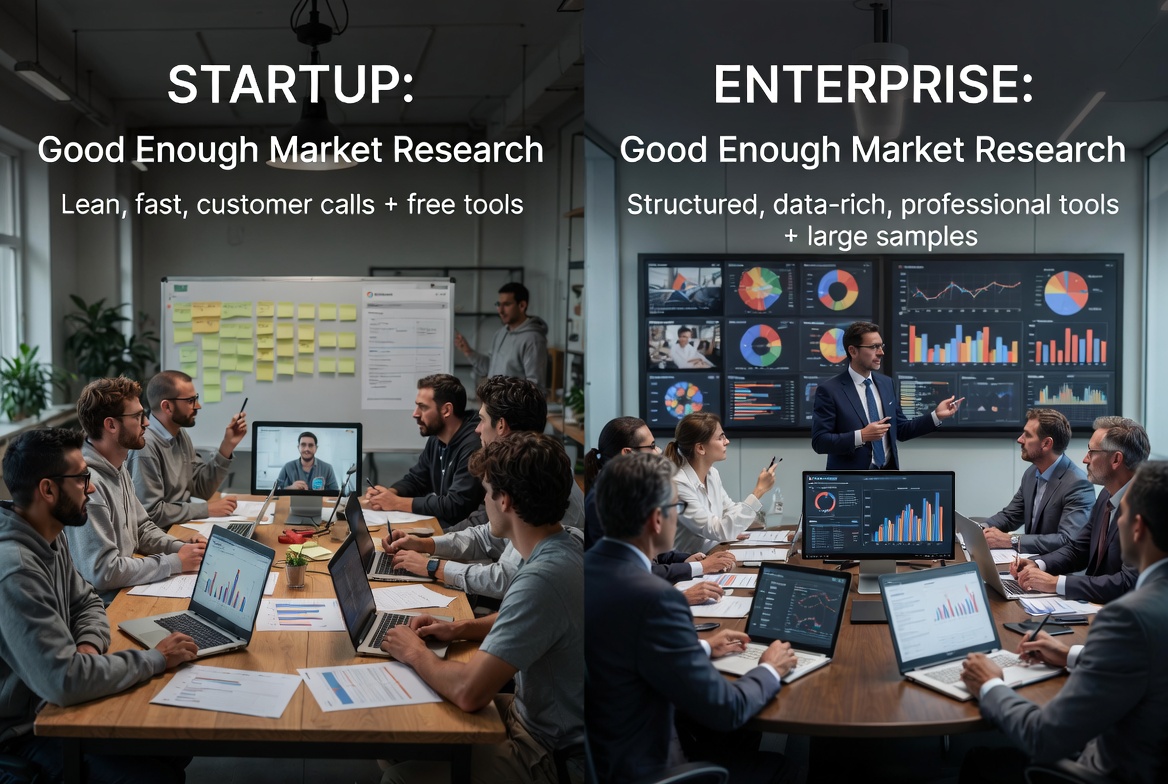
Good enough market research for startups versus enterprises is not the same thing — and confusing the two is costing businesses millions of dollars, missed opportunities, and more wasted PowerPoint slides than anyone should have to suffer through.
One of the most mispriced assets in all of business — whether you’re a two-person startup operating out of a garage that smells like anxiety and instant noodles, or a Fortune 500 enterprise sitting on a $3 billion war chest — is market research. Not because it doesn’t work. Oh, it absolutely works. But because almost nobody is doing the right type of it for where they actually are in their business journey.
You wouldn’t wear a tuxedo to go fishing. And you wouldn’t show up to the Oscars in your fishing waders. Unless you’re a startup founder, in which case, honestly, you might do both by accident because nobody told you the rules. That’s what we’re here to fix today.
This article is going to walk you through what “good enough” market research actually looks like — the methods, the mindset, the money — for startups and enterprises separately, with academic receipts, real case studies, and enough jokes to make you feel like you accidentally wandered into a comedy club that somehow also has a Bloomberg terminal.
Let’s get into it.
Part One: The Market Research Spectrum (And Why Your Position on It Matters)
Before we even think about methods and tools, let’s establish the philosophical foundation. Market research is fundamentally about reducing uncertainty in decision-making. That sounds simple, right? Nope. Because here is where everyone goes wrong: the acceptable level of uncertainty is wildly different depending on who you are.
A startup founder making a decision about whether to build Feature A or Feature B doesn’t need a six-month longitudinal qualitative study with a statistically significant panel of 5,000 respondents. They need to talk to ten people this week. Real talk. Ten conversations done right will outsell ten thousand survey responses done lazy, every single time.
An enterprise, on the other hand, preparing to enter a new market segment where the minimum viable commitment is $200 million needs something a little more robust than a founder saying, “I asked my cousin and he thought it was a good idea.” Your cousin is not the market. I don’t care how good his instincts are.
The academic literature on entrepreneurial decision-making is unambiguous on this point. A landmark study published in the Strategic Entrepreneurship Journal by Leatherbee and Katila, building on Steve Blank’s customer discovery framework, found that lean startup’s emphasis on direct customer discovery — testing business hypotheses with potential customers early in product development — genuinely helps early-stage teams converge on viable business ideas faster and with less capital wasted [1]. The key word is faster. Speed is oxygen for a startup. For an enterprise, speed is important but survivability isn’t the same existential pressure.
And here’s the kicker — that same study found that teams who thought they already understood the market and skipped customer discovery were the ones most likely to build something nobody wanted. Sound familiar? I’ve watched traders do the same thing. Convinced they have the edge, they skip the fundamentals. Then the market humbles them publicly. Don’t be that person.
Part Two: What ‘Good Enough’ Looks Like for Startups
2.1 The Startup Reality Check (No Budget, No Time, No Mercy)
Let me paint you a picture. You’ve got a brilliant idea. You have maybe six months of runway. Your co-founder just told you they’re “pretty sure” there’s a market for this, which is the business equivalent of saying you’re “pretty sure” you left the stove off. It’s not reassuring.
CB Insights tracked the post-mortem data of thousands of failed startups and found that 35% failed because there was no market need for their product [2]. That’s not a funding problem. That’s not a talent problem. That’s a “we did not do our homework” problem. And a 2023 Embroker study confirmed that 90% of startups fail overall, with 10% going under in their first year alone [2]. Those are numbers that should make you sit down and breathe.
So what does good enough market research look like when you’re a startup? Here’s the trader’s translation: you’re not trying to achieve certainty. You’re trying to achieve directional conviction fast enough to make a move before your runway disappears.
2.2 The Startup Research Toolkit: Lean, Mean, and Occasionally Desperate
Customer Interviews (The Holy Grail You Keep Skipping)
The single most underutilised tool in a startup’s arsenal is the humble customer interview. Not a survey. Not a focus group run by someone’s marketing intern. An actual conversation, with a real human being who might one day give you money, where you ask them about their problems rather than pitching your solution.
This is the core of the Lean LaunchPad methodology, popularised by Steve Blank and documented by the NSF’s Innovation Corps programme, which found that customer discovery conversations fundamentally improve a startup’s ability to identify genuine market needs before over-committing resources to product development [3]. The data is in. The receipts are real. Talk to your customers.
Now, how many interviews do you need? The magic number for early discovery is somewhere between ten and twenty-five conversations to begin identifying thematic saturation — the point where new interviews stop producing new insights. At that stage, you’re not learning anything new; you’re just confirming what you already know. That’s actually fine! Confirmation is data too.
The catch? Most startup founders do this completely wrong. They go into customer interviews with the posture of a door-to-door salesman who already knows you’re buying the vacuum. They ask leading questions like, “Don’t you think it would be amazing if an app could do X?” And the customer, being a polite human being, says “Yes, sure, that sounds great,” — and then never opens their wallet.
You know what that is? That is the market research equivalent of someone asking if you want dessert at a restaurant and you saying yes to be nice, then sitting there not eating it. You didn’t want the dessert. You just didn’t want to have the conversation.
The Minimum Viable Survey
If you absolutely must use a survey — and sometimes you must — keep it brutally short. Three to five questions maximum. If your survey is longer than that, you have lost the plot and also probably lost your respondents around question four. People’s attention spans are not getting longer. I have watched grown adults at trading desks abandon a ten-question survey because they spotted something more interesting, and that “something more interesting” was a coffee machine starting up across the room.
A well-constructed five-question survey targeting the right audience segments, asking about pain points, current spending on solutions, and willingness to pay, will give you more actionable signal than a 40-question academic opus that three people actually finish.
Secondary Research: Free and Fast
Here is another secret that startup founders treat like it doesn’t exist: there is an enormous amount of free, publicly available data that can tell you whether your market is real. We’re talking about Google Trends, Reddit threads (the world’s most honest focus group that nobody moderates), app store reviews of competitor products (where unhappy customers describe exactly what they wish existed), LinkedIn Sales Navigator for market sizing, and government economic data from the ONS, US Census Bureau, or Eurostat.
You have the internet. The internet has the data. Use it before you spend money you don’t have on research you can do yourself in a long weekend.
2.3 Case Study: Airbnb’s Original Market Research (Or Lack Thereof)
Let’s talk about Airbnb, because this is a case study that lives in my head rent-free — which, fittingly, is exactly what Airbnb’s first guests were doing.
When Brian Chesky and Joe Gebbia launched the concept in 2008, they did not commission a $500,000 market research study from a consulting firm. They could not afford a $500,000 anything. What they did was genuinely go out, talk to potential hosts and guests, and test the concept at minimum viable scale by literally renting out air mattresses in their own apartment during a design conference.
Their early “research” was participatory, qualitative, and brutally direct. They went to New York City and personally visited hosts to understand why some listings performed better than others. They took the photographs themselves. They iterated based on immediate feedback loops.
This is startup market research at its finest: fast, cheap, qualitative, and directly tied to action. There was no six-month research phase. There was a hypothesis, a test, a learning, and an iteration. The result? A company now valued at over $75 billion [4].
Now, could they have done more rigorous research? Sure. But would it have been worth the time and money at that stage? Absolutely not. When you’re trying to survive, “good enough” is doing ten interviews this week, not commissioning a study that will land in your inbox after you’ve already made the decision anyway.
2.4 The Startup Research Mindset: Speed Over Perfection
Here is the central thesis for startup market research, which I want you to tattoo on your business plan (metaphorically):
Good enough is fast enough.
In the research on software startup decision-making published in academic literature (Unterkalmsteiner et al., documented in an empirical study on startup uncertainty), early-stage startups operate in what researchers describe as a “chaotic environment” where decisions must be made under conditions of extreme uncertainty [5]. That environment does not reward the team that waits for perfect information. It rewards the team that gets directional signal and moves.
A published review of lean startup methodology in Procedia Computer Science (Olek et al., 2023) confirms that the Build-Measure-Learn cycle embedded in lean startup practice is specifically designed to replace extensive upfront research with rapid empirical cycles of hypothesis testing [6]. In other words: the research IS the product iteration, not a precondition for it.
I want to be very clear about one thing, though. “Good enough” does not mean “sloppy.” It means calibrated. It means understanding that the goal of your research at this stage is not to be right — it’s to be less wrong faster. That’s a very different objective, and getting comfortable with that distinction is the difference between a startup that learns and one that burns.
Part Three: What ‘Good Enough’ Looks Like for Enterprises
3.1 The Enterprise Reality Check (Too Much Budget, Too Many Stakeholders, Way Too Many Meetings)
Right. Now let’s cross the street and talk to the enterprise folks.
You work for a large organisation. You have a budget. You have a research team. You have a vendor list that gets reviewed annually by procurement. You have a steering committee that oversees the steering committee. And somehow, with all of this infrastructure, you are still making decisions based on gut feeling and the opinion of whoever shouted loudest in the last all-hands meeting.
You know what this is? This is having a whole gym and never going. Honestly, the enterprise relationship with market research is complicated in the most expensive possible way.
The 2024 Gartner CMO Spend Survey found that marketing budgets at large enterprises had dropped to just 7.7% of overall company revenue, and that 59% of CMOs reported having insufficient budget to execute their full strategy [7]. So enterprises are not exactly swimming in money either. They’re just swimming in process.
And here’s the dark irony: enterprises often spend money on the wrong research at the wrong time in the wrong format, and then don’t actually use it when the decision point arrives. I’ve seen it happen. A company commissions a beautiful, 200-page research report, full of charts and regional breakdowns and competitive matrices, and it sits in a SharePoint folder for eight months until the executive who commissioned it leaves the company. New executive comes in, has different priorities, commissions another report. The cycle continues. Nobody reads anything. A small woodland creature weeps.
3.2 The Enterprise Research Toolkit: Rigour, Scale, and Political Survival
Quantitative Research at Scale
The enterprise’s superpower is scale. When you have the ability to field a survey to 10,000 respondents across multiple geographies, you should absolutely be doing that for decisions that require it. The key phrase is decisions that require it.
Not every enterprise decision needs a population-level quantitative study. But strategic market entry decisions? New product category bets? Brand perception shifts after a major corporate event? These absolutely warrant the full toolkit.
The academic literature on market research ROI makes clear that research functions best as “insurance against decision-making risk” [8]. B2B International’s authoritative review of market research ROI frameworks argues that organisations which view research as risk reduction — rather than as a cost — allocate it far more effectively. When you frame market research as the price of not making a $200 million mistake, the $500,000 study suddenly looks like a bargain.
Segmentation and Persona Research
One area where enterprises genuinely earn their research spend is in customer segmentation. Understanding not just who your customers are but why different clusters of customers behave differently is the kind of insight that only emerges from large-scale, properly structured quantitative research combined with qualitative depth interviews.
Here is a number worth knowing: McKinsey’s analysis of enterprise technology performance found that enterprises with high-performing insight and IT organisations have up to 35% higher revenue growth and 10% higher profit margins than their peers [9]. Not 3.5%. Thirty-five percent. That is not a rounding error. That is an entirely different business.
Continuous Insight Programmes vs. Ad Hoc Research
One of the most significant gaps in enterprise market research practice is the reliance on ad hoc, project-based research rather than continuous insight programmes. Think of the difference between going to the doctor only when you’re already sick versus getting regular check-ups. One approach manages crises. The other prevents them.
Online research panels — maintained audiences of pre-profiled respondents — dramatically reduce the cost and time of individual research projects and enable the kind of always-on customer feedback loops that modern enterprises need to stay competitive [10]. Investing in panel infrastructure is one of the highest-ROI moves an enterprise research team can make.
Competitive Intelligence
Enterprises have an obligation to do competitive intelligence that goes well beyond what a startup can resource. This means tracking patent filings, procurement data, executive hiring patterns, regulatory submissions, and market share shifts across geographies. This is research as business intelligence, not just as customer insight.
The peer effect research published in PLOS ONE (an empirical study of enterprise innovation in China, applicable broadly) demonstrates that enterprises systematically monitor competitor innovation investments and adjust their strategies accordingly — suggesting that competitive market intelligence is not just helpful but structurally embedded in how large organisations make decisions [11].
3.3 The Enterprise Research Failure Modes (And Lord Are There Many)
Let’s talk about the ways enterprises mess this up, because they are numerous and spectacular.
Failure Mode 1: The Vanity Research Project
This is when research is commissioned not because a decision needs to be made, but because it looks good in a board presentation. The output is impressive. The insight is vague. The action is nonexistent. I call this “research theatre,” and if you work in a large organisation, you know exactly what I’m talking about. You’ve been in the play.
Failure Mode 2: Analysis Paralysis
You have done the quantitative research. You have done the qualitative depth interviews. You have done the ethnographic observation study. You now have fifteen hundred pages of findings and seventeen competing recommendations. Nobody can agree on what to do next. The decision window closes. The competitor moves. You are left standing there holding fifteen hundred pages of very expensive confetti.
The research literature on decision-making identifies this exact failure mode: organisations that collect data without a clear decision framework in advance tend to generate insights that cannot be translated into action [8]. The fix? Define the decision you’re trying to make before you design the research. Not after. Before. This sounds obvious. It is apparently not practised.
Failure Mode 3: Research That Validates Rather Than Informs
The most insidious enterprise research failure is when research is used to validate a decision that has already been made, rather than to inform a decision that is still open. This is the market research equivalent of asking for directions after you’ve already arrived somewhere wrong and insisting you took the right route.
When the CEO has already decided to launch in Latin America and the research team is tasked with finding evidence to support that decision, the research is not research. It is expensive PR. And it will, at some point, blow up in someone’s face. Usually the person who signed off on the study, which means that person had all the downside of risky decision-making with none of the benefit of having genuinely informed it.
3.4 Case Study: Netflix and the Enterprise Research Model Done Right
Netflix provides what is perhaps the best modern case study of enterprise market research operating at its highest level.
When Netflix made the decision to invest in original content — a bet that was, let’s be real, terrifying — they did not simply ask customers if they wanted original Netflix shows. They analysed behavioural data at a scale that no startup could match: viewing patterns, completion rates, search behaviour, re-watch frequency, genre adjacency data. When they greenlit House of Cards, it was because their data told them that their customers who liked political thrillers, David Fincher films, and Kevin Spacey performances were a large, high-retention, high-value segment.
They used the enterprise superpower: scale data, properly structured and properly interrogated, to make a decision with enormous capital commitment behind it. They didn’t ask customers what they wanted. They studied what customers did and extrapolated forward.
This is enterprise market research at its best: using proprietary scale data, rigorous analytical frameworks, and behavioural signal (not just stated preference) to reduce risk on a big strategic bet. Netflix’s success with original content — growing from a DVD-by-mail service to a global content powerhouse — validates the approach [12].
Now, could a startup do this? No. And that is exactly the point. It required massive data infrastructure, data science capacity, and the patience to build those capabilities before making the bet. Enterprises have that. Startups don’t. And that’s fine — because startups have the speed and flexibility that enterprises would kill for.
Part Four: The Head-to-Head Comparison (Where the Real Differences Live)
4.1 Budget Asymmetry
Let’s talk numbers, because numbers are where I live.
A typical startup doing market research in its early stages is working with somewhere between $0 and $5,000 for an initial research phase. This is not a crisis — it’s a constraint that actually forces discipline. When you have no budget for a large-scale survey, you talk to customers. When you talk to customers, you get real signal. There’s a sick, cosmic joke in the fact that the startup’s limitation becomes its advantage.
An enterprise, by contrast, may commission individual research projects that cost anywhere from $50,000 to $500,000 or more for large-scale, multi-market quantitative studies. The 2024 Gartner CMO data tells us that marketing budgets — of which research is a component — average around 7.7% of total company revenue [7]. For a company doing $1 billion in revenue, that’s $77 million in marketing spend, a meaningful fraction of which should be — and often isn’t — going to research.
The point is not that more budget equals better research. The point is that the appropriate research intensity should scale with the decision size and the organisation’s ability to act on the findings. Spending $500,000 on research for a decision that is already effectively made is not investment. It is expenditure. Very different.
4.2 Speed Asymmetry
This one is stark. A startup can design, field, and analyse a customer interview study in two weeks. An enterprise can take two weeks just to get stakeholder sign-off on the research brief. I am not exaggerating. I have lived this. I have watched this happen in real-time while sitting in a meeting that itself was scheduled to discuss whether to have another meeting.
The research on software startup decision-making (Unterkalmsteiner et al.) explicitly identifies speed as a structural characteristic of startup operations — not a choice, but an existential necessity [5]. Startups that move slowly die. Enterprises that move too fast also die, but much more slowly and with a much larger severance package.
The enterprise research calendar must, therefore, be designed to serve decision timelines — not the other way around. One of the most common enterprise research failures I observe is a research programme that operates on an annual cycle when the business decisions it’s meant to inform are being made quarterly. That is a timing mismatch with material consequences.
4.3 Risk Tolerance Asymmetry
A startup making a wrong call on market research can pivot. It costs them time, maybe some runway, maybe a painful all-hands where the co-founders have to admit they got it wrong. That is survivable. Many of the most successful companies in the world pivoted from an original concept because the market research — formal or informal — told them something wasn’t working.
Instagram started as Burbn, a location-based social network. Twitter spun out of Odeo, a podcasting platform. YouTube originally tried to be a video dating site. Yes. A video dating site. And now it’s the world’s second-largest search engine.
An enterprise making a wrong call on market research when it has already committed $300 million to a market entry? That’s a different conversation. That’s a Board conversation. That’s a Bloomberg article about the strategic pivot. That’s the kind of news that moves the stock price. This is why enterprise research must be both more rigorous and more explicitly tied to decision frameworks.
4.4 Stakeholder Complexity Asymmetry
Here’s one that doesn’t get talked about enough: research in an enterprise isn’t just about finding truth. It’s also about organisational persuasion.
When an enterprise research team presents findings that contradict what the sales VP believes about the market, the problem isn’t the data — it’s the politics. Getting an organisation of 50,000 people to accept that their mental model of a market is wrong requires more than a chart. It requires a research programme that was designed with internal stakeholder management in mind from day one.
Startup founders don’t typically have this problem, because when the co-founder disagrees with the research findings, you can just argue it out over the kitchen table and make a call. Or someone cries. Either way, you’re moving by Monday.
Part Five: The ‘Good Enough’ Framework — A Practical Decision Tree
Here is a simple framework — trader’s edition — for figuring out what level of market research is actually appropriate for your situation.
Step 1: What decision are you trying to make?
If it’s a decision that is reversible within 90 days at low cost, do the minimum viable research. Customer interviews. Basic secondary research. Move.
If it’s a decision that is reversible but at significant cost (rebuilding a product, restructuring a team, repositioning a brand), do an intermediate level of research. Mix of qualitative and lightweight quantitative. Take two to four weeks. Move.
If it’s a decision that is largely irreversible at scale — market entry, acquisition, major capital commitment — do the full research programme. Quantitative at scale, qualitative depth, competitive intelligence, scenario analysis. Do it right or don’t do it.
Step 2: What is your research asset base?
Startups: you have time and hustle. Use them. Enterprises: you have data infrastructure, existing customer relationships, brand credibility for research recruitment. Use those.
Step 3: What’s the cost of being wrong?
If being wrong costs you three months of runway and some credibility, you don’t need to research for six months before acting. If being wrong costs you a $200 million market entry investment and six board seats, you need to research until you can say with confidence that you’ve reduced uncertainty to an acceptable threshold.
This framework is consistent with the B2B International view of market research as risk insurance [8] — you buy as much insurance as is proportionate to the risk you’re covering. Not more. Not less.
Part Six: The Future of Market Research — AI, Speed, and the Democratisation of Insight
We would be doing everyone a disservice if we didn’t acknowledge that the landscape of market research is changing fast, and it is changing in ways that specifically benefit startups.
AI-powered research tools — from automated interview analysis to synthetic market research panels — are compressing the cost and time curves dramatically. Tools that once required a specialist research firm can now be operated by a founder with a laptop and a cloud subscription. Sentiment analysis that once took weeks now takes hours. Thematic coding of interview transcripts that once required a qualitative researcher is now a $20 software subscription.
The 2025 Gartner CMO Spend Survey noted that CMOs at enterprise level are increasingly leveraging AI to improve research productivity — with 49% reporting improved time efficiency and 40% improved cost efficiency from GenAI research applications [13]. If enterprises are getting gains of that magnitude, startups — typically faster technology adopters — should be all over this.
This means the gap between startup and enterprise research capability is narrowing. Which raises an interesting question: as the tools democratise, will the distinction between startup and enterprise research methods converge?
The short answer is: not entirely. Because the fundamental driver of the distinction isn’t tool availability — it’s decision size, risk profile, and stakeholder complexity. AI makes research faster and cheaper for everyone. It does not change the fact that a startup making a $50,000 bet and an enterprise making a $500 million bet have fundamentally different research obligations.
Part Seven: Common Mistakes Both Types Make (And How to Stop Making Them)
I want to close out with the universal mistakes — the ones that transcend company size and are equal-opportunity destroyers of research value.
Mistake 1: Asking the wrong questions
Whether you’re a startup doing customer interviews or an enterprise running a quantitative survey, asking leading questions, ambiguous questions, or hypothetical-future questions (“would you use this if it existed?”) produces garbage data. People are terrible at predicting their own future behaviour. Study what they currently do. Ask about their current problems. Work from there.
Mistake 2: Researching too late
Market research done after the product is built, the market entry is committed, or the campaign is live is not research — it’s evaluation. Evaluation has its place, but it’s not a substitute for upstream research that could have prevented the mistake you’re now measuring. Both startups and enterprises are guilty of this. The timeline gets compressed, the research gets pushed to “after launch,” and then everyone is surprised by the results. Don’t do this.
Mistake 3: Not acting on findings
Research that sits in a PDF is not research. It is an expensive document. The only value in market research is in the decisions it informs and the actions it enables. If your research process does not end with a clear set of implications and recommended actions — and if those implications are not explicitly connected to the decision they were meant to inform — the research failed, regardless of how methodologically sound it was.
Mistake 4: Using research to avoid making decisions
This is the one I see most often: some people commission market research not because they want insight, but because they want to delay a decision that scares them. “Let’s do another round of interviews.” “We should validate this with a survey before we commit.” “I think we need one more focus group before we’re ready.” At some point, this is just fear in a business casual outfit.
Market research is a tool for better decisions, not a substitute for making them. There is a point — and good researchers will tell you when you’ve reached it — where you have enough information to act. When you’re there, act.
Conclusion: The Trader’s Take
Here is how I’m going to land this plane.
Market research is not one thing. It is a spectrum of tools, methods, and investment levels that must be matched — precisely and deliberately — to the stage, size, risk profile, and decision context of the organisation doing it.
For startups, good enough is fast, qualitative, and directly tied to survival-level decisions. Ten to twenty-five customer interviews, smart secondary research, and a bias toward action will beat a six-month research programme every single time when you’re operating on a tight runway. The academic evidence — from Leatherbee and Katila’s lean startup research to the NSF’s Customer Discovery methodology work — backs this up without reservation.
For enterprises, good enough is rigorous, scaled, and explicitly connected to material decisions. Anything less than that is theatre. Use the budget you have to do the research that matches the risk you’re taking. Use AI to improve efficiency without cutting corners on rigour. Build continuous insight infrastructure instead of relying on ad hoc projects.
Both of you: stop asking the wrong questions, stop researching too late, and for the love of everything that is good and profitable in this world, act on your findings.
The market is always moving. Research is how you stay ahead of it. But only if you do the right type, at the right time, with the right calibration for who you are and what’s actually at stake.
Now go talk to ten customers. I’ll wait.
References
- Leatherbee, M. & Katila, R. (2020). The Lean Startup as an Actionable Theory of Entrepreneurship. Strategic Entrepreneurship Journal. Available at: https://stvp.stanford.edu/podcasts/research-insight-new-data-on-lean-startup
- Embroker / CB Insights (2023). Customer Discovery and Startup Failure Rates. Dovetail Research Summary. Available at: https://dovetail.com/product-development/customer-discovery/
- Blank, S. et al. (2018). Lean LaunchPad and Customer Discovery as a Form of Qualitative Research. NSF PAGES / National Science Foundation I-Corps Programme. Available at: https://par.nsf.gov/biblio/10072084-lean-launchpad-customer-discovery-form-qualitative-research
- Shepherd, D.A. & Gruber, M. (2021). The Lean Startup Framework: Closing the Academic–Practitioner Divide. Entrepreneurship Theory and Practice, SAGE Journals. Available at: https://journals.sagepub.com/doi/10.1177/1042258719899415
- Unterkalmsteiner, M. et al. (2021). Amidst Uncertainty — or Not? Decision-Making in Early-Stage Software Startups. arXiv. Available at: https://arxiv.org/pdf/2102.06501
- Olek, K. et al. (2023). Startups and Lean Startup Approach in Building Innovative Companies Creating Unique Market Values. Procedia Computer Science, Vol. 225, pp. 3745–3753. Available at: https://www.researchgate.net/publication/377697599
- Gartner (2024). Gartner CMO Survey Reveals Marketing Budgets Have Dropped to 7.7% of Overall Company Revenue in 2024. Gartner Newsroom. Available at: https://www.gartner.com/en/newsroom/press-releases/2024-05-13-gartner-cmo-survey-reveals-marketing-budgets-have-dropped-to-seven-point-seven-percent-of-overall-company-revenue-in-2024
- B2B International (2022). Measuring and Maximising the ROI of Market Research. B2B International Research Review. Available at: https://www.b2binternational.com/publications/research-for-decisions/
- McKinsey & Company (2025). The New Economics of Enterprise Technology in an AI World. McKinsey Digital. Available at: https://www.mckinsey.com/capabilities/mckinsey-digital/our-insights/the-new-economics-of-enterprise-technology-in-an-ai-world
- FlexMR (2022). Which Market Research Method Provides the Highest ROI? FlexMR Blog. Available at: https://blog.flexmr.net/which-market-research-method-provides-the-highest-roi
- An et al. (2022). Peer Effect of Enterprise Innovation: Empirical Evidence from China. PLOS ONE / PMC. Available at: https://pmc.ncbi.nlm.nih.gov/articles/PMC9642079/
- McAfee, A. & Brynjolfsson, E. (2012). Big Data: The Management Revolution. Harvard Business Review. Available at: https://hbr.org/2012/10/big-data-the-management-revolution
- Gartner (2025). Gartner 2025 CMO Spend Survey Reveals Marketing Budgets Have Flatlined at 7.7% of Overall Company Revenue. Gartner Newsroom. Available at: https://www.gartner.com/en/newsroom/press-releases/2025-05-12-gartner-2025-cmo-spend-survey-reveals-marketing-budgets-have-flatlined-at-seven-percent-of-overall-company-revenue
Disclaimer: This article is for informational and educational purposes only and does not constitute financial or trading advice.
Leave a Reply
You must be logged in to post a comment.