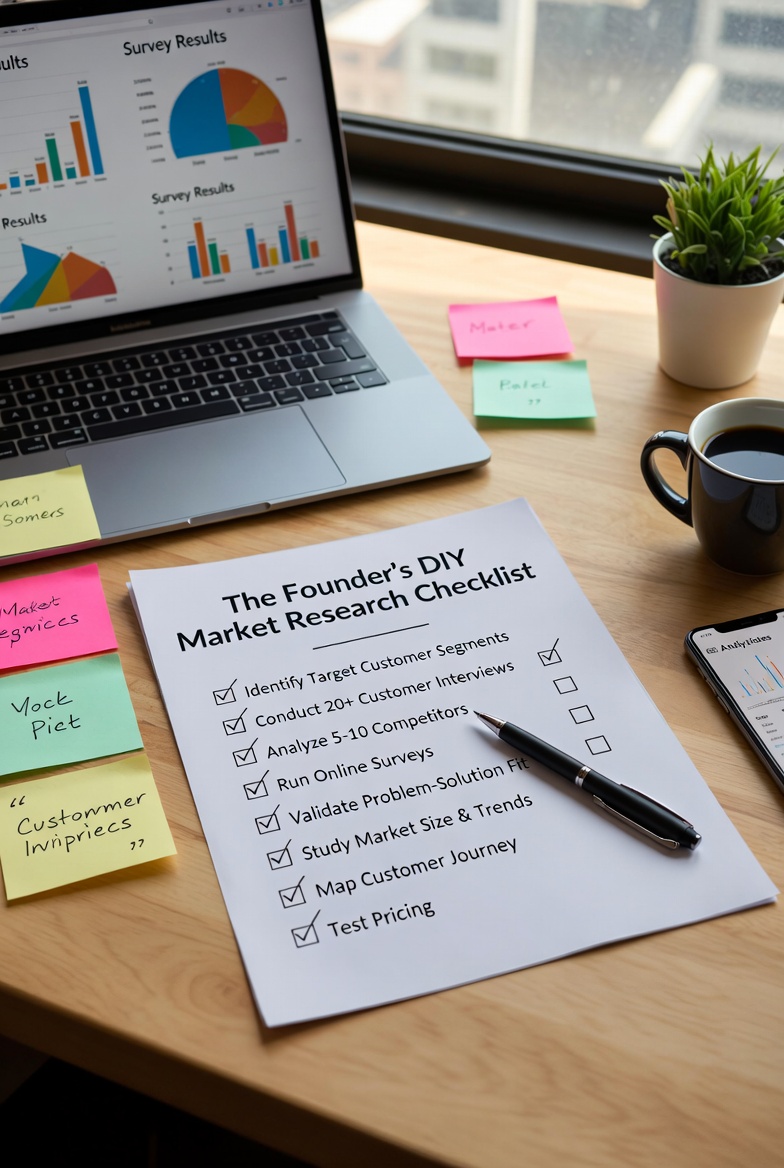
The Founder’s DIY Market Research Checklist is a 12-step action framework that walks you through every critical validation exercise — from pinpointing your customer’s exact problem and sizing your market with TAM/SAM/SOM, to running discovery interviews, testing willingness to pay, and mapping your go-to-market channels. Complete every item before you build and you replace expensive guesswork with the kind of evidence that wins customers, survives competition, and convinces investors.
Every founder who has ever skipped market research before launching a startup has essentially walked into a dragon’s den wearing a suit made of raw beef — bold, baffling, and almost certainly about to get eaten. If you are serious about building a business, mastering the founder’s DIY market research checklist is not optional. It is the difference between launching a product the market has been begging for and launching one that your mum, your auntie, and literally nobody else will ever buy.
I have been in markets — financial markets, street markets, online markets — long enough to know one immovable truth: you do not show up to sell something before you know who is buying. That is not courage. That is just showing up to the wrong party in the wrong outfit. And trust me, I have been to that party. The music was bad, the snacks were weird, and nobody wanted what I was selling.
This checklist exists so you never attend that party.
Why Market Research Is the Non-Negotiable Foundation of Every Successful Startup
Before we get into the actual checklist, let us have a short moment of honesty. Most founders — myself included at various points — think they know their market. They think it because they have talked to three friends, read two blog posts, and watched one YouTube video from a guy in a Lamborghini.
That is not market research. That is vibes. And vibes, my friend, do not pay invoices.
According to CB Insights’ analysis of post-mortems from over 400 failed VC-backed startups, 42% of startups fail because there is no market need for their product. Not because the founders were lazy. Not because they lacked passion. Because they skipped validation. They built the solution before they understood the problem. They answered a question nobody was asking.
The academic research is equally brutal. A 2023 peer-reviewed study published in Scientific Reports (Nature) analysed founder characteristics and startup outcomes across more than two million companies using the Crunchbase dataset. The findings confirmed what successful traders have known forever: knowledge of the market environment, not just technical skill, is the primary determinant of early-stage startup performance.
And if you think this only applies to tech startups — think again. Whether you are launching a SaaS platform, a cleaning company, an e-commerce brand, or a hot sauce with your grandmother’s face on the label, the principles of market research apply universally.
So here is your checklist. Work through it honestly, sequentially, and without skipping to the end like you are reading the last page of a novel. Each step builds on the last. Each step saves you money. Each step is the difference between a business and an expensive hobby.
CHECKLIST ITEM 1: Define Your Problem Statement — With Ruthless Precision
☐ Write down the exact problem you are solving, for exactly whom, and why existing solutions fall short.
This sounds painfully simple. It is not. Most founders can tell you what their product does. Almost none of them can tell you — with surgical precision — what problem it solves, for which specific type of person, on which specific occasion, better than what specific alternative.
Here is the difference:
- Weak problem statement: “People find it hard to manage their finances.”
- Strong problem statement: “Freelance graphic designers aged 25–40 in the UK spend an average of 3.5 hours per week reconciling invoices across multiple clients, and existing tools like Excel are too complex and accounting software like Xero feels excessive for their small scale of operation.”
See the difference? The second one practically tells you who to interview, what features to build, how to price it, and how to market it. It is so specific it is almost uncomfortable — and that discomfort is a good sign.
The academic foundation for this approach comes from the customer development methodology pioneered by Steve Blank and popularised by Eric Ries in The Lean Startup (2011). As documented in Shepherd & Gruber’s 2021 peer-reviewed article in Entrepreneurship Theory and Practice, Ries’ framework insists that founders must test four critical hypotheses before building anything: Do customers recognise the problem? Would they pay for a solution? Would they buy from you? Can you actually build it?
Notice that Question 4 — the one founders are most eager to answer — comes last.
Your Action Items:
- Write your problem statement in one paragraph, maximum.
- Name your customer as specifically as possible (age, occupation, behaviour, location, context).
- Identify the “next best alternative” they currently use and articulate why it fails them.
- If you cannot do this clearly, you are not ready to do market research. You are ready to do more thinking first.
CHECKLIST ITEM 2: Conduct Desk Research — The Free Intelligence That Most Founders Ignore
☐ Spend at least 10 focused hours consuming secondary research before you talk to a single customer.
I know, I know. Talking to customers sounds more exciting. It is more exciting. But it is also more dangerous when you go in uninformed — because you will ask the wrong questions, interpret the answers incorrectly, and come away thinking you have validated something you have not.
Before you open your mouth to a potential customer, open a browser and go deep.
Desk research sources to check:
- Google Scholar (scholar.google.com) — Search for peer-reviewed articles related to your industry, consumer behaviour patterns, and problem space. Free. Underused. Invaluable.
- Statista (statista.com) — Industry size, consumer statistics, market trend reports. Many are behind a paywall, but a significant amount is free.
- ONS (Office for National Statistics) (ons.gov.uk) — If you are building for a UK market, this is a goldmine of demographic, economic, and behavioural data.
- Companies House (companieshouse.gov.uk) — Research your competitors’ actual financials. Publicly filed. Free. And absolutely nobody talks about this enough.
- Reddit, Trustpilot, and Amazon Reviews — This is where your future customers go to scream into the void about their problems. Those screams are your product roadmap.
This step is where you build what academics call your secondary research foundation. According to Blank & Dorf (2012) as reviewed in Bortolini et al.’s comprehensive historical review of Lean Startup in Management Decision journal, secondary research allows founders to form initial hypotheses about customer segments, problem severity, and competitive landscape — hypotheses that are then tested through primary research.
Think of desk research like scouting the restaurant before you bring a date. You do not just show up. You check the menu, the reviews, the prices. You find out if they even have vegetarian options. You prepare. And then you show up prepared.
That is what desk research is for.
CHECKLIST ITEM 3: Map the Competitive Landscape — Know Everyone in the Room
☐ Identify your direct competitors, indirect competitors, and emerging threats. Map them visually.
Let me tell you about Juicero. In 2016, Juicero raised $120 million in funding to sell a $699 internet-connected juice press that squeezed proprietary juice packets. Everything was going swimmingly until a Bloomberg journalist pointed out you could just… squeeze the packets with your hands. With your hands. No $699 machine required.
The company collapsed. The product worked. But the market research failed — catastrophically — on the competitive landscape. Nobody asked: what is the simplest, cheapest alternative? The answer was: human fingers, which retail at approximately zero pounds per pair.
Do not be Juicero.
Your competitive landscape map should include:
- Direct competitors — Companies solving the same problem for the same customer in the same way.
- Indirect competitors — Companies solving the same problem via a different mechanism (e.g., if you are building a budgeting app, Excel is an indirect competitor).
- Status quo — Sometimes the biggest competitor is “doing nothing” or “the current manual process.” This is the most underrated competitor in startup history.
For each competitor, note:
- Pricing model
- Target customer segment
- Key strengths (based on reviews and public feedback)
- Documented weaknesses (where customers complain, i.e., their 1-star reviews)
- Growth trajectory (use SimilarWeb for website traffic trends; free tier available)
A 2024 analysis published on Tandfonline examining critical decisions in early-stage startups confirmed that founders with prior environmental scanning experience — meaning those who actively mapped their competitive context before launching — showed meaningfully higher rates of successful product adaptation. In other words, knowing the room before you enter it is not just smart. It is statistically correlated with survival.
CHECKLIST ITEM 4: Define and Size Your Market — TAM, SAM, and SOM Are Not Just Acronyms for Impressing Investors
☐ Calculate your Total Addressable Market (TAM), Serviceable Addressable Market (SAM), and Serviceable Obtainable Market (SOM).
Alright, real talk. Every time someone presents a business plan and says “our market is worth five billion pounds and we just need one percent of that,” I want to lie down on the floor for a moment and not get up.
One percent of five billion pounds. Wild. Romantic. Completely meaningless.
Here is how market sizing actually works.
TAM (Total Addressable Market): The total global revenue opportunity if every possible customer bought your product. This is your theoretical ceiling. Useful for context. Dangerous as a strategy.
SAM (Serviceable Addressable Market): The portion of TAM you can actually reach given your geography, language, pricing, distribution model, and business constraints. This is where reality starts.
SOM (Serviceable Obtainable Market): What you can realistically capture in Year 1–2, given your resources, competitive position, and go-to-market strategy. This is the only number that matters for your first 24 months.
As Jon Warner explains in his widely-cited Medium guide on TAM/SAM/SOM methodology for startups: “VCs love seeing founders who have dug up authoritative data” and have built their estimates from both top-down (industry reports) and bottom-up (customer interviews and pricing data) methodologies. A VC who sees a founder cite a Gartner report and their own pre-launch waitlist data in the same pitch is a VC who leans forward in their chair.
Case Study: Airbnb’s Initial Market Sizing
When Brian Chesky and Joe Gebbia launched Airbnb, they did not pitch “the total global travel accommodation market is worth $500 billion.” They started hyper-local — targeting people attending specific conferences in San Francisco who could not find hotel rooms. Their initial SOM was laughably small by any standard. But it was real. It was validatable. And it gave them enough data to iterate rapidly before scaling.
They understood their SAM before anyone started talking about TAM. The rest, as they say, is a $75 billion company.
Your action here: use a bottom-up approach first. Count the number of potential customers you can actually reach in the next 12 months with your current resources. Multiply that by your realistic average revenue per customer. That is your real Year 1 SOM. It will be smaller than you want. It will also be infinitely more useful.
CHECKLIST ITEM 5: Build Your Customer Persona — Not a Fantasy, a Forensic Portrait
☐ Develop at least two detailed customer personas based on data, not assumptions.
A customer persona is not “Sarah, 35, likes yoga and uses Instagram.” That is an aesthetic. That is a vibe board. That is a person you invented.
A real customer persona is built from interviews, behavioural data, and observable patterns. It includes not just demographics but psychographics — what Sarah values, what she fears, what triggers her to look for a solution, and what barriers stop her from buying.
Here is what a proper persona document includes:
- Demographic profile — Age range, occupation, income bracket, geography, household composition.
- Problem context — When does this problem occur? How often? How acutely does it disrupt their day?
- Current behaviour — What do they currently do to solve this problem? (This is your real competition.)
- Decision triggers — What would have to happen for them to actively seek a new solution?
- Objections and barriers — Price? Trust? Habit? Convenience? Time?
- Information channels — Where do they learn about new solutions? LinkedIn? TikTok? Industry newsletters? Word of mouth?
The Tandfonline peer-reviewed study on startup success factors found that the key competency cluster separating successful founders from unsuccessful ones included market knowledge — specifically, understanding customer segments at a deep, nuanced level. Founders who knew their customer as a complex human being, not a demographic bucket, consistently outperformed those who did not.
Now here is where I, as your comedic market research guide, must deliver some uncomfortable news. Most of you reading this have already built a persona in your head. It lives there rent-free, fully formed, nodding enthusiastically at everything you are creating. That persona is lying to you. That persona is your imagination in a trench coat pretending to be a customer. Please evict it immediately and replace it with someone you actually interviewed.
CHECKLIST ITEM 6: Primary Research — Get Off the Internet and Talk to Real Human Beings
☐ Conduct a minimum of 20–30 one-on-one customer discovery interviews before drawing any conclusions.
I want to be very clear about why 20 is the minimum and not the maximum.
Talking to five people and declaring your idea validated is like tasting one chip and declaring yourself a chef. You have not proven anything. You have had a snack. We are trying to build a restaurant, not have a snack.
The Parul University PIERC student founder programme explicitly teaches that “meaningful patterns only emerge after 20–30 interviews,” and that speaking to five people and assuming validation is “one of the most common mistakes student founders make.” This tracks with what Blank and Dorf established in The Startup Owner’s Manual — pattern recognition in customer data requires statistical breadth, not just depth.
How to conduct brilliant customer discovery interviews:
DO:
- Start by asking about the problem, not your solution. Ever.
- Ask about the last time they experienced the problem (past behaviour is far more reliable than hypothetical future behaviour).
- Ask “how much does this cost you?” in both time and money.
- Ask “what have you already tried to fix this?”
- Shut up and listen. Like, actually shut up. Do not fill silences.
DO NOT:
- Pitch your product during a discovery interview (this invalidates the whole thing).
- Ask leading questions (“Don’t you think it would be amazing if…?”)
- Interview only your friends and family (they love you; love makes for terrible research).
- Stop at five interviews because five people said positive things.
One framework I swear by as a trader is Rob Fitzpatrick’s “The Mom Test” rule: ask questions that your own mother could not give a falsely positive answer to. If your question can be answered with “Oh sweetheart, that sounds wonderful,” it is a bad research question.
Record every interview. Transcribe them. Look for patterns. Look for the phrases that come up repeatedly. Look for the problems people didn’t mean to mention but mentioned anyway — those are the gold nuggets, often more valuable than the explicit answers.
CHECKLIST ITEM 7: Survey Research — Scale Your Insights Across a Broader Sample
☐ Deploy a structured survey to at least 100 respondents from your target segment.
Interviews give you depth. Surveys give you breadth. You need both.
Once you have identified patterns from your 20–30 interviews, you can use surveys to validate whether those patterns hold at scale. A survey of 100+ people in your target segment is enough to start drawing statistically meaningful conclusions for early-stage decision-making.
Tools to use: Google Forms (free), Typeform (more engaging, freemium), and SurveyMonkey (robust, freemium) are all solid options depending on your needs.
Distribution channels: LinkedIn posts and relevant groups, Reddit subreddits in your target niche (Redditors will give you brutally honest feedback — exactly what you want), Facebook Groups, Twitter/X with relevant hashtags, and any email list you already hold.
What to include:
- 3–5 questions about the problem and how they currently handle it
- Frequency and severity (use a 1–10 scale)
- Willingness to pay in ranges (open-ended pricing questions produce unreliable answers)
- A single open-ended “anything else?” question at the end — often the most illuminating response of the entire survey
Keep it under 10 minutes. Every additional minute reduces completion rates by roughly 5–10%. People have things to do. Respect their time.
CHECKLIST ITEM 8: Analyse Willingness to Pay — Because “People Would Definitely Use This” Means Absolutely Nothing
☐ Validate not just that people want your solution, but that they are willing to pay for it at a price that makes your business viable.
Here is one of the most common — and most expensive — mistakes I see founders make as a trader: they validate interest and confuse it with demand. These are two entirely different things, and conflating them has killed more businesses than I can count.
People are interested in free things. People want free things. The world is absolutely overflowing with people who will enthusiastically tell you they want something, right up until the moment you ask them for money. Then, suddenly, they have to wash their hair that day. Every day. Forever.
Willingness-to-pay research methods:
- Van Westendorp Price Sensitivity Meter — Ask four questions: At what price would this product be too expensive? At what price would it be so cheap you’d question quality? At what price would it be getting expensive but acceptable? At what price would it be a bargain? Plot the results. The intersection reveals your optimal pricing range. It is a genuinely clever methodology, easy to run in a survey, and peer-reviewed in pricing literature going back to the 1970s.
- Conjoint analysis — Present customers with different bundles of features at different prices and have them choose. More complex to run, but gives you incredible insight into which features drive value and at what price point.
- Pre-sales and waitlists — The most honest willingness-to-pay signal is actual money. If you can get even 20–50 people to pay a deposit or pre-order price before you have built anything, you have real validation. Airbnb did it. Kickstarter built an entire business model around it.
Case Study: Dropbox’s Pre-Validation
Before Drew Houston wrote a single line of production code for Dropbox, he made a three-minute explainer video demonstrating the product concept. He posted it on Hacker News overnight. By morning, the waitlist had grown from 5,000 to 75,000 sign-ups. That was not just interest validation — it was demand-at-scale validation, achieved with a video and a landing page before the product existed.
The lesson: you can validate demand before you build. In fact, you should.
CHECKLIST ITEM 9: Competitive Differentiation Analysis — Figure Out Why You, Not Them
☐ Define your Unique Value Proposition (UVP) with specific, evidence-based points of differentiation.
You have mapped your competitors. You know the market. Now answer the question every potential customer is silently asking: “Why should I choose you over everyone else?”
Your UVP is not “we are better.” It is not “we are more innovative.” Those are claims, not propositions. A UVP is specific, substantiated, and speaks directly to the problem your customer cares most about.
UVP Formula:
“For [customer type], who [has this specific problem], [Product Name] is a [category] that [does this specific thing], unlike [competitor], which [fails in this specific way].”
Yes, it is a bit mechanical when you first write it. Yes, it will feel clunky. Write it anyway, then refine it through testing. Run it past 10 people in your target segment. If they nod and say “yes, that is exactly my problem,” you are on track. If they look confused, or politely change the subject, revise.
The peer-reviewed study on startup success in Scientific Reports found that founders who demonstrated strong market knowledge — including an understanding of competitive differentiation — were associated with companies that achieved higher funding milestones and survival rates. Knowing why you are better is not a marketing exercise. It is a survival skill.
CHECKLIST ITEM 10: Identify Your Go-to-Market Channels — Because a Great Product Nobody Knows About Is Just a Very Expensive Hobby
☐ Map the channels through which your target customers discover and buy solutions like yours.
You can have the best product in the world. The most rigorously validated market research. The most beautifully designed UVP. And if you try to sell it through the wrong channel, none of it matters. You will be standing in a fish market trying to sell football boots, wondering why nobody is interested.
Channel identification is market research in its own right. For each customer persona you have built, you need to understand:
- Where do they discover new products? (Search engines? Social media? Industry newsletters? Trade conferences? Word of mouth from peers?)
- Where do they evaluate options? (Review sites? Case studies? Free trials? Demos? LinkedIn?)
- Where do they buy? (Direct website? App stores? Sales call? Referral?)
The combination of discovery + evaluation + purchase channels forms your go-to-market pathway. Each step needs to be intentional, resourced, and tracked.
Case Study: Slack’s Channel Strategy
When Slack launched in 2013, it did not try to reach all business users through advertising. Stewart Butterfield focused exclusively on getting one team within a target organisation to fall in love with the product. Word of mouth within companies — the colleague-to-colleague channel — was their primary growth engine. They understood that their buyer was not a CEO making a top-down decision but a team lead solving a day-to-day communication problem. The product-led growth model, matched precisely to the channel through which their audience actually spread information, turned Slack into a $27 billion company.
They chose the channel because of what they knew about their customer. Not before.
CHECKLIST ITEM 11: Build a Minimum Viable Research Report — Document Everything
☐ Compile your findings into a concise research document that can be shared with co-founders, investors, and advisors.
Look — I have been joking around through most of this checklist. But here I need to be direct: if it is not documented, it did not happen.
Your brain is not a reliable storage system for market research insights. You will misremember what that interview respondent said six weeks ago. Your co-founder will have a slightly different recollection. An investor will ask you a question and you will go blank because the insight you need is buried somewhere in a voice note you recorded while walking the dog.
Document everything. Always.
Your minimum viable research report should include:
- Executive summary — One page. Problem, customer, market size, competitive landscape, key insights from primary research.
- Customer discovery findings — Themes from interviews, direct quotes (anonymised), surprising insights.
- Survey results — Key statistics, charts, willingness-to-pay data.
- Market sizing — TAM, SAM, SOM with data sources cited.
- Competitive landscape — Competitor matrix with positioning.
- Key assumptions remaining — What do you still not know? What are the biggest risks to your hypothesis?
That last section — the assumptions you have not yet validated — is often the most valuable part of the document. It tells you exactly where to focus your next round of research. And it shows investors that you have intellectual honesty about what you know and what you do not.
CHECKLIST ITEM 12: Run a Landing Page Experiment — Let the Market Vote With Its Inbox
☐ Build a simple landing page describing your solution and measure sign-up conversion rates before building anything.
This is the laziest, most efficient piece of market research available to modern founders. And the fact that more people do not do it — before spending months of their lives building products — is genuinely baffling to me.
Build a landing page. Describe the problem and your proposed solution in clear, compelling language. Add a sign-up or pre-registration form. Drive traffic to it through three channels (LinkedIn post, Reddit, one paid ad campaign — even £50 of Google Ads). Measure the conversion rate.
A conversion rate above 5–10% on cold traffic is a very promising signal. Under 1–2%? Your messaging is off, your targeting is wrong, or your solution is not compelling enough to prompt action. All of these are useful discoveries, and they cost you approximately one weekend and £50 rather than six months and your life savings.
First Round Capital’s research, reported in PrometAI’s analysis of startup failure patterns, found that only 22% of startups that skipped formal market research achieved product-market fit within their first two years. Two years. That is 24 months of your life you could spend not achieving the one thing your business exists to achieve.
The landing page experiment is not a replacement for the full checklist. It is a final validation layer — a quick, cheap signal that tells you whether the market you have spent weeks researching is actually ready to act.
Three Cautionary Case Studies Every Founder Needs to Read
Case Study 1: Quibi — The $1.75 Billion Lesson in Skipping Research
In 2020, Quibi launched with $1.75 billion in funding, a star-studded content library, and a concept built around 10-minute “quick bites” of video content for mobile viewing. It shut down after six months.
The core market research failure? Quibi assumed people wanted short-form video content exclusively on mobile, in portrait mode, without the ability to share or screenshot content. Every single one of these assumptions could have been tested — cheaply, quickly, decisively — before a single dollar was raised. Instead, the founders (despite being experienced Hollywood veterans) relied on intuition at industrial scale.
A survey of 500 target users. A prototype with five features. A willingness-to-pay test. Any of these, executed honestly, might have revealed that people watching short video content… liked sharing it. On social media. Which Quibi had disabled.
Case Study 2: Airbnb — Market Research That Looked Like Desperation
Brian Chesky and Joe Gebbia famously launched Airbnb by renting air mattresses in their San Francisco apartment to conference attendees who could not find hotel rooms. This was not just a funding hack. It was the most effective piece of market research they ever ran. They were living inside their target customer’s problem, experiencing the supply constraint directly, testing willingness to pay in real-time, and gathering feedback from actual users who had chosen their product over a hotel.
By the time they pitched Y Combinator, they had evidence. Not just a hypothesis. Not just a presentation. Actual transaction data, actual user feedback, actual willingness-to-pay validation.
Market research does not have to be expensive. It has to be honest.
Case Study 3: Dollar Shave Club — Research That Turned Into a Revolution
When Michael Dubin founded Dollar Shave Club in 2012, he had done his homework. He knew that men were frustrated by expensive branded razors — the Gillette Mach 3 effect — and that the subscription model had not yet been applied to personal care commodities. His research was embedded in his pitch, his video, and his product architecture. The famous launch video — which cost $4,500 to make — went viral because it spoke directly to a validated customer frustration in language those customers actually used.
Dollar Shave Club was acquired by Unilever in 2016 for $1 billion. Market research, communicated brilliantly, is not just a business planning tool. It is a marketing asset.
The Master Checklist: Your Quick-Reference Summary
Here is your full checklist in condensed form. Print it. Pin it on your wall. Stare at it every morning until every item is ticked.
☐ 1. Define your problem statement with forensic precision
☐ 2. Complete at least 10 hours of desk research before customer contact
☐ 3. Map direct competitors, indirect competitors, and the status quo
☐ 4. Calculate TAM, SAM, and SOM using both top-down and bottom-up methods
☐ 5. Build two or more data-based customer personas
☐ 6. Conduct 20–30 one-on-one customer discovery interviews
☐ 7. Deploy a structured survey to 100+ target segment respondents
☐ 8. Validate willingness to pay using Van Westendorp, conjoint analysis, or pre-sales
☐ 9. Define your UVP with specific, competitive, evidence-based differentiation
☐ 10. Map the channels through which your customer discovers and buys solutions
☐ 11. Compile findings into a minimum viable research report
☐ 12. Build a landing page experiment and measure conversion rates
Final Thoughts From the Trader: Do the Work Nobody Else Will Do
I have watched founders pitch brilliant ideas without a shred of evidence. I have watched smart, capable, hardworking people pour their time, money, and identity into products that the market never asked for. I have, at various points in my career, been that person.
And the one thing — the single, consistent thing — that separated the founders who made it from those who didn’t was not intelligence, not luck, not connections, and not money.
It was knowing. Knowing the market. Knowing the customer. Knowing the competition. Knowing the price point. Knowing the channel.
This checklist is not glamorous. There is no viral moment in calling your twentieth interview respondent. There is no social media content in reading a competitor’s Companies House filing at 11pm on a Tuesday. But this is where businesses are actually built — in the quiet, unglamorous, rigorous work of knowing before you build.
The party where nobody wants what you are selling? I have been there. I have left early, gone home, done the research, and come back the next time with something the room actually wanted.
You can do the same. And when you do — when you show up with evidence, with data, with a product built on the foundation of genuine market understanding — that is when the room turns toward you.
Do the work. Know the market. Build the thing they are already looking for.
Frequently Asked Questions
Q1: What is the founder’s DIY market research checklist?
It is a 12-step framework that guides founders through defining their problem, sizing their market, interviewing customers, and validating demand before building a product.
Q2: How many customer interviews do I need to conduct before validating my startup idea?
Research consistently shows that meaningful patterns only emerge after a minimum of 20–30 one-on-one customer discovery interviews.
Q3: What is the difference between TAM, SAM, and SOM?
TAM is your theoretical global market ceiling, SAM is the portion you can realistically reach, and SOM is what you can actually capture in your first one to two years.
Q4: Why do most startups fail according to research?
According to CB Insights’ analysis of over 400 failed VC-backed startups, 42% fail because there is no genuine market need for their product.
Q5: What is a Unique Value Proposition (UVP) and why does it matter?
A UVP is a specific, evidence-based statement explaining exactly why your product solves a customer’s problem better than every competing alternative, and it directly determines whether customers choose you or move on.
Q6: How do I validate willingness to pay without a finished product?
You can use the Van Westendorp Price Sensitivity Meter in a survey, run conjoint analysis, or collect pre-sales and waitlist deposits before a single line of code is written.
Q7: What is secondary research and where should founders start?
Secondary research means analysing existing data sources — including Google Scholar, Statista, ONS, Companies House, and Amazon reviews — to form validated hypotheses before conducting primary customer interviews.
Q8: How does a landing page experiment help with market research?
A landing page with a sign-up form and paid traffic tests real-world demand conversion rates before you invest months building a product nobody asked for.
Q9: What is the Van Westendorp Price Sensitivity Meter?
It is a four-question survey methodology, peer-reviewed in pricing literature since the 1970s, that reveals the optimal price range customers will accept without questioning quality or rejecting on cost.
Q10: How should I document my market research findings?
Compile everything into a minimum viable research report covering your executive summary, interview themes, survey results, market sizing, competitive matrix, and — critically — the key assumptions you still have not validated.
References
- CB Insights (2024). The Top 12 Reasons Startups Fail. CB Insights Research. https://www.cbinsights.com/research/startup-failure-reasons-top/
- Bonaventura, M., et al. (2023). The impact of founder personalities on startup success. Scientific Reports (Nature Publishing Group), 13. https://www.nature.com/articles/s41598-023-41980-y
- Shepherd, D.A., & Gruber, M. (2021). The Lean Startup Framework: Closing the Academic–Practitioner Divide. Entrepreneurship Theory and Practice, 45(5), 967–989. https://journals.sagepub.com/doi/10.1177/1042258719899415
- Bortolini, R.F., et al. (2018). Lean Startup: a comprehensive historical review. Management Decision, 56(10), 2130–2148. https://www.researchgate.net/publication/326960493_Lean_Startup_a_comprehensive_historical_review
- Mudzakkir, M.F., et al. (2023). Founders and the success of start-ups: An integrative review. Cogent Business & Management, 10(3). https://www.tandfonline.com/doi/full/10.1080/23311975.2023.2284451
- Skawińska, E., & Zalewski, R. (2024). Critical decisions at the early stage of start-ups: a systematic literature review. Journal of Innovation and Entrepreneurship (SpringerOpen). https://innovation-entrepreneurship.springeropen.com/articles/10.1186/s13731-024-00438-9
- Ries, E. (2011). The Lean Startup: How Today’s Entrepreneurs Use Continuous Innovation to Create Radically Successful Businesses. Portfolio Penguin. Referenced in: https://www.bibsonomy.org/bibtex/1ca76a5ba307e415da1550b36d8660946/tobi3112
- Blank, S., & Dorf, B. (2012). The Startup Owner’s Manual: The Step-By-Step Guide for Building a Great Company. K&S Ranch Press. Referenced in: https://publications.lib.chalmers.se/records/fulltext/176144/176144.pdf
- PrometAI (2026). Why 90% of Startups Fail: A Data-Driven Analysis of Failure Patterns. https://prometai.app/blog/why-startups-fail
- Warner, J. (2025). Effective Market Sizing (TAM, SAM, SOM) for Startups and VCs. Medium. https://optimaljon.medium.com/effective-market-sizing-tam-sam-som-pam-for-startups-and-vcs-e7b0847af8c0
- SERPdojo (2024). 50+ Reasons Why Startups Fail — 2024 Statistics. https://www.serpdojo.com/resources/50-reasons-why-startups-fail-2024-statistics
- Preuve AI (2026). CB Insights “42% No Market Need”: What 4000 Scans Reveal. https://preuve.ai/blog/why-startups-fail-market-fit
Disclaimer: This article was written for informational and educational purposes only. Nothing herein constitutes investment advice. Always conduct your own due diligence and consult a qualified financial professional before making investment decisions.
Leave a Reply
You must be logged in to post a comment.