
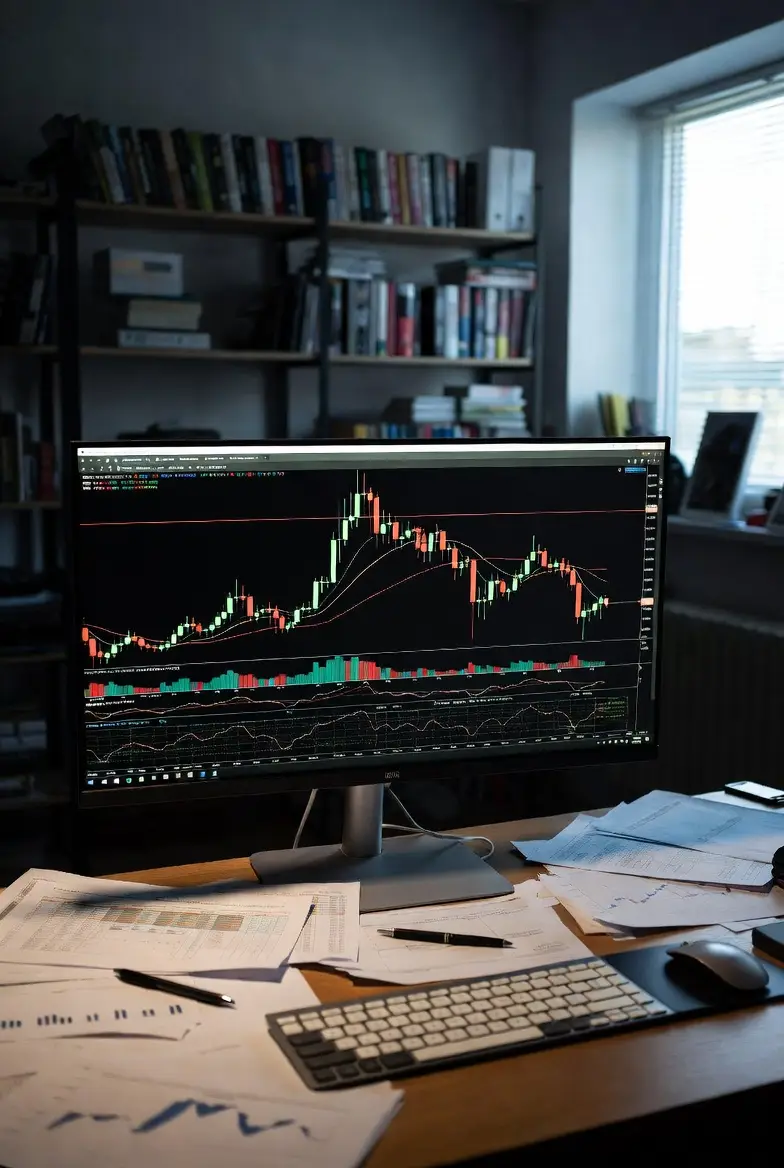
Cryptocurrency market research methods, Bitcoin trading analysis, and digital asset research strategies are the single most important skills you will ever develop as a crypto investor — and the vast majority of people reading this are skipping every single one of them. You know who you are. You’re the person who bought Dogecoin at midnight because a celebrity tweeted a dog emoji. You checked your portfolio 47 times the next day. The coin dropped 60%. You blamed the market. Baby, the market didn’t do that. You did that.
I’ve been trading crypto long enough to know that this market will humble you faster than it will enrich you — unless you come prepared. And “prepared” doesn’t mean having a Twitter account and a gut feeling. It means understanding technical analysis, on-chain data, sentiment indicators, fundamental valuation models, and the macroeconomic forces that send Bitcoin soaring or send you into a spiral of regret eating cereal at 2am wondering where your savings went.
This guide is your complete, researched, evidence-backed, and occasionally hilarious walkthrough of cryptocurrency market research methods. We’re going deep. We’re citing peer-reviewed papers. We’re looking at real case studies. And yes, I’m going to make you laugh, because honestly? If you can’t laugh at this market, it will break you.
Let’s go.
Section 1: What Is Cryptocurrency Market Research — And Why Are You Already Doing It Wrong?
Cryptocurrency market research is the systematic process of gathering, analysing, and interpreting data about digital asset markets in order to make informed trading and investment decisions. It encompasses everything from price chart analysis to blockchain transaction data, developer activity, regulatory developments, and macroeconomic correlation.
Here’s the thing people don’t want to hear: most retail crypto investors don’t do research at all. They do vibes-based investing. They see a coin trending on Reddit, they FOMO in at the top, and then they spend three months watching it bleed, telling themselves it’s just a “dip.” It’s not a dip, my friend. That was a cliff. You walked off it voluntarily.
A landmark survey and comprehensive review published in Financial Innovation highlighted that the cryptocurrency market is driven by a complex interaction of supply and demand dynamics, technological factors, macroeconomic conditions, market volatility, investor psychology, and social media sentiment [1]. Six entire categories of influences! And yet most people check one thing — the price — and treat that as research.
That’s like checking what a car looks like on the outside and deciding you don’t need to look under the hood. Then being surprised when the engine falls out on the motorway.
Proper cryptocurrency market research methods fall broadly into five major categories:
- Technical Analysis (TA) — studying price charts and indicators
- Fundamental Analysis (FA) — evaluating the intrinsic value of a project
- On-Chain Analysis — examining blockchain data directly
- Sentiment Analysis — measuring market psychology
- Macro & Regulatory Analysis — understanding the big-picture economic environment
We’re going to break each one down. Buckle up.
Section 2: Technical Analysis — Reading the Charts (Or: How to Feel Smart While Still Being Wrong)
Technical analysis is the study of historical price data, volume, and market patterns to forecast future price movements. It operates on three core assumptions: that market price reflects all available information, that prices move in trends, and that history tends to repeat itself.
I’ll be honest with you — TA doesn’t always work. Sometimes the chart says the price is going up and then Elon Musk tweets something and the whole market decides it’s going sideways for six months. But here’s the thing: neither does ignoring it. You’ve got to have some framework, and TA is the most universally used framework in crypto trading.
Key Technical Indicators for Crypto Traders
Moving Averages (MA): The Simple Moving Average (SMA) and Exponential Moving Average (EMA) smooth out price data to identify trend direction. The 50-day and 200-day moving averages are especially watched. When the 50-day MA crosses above the 200-day MA, traders call it a “Golden Cross” — a bullish signal. When it crosses below, it’s a “Death Cross.” I named my WiFi “Death Cross 2022” and every time my internet was slow, I felt spiritually connected to the market.
Relative Strength Index (RSI): Developed by J. Welles Wilder, RSI measures the speed and magnitude of price changes on a 0–100 scale. Above 70 is traditionally “overbought” territory; below 30 is “oversold.” In crypto, assets can stay overbought or oversold for alarming periods of time, which is the market’s way of telling you that rules are suggestions, not laws.
Bollinger Bands: These use standard deviation to create dynamic upper and lower price bands around a moving average. When the bands squeeze together, it indicates low volatility and often precedes a large move. In which direction? That’s the question, isn’t it. The Bollinger Bands don’t know either. They’re just optimistic.
MACD (Moving Average Convergence Divergence): This momentum indicator shows the relationship between two EMAs. Crossovers and divergences between the MACD line and signal line are used to identify trend reversals. It sounds complicated. It is a little complicated. But you will feel incredibly important explaining it at dinner parties.
Research Evidence: Does Technical Analysis Actually Work in Crypto?
A significant academic study published in Applied Sciences in 2025 introduced the Rolling Strategy–Hold Ratio (RSHR), a novel methodology that evaluates trading strategies from thousands of different time-entry points to avoid the common pitfall of overfitting to selected periods [2]. The research analysed data across the 2017–2024 period and found that properly applied technical strategies achieved above-average performance consistently — not 100% of the time, but consistently. Consistency matters. That’s why it’s called a trading strategy and not a trading gamble. Well. Sometimes it’s both.
Additionally, a paper on technical analysis and machine learning published on arXiv found that combining classical technical indicators with modern deep learning architectures — particularly Long Short-Term Memory (LSTM) networks — produced stronger predictive accuracy than either approach alone [3]. Translation: the robots are better at reading charts than you are. But you can understand what the robots are doing, which still makes you smarter than the person buying Dogecoin at midnight.
Case Study 1: Bitcoin’s 2020 Golden Cross
In May 2020, Bitcoin’s 50-day moving average crossed above its 200-day moving average, forming a classic Golden Cross on the daily chart. For traders who identified this signal, it marked a significant long entry opportunity. Bitcoin subsequently rallied from approximately $9,000 in May 2020 to over $60,000 by April 2021 — a gain of roughly 567%. The Golden Cross didn’t guarantee that outcome, but it was a technically valid entry signal that aligned with broader market conditions. Those who combined this signal with on-chain and macro data were positioned exceptionally well.
Now I’m not going to sit here and pretend I called that perfectly. I’m a trader, not a prophet. But I did have a position, and I did look at my portfolio every morning like I was expecting a text back from someone special. You know how that feels? Absolutely unhinged. Worth it though.
Section 3: Fundamental Analysis — Does This Thing Actually Have Value?
Fundamental analysis in cryptocurrency is the process of evaluating whether a project’s intrinsic value justifies its market price. Unlike stocks, which have earnings, dividends, and balance sheets, crypto assets are valued on a combination of technology, utility, network adoption, tokenomics, team quality, and ecosystem development.
This is where a lot of casual investors check out. They see “tokenomics” and their eyes glaze over like they just sat down in a university lecture they accidentally walked into. But listen — this is where real edge lives. Technical analysis tells you when to buy. Fundamental analysis tells you what to buy.
Core FA Metrics for Crypto
Market Capitalisation vs. Total Value Locked (TVL): For DeFi protocols, the ratio of market cap to TVL is a key valuation metric. A protocol trading at 1x TVL is very differently situated than one at 10x TVL. Low ratios can indicate undervaluation; extremely high ratios often indicate speculation running ahead of actual usage.
Network Value to Transactions (NVT) Ratio: Developed by Willy Woo, the NVT ratio is analogous to the Price-to-Earnings ratio in stock markets. It divides network value (market cap) by daily on-chain transaction volume. A high NVT suggests the price is high relative to actual on-chain economic activity — a potential indicator of overvaluation. When Bitcoin’s NVT was extremely elevated in late 2017, the subsequent crash to below $4,000 in 2018 was not exactly a surprise to those who were watching it.
Developer Activity: One of the most underrated fundamental metrics. Projects with consistent, high-frequency commits to their public GitHub repositories are actively building. Projects that haven’t touched their code in six months are either finished or the developers are on a very long holiday. Neither is bullish.
Token Supply Mechanics: Inflationary vs deflationary tokenomics matter enormously over time. Bitcoin’s fixed supply of 21 million coins and its halving mechanism — which cuts miner rewards every four years — creates predictable supply scarcity. Understanding emission schedules, vesting periods, and token unlock dates can help you avoid buying into a project right before millions of team tokens become available for sale. That is a specific kind of pain that I would not wish on anyone.
Research Evidence: What Drives Crypto Valuations?
The comprehensive systematic literature review published in China Accounting and Finance Review by Peng et al. (2024) analysed 88 peer-reviewed articles and identified six main categories driving cryptocurrency pricing: supply and demand dynamics, technology factors, macroeconomic conditions, market volatility, investor behavioural attributes, and social media influence [4]. What this tells us is that no single factor dominates — which is why a multi-method research approach is non-negotiable for serious traders.
Case Study 2: Ethereum’s “Merge” — Fundamental Analysis in Action
In September 2022, Ethereum completed “The Merge,” transitioning from a Proof-of-Work consensus mechanism to Proof-of-Stake. For fundamental analysts, this was one of the most scrutinised events in crypto history. The transition dramatically reduced ETH issuance (approximately 90% reduction in new supply per year), eliminated energy-intensive mining, and introduced deflationary mechanics via EIP-1559’s fee burning. Analysts who understood these fundamentals had a clear thesis: reduced supply + increased institutional suitability = structural long-term bullish case.
The market’s reaction was complex — Ethereum dipped short-term but then dramatically outperformed in the subsequent bull cycle. This is what fundamental analysts mean when they say you’re not just trading price, you’re investing in a network. Sometimes the market catches up. When it does, you want to already be there.
Section 4: On-Chain Analysis — Going Straight to the Source
If technical analysis reads the price, and fundamental analysis reads the project, then on-chain analysis reads the blockchain itself. Every transaction, every wallet movement, every exchange deposit and withdrawal — it’s all public, permanent, and analysable.
This is one of crypto’s genuine advantages over traditional financial markets. In the stock market, you can’t see what institutional investors are doing in real time. In crypto, you can watch a whale wallet move 10,000 Bitcoin to an exchange and know within minutes that something interesting might be about to happen. Is that intimidating? A little bit. But it’s also incredibly powerful.
On-chain analysis is the market research method that separate serious crypto analysts from everyone else. It’s like having X-ray vision, except the X-ray machine is a blockchain explorer and the thing you’re seeing through is the entire market’s financial behaviour. No filter. No PR spin. Just raw data.
Key On-Chain Metrics
Exchange Flow: The movement of crypto assets into and out of centralised exchanges. Large inflows to exchanges often signal that holders are preparing to sell (bearish pressure). Large outflows suggest holders are moving assets to cold storage — a long-term holding signal (bullish pressure).
HODL Waves: A visualisation of Bitcoin supply grouped by the last time coins moved. When a large percentage of supply is in “long-term holder” wallets (unmoved for 155+ days), it indicates conviction. When short-term holders control a large share, it often coincides with market tops.
Realised Price: Unlike market price (what the last buyer paid), realised price reflects what the average holder actually paid for their coins. When market price falls below realised price, the average holder is underwater — a condition historically associated with market bottoms and high long-term accumulation value.
Miner Revenue and Hash Rate: Mining economics affect sell pressure. When miner revenue drops significantly, miners may sell holdings to cover operating costs. Hash rate decline can indicate miner capitulation — historically a signal that the worst may be near.
Research Evidence: On-Chain Patterns and Market Behaviour
A rigorous academic paper published in arXiv by Watorek et al. (2023) analysed high-frequency price dynamics of Bitcoin, Ethereum, Dogecoin, and WINkLink across 2020–2022, decomposing market activity into recurring patterns and noise components [5]. The research found distinctly different behaviour from traditional stock markets due to 24/7 trading, identifying three enhanced-activity phases corresponding to Asian, European, and US trading sessions. This has direct practical implications: on-chain data and price action behave differently at different times of day, and sophisticated traders account for this in their execution strategies.
The comprehensive survey of cryptocurrency trading research by Fang et al., covering 146 academic papers, confirmed that on-chain data combined with econometric models consistently produces stronger predictive signals than price-only models [6]. You know what they say — the data doesn’t lie. Only the people selling you a trading course do.
Section 5: Sentiment Analysis — Because the Market Is 80% Emotion
Let me tell you something about markets. Markets are not rational. Markets are a collection of human beings — and human beings are deeply, profoundly irrational when money is involved. Fear and greed don’t just influence the market; they are the market for extended periods of time. Sentiment analysis is the method of quantifying that collective emotional state.
You know how you can walk into a room and just feel the energy? Sentiment analysis is that, but for financial markets, and done with mathematics instead of intuition. It’s the difference between saying “vibes seem off” and saying “the Fear & Greed Index is at 12, social media negativity is elevated, and search volume for ‘crypto crash’ is spiking — reduce exposure.”
Same energy. Very different level of precision.
Tools and Methods for Sentiment Analysis
The Crypto Fear & Greed Index: Perhaps the most widely referenced retail sentiment tool, this index aggregates data from volatility, market momentum, social media, surveys, dominance, and trends to produce a single 0–100 score. 0 = Extreme Fear. 100 = Extreme Greed. Warren Buffett’s famous principle — “be fearful when others are greedy and greedy when others are fearful” — is essentially the manual strategy version of this index.
Social Media Volume and Tone: Twitter/X, Reddit, Telegram, and Discord are where crypto discourse lives. Spikes in social volume for a specific asset often precede price volatility. The direction (positive or negative) of that volume is equally important.
Google Trends: Search volume for terms like “buy Bitcoin,” “crypto crash,” or specific coin names provides a proxy for retail interest. Historical correlations between Google Trends spikes and price tops are striking — and sobering.
Options Market Sentiment: The put/call ratio in crypto derivatives markets reveals whether institutional and sophisticated traders are positioned defensively (puts) or offensively (calls). This is the smart money’s emotional state, and it’s worth watching.
Research Evidence: Social Media Predicts Crypto Prices
This is where the research really gets interesting. A peer-reviewed study published in Mathematics (2023) by di Tollo, Andria, and Filograsso used natural language processing (NLP) and stochastic neural networks to extract sentiment from Twitter and test its predictive power for cryptocurrency price trends [7]. Their model, using data from 2022–2023, showed meaningful predictive accuracy, demonstrating that social sentiment provides genuine information content beyond historical prices alone.
Going further, a study published on arXiv demonstrated a gradient boosting tree model trained on sentiment indices from social media achieved a 0.81 correlation with actual cryptocurrency price movements during testing, with statistical significance at p < 0.0001 [8]. A 0.81 correlation is not perfect, but in financial markets? That’s genuinely remarkable. That’s the difference between a coin flip and an edge.
A further comprehensive review covering machine learning applications in cryptocurrency price prediction from 2014 to 2024 found that sentiment analysis methods using NLP — including large language models (LLMs) — increasingly outperform traditional price-only models when forecasting short-term price direction [9]. The robots are getting smarter about feelings. I don’t know whether that’s inspiring or terrifying.
Case Study 3: The Luna/LUNA Collapse and Sentiment Warning Signs
In May 2022, the algorithmic stablecoin TerraUSD (UST) lost its peg to the dollar, triggering a catastrophic collapse of the Terra ecosystem. The total market value loss exceeded $40 billion in under a week. Before the collapse, multiple sentiment signals were flashing danger: social media was filling with questions about UST’s stability mechanism, on-chain data showed large UST withdrawals from Anchor Protocol, and the Fear & Greed Index had been trending toward fear for weeks.
Traders who were monitoring sentiment data and on-chain flows had meaningful advance notice that something was very wrong. Traders who were checking the price and reading promotional tweets did not. The difference was research. Real, systematic, cross-method research. I cannot stress this enough, and I say this with the energy of someone who has watched colleagues lose significant money because they ignored all the warning signs and said “it’ll bounce back.” It did not bounce back.
Section 6: Macro and Regulatory Analysis — The Big Picture
Here’s a truth that took me embarrassingly long to fully internalise: crypto does not exist in a vacuum. Bitcoin is not immune to interest rate decisions. Ethereum is not unaffected by SEC announcements. The entire digital asset market is increasingly correlated with traditional financial markets, and ignoring the macro environment is like trying to swim without noticing which direction the current is flowing.
You can be perfectly right about your technical setup, your fundamental thesis, and your sentiment read — and still lose money because the Federal Reserve raised interest rates 75 basis points and risk assets went into freefall across the board. It happens. It has happened. It will happen again.
Key Macro Factors Affecting Crypto Markets
Interest Rate Environment: In low-rate environments, risk assets (including crypto) tend to flourish as investors search for yield. In high-rate environments, safer assets become relatively more attractive and speculative markets suffer. The correlation between Bitcoin and the NASDAQ — both high-risk, high-growth assets — has been well-documented in post-2020 market cycles.
Dollar Strength (DXY): The US Dollar Index measures the dollar’s strength against a basket of major currencies. Historically, Bitcoin and the DXY have shown an inverse relationship — when the dollar strengthens, crypto often weakens, and vice versa. This makes intuitive sense: crypto is priced in dollars, and a stronger dollar reduces the purchasing power argument for alternative stores of value.
Institutional Adoption: The January 2024 approval by the US Securities and Exchange Commission of spot Bitcoin ETFs from firms including BlackRock and Vanguard — organisations managing assets exceeding $30 trillion — was one of the most significant macro-regulatory events in crypto history [2]. Following this approval, BlackRock published guidance recommending a 1–2% Bitcoin portfolio allocation, noting that even this conservative allocation could substantially impact Bitcoin’s valuation at institutional scale. This was the moment the “institutional floodgates” narrative stopped being a dream and started being a fact.
Regulatory Developments: The global regulatory landscape for digital assets is constantly evolving. Regulatory clarity tends to be bullish (it enables institutional participation); sudden crackdowns or restrictions tend to be bearish. Traders must monitor legislative developments in the US (SEC, CFTC), the EU (MiCA regulation), and major jurisdictions like the UK, Singapore, and Hong Kong.
Research Evidence: The Macro-Crypto Link
The 2024 bibliometric review published in ScienceDirect, covering scientific production on cryptocurrency and financial assets from 2008 to 2024, identified macroeconomic conditions and regulatory frameworks as two of the most consistently cited determinants of cryptocurrency market performance [10]. The review spanned 88 academic papers and found emerging research themes increasingly focused on sustainability, energy consumption, and institutional integration — all of which are macro-level considerations. The market is maturing. The analysis methods must mature with it.
Case Study 4: Bitcoin Halving Cycles and Macro Timing
Bitcoin undergoes a “halving” approximately every four years, in which the reward for mining new blocks is cut in half. This supply shock mechanism has historically been followed — with a lag of several months — by significant bull markets. The halvings of 2012, 2016, and 2020 each preceded major upward price cycles. The April 2024 halving reduced the block reward from 6.25 BTC to 3.125 BTC, and combined with the ETF approval in January 2024, created a macro-fundamental backdrop that sophisticated analysts had been positioning for well in advance.
Traders who understood the halving cycle, the ETF impact on demand, the macro interest rate trajectory, and the on-chain supply dynamics had a comprehensive research framework. Those who understood all four simultaneously had one of the clearest long-term setups in recent memory. Did everyone execute perfectly? No. Did research give people a genuine edge? Absolutely. Unambiguously yes.
Section 7: Combining Methods — The Research Stack
The most dangerous words in cryptocurrency trading are: “I only need one method.” The trader who only does technical analysis will get destroyed when a project turns out to be a scam with beautiful charts. The trader who only does fundamental analysis will buy a legitimately excellent project at 10x the fair price during a market euphoria and then wait three years to break even. The sentiment-only trader will panic buy and panic sell in perfect synchronisation with the worst possible timing.
Professional-grade cryptocurrency market research is about building what I call a research stack — a layered approach where multiple methods confirm or contradict each other.
Here’s how a research stack actually works in practice:
Step 1 — Macro Filter: What is the macro environment? Are we in a risk-on or risk-off period? What is the Fed doing? Where is the DXY? This determines the overall market posture: aggressive, neutral, or defensive.
Step 2 — Fundamental Screening: Which projects have genuine utility, active development, strong tokenomics, and network growth? This is your universe of candidates.
Step 3 — On-Chain Confirmation: For your shortlisted projects, what does the on-chain data say? Are large wallets accumulating or distributing? Is exchange flow bullish? What does the realised price tell us about value zones?
Step 4 — Sentiment Timing: What is the current sentiment environment? Is the project being discussed constructively or hysterically? Is the broader market in fear or greed? Sentiment helps you time entries — you want to buy when others are fearful about a fundamentally sound project.
Step 5 — Technical Execution: Once your macro, fundamental, on-chain, and sentiment analysis all align, technical analysis tells you exactly where to put your order. You use TA for entry precision, not for the overall thesis.
This stacked approach turns research from a series of isolated opinions into a converging weight of evidence. You’re not betting on one thing being right. You’re identifying situations where multiple independent methods all agree.
And when multiple independent methods all agree and you still lose money? The market laughs at you. That’s allowed. I’ve been there. I laughed too. Eventually.
Section 8: Tools of the Trade — Your Research Arsenal
You cannot do modern cryptocurrency market research without the right tools. Here are the most respected platforms across each category, used by professional traders and institutional analysts.
Technical Analysis
- TradingView — Industry standard for charting. Custom indicators, multi-timeframe analysis, and alerts. The free tier is surprisingly capable; paid tiers are worth it for serious traders.
- Coinigy — Multi-exchange charting and portfolio tracking, popular among active traders.
On-Chain Analysis
- Glassnode — The gold standard for on-chain data. Tracks realised price, HODL waves, exchange flows, miner metrics, and hundreds of blockchain-native indicators.
- Nansen — Blockchain analytics with wallet labelling. See what “smart money” wallets are doing in real time.
- Dune Analytics — Community-powered on-chain dashboards, increasingly comprehensive for DeFi analytics.
Sentiment Analysis
- Alternative.me Fear & Greed Index — Simple, widely tracked, and useful as a contrarian indicator.
- LunarCrush — Crypto-specific social media analytics tracking volume, engagement, and tone.
- Santiment — Combines on-chain data with social media sentiment metrics.
Fundamental Research
- Messari — Professional-grade crypto research and real-time metrics. The Bloomberg of digital assets.
- DeFiLlama — The definitive source for TVL data across DeFi protocols.
- CryptoMiso — Tracks GitHub developer activity across projects.
Macro and News
- CoinDesk and The Block — Tier 1 crypto journalism covering regulatory and institutional developments.
- FedWatch Tool (CME Group) — Tracks market expectations for Federal Reserve rate decisions. Critical for macro-aligned traders.
Section 9: The Psychology of Cryptocurrency Market Research
I need to talk about this because no article on market research is complete without acknowledging the biggest enemy of good research: yourself.
Here’s the honest truth. You can learn every method in this article. You can set up TradingView, get a Glassnode subscription, track the Fear & Greed Index every morning, read DeFiLlama before breakfast, and still make absolutely catastrophic decisions — because the moment real money is involved, your brain turns against you.
Confirmation bias is the biggest culprit. You research a coin, you like it, and then — almost without noticing — you start finding evidence that supports your position and dismissing everything that contradicts it. The chart’s looking bearish? Temporary noise. The founder just sold 30% of their tokens? They probably needed money for something legitimate. Exchange deposits are spiking? Could mean anything. You are basically a lawyer representing your own bad trade, and you are working very hard for your client.
This is not weakness. This is literally how human brains are wired. We are not evolved to be rational about potential gains and losses. The amygdala doesn’t care about technical divergences.
The professional response is to build research processes rather than making research decisions in the moment. Define your criteria before you look at a trade. Write them down. Assign weights to your indicators. Don’t change your framework mid-analysis because you already want the trade to work.
The coulda been trades are always the most painful — the ones where your research was right, but emotion overrode it. Automated alerts. Pre-defined stop losses. Position sizing rules you don’t negotiate with yourself. The market will test every one of them. Hold the line.
Section 10: Building Your Personal Research Process — A Practical Framework
Let’s put this all together. Here’s a practical, step-by-step research framework you can begin implementing immediately. This is not a theoretical exercise. This is how professional cryptocurrency research actually gets done.
The Pre-Trade Research Checklist
Macro Layer (weekly review)
- [ ] Current Federal Reserve stance and rate trajectory
- [ ] DXY trend (strengthening or weakening)
- [ ] Bitcoin dominance (rising = risk-off within crypto; falling = alt season conditions)
- [ ] Any pending major regulatory decisions
Fundamental Layer (per project)
- [ ] What problem does this project solve, and is the problem real?
- [ ] Who is the team, and what is their track record?
- [ ] What are the tokenomics? Check supply schedule, vesting, and inflation rate.
- [ ] How active is development? Check GitHub commits over the past 90 days.
- [ ] What is the current TVL or network activity relative to market cap?
On-Chain Layer (per project)
- [ ] Are large wallets accumulating or distributing?
- [ ] What is the exchange flow trend over the past 30 days?
- [ ] Where is the current price relative to realised price?
- [ ] Are long-term holders holding or beginning to sell?
Sentiment Layer (daily check)
- [ ] Current Fear & Greed Index reading
- [ ] Social volume and sentiment for target asset
- [ ] Any relevant news driving sentiment?
Technical Layer (entry timing)
- [ ] Identify key support and resistance zones
- [ ] Check RSI across multiple timeframes
- [ ] Look for volume confirmation at key levels
- [ ] Define exact entry, stop loss, and take profit levels before opening the trade
When all five layers are aligned — macro is supportive, fundamentals are strong, on-chain is bullish, sentiment is fearful (a contrarian entry signal), and technical analysis gives a clean setup — you have as strong a research-backed trade as this market can provide.
Will you still sometimes be wrong? Yes. This is crypto. But you will be systematically, intelligently, defensibly wrong — not randomly, emotionally, avoidably wrong. There is a profound difference between those two outcomes, even when the P&L looks the same short-term.
Conclusion: Research Is the Edge You Actually Control
Here’s my final thought, and I mean it sincerely beneath all the jokes: cryptocurrency market research methods are the only sustainable edge available to individual traders.
You can’t out-compute the algorithmic traders. You can’t out-capitalise the institutions. You can’t predict regulatory announcements or a sudden viral tweet that swings the entire market. You cannot control the volatility, the manipulation, or the sentiment swings that can move assets 20% in an afternoon.
But you can do better research than 90% of the market. And in a game where most participants are doing none, doing real, systematic, multi-method research puts you in a genuinely different category.
The five methods we’ve covered — technical analysis, fundamental analysis, on-chain analysis, sentiment analysis, and macro/regulatory analysis — are not competing. They are complementary lenses. Each shows you something the others can’t. Together, they build a picture that approaches something resembling clarity in a market constitutionally designed to be confusing.
Start building your research stack. Use the tools. Read the data. Build the process. Question your own biases. And when the market still does something completely irrational despite all your excellent research? Laugh. Take notes. Adjust. Come back tomorrow.
The market will humble you. But a humble, well-researched trader who learns from every trade is infinitely more dangerous to this market than a confident, gut-feeling FOMO buyer who got lucky twice and thinks they’ve cracked the code.
Now go do your research. Stop buying coins because of dog emojis.
References
- Peng, S., Prentice, C., Shams, S., & Sarker, T. (2024). A systematic literature review on the determinants of cryptocurrency pricing. China Accounting and Finance Review, 26(1), 1–30. https://doi.org/10.1108/CAFR-05-2023-0053
- Šimko, M., & Šimko, P. (2025). Timing Usage of Technical Analysis in the Cryptocurrency Market. Applied Sciences, 15(23), 12802. https://doi.org/10.3390/app152312802
- Macedo, L., et al. (2024). Technical Analysis Meets Machine Learning: Bitcoin Evidence. arXiv preprint. https://arxiv.org/abs/2511.00665
- Peng et al. (2024) — full reference as [1] above. https://doi.org/10.1108/CAFR-05-2023-0053
- Watorek, M., Skupień, M., Kwapień, J., & Drożdż, S. (2023). Decomposing cryptocurrency high-frequency price dynamics into recurring and noisy components. arXiv preprint arXiv:2306.17095. https://arxiv.org/pdf/2306.17095
- Fang, F., Ventre, C., Basios, M., Kong, H., Kanthan, L., Martinez-Rego, D., Wu, F., & Li, L. (2021). Cryptocurrency Trading: A Comprehensive Survey. arXiv preprint arXiv:2003.11352. https://arxiv.org/pdf/2003.11352
- di Tollo, G., Andria, J., & Filograsso, G. (2023). The Predictive Power of Social Media Sentiment: Evidence from Cryptocurrencies and Stock Markets Using NLP and Stochastic ANNs. Mathematics, 11(16), 3441. https://doi.org/10.3390/math11163441
- Lamon, C., Nielsen, E., & Redondo, E. (2018). Sentiment-Based Prediction of Alternative Cryptocurrency Price Fluctuations Using Gradient Boosting Tree Model. arXiv preprint arXiv:1805.00558. https://arxiv.org/pdf/1805.00558
- Chowdhury, R., et al. (2024). Enhancing Cryptocurrency Market Forecasting: Advanced Machine Learning Techniques and Industrial Engineering Contributions. arXiv preprint arXiv:2410.14475. https://arxiv.org/pdf/2410.14475
- Narang, N., et al. (2025). Cryptocurrency research: Bibliometric review and content analysis. ScienceDirect / International Review of Financial Analysis. https://www.sciencedirect.com/science/article/pii/S1059056025001030
Disclaimer: This article is for educational and informational purposes only. Nothing in this article constitutes financial advice. Cryptocurrency markets are highly volatile and speculative. Always conduct your own research before making any investment decisions.
Leave a Reply
You must be logged in to post a comment.