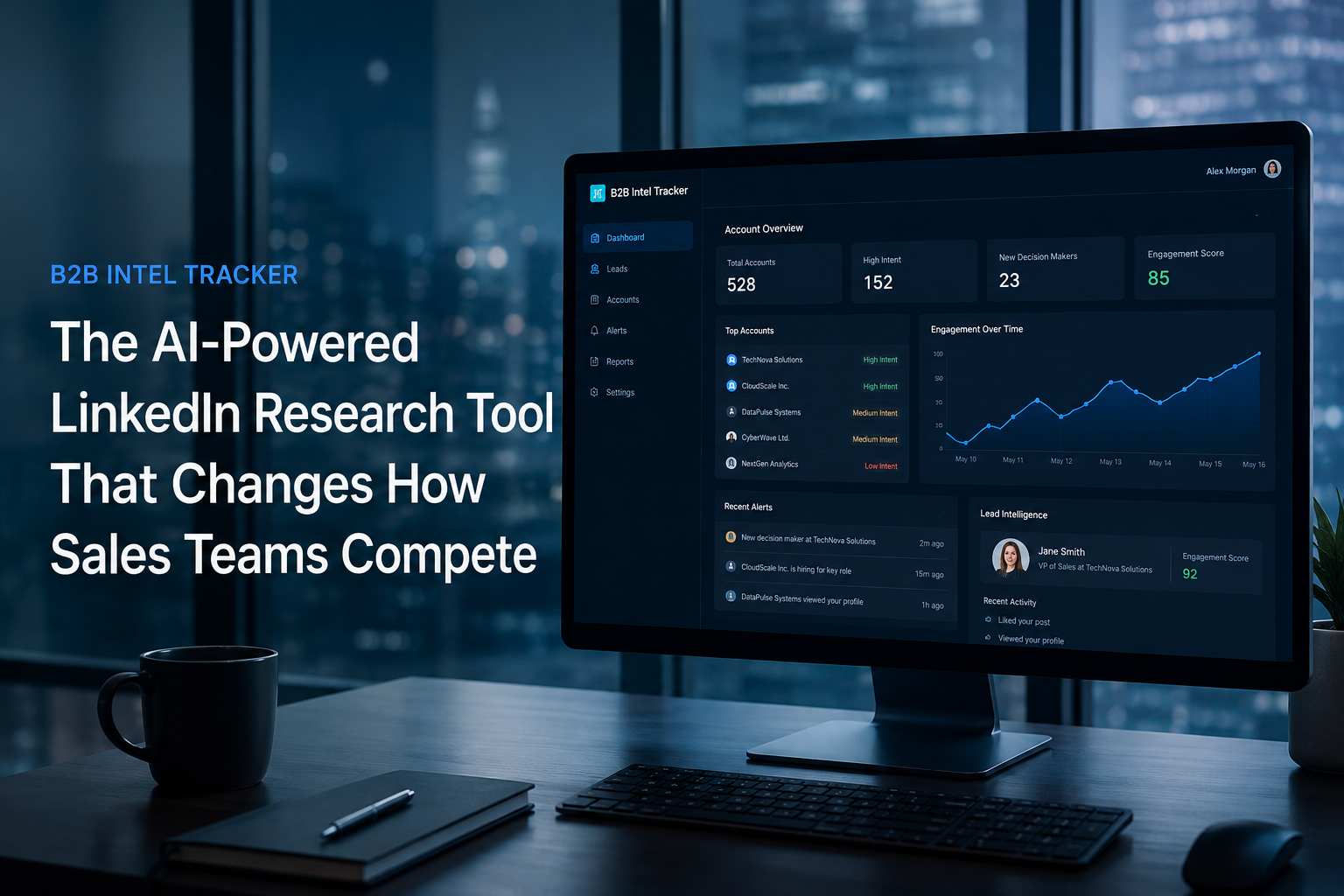
The B2B Intel Tracker is a free, single-file React web app that combines competitor tracking, buyer persona management, Boolean search generation, and AI-powered strategic reports in one dark-mode command center. Built with direct Anthropic API integration, it gives any go-to-market team enterprise-grade LinkedIn intelligence capabilities without subscriptions, backends, or build tools.
There is a particular kind of frustration that every revenue leader knows well. It surfaces on Sunday evenings, in the quiet between the week that just ended and the one about to begin. It is the suspicion — sometimes a certainty — that somewhere across town, or across the continent, a competitor is moving faster. Hiring the right people. Messaging the right buyers. Closing the deals you thought were yours.
The antidote to that frustration is intelligence. Not the vague, impressionistic kind gathered from a quarterly analyst briefing or a competitor’s homepage refresh, but the granular, real-time, actionable kind: who is a rival company bringing into its product team? Which pain points are your ideal customers posting about publicly? What Boolean combination unlocks the hidden layer of LinkedIn where your next ten customers are waiting to be found?
Until recently, building that kind of intelligence infrastructure required a dedicated analyst, a suite of expensive tools, and hours of manual synthesis every week. The B2B Intel Tracker changes that equation entirely. It is a single-page React application that combines a clean, dark-mode command-center interface with direct integration to the Anthropic API, bringing genuine AI-powered competitive research to any go-to-market team willing to spend twenty minutes setting it up.
This article takes a comprehensive look at what the tool does, how it works, why the design choices behind it matter, and how sales, marketing, and revenue operations teams can extract maximum value from it.
The Intelligence Gap in Modern B2B Sales
Before examining the tool itself, it is worth understanding the problem it solves — because that problem is larger and more structurally embedded than most teams acknowledge.
The modern B2B buyer journey is long, complex, and heavily influenced by digital signals that exist long before any sales conversation begins. Buyers research vendors for months before filling out a demo form. They post on LinkedIn about their frustrations, their priorities, their vendor evaluations. They attend conferences, shift roles, raise funding rounds, and build new teams. Every one of these events is a signal. Taken together, they form a rich, continuously updating picture of where the market is moving and which buyers are most likely to convert.
The challenge is that capturing and synthesizing those signals at scale requires infrastructure most teams do not have. Large enterprises can afford dedicated competitive intelligence platforms, full-time analysts, and integrations between half a dozen data providers. But the majority of B2B companies — and almost all early-stage and mid-market ones — operate without any systematic approach to competitive intelligence. They track competitors manually, update a shared Google Doc sporadically, and rely on sales reps to surface competitive intel organically from deal conversations.
The result is a persistent intelligence gap. Teams make pricing decisions without knowing what competitors are charging. They build messaging without understanding how rival positioning is landing. They build outbound sequences targeting the wrong personas because no one has recently revisited who the ideal customer profile actually is.
Consider what that gap costs in practice. A sales team that discovers mid-deal that a competitor has launched a new feature directly relevant to the prospect’s requirements is a team that has been caught flat-footed. A marketing team that builds a campaign around a differentiator the market has stopped caring about wastes not just budget but momentum. An account executive who cannot answer a prospect’s question about how their product compares to the category leader leaves that conversation with reduced credibility and an uphill re-engagement battle.
These are not hypothetical failures. They happen every week at companies of every size. The underlying cause is almost always the same: the intelligence infrastructure did not exist, was not maintained, or was not accessible at the moment it was needed.
LinkedIn is the most under-leveraged asset in most B2B intelligence programs. It is a living, continuously updated database of professional intent signals. When a Head of RevOps posts about their frustrations with their current CRM, that is a buying signal. When a competitor announces a wave of enterprise sales hires, that is a strategic signal. When a target account’s VP of Engineering changes jobs to a company in your ICP, that is a prospecting signal. The challenge is that systematically monitoring these signals, organizing them into actionable intelligence, and translating them into effective search and outreach strategies requires both discipline and tools that most teams lack.
The B2B Intel Tracker is designed to close that gap — not by replacing enterprise intelligence platforms, but by giving smaller teams a structured, AI-assisted framework for gathering, organizing, and acting on competitive and buyer intelligence from one of the richest professional data sources available.
Architecture and Design Philosophy
The application is built as a single-page React app, which means everything loads once and navigation between modules happens without page refreshes. This architectural choice is not merely a technical preference — it reflects a deliberate decision about how intelligence tools should feel to use.
Competitive research is inherently non-linear. A sales leader reviewing a competitor profile will want to immediately jump to the Boolean search generator to find that competitor’s key hires on LinkedIn. A marketing strategist reviewing buyer persona pain points will want to spin up a positioning report without losing their place. The single-page architecture supports these fluid, associative workflows in a way that a traditional multi-page application cannot.
The visual language of the tool is equally deliberate. The dark command-center aesthetic — deep navy backgrounds, subtle grid lines, cyan and indigo accent colors, glassmorphic cards — is not simply a stylistic preference. It signals to users that this is an intelligence environment, not a customer-facing interface. The typography pairing of DM Serif Display for headings and IBM Plex Sans for body text creates a tension between editorial authority and technical precision that feels appropriate for a tool sitting at the intersection of strategy and data.
The application uses CSS-in-JS styling with inline styles and CSS variables for theming, which keeps the component architecture clean and eliminates the need for an external stylesheet. Tailwind utility classes inform the spacing and layout logic, while the custom color palette — built around the primary accent of sky blue (#0EA5E9) and secondary indigo (#6366F1) — provides consistent visual hierarchy across all five modules.
The Five Modules: A Deep Dive
Module One: The Dashboard
The Dashboard is the first thing users see after entering their Anthropic API key, and it serves two purposes simultaneously: it provides an at-a-glance summary of the intelligence gathered across the tool, and it sets the cognitive tone for how users should engage with market data.
The top row of metric cards displays four core numbers: competitors tracked, buyer personas defined, total intel signals collected, and search templates available. These are not vanity metrics. They are proxies for the completeness of the intelligence picture. A team that has tracked only two competitors and defined a single buyer persona is operating with a narrow view of the market. The dashboard makes that incompleteness visible, creating a gentle ongoing pressure to expand the intelligence coverage.
Below the metric cards, the Dashboard splits into two panels. On the left, the Competitor Threat Matrix displays each tracked competitor alongside a color-coded strength bar. The color encoding is intentional and instructive: red bars signal high-threat competitors (strength scores above 80), amber indicates moderate threats, and green marks lower-priority players. At a glance, any team member can understand where competitive attention should be focused without reading a word of analysis.
On the right, the Latest Signals panel aggregates the most recent intel signals from all tracked competitors into a unified feed. This is where the intelligence infrastructure starts to feel alive. Rather than siloed competitor profiles that each require individual review, the signal feed creates a single stream of market movement that can be scanned in under a minute.
The design of the Dashboard reflects a core philosophy of the tool: intelligence should reduce cognitive load, not increase it. Every element is there to make complex market dynamics easier to grasp, not to demonstrate comprehensiveness for its own sake.
Module Two: Competitor Intelligence
The Competitor Intelligence module is the operational core of the B2B Intel Tracker. It is where teams build and maintain their competitive profiles — and where the Anthropic API integration first demonstrates its value.
Each competitor card displays five key pieces of information: the company name, the key contact title being tracked, the competitor’s strategic focus area, a threat score, and a list of intel signals. The threat score is a 0-to-100 numeric assessment of competitive danger, set by the user and visualized as a color-coded strength bar. It is intentionally subjective — the point is not to derive a scientifically precise threat level, but to force a qualitative judgment that can be tracked and revised over time.
The intel signals section is where the module earns its place. Signals are short, specific observations about competitor behavior: a large engineering hire, a new product launch, a geographic expansion, a pricing model change, a strategic partnership. They are the raw material from which competitive strategy is built. The application provides seed signals for the pre-populated competitors (Salesforce, HubSpot, and Pipedrive) to illustrate the kind of information worth tracking: “Hiring 40+ ML engineers,” “New Einstein AI launch,” “EU expansion push,” “API partner program.”
The AI Analysis button is where the module becomes genuinely powerful. When a user clicks it for a given competitor, the application sends a structured prompt to the Anthropic API through a direct browser fetch, passing the competitor’s name, strategic focus, and current signals as context. The prompt is engineered to produce actionable output — not a summary of what was already known, but an assessment of threat level, identification of key strategic moves, and specific counter-action recommendations.
This is not a trivial capability. Generating this kind of synthesis from raw competitive data typically requires either a skilled analyst or a lengthy manual process. The AI Analysis feature compresses that work to a few seconds, producing a concise bullet-point briefing that a sales rep can read before a competitive call or a CMO can reference when reviewing messaging strategy.
The module also includes full CRUD functionality: users can add new competitors through an inline form that captures company name, key contact title, strategic focus, and initial threat score, and remove competitors they no longer wish to track. The threat score slider in the add form is a small but meaningful design detail — it forces the person adding the competitor to immediately make a judgment about how seriously to take them, rather than deferring that assessment indefinitely.
Module Three: Buyer Personas
If the Competitor Intelligence module is about understanding the threats coming from the outside, the Buyer Personas module is about understanding the opportunities waiting to be captured. It provides a structured framework for defining, documenting, and operationalizing ideal customer profiles — and it closes the loop between persona definition and LinkedIn prospecting in a way that most CRM systems never do.
Each persona card captures five dimensions of the ideal customer: job title, seniority level, industry, pain points, and targeting keywords. The pain points section is particularly valuable because it forces teams to think from the buyer’s perspective rather than the seller’s. A sales team that can articulate three specific pain points for a Revenue Operations Director at a Series B SaaS company — “fragmented data,” “manual reporting,” “poor forecast accuracy” — will write better outbound emails, build more resonant sequences, and qualify deals more efficiently than one that relies on generic ICP descriptions.
The keywords section serves a different but complementary function. These are the terms ideal buyers use in their own LinkedIn posts, job descriptions, and public communications. Capturing them in the persona profile creates a vocabulary for search and outreach that is grounded in the buyer’s own language rather than internal marketing jargon.
The most distinctive feature of the Buyer Personas module is the automatic LinkedIn Boolean query generation. When a new persona is saved, the application constructs a Boolean search string from the title, seniority, and industry fields and displays it at the bottom of the persona card. For the pre-populated Revenue Operations Lead persona, for example, the generated query reads: title:"Revenue Operations" AND ("Director" OR "Head of") AND "SaaS". This is a ready-to-paste LinkedIn Sales Navigator or Recruiter search string that would surface exactly the kind of profiles the team should be targeting.
This feature represents a meaningful workflow acceleration. Building effective Boolean search strings is a skill that takes time to develop, and most salespeople are not particularly good at it. By automating the translation from persona definition to search syntax, the application removes a bottleneck that typically sits between strategic ICP work and tactical outbound prospecting.
Module Four: Boolean Search Generator
The Boolean Search Generator is the module most directly focused on LinkedIn research tradecraft. While the Buyer Personas module auto-generates basic search strings from persona definitions, the Boolean Search Generator provides a full environment for constructing, editing, and AI-optimizing complex search queries for six distinct research use cases.
The six templates cover the most valuable categories of LinkedIn intelligence work:
ICP Targeting is the foundational use case — finding the right job titles at the right company types with the right seniority level. The template provides a structure with placeholders for title, seniority levels, and company type, which users fill in for their specific context.
Competitor Employees is a more sophisticated and frequently underused technique. By searching for current or former employees of a specific competitor, filtered by seniority and function, teams can identify people who understand a rival’s product deeply — either as potential recruits or as sources of competitive insight. The template excludes interns by default, a small detail that reflects real-world best practice.
Hiring Intelligence is one of the highest-signal competitive research techniques available on LinkedIn. When a competitor posts a wave of job listings in a specific function, it reveals strategic direction with more reliability than any press release. The template constructs searches that surface posts and profiles linking a company name to hiring activity in a specific role or department.
Pain Point Signals flips the approach: instead of searching for people with a specific title, it searches for people who are talking about specific problems. This is particularly powerful for identifying in-market buyers — people whose public LinkedIn activity reveals active pain that the seller’s product can address.
Event Attendees is valuable for conference-driven sales motions. By combining an event name or hashtag with target job titles, teams can rapidly identify high-value prospects who are already signaling interest in a relevant topic or community.
Funding Trigger is perhaps the highest-intent template. Recent funding is one of the strongest buying signals in B2B sales, because newly funded companies almost universally expand their revenue teams, invest in new tools, and have budget to deploy. The template constructs searches that combine funding language with industry and title filters to surface exactly those buyers.
The AI optimization feature is where the module’s full potential is realized. Users can type additional context into the AI Context field — describing the specific scenario, target market, or use case they are working on — and click AI Optimize Query to send the current search string and context to the Anthropic API. The model returns a refined, production-ready Boolean string that applies proper LinkedIn search syntax, incorporates the additional context, and is generally more precise and effective than what most users would construct manually.
The copy functionality completes the workflow: with a single click, the original or AI-optimized query is copied to the clipboard and ready to paste directly into LinkedIn Sales Navigator, LinkedIn Recruiter, or the standard LinkedIn search bar.
Module Five: Strategic Reports
The Strategic Reports module is where the intelligence gathered across the tool is transformed into decision-ready outputs. It provides four distinct report types, each generated by the Anthropic API from the live data in the tracker — competitor profiles, threat scores, signals, and persona definitions.
Competitive Landscape produces a structured analysis of the competitive environment as a whole. Given the competitors in the tracker, their threat scores, strategic focuses, and signals, the model synthesizes an executive summary, identifies the top three threats, surfaces strategic opportunities, and recommends specific actions. This is the kind of document that typically takes an analyst a day or more to produce from scratch. The AI generates a solid first draft in seconds.
ICP Strategy Brief draws on the buyer persona data to produce a strategic document covering primary ICP definition, key messaging angles, recommended LinkedIn targeting approach, and specific outreach triggers. This bridges the gap between persona research and tactical execution — it is the document a new sales hire should read before their first outbound call, and the document a marketing director should reference when reviewing campaign messaging.
Battle Card is built for the sales floor. It uses competitor data to produce a practical competitive selling tool: key differentiators, objection handling scripts, competitive traps to avoid, and a winning talk track. Battle cards are notoriously difficult to keep current — most sales teams have a folder of outdated ones that no one reads. Because this battle card is generated from live tracker data, it reflects the current competitive landscape rather than a snapshot from six months ago.
Positioning Report is the most strategic of the four outputs. It combines competitor and persona data to produce a market positioning analysis covering the company’s position relative to competitors, unique value propositions, a messaging framework, and identification of white space opportunities — gaps in the market that competitors are not addressing.
The data sources panel on the left side of the reports module displays exactly which competitors and personas will be used in the generated report, giving users confidence about what is informing the analysis. The copy button on generated reports makes it easy to take the output into a document editor for refinement and distribution.
The Anthropic API Integration: Design Decisions That Matter
The decision to integrate directly with the Anthropic API — rather than building a backend that manages API calls server-side — is one of the most interesting architectural choices in the B2B Intel Tracker, and it deserves examination.
Direct browser-to-API calls require the user to provide their own API key and store it in application state. This design has a number of implications. On the security side, it means the application never stores or transmits API keys to any intermediary server — the key goes directly from the user’s browser to Anthropic’s endpoint. This is, in most respects, a more secure arrangement than one where keys are stored in a database. The risk surface is smaller, and the user retains complete control over their own credentials.
On the operational side, it means each user pays for their own API usage, which scales naturally with actual use. There is no shared quota, no risk of one team’s heavy usage degrading performance for others, and no subscription model to manage.
The model selection — claude-sonnet-4-20250514 — reflects a deliberate balance between capability and cost. Claude Sonnet is fast enough for the response times the interface demands, capable enough to produce genuinely useful competitive analysis and report content, and cost-effective enough for the kind of repeated, exploratory use that competitive research encourages.
The prompt engineering across the four AI-powered features (competitor analysis, Boolean query optimization, and the four report types) follows a consistent philosophy: provide rich context, specify the output format precisely, and ask for actionable rather than descriptive outputs. The competitor analysis prompt, for example, explicitly asks for bullet points, a 150-word maximum, and specific coverage of threat level, strategic moves, and counter-actions. This kind of structured prompting dramatically improves the consistency and usefulness of the outputs.
Practical Workflows: How Teams Should Use the Tool
Understanding the features of the B2B Intel Tracker is one thing. Understanding how to integrate it into a real go-to-market workflow is another. Here are four specific workflow patterns that extract maximum value from the tool.
The Weekly Intel Review
Every Monday morning, a revenue operations lead opens the B2B Intel Tracker and reviews the Dashboard. They scan the threat matrix for any changes since last week, check the signal feed for new competitor activity, and add any new signals they have collected through the week — from LinkedIn posts, job listings, customer conversations, or press coverage. If any competitor’s signals have materially changed, they click the AI Analysis button to regenerate the competitive briefing and share it with the broader revenue team in their weekly stand-up.
This workflow takes fifteen to twenty minutes and produces a shared, current understanding of the competitive landscape that informs pricing discussions, sales conversations, and marketing decisions for the week ahead. The discipline of a weekly review also creates a habit of active intelligence gathering. When sales reps know that a weekly intel review is happening, they become more alert to competitive signals in their own conversations and more likely to feed them back into the system.
The New Market Entry Research Sprint
A marketing director preparing to launch in a new vertical spends two hours in the B2B Intel Tracker building out the intelligence picture. They add the three to five leading competitors in the new space, research their strategic focuses and signals, and set preliminary threat scores. They then build out two or three buyer personas for the new vertical, defining pain points and keywords through a combination of LinkedIn research and customer interviews. They use the Boolean Search Generator to construct targeted search strings and use the AI optimization feature to refine them. Finally, they run the ICP Strategy Brief and Positioning Report to generate a first-draft strategic foundation for the new vertical launch.
What would previously have taken two days of manual research and document writing is compressed to a focused two-hour session. Crucially, the outputs are not just faster — they are more structured and more reproducible. Because the research is organized in the tracker rather than scattered across browser tabs and Notion pages, it can be revisited, updated, and built upon as the vertical matures.
The Pre-Call Competitive Prep
A senior account executive has a late-afternoon call with a prospect who has been evaluating a key competitor. They open the competitor’s profile in the B2B Intel Tracker, check the current signals, and click AI Analysis to refresh the competitive briefing. They then generate an updated Battle Card to review the latest objection handling and differentiators. They are on the call ten minutes later, prepared with specific, current intelligence rather than relying on six-month-old battle card content.
The difference between walking into a competitive deal briefed and unbriefed is often the difference between winning and losing. The account executive who can reference a competitor’s recent pivot, anticipate the objections it creates, and articulate a crisp counter-position is demonstrating intelligence — in both senses of the word.
The Outbound Campaign Build
A sales development representative is building a new outbound sequence targeting a specific buyer type. They open the Buyer Personas module, review the existing persona for the target role, and note the pain points and keywords. They navigate to the Boolean Search Generator and use the ICP Targeting template to build a search string, then use the AI optimization feature with context about the specific campaign — the product being promoted, the value proposition being tested, the vertical being targeted. The refined search string goes directly into LinkedIn Sales Navigator. Within the hour, the rep has a prospect list of several hundred qualified, persona-matched profiles and the pain-point vocabulary to write messaging that will actually resonate.
This workflow replaces what is often an hour of fumbling with LinkedIn search — building queries by trial and error, getting too many results, narrowing too aggressively — with a structured, AI-assisted process that produces better results faster.
Limitations and Honest Caveats
No tool is without limitations, and intellectual honesty requires naming them clearly.
The B2B Intel Tracker is a research organization tool, not a data source. It does not automatically surface competitor signals from the web — users must add signals manually, which requires consistent discipline. Teams that do not build a habit of adding signals will find their competitor profiles quickly going stale. The solution to this is not a technical one; it is a behavioral one. The tool needs a champion who makes intel gathering a weekly practice, and that champion needs organizational support to sustain it.
The LinkedIn Boolean queries generated by the tool are starting points, not finished products. LinkedIn’s search algorithm applies its own relevance weighting on top of Boolean logic, which means that even a technically correct query may return unexpected results depending on how LinkedIn’s ranking systems are calibrated at any given moment. The AI-optimized queries are generally better than what most users would build manually, but they should be treated as drafts to be refined through real search sessions rather than final strings to be deployed without testing.
The AI-generated reports and analyses are based entirely on the data in the tracker. If that data is incomplete or inaccurate — if threat scores are miscalibrated, if signals are outdated, if personas are based on assumptions rather than research — the reports will reflect those limitations. Garbage in, garbage out remains as true with AI as without it. The competitive landscape report, for instance, will be significantly more useful for a team that has tracked ten competitors with fifteen signals each than for a team that has two competitors with no signals. The AI synthesizes what it is given; it cannot compensate for absent intelligence.
There is also a contextual limitation to acknowledge. The AI analyses and reports are good first drafts — they surface patterns and recommendations that a skilled analyst might produce — but they lack the specific organizational and market context that a deep domain expert would bring. The Battle Card generated from tracker data will be more useful to a team that reviews, edits, and adds their own hard-won competitive positioning than to a team that deploys it verbatim without validation.
Finally, the direct browser-to-API architecture means the application requires an active Anthropic API key and a live internet connection to use any AI features. Teams working in environments with strict network controls or API usage restrictions will need to account for this. The non-AI features — the competitor tracking, the persona builder, the search template library, the Dashboard — work fully without an API connection, but the analytical horsepower that makes the tool most powerful requires it.
The Broader Significance: Democratizing Competitive Intelligence
Stepping back from the specific features of the B2B Intel Tracker, the tool represents something larger: a demonstration of what becomes possible when AI is integrated thoughtfully into professional workflow tools at the application layer.
For most of the history of B2B sales and marketing, competitive intelligence has been a function of organizational scale. Large companies with large budgets could build robust intelligence capabilities. Everyone else made do with ad hoc research and gut instinct. The emergence of capable, affordable AI APIs changes that equation in a fundamental way. The analysis that previously required a skilled analyst can now be generated from structured data by any team member, in seconds, using a tool that costs nothing to build and pennies to run.
The B2B Intel Tracker is a proof of concept for this new paradigm. It shows what a small, focused AI-integrated application can do for a specific professional workflow — and it invites the question of how many other intelligence-intensive professional tasks could be similarly transformed.
The answer, almost certainly, is many. Legal research. Financial analysis. Clinical literature review. Regulatory compliance monitoring. Strategic planning. In each of these domains, the same fundamental pattern applies: there is structured data to be gathered and maintained, and there is analytical synthesis to be generated from that data. AI can accelerate and improve the synthesis step in all of them.
But the B2B Intel Tracker does not just demonstrate a technical possibility — it demonstrates a design philosophy. The tool is useful not merely because it has AI capabilities, but because those capabilities are embedded in a well-designed, workflow-appropriate interface that makes them easy to access and act on. The AI features do not dominate the tool; they complement it. The Boolean Search Generator works without the AI optimization. The Competitor profiles are useful without the AI analysis. The AI features accelerate and enhance workflows that would exist and have value without them.
This is the right model for AI integration: additive, not substitutive. The human researcher still does the work of identifying competitors, gathering signals, defining personas, and interpreting reports. The AI accelerates the synthesis steps and lowers the barrier to producing structured, polished outputs from raw research. The combination is more powerful than either alone.
Conclusion
The B2B Intel Tracker is a compact, elegant, and genuinely useful tool for go-to-market teams who need to compete intelligently without the budget or headcount of an enterprise intelligence operation. Its five modules — Dashboard, Competitor Intelligence, Buyer Personas, Boolean Search Generator, and Strategic Reports — address the core needs of competitive and buyer research with a coherent, workflow-aware design that makes AI assistance feel natural rather than forced.
The direct Anthropic API integration is its most distinctive technical feature, enabling real-time competitive analysis, search query optimization, and strategic report generation from within a single interface. The dark command-center aesthetic communicates authority and precision. The single-page architecture supports the fluid, non-linear way that strategic research actually happens.
For sales leaders building competitive programs on a budget, for marketing directors developing ICP strategy for new verticals, for revenue operations teams trying to create a shared, current view of the market — the B2B Intel Tracker is a tool worth adopting and integrating into weekly practice.
Intelligence has always been the advantage that separates companies that win from those that merely compete. The B2B Intel Tracker makes that advantage accessible to anyone with an API key and a willingness to show up with curiosity every Monday morning.
That is, quietly, a significant thing.
Frequently Asked Questions
- What is the B2B Intel Tracker? It is a free, self-contained HTML web app that uses the Anthropic API to help sales and marketing teams track competitors, define buyer personas, generate LinkedIn Boolean search strings, and produce AI-written strategic reports.
- Do I need to pay for the tool itself? No — the app is completely free to download and use; you only pay for your own Anthropic API usage, which is billed directly by Anthropic at standard token rates.
- Is my API key safe? Yes — your key is stored only in browser memory for the duration of your session and is sent exclusively to Anthropic’s own API endpoint, never to any third-party server.
- Do I need coding skills or a build tool to use it? No — the entire app is a single
.htmlfile that runs in any modern browser without installation, Node.js, or a terminal. - How do I add it to my website or blog? Upload the
.htmlfile to any web host and either link directly to it or embed it on a page using a standard<iframe>tag. - What does the Boolean Search Generator actually produce? It produces ready-to-paste LinkedIn search strings using operators like
AND,OR,NOT, andtitle:— optimized for finding B2B decision-makers — which you can further refine using the built-in AI optimization feature. - What AI model powers the analysis and reports? All AI features use Claude Sonnet via the Anthropic API, which handles competitor analysis, Boolean query optimization, and the four strategic report types.
- Does the app save my data between sessions? No — all data lives in React state and resets when you close the browser tab, so you’ll need to re-enter your API key and any tracked competitors or personas each session.
- What are the four strategic report types? The app generates a Competitive Landscape report, an ICP Strategy Brief, a Sales Battle Card, and a Market Positioning Report — each synthesized from the competitors and personas you have tracked.
- Who is this tool best suited for? It is ideal for B2B sales leaders, revenue operations teams, and marketing directors at early-stage or mid-market companies who need structured competitive and buyer intelligence without the budget for enterprise platforms.
Disclaimer: This article was written for informational and educational purposes only. Nothing herein constitutes investment advice. Always conduct your own due diligence and consult a qualified financial professional before making investment decisions.
Leave a Reply
You must be logged in to post a comment.