
To conduct product market research for mobile apps, start by clearly defining your target audience, analyzing competitors through app store data and reviews, and gathering insights via surveys, user interviews, and analytics tools like Google Trends or Sensor Tower. Then, validate your findings with prototypes or beta testing, synthesize the data to identify opportunities and risks, and iterate your app concept based on real user needs and market gaps.
Why Mobile App Market Research Is Non-Negotiable
Let me paint you a picture. You have a brilliant idea for an app. Maybe it’s a fitness tracker. Maybe it’s a food delivery service. Maybe it’s a social media platform where people only post pictures of their pets in business attire. Whatever it is, you’re excited. You can feel the money coming. You can smell the download notifications.
And then you skip the research phase.
Six months later, your app has 47 downloads — 12 of which are your mum testing it, 8 are your friends pretending to test it, and 27 are bots. This is not success. This is what traders call a position blown before the market even opens.
The global mobile application market generated $475.90 billion in revenue in 2022, with projections estimating a staggering $935 billion milestone by 2024 [1]. The Google Play Store alone has 2.87 million apps available for download [1]. You are not entering a small pond. You are jumping into an ocean with sharks wearing business suits.
The average smartphone user now spends nearly three hours a day on mobile apps [1]. Three hours. That means somewhere out there, a human being could theoretically spend three hours a day on your app. But they won’t if you don’t know who they are, what they want, or why they should pick you over the 2.87 million other options.
This is why market research is the foundation. Not the finishing touch. Not the optional add-on. The foundation.
A landmark review by Stocchi et al. (2022) in the Journal of the Academy of Marketing Science analysed 471 studies on mobile app marketing and concluded that understanding the customer journey — including experience, value creation, and competitive positioning — is essential to achieving sustainable competitive advantage in the app ecosystem [2]. In plain English: know your market, or get mopped up by someone who does.
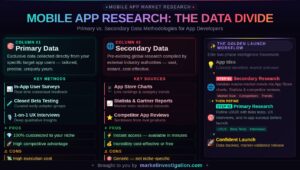
The inforgraphic below shows you primary vs secondary data methodologies for app developers:
Step 1: Define Your Research Goals (Before You Research Anything)
Here’s something I’ve noticed in trading and in life: people love to start doing things before they know what they’re trying to accomplish. They just start. Moving fast. Looking busy. Looking confident. Going absolutely nowhere.
You know the type. They walk into the gym with the biggest gym bag you’ve ever seen. Water bottle with about forty motivational stickers on it. Wireless headphones. Towel from a five-star hotel. Brand new trainers that have never touched a treadmill. And they walk around for forty-five minutes doing nothing, then leave. That is a very expensive way to achieve absolutely nothing.
Don’t be gym bag guy. Before you research anything, define your goals.
Ask yourself:
- What problem does my app solve? If you can’t answer this in one clear sentence, you are not ready. The app doesn’t solve a problem yet — it is the problem.
- Who is my target user? “Everyone” is not an answer. “Everyone” is how you end up with an app that appeals to no one.
- What does success look like? 10,000 downloads? $50,000 in revenue? Number one in your category? Define it.
- What do I need to know before I can move forward? This tells you what research to actually conduct.
Write these down. Physically. On paper. Because when you’re three weeks deep into competitor analysis and you’ve forgotten why you started, those goals will save you.
Step 2: Understand Your Total Addressable Market (TAM)
As a trader, TAM is one of the first things I look at. How big is this market? Is there actually money here? Because no matter how beautiful your app is, if the market is a tiny puddle, you’re going to run out of room very quickly.
Total Addressable Market refers to the total revenue opportunity available to your app if you captured 100% market share in your category. Nobody captures 100% market share. Even Facebook doesn’t have 100% of social media. But TAM tells you the ceiling, and that matters.
How do you calculate it?
- Top-down approach: Start with industry reports. For example, the global fitness app market is projected to surge to $56.29 billion by 2030 [3]. If you’re building a fitness app, that’s your starting point. Now narrow it down by geography, age group, and the specific type of fitness feature you’re offering.
- Bottom-up approach: Estimate the number of people who would use your app, how often, and how much they’d pay. Multiply. This is more granular and, frankly, more honest.
- Value theory approach: What value are you delivering and what would users genuinely pay for it? This is particularly useful for premium apps.
Use platforms like Statista, SensorTower, data.ai (formerly App Annie), and Think with Google to gather credible market size data [4]. These are not optional extras — these are your Bloomberg terminals of the app world.
Speaking of size — you know how some people just walk into a room and underestimate everything? Don’t underestimate your market, but also don’t overestimate it. I’ve seen app founders walk into pitch meetings claiming their TAM is “the entire human population with a smartphone.” Sir. That is not a TAM. That is a prayer.
Step 3: Conduct Thorough Competitor Analysis
You can learn more from your competitors’ reviews than from their marketing. Let me say that again: your competitors’ one-star reviews are a goldmine.
Every time someone leaves a one-star review saying “this app crashes every time I open it” or “where is the dark mode, my eyes are suffering,” they are handing you a free product roadmap. They are telling you exactly what to build. For free. Without being asked.
A 2023 study published in Journal of Marketing Analytics by Sällberg, Wang, and Numminen found that online ratings and reviews directly influence download behaviour, and that the interplay between ratings and reviews is critical to a consumer’s decision to download an app [5]. Translation: reviews don’t just reflect quality — they drive acquisition. Which means your competitors’ bad reviews are not just useful to you as a builder — they are actively pushing frustrated users toward alternatives. Be that alternative.
Here’s how to conduct a proper competitor analysis:
4.1 Identify Your Competitors
There are three types:
- Direct competitors: Apps doing exactly what you want to do. Same target audience. Same core feature set.
- Indirect competitors: Apps solving the same problem in a different way. If you’re building a habit tracker, journaling apps are indirect competitors.
- Substitutes: Non-app solutions. A paper planner. A spreadsheet. A Post-it note on the fridge.
4.2 Analyse Their App Store Presence
Download their apps. Yes, actually download them. Use them. Live in them for a week. Check:
- Star ratings (and how they trend over time)
- Number of reviews
- Most common complaints
- Most praised features
- Frequency of updates
4.3 Study Their Monetisation Models
Are they freemium? Subscription-based? Paid upfront? Supported by ads? According to market data, free apps with in-app purchases and subscriptions drive nearly all mobile app revenue [1]. Understanding how your competitors monetise tells you what users in your space are already trained to pay for — and what they resist.
4.4 Track Their Marketing
Where are they showing up? Instagram? TikTok? Google ads? What is their messaging? Who are they speaking to? Tools like SimilarWeb and SensorTower can show you download trends and estimated revenue, which gives you a window into what’s working for them without having to ask.
I had a competitor once — at least, I thought of him as a competitor — who was doing everything I was doing but louder and with more confidence. And I was over here trying to figure out what his secret was. Turns out he had no secret. He just had better marketing. Same product. Better packaging. The lesson? In the app world, presentation is not vanity. It’s strategy.
Step 4: Define Your Target Audience and Build User Personas
This is where most founders get lazy, and I understand why. Building user personas feels like homework from a marketing textbook from 2005. It feels like something a professor in a cardigan makes you do. But here’s the thing — it works.
A user persona is a fictional, research-based profile of your ideal user. It should include:
- Demographics: Age, gender, location, income, education
- Psychographics: Values, lifestyle, interests, attitudes
- Pain points: What frustrates them? What problem are they trying to solve?
- Goals: What are they trying to achieve, in life and specifically with an app?
- Behaviours: How often do they use apps? What categories? How long per session?
- Device preferences: iOS or Android? High-end device or mid-range?
How do you gather this data? Multiple methods:
Surveys: Use platforms like SurveyMonkey or Google Forms to ask your target demographic direct questions. Keep surveys under 10 minutes — nobody is giving you their Sunday afternoon for free.
Interviews: One-on-one conversations reveal depth that surveys can’t. Ask open-ended questions. Let people talk. The best insights come when you stop asking questions and let someone rant.
Social listening: Monitor Reddit, Twitter/X, TikTok comments, Facebook Groups, and niche forums where your potential users hang out. What do they complain about? What do they celebrate? What language do they use? That last point is crucial — if your marketing doesn’t use the same language your users use, it won’t land. It’s like showing up to a grime concert in a tuxedo. Technically fine. Completely wrong.
Analytics from similar products: If you’ve built anything before — even a side project — look at your existing user data. It’ll tell you things about behaviour that no survey can.
A study by Motger et al. (2024), published on arXiv and submitted to a software engineering context, demonstrated that automated analysis of user reviews across mobile app market segments can reveal nuanced competition dynamics and user satisfaction patterns that are invisible through manual research alone [6]. Translation: the data is already out there — you just need to know how to find and read it.
Step 5: Validate Your Idea Before You Build Anything
I’m going to say something that makes a lot of founders uncomfortable: your idea is not special until the market says it’s special.
I know. That hurts. But it’s true. In trading, we call this “don’t fall in love with your position.” You might think a trade is the most elegant, bulletproof setup you’ve ever seen. The market disagrees. Now you’re holding a bag. The same applies to app ideas.
Before you write a single line of code, validate your concept. Here’s how:
Landing Page Test
Build a simple landing page that describes your app as if it already exists. Drive targeted traffic to it through paid ads or social media. Measure how many people sign up to “be notified when it launches.” If almost nobody signs up, the market is talking to you. Listen.
Concierge MVP
Instead of building the full app, manually deliver the service the app would provide to a small group of real users. This gives you direct feedback without the cost of development. Airbnb famously did this in its early days — the founders manually photographed properties and handled bookings themselves before building any technology.
Pre-selling
Can you sell the app before it exists? This is the ultimate validation. If someone hands over money for a product that isn’t built yet, they believe in the concept. If they won’t even pay $0.99 to pre-order it, re-evaluate.
Fake Door Testing
Add a feature button to an existing product or website that doesn’t actually do anything yet. When users click it, they see a message saying “this feature is coming soon — sign up to be notified.” Track the click rate. If everyone clicks it, build it. If nobody does, don’t.
You know what fake door testing is like? It’s like putting “coming soon” on a restaurant menu. If nobody asks about it, maybe that dish doesn’t need to exist. But if six people every night say “when is the truffle risotto coming back?” — you bring back the truffle risotto. You bring it back immediately.
Step 6: Conduct App Store Optimisation (ASO) Research
App Store Optimisation is to app development what search engine optimisation is to a website — it determines whether anyone finds you or not. And yet, shockingly, many developers treat ASO as an afterthought.
ASO research involves:
- Keyword research: What terms are users actually searching for in the App Store and Google Play? Tools like AppFollow, AppTweak, and Sensor Tower provide search volume and difficulty scores for app store keywords. Identify high-volume, low-competition keywords in your category.
- Title and description analysis: Look at the top 5 apps in your category. Dissect their titles, subtitles, and descriptions. What keywords do they prioritise? What emotional hooks do they use?
- Screenshot and preview video analysis: What visual narratives do top apps tell in their screenshots? What problem-solution arc do they demonstrate in their preview videos?
- Category selection: Are you in the right category? Sometimes a niche category with less competition is more strategic than the obvious primary category.
According to Stocchi et al. (2022), one of the major gaps in academic understanding of the mobile app market is the need for empirical research on “app competition dynamics, ascertaining likely differences for dissimilar app categories” [2]. In other words — category matters enormously, and most developers underestimate it.
Step 7: Analyse the Monetisation Landscape
Let’s talk money. Because ultimately, this is what we’re here for.
I’m a trader. If there’s no money in it, I’m out. I’m not building a charity. I’m building a business. If you’re building a charity, that’s beautiful and I respect it deeply — but you’re reading the wrong article.
Understanding how money flows in your app category is a critical piece of market research. Here’s what to study:
Freemium Model: The app is free, with premium features locked behind a paywall. This is the dominant model — it lowers the barrier to acquisition while creating a conversion funnel. Study what percentage of users in your category convert to paid.
Subscription: Users pay monthly or annually. This provides predictable recurring revenue. According to app market data, US in-app purchases increased 16% to $52.4 billion in 2024, with streaming subscriptions and gaming leading the charge [7]. Subscription models work particularly well for productivity, health, and entertainment apps.
In-App Purchases (IAP): Particularly dominant in gaming. Over $25.5 billion of US app revenue in 2024 came from gaming alone [7]. IAP allows users to spend variable amounts, which creates a wide revenue spectrum.
Ad-Supported: Free to use, revenue generated from advertising. Works at scale but requires massive user numbers to generate meaningful revenue. Best suited to apps with high daily active usage and long session times.
Paid Upfront: Users pay before downloading. Rare in today’s market, but still viable for highly specialised professional tools. Think professional audio engineering software, legal document templates, or niche data tools for specific industries. If your core user is a professional who needs a specific output delivered reliably, paid upfront can work beautifully.
Hybrid models: Many of the most successful apps combine multiple approaches. A game might be free-to-play with IAP and an optional ad-removal purchase. A productivity app might offer a free tier, a monthly subscription, and a one-time lifetime purchase option. Research which hybrid models are gaining traction in your category — because consumer expectations around payment are shifting rapidly. What worked in 2020 may feel outdated by 2026.
It’s also worth researching price sensitivity by geography. What users in the United States are willing to pay for a subscription is dramatically different from what users in India or Brazil will pay. If your research reveals a large potential audience in price-sensitive markets, your monetisation model needs to account for that — through regional pricing, ad-supported free tiers, or microtransaction structures that work at lower price points.
Research your category to understand what users are already comfortable paying for and at what price points. Sticker shock is real. If your entire category is freemium and you launch as paid upfront at £9.99, you are going to have a very quiet launch day. A very quiet, expensive launch day.
Step 8: Study Retention and Engagement Benchmarks
Acquisition gets the headlines. Retention builds the business.
According to a 2026 mobile app market report by ASO Mobile, the industry has entered a maturity phase where app success depends less on downloads and more on retention and long-term user value [8]. Acquiring new users is getting more expensive, and cost per install is gradually rising. The smartest app developers have shifted their focus from “how many people can I get to download this?” to “how many people will still be using this in 90 days?”
Research what retention benchmarks look like in your category. Industry averages vary significantly:
- Day 1 retention: The percentage of users who return the day after first download. Across all app categories, this typically sits between 20–40%.
- Day 7 retention: Drops significantly. Most app categories see 10–20% by Day 7.
- Day 30 retention: Often under 5% across all apps. For successful apps, this can be 10–25%.
These benchmarks are your baseline. If you’re building a social app, your retention targets will differ from a utility app or a game. Research your specific category. Identify the retention benchmarks of top performers. Then design your onboarding experience specifically to beat them.
Bad onboarding is like having a first date where you spend the entire time talking about your ex. People leave. They leave fast. And they don’t come back.
Step 9: Map the User Journey and Identify Drop-Off Points
Your user journey is the sequence of steps someone takes from first discovering your app to becoming a loyal, paying user. Mapping this journey is not a creative exercise — it is a research exercise.
For each stage of the journey, ask:
Discovery: How will users find your app? App store search? Social media ads? Word of mouth? Influencer recommendation? PR? Research how top apps in your category acquire their first 10,000 users.
Download: What persuades someone to download your app rather than a competitor’s? Review your competitors’ App Store listings from the perspective of an undecided user.
Onboarding: What is the first-use experience? Research suggests that apps that demonstrate core value within the first 3 minutes of use have significantly higher Day 1 retention. What’s your core value? Can you demonstrate it immediately?
First use: Did the user accomplish what they came to do? Did they encounter friction? Feature discovery during first use determines whether someone becomes a regular user or a one-time opener.
Habitual use: What creates the habit loop? What triggers bring users back? Research the notification strategies, gamification elements, and social hooks that top apps in your category use.
Monetisation: At what point in the user journey does conversion happen most naturally? Too early and it feels aggressive. Too late and you’ve spent money acquiring a user who never converts.
Research all of these stages using competitor app teardowns, user interviews, and by actually onboarding yourself to competing apps with fresh eyes.
Case Study 1: Duolingo’s Market Research Mastery
Duolingo is one of the most instructive case studies in mobile app market research. Before they built anything, founder Luis von Ahn conducted extensive research into how people learn languages. Key findings:
- Existing language learning tools (Rosetta Stone, classroom instruction) were expensive and inaccessible to billions of potential learners
- Motivation, not ability, was the primary reason people quit language learning
- Short, frequent practice sessions (micro-learning) outperformed long, infrequent ones
Armed with this research, Duolingo designed an app that was free (addressing the price barrier), gamified (addressing the motivation barrier), and structured around 5–15 minute daily lessons (addressing the session length insight).
The result? Over 500 million registered users and a publicly traded company with a market cap that exceeded $8 billion at its peak. That is not luck. That is what happens when market research directly informs product design.
Duolingo also understood something crucial: the owl mascot needed to be slightly threatening. You don’t want to miss a lesson when the owl is watching. That owl has the energy of a very disappointed relative at Christmas dinner, and somehow that motivates millions of people to learn Portuguese. Behavioural research is powerful, people.
Case Study 2: Spotify’s Competitive Intelligence Operation
Before Spotify launched in the UK in 2011 and in the US in 2012, the streaming music market was already occupied by established players: iTunes, Pandora, and illegal downloading (which, let’s be honest, was the dominant competitor that nobody talked about in polite company).
Spotify’s market research identified several critical insights:
- Users wanted access, not ownership — a shift in consumer psychology driven by changing attitudes toward digital goods
- Friction in purchasing individual songs was a significant deterrent to legitimate music consumption
- Personalisation and discovery were underserved — people wanted to be introduced to new music, not just access music they already knew
These insights led to Spotify’s freemium model (eliminating the price barrier), its data-driven recommendation algorithms (addressing discovery), and its collaborative playlist features (addressing social sharing behaviours).
Research by Goulart, Stocchi, and Porto (2026), published in Journal of Marketing via SAGE Publications, examined app market dynamics using the NBD-Dirichlet model and found that penetration and purchase frequency metrics are critical to understanding how apps gain and sustain market share in competitive categories [9]. Spotify’s growth trajectory maps precisely onto this framework — they won market share through penetration (freemium lowered barriers) and sustained it through frequency (daily listening habits).
Spotify knows so much about your listening habits they could write your biography. They know you listened to break-up ballads at 2am on a Tuesday in February 2019. They know. They’re not judging you. But they know. And that data is why their personalisation is terrifyingly good.
Case Study 3: Calm’s Niche Domination Strategy
Calm entered the meditation and mindfulness app market at a time when Headspace already had significant brand recognition. Conventional wisdom might have said: market’s taken, find something else.
Calm’s research, however, revealed a specific underserved audience segment: people who wanted guided relaxation and sleep content, not just meditation. Users who described themselves as “not meditators” but desperately needed help sleeping. This was a meaningful differentiation.
They went deep on this segment. Sleep stories — narrated bedtime content for adults — became one of Calm’s signature features. It was born from user research, not from a brainstorm. Calm grew to over 100 million downloads and was valued at $2 billion in 2020.
The lesson: market research is not just about confirming your original idea — it is about discovering the better version of your idea that actually exists in the market.
Step 10: Build a Research Repository and Review It Continuously
This is the step that separates serious builders from excited beginners: the habit of continuous research.
Market research is not a one-time event. The mobile app market moves fast. Consumer behaviour shifts. Competitors launch new features. New categories emerge. What was true about your target audience in January may be obsolete by October.
Build a living research repository — a structured document or workspace where your team continuously updates:
- Competitive intelligence
- User feedback and reviews
- Industry reports and academic findings
- App store performance data
- User interview recordings and transcripts
- A/B test results
Tools like Notion, Confluence, or even a well-maintained Google Drive structure work perfectly for this. The format matters less than the habit.
According to Stocchi et al. (2022), one of the key priorities for future research is developing metrics and methods to evaluate “app return on investment” and better understand “app competition dynamics” over time — precisely because the market is not static [2]. If academics are highlighting the need for longitudinal intelligence, practitioners should be doing it as standard practice.
You know what a static research document looks like after six months? A fossil. Interesting as a historical artefact. Completely useless for making decisions today. Don’t let your research become a fossil.
Schedule a formal research review every quarter. Block the time. Put it in the calendar. Treat it like a board meeting — because if your research is shaping your product decisions, it effectively is one. Invite your product manager, your lead developer, and if you have them, your growth and marketing leads. Ask the same questions every quarter: what has changed in the market, what have our users told us in the past 90 days, and what do our competitors appear to be prioritising? If something in your strategy no longer matches your findings, change the strategy. That is not weakness. That is discipline.
Tools Summary: Your Market Research Stack
Here’s a practical toolkit for mobile app market research:
| Tool | Purpose |
|---|---|
| SensorTower | App store analytics, competitive download data, revenue estimates |
| data.ai (App Annie) | Market intelligence, audience insights, competitive benchmarking |
| AppTweak | ASO keyword research, competitor analysis |
| Think with Google | Trend data, audience insights, consumer behaviour reports |
| Statista | Industry statistics and verified market reports |
| SurveyMonkey | User survey creation and distribution |
| UserTesting | Moderated and unmoderated user testing sessions |
| Hotjar | Heatmaps and session recordings for web-based research |
| Dovetail | Research repository and synthesis tool |
| Reddit & App Store Reviews | Free, unfiltered user sentiment |
You don’t need all of these on day one. But knowing they exist and building a research stack progressively is how professional product teams operate.
The Trader’s Final Word: Research Is Your Competitive Edge
Let me bring this home.
In financial markets, information asymmetry is the source of edge. The trader who knows something the market hasn’t priced in yet wins. Everyone else is just noise. The same principle applies to mobile apps.
When you conduct thorough product market research — when you know your user more deeply than your competitors do, when you understand the monetisation landscape more precisely, when you have validated your idea with real market signals rather than friends’ encouragement — you have an information advantage. And in a market with 2.87 million competing apps, information advantage is everything.
I’ve watched people skip market research and go straight to development. It’s like pulling into a car park at maximum speed without checking if there are spaces. Very confident. Very committed. And then you’re stuck reversing out looking embarrassed while everyone watches.
The mobile app market is not going anywhere. Global user spending is still growing. Retention is becoming the new acquisition. AI-powered personalisation is becoming table stakes. New categories are emerging every quarter. The opportunity is real, the window is open, and the tools to conduct proper research have never been more accessible.
But none of that matters if you don’t do the work.
Do the research. Know your market. Know your user. Validate before you build. Study your competitors without obsessing over them. Build systems for continuous intelligence. And never — not even for a moment — confuse your enthusiasm for evidence.
Because in this market, the apps that survive are not always the most technically impressive. They’re the ones built by people who understood what users actually needed before they wrote a single line of code.
That’s the trade. Now go execute it.
Frequently Asked Questions
Q1. What is product market research for mobile apps?
It is the process of gathering and analysing data about your target users, competitors, and market conditions to validate and guide your app’s development before you build it.
Q2. Why is market research important before building a mobile app?
Without it, you risk spending months and thousands of pounds building a product nobody wants, in a market you don’t fully understand.
Q3. How do I find out if there is demand for my app idea?
You can validate demand through landing page tests, pre-selling, concierge MVPs, and fake door testing before writing a single line of code.
Q4. What is a Total Addressable Market (TAM) and how do I calculate it?
TAM is the maximum revenue your app could generate if it captured 100% of its target market, calculated using top-down industry reports, bottom-up user estimates, or value-based pricing models.
Q5. How do I analyse my competitors’ mobile apps?
Download and use them directly, study their App Store ratings, reviews, update frequency, monetisation models, and marketing channels using tools like SensorTower and data.ai.
Q6. What is a user persona and why do I need one for my app?
A user persona is a research-based profile of your ideal user — including their demographics, goals, and pain points — that ensures every product and marketing decision is built around a real human need.
Q7. What tools are best for mobile app market research?
The most effective stack includes SensorTower for competitive intelligence, AppTweak for ASO, Statista for market data, SurveyMonkey for user surveys, and Reddit or App Store reviews for unfiltered sentiment.
Q8. What is App Store Optimisation (ASO) research?
ASO research is the process of identifying the keywords, titles, descriptions, and visual assets that help your app rank higher and convert more downloads in the App Store and Google Play.
Q9. How do I choose the right monetisation model for my app?
Research the dominant revenue models in your specific app category — freemium, subscription, in-app purchases, or ad-supported — and select the one that matches your users’ existing payment behaviour.
Q10. How often should I review my mobile app market research?
You should conduct a formal research review every quarter, updating your competitive intelligence, user feedback, and market data to ensure your strategy reflects current conditions, not outdated assumptions.
References
[1] Netguru (2025). 2025’s Essential Mobile App Statistics: Trends, Growth, and User Insights. Retrieved from https://www.netguru.com/blog/mobile-app-statistics
[2] Stocchi, L., Pourazad, N., Michaelidou, N. et al. (2022). Marketing research on Mobile apps: past, present and future. Journal of the Academy of Marketing Science, 50, 195–225. https://doi.org/10.1007/s11747-021-00815-w
[3] Research and Markets (2024). Global Fitness App Market: Projected to Surge to USD 56.29 Billion by 2030. Globe Newswire. Retrieved from https://www.globenewswire.com
<a name=”ref4″></a>[4] AppMySite (2025). How to conduct mobile app market research? A complete guide for 2025. Retrieved from https://blog.appmysite.com/how-to-conduct-mobile-app-market-research/
[5] Sällberg, H., Wang, S. & Numminen, E. (2023). The combinatory role of online ratings and reviews in mobile app downloads: an empirical investigation of gaming and productivity apps from their initial app store launch. Journal of Marketing Analytics, 11, 426–442. https://doi.org/10.1057/s41270-022-00171-w
[6] Motger, Q. et al. (2024). Unveiling Competition Dynamics in Mobile App Markets through User Reviews. arXiv preprint arXiv:2312.01981. Retrieved from https://arxiv.org/abs/2312.01981
[7] SkyQuest Technology (2024). Mobile Application Market Size, Share, and Growth Analysis. Retrieved from https://www.skyquestt.com/report/mobile-application-market
[8] ASO Mobile (2026). Mobile App Market 2024 Report: Monetization, AI, and User Behavior. Retrieved from https://asomobile.net/en/blog/mobile-app-market-2024-report
[9] Goulart, G. S., Stocchi, L., & Porto, R. B. (2026). Understanding Market Dynamics and Performance of Mobile Apps. Journal of Marketing (SAGE Publications). https://doi.org/10.1177/14413582251329941
Disclaimer: This article is for educational and informational purposes. Always conduct your own due diligence before making strategic business decisions — and for the love of everything, update your competitive research more than once a decade. The market waits for no one. Neither do your competitors. But now, neither do you.
Leave a Reply
You must be logged in to post a comment.