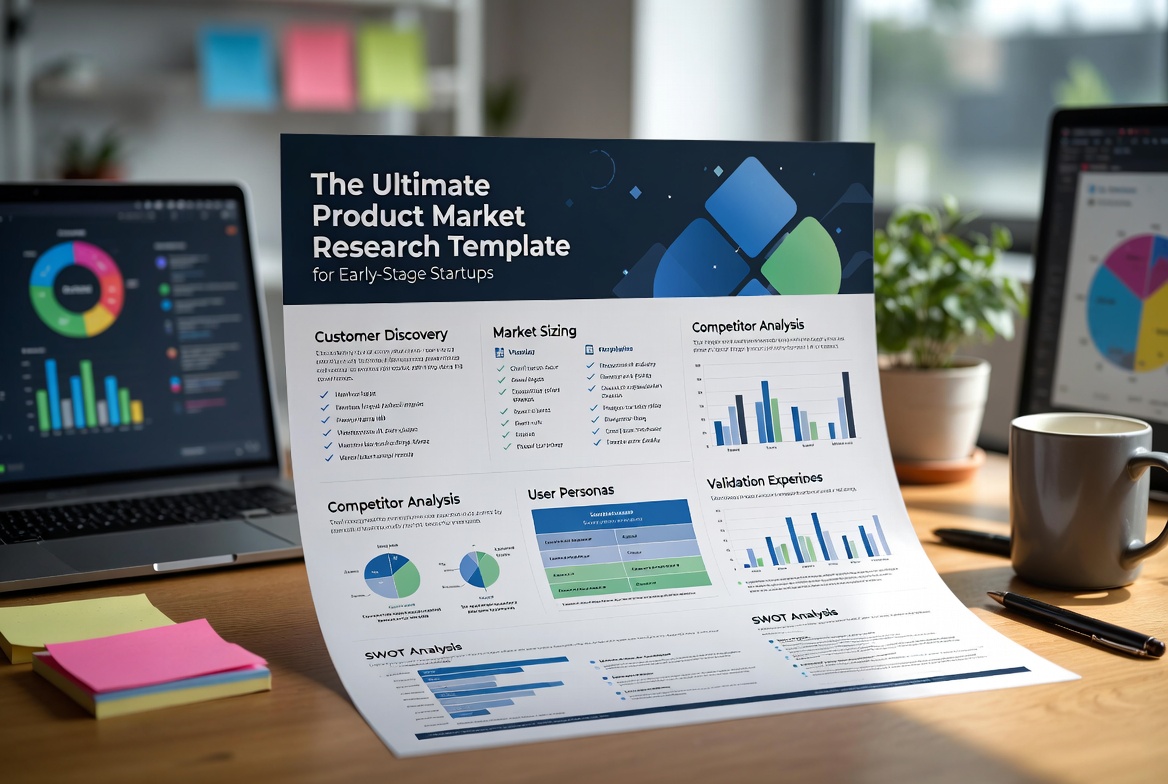
Product market research is the structured process of validating real customer demand before you commit time, money, or code to building anything — and this guide gives you the exact framework, templates, and questions to do it right. Follow the step-by-step system below to move from untested assumption to investor-ready, evidence-backed product clarity.
At the end of this article is a tool called The Product Market Research Hub which is an Early-Stage Startup Validation Interactive Workspace for you and you can use it for free starting from now.
Why Founders Fail Without Data: The Power of Product Market Research
Let’s start with the uncomfortable truth that nobody in your startup accelerator is bold enough to say out loud: if you skip product market research, you are not an entrepreneur — you are a very expensive hobbyist.
Product market research is the structured process of validating whether a real market exists for your product idea before you burn through your savings, your co-founder’s patience, and your mum’s generous “investment” of £4,000 she made from her Premium Bonds. It is the discipline that separates the founders who build things people actually pay for from the ones who spend eighteen months coding a gorgeous app only to discover their total addressable market is, effectively, themselves and one enthusiastic friend.
Here is the data that should stop you cold. According to CB Insights’ updated 2024 analysis of 431 failed VC-backed companies, 43% of startups fail due to poor product-market fit — meaning they built something and then discovered, usually too late, that not enough people cared to pay for it (CB Insights, 2024). That is nearly half of all startup deaths, and every single one was preventable. The researchers note that running out of capital — the thing founders blame — affected 70% of failures, but that capital drought was a symptom, not the disease. The disease was skipping validation.
Now, you might be sitting there thinking, “That won’t be me. My idea is different.” And listen — I say this with full love and respect — that is exactly what the other 43% said. They were convinced too. They had a pitch deck and a vision board and a motivational quote on their laptop. They also had no customers.
A landmark paper published in the Journal of Business Venturing, “Understanding the Dynamics of Startup Failure,” found that product/market misfit, lack of capital, and poor competitive positioning emerged consistently as the dominant failure drivers across industries and geographies, noting that these failures rarely trace to a single catastrophic error but rather to “a convergence of strategic blind spots… that quietly compound over time” (IJFMR, 2026). In plain English: founders walk off a cliff one small misstep at a time, usually while posting LinkedIn updates about their “incredible journey.”
The good news? Every single one of those missteps is detectable before launch — if you do the research.
This is why structured product market research frameworks exist. A systematic approach to customer discovery and competitive analysis is not bureaucracy. It is your financial immune system. Investors know this. The Journal of Innovation and Entrepreneurship (2025) reviewed multiple failure studies and found that startups applying formal frameworks, including resource-based view analysis and dynamic capabilities theory, demonstrated significantly deeper understanding of competitive positioning than those relying on intuition alone (Springer, 2025). Translated: the founders who did their homework raised more money and lasted longer.
So let us do your homework. All of it. Together. Right now.
Phase 1: Defining Your Objectives in Product Market Research
Before you open a single spreadsheet or speak to a single customer, you need to know what you are trying to find out. This sounds obvious, but you would be genuinely shocked at how many founders start “doing research” with no defined goal, wander around interviewing people about vague topics, and then conclude that their idea is “validated” because everyone they spoke to was polite. That is not research. That is a very expensive series of pleasant conversations.
Setting Clear Hypotheses for Product Market Research
A hypothesis is a specific, testable assumption about your customer, their problem, and your proposed solution. The keyword is testable. “People will love our platform” is not a hypothesis — that is a feeling. “Freelance graphic designers aged 25–40 spend more than three hours per week manually chasing invoice payments, and would pay up to £30/month for an automated tool that eliminates this entirely” — that is a hypothesis.
Notice the difference. The second version has a specific customer segment, a specific pain point, a specific time cost, and a willingness-to-pay threshold. You can test every component of it. You can be proven right — or, the part that makes founders deeply uncomfortable — proven wrong. Being proven wrong before you build costs you a few weeks. Being proven wrong after eighteen months costs you everything.
Structure your hypotheses using this framework:
The Customer Hypothesis: Who exactly is experiencing this problem? Be uncomfortably specific. Not “small business owners” — “solo estate agents in mid-sized UK cities managing more than 15 active listings simultaneously.”
The Problem Hypothesis: What is the exact pain point, and how severe is it? Severity matters enormously. A problem that causes mild inconvenience will never sustain a business. A problem that keeps someone awake at night or costs them money every single week? Now you have something to work with.
The Solution Hypothesis: Why is your proposed approach meaningfully better than every alternative currently available? And yes, “doing nothing” counts as an alternative.
The Value Proposition Hypothesis: What specific outcome does your customer achieve by using your product, and is that outcome worth paying for?
Write these down. Make them uncomfortable in their specificity. They are your compass for everything that follows.
Establishing Key Performance Metrics in Product Market Research
Once your hypotheses are documented, you need to define what “validated” looks like before you start collecting data. This is what researchers call establishing success criteria upfront — and it prevents the single most common form of self-deception in early-stage startups: moving the goalposts after disappointing results.
Define both qualitative success signals — the types of language and reactions that indicate genuine pain — and quantitative success signals — specific numbers that confirm market demand at sufficient scale.
Qualitative signals that your problem hypothesis is real include: interviewees interrupting you mid-sentence to explain the problem in vivid detail; unprompted mentions of money lost or time wasted; existing workarounds that are demonstrably clunky or expensive. These are the golden moments in customer discovery. When someone says, “Oh my god, we literally have a full-time person whose only job is to manage this problem,” you have struck gold.
Quantitative signals include: at least 7 out of 10 interviews confirming the same core pain point independently; a clear and consistent willingness-to-pay range emerging across respondents; and survey data showing the problem ranks in the top three operational frustrations for your target segment.
The concept of “Minimum Viable Clarity” — the threshold of certainty you need before committing engineering resources — is your target. You do not need 100% certainty. The market will never give you that. But you do need enough signal to make a rational, evidence-based bet. Anything less is gambling with other people’s money, and that is a rough conversation to have at a board meeting.
Phase 2: Analyzing the Competitive Landscape with Product Market Research
The competitive analysis phase of product market research is where most founders dramatically undersell themselves. They either perform a quick Google search, declare “nothing like this exists,” and move on — which is almost never true — or they spend so long mapping competitors that they forget to build anything. Neither is helpful. You are looking for something specific: the gap between what the market offers and what your target customer actually needs.
Profiling Direct and Indirect Competitors through Product Market Research
Direct competitors are the obvious ones — products that do what yours does, or nearly what yours does, for the same customer. Indirect competitors are the sneaky ones, and they are often more dangerous. An indirect competitor is anything your customer currently uses to solve the problem you are trying to solve, even if that solution looks nothing like your product.
If you are building an automated scheduling tool for personal trainers, your direct competitors are other scheduling apps. Your indirect competitors are WhatsApp, Excel spreadsheets, and a pen-and-paper calendar. That last one is not a joke. Pen and paper competes with billion-dollar software companies every single day, because switching costs are real and inertia is a powerful force in human behaviour.
For each competitor — direct and indirect — map the following dimensions:
Feature Set: What does it actually do? Not what their marketing says it does, but what paying users report it does. These are different things, and the gap between them is often where your opportunity lives.
Pricing Model: How do they charge? Per seat, per usage, flat monthly, freemium with paid tiers? Understanding pricing architecture reveals assumptions about customer value and budget sensitivity.
Market Share and Traction Signals: How many users, reviews, or publicly available data points exist? App store ratings, G2 reviews, LinkedIn follower growth, and Trustpilot scores are all imperfect but useful proxies.
Identified Weaknesses: What do negative reviews consistently complain about? What pain points does their product fail to address? This is your treasure map. When five hundred reviews on a competitor’s platform all mention the same frustrating limitation, that is the market telling you exactly where to aim.
Discovering Blue Ocean Market Gaps via Product Market Research
The competitive matrix is your primary tool for identifying what strategists W. Chan Kim and Renée Mauborgne called “blue ocean” territory — market space where competition is minimal or nonexistent because incumbents have collectively overlooked a specific customer segment or use case.
Build a feature scoring matrix: list your top five to eight competitors along one axis and the ten to twelve most important product attributes along the other. Score each competitor from one to five on each attribute. When you plot this visually, patterns emerge with startling clarity.
You are specifically looking for two types of gaps. First, underserved demographics — customer groups who share the core problem but are systematically ignored by existing solutions, usually because they are perceived as too small, too niche, or too low-margin to bother with. These groups often have intense loyalty for any product that actually speaks to their specific needs. Second, underweighted attributes — product dimensions where every existing player scores poorly, not because the problem is technically hard to solve, but because no one has prioritised it.
The goal is not to copy your competitors’ product with a slightly better UI. The goal is to render their product partially irrelevant for a specific subset of the market by addressing needs they have collectively decided are not worth addressing. That is how category leadership begins.
Phase 3: Customer Discovery and Persona Building in Product Market Research
This is the beating heart of the entire product market research process. Everything else — the hypothesis setting, the competitive analysis, the market sizing — is either preparation for this phase or a downstream output of it. If you do customer discovery well, the rest of your research crystallises with remarkable speed. If you do it poorly, you end up with a folder full of warm compliments and zero actionable insight.
Designing the Ideal Customer Profile using Product Market Research
The Ideal Customer Profile, or ICP, is a detailed, evidence-based portrait of the specific type of person or business most likely to buy your product, derive genuine value from it, and continue paying for it over time. It is not a demographic box-ticking exercise. It is a deep psychological and behavioural profile built from real-world data.
For B2C products, your ICP should capture:
Demographics: Age range, location, income bracket, education level, and employment status. These establish accessibility and economic context.
Psychographics: Values, lifestyle priorities, personal ambitions, and the identity narrative they construct around themselves. This is where products become meaningful rather than merely functional. Nobody buys a product. They buy a better version of themselves.
Technology Stack: What tools and platforms does this person already use daily? How tech-literate are they? What is their tolerance for onboarding friction? A product that requires thirty minutes of setup to derive value will fail with time-poor customers, regardless of how powerful it is after the setup.
Behavioural Patterns: What does their actual day look like? When does the problem you are solving occur, and how frequently? What do they currently do about it?
For B2B products, a critical distinction that most early-stage founders miss: the user and the buyer are not the same person. The junior HR coordinator who lives inside your HR software daily is not the CFO who signs the annual licence fee. Both personas matter — but they need completely different value propositions.
Your user needs your product to make their daily work less painful. Your buyer needs evidence of measurable ROI, reduced organisational risk, or a strategic problem solved. Build both personas. Validate both through separate research tracks. Confusing the two is one of the most expensive mistakes in B2B startup history.
Crafting High-Impact Interview Questions for Product Market Research
Customer interviews are the gold standard of early-stage product market research — and they are also the most consistently misused tool in the founder’s toolkit. The average founder walks into a customer interview, pitches their idea within the first three minutes, watches their interviewee smile and nod encouragingly, and walks out convinced they have “validated” their concept. They have validated nothing except that most humans are too polite to tell you your idea is not compelling.
Rob Fitzpatrick’s The Mom Test (Fitzpatrick, 2013) — named after the principle that even your mother will lie to protect your feelings — establishes the foundational rules for useful customer interviews. The core principle is deceptively simple: never ask anyone for their opinion of your idea. Instead, ask about their life, their specific past behaviours, and the concrete problems they have already tried and failed to solve.
The difference in practice is dramatic.
Terrible question: “Would you use an app that helped you manage your freelance client communications?” Why it’s terrible: It is hypothetical, forward-looking, and loaded with implied social desirability. The answer is almost always “yes,” and it means absolutely nothing.
Excellent question: “Walk me through what happened the last time a client miscommunicated something important to you. What did you do? How long did it take to resolve? What did it cost you?” Why it’s excellent: It is retrospective, specific, and behavioural. The answer contains actual signal about frequency, severity, and existing coping mechanisms.
Additional high-value interview questions for product market research:
“What’s the most frustrating part of your current process for [relevant workflow]? How often does that happen?”
“You mentioned you tried [existing tool or method]. What made you stop using it?”
“If you could wave a magic wand and change one thing about how you currently handle this, what would it be?”
“What would it cost you — in time, money, or stress — if this problem went completely unsolved for the next twelve months?”
That last question is particularly powerful. It quantifies pain in the customer’s own words. When someone tells you that an unsolved problem costs them six hours a week or results in two or three lost clients per year, you have just been handed your pricing anchor and your ROI narrative simultaneously.
Running Unbiased Surveys for Quantifiable Product Market Research
Interviews are qualitative — they give you depth, texture, and the lived experience of your customer’s pain. Surveys are quantitative — they give you breadth and statistical confidence. Both are necessary. Neither is sufficient alone.
For early-stage product market research, your survey should accomplish three things: confirm that the problem exists at meaningful scale, quantify its severity relative to other operational challenges, and establish a preliminary picture of willingness to pay.
Survey design principles that actually work:
Keep it under ten questions. Attention drops sharply after the fifth minute, and survey abandonment spikes past eight to ten questions for cold respondents.
Use primarily closed questions with five-point Likert scales for severity ratings, but include two or three open-text fields for unexpected insights. The open-text responses are where your best qualitative gold tends to hide.
Ask about past behaviour, not future intent. “Have you ever paid for a tool to help you manage X?” is worth ten times more than “Would you ever pay for a tool to manage X?”
Sourcing respondents on a budget:
LinkedIn is underrated for B2B research. A well-crafted direct message to fifty relevant profiles explaining that you are conducting research (not pitching a product) and offering a £10 Amazon voucher as compensation will typically yield a 15–25% response rate. That is eight to twelve substantive responses from a genuinely relevant audience for under £120.
Reddit’s topic-specific subreddits are exceptional for B2C research, particularly for niche audiences. A thoughtfully written post in r/freelance, r/smallbusiness, or an industry-specific community — being transparent about your research purpose — frequently generates passionate, detailed responses at zero cost.
For statistically relevant sample sizes at the early stage, you do not need 1,000 respondents. For qualitative pattern identification in interviews, twelve to fifteen conversations with your precise target persona is typically sufficient to reach thematic saturation. For quantitative surveys, fifty to one hundred completed responses from a well-defined target segment gives you directional confidence to proceed. You are not trying to publish in an academic journal. You are trying to make a rational decision about where to allocate the next three months of your life.
Phase 4: Market Sizing and Total Addressable Market (TAM) in Product Market Research
Welcome to the section of product market research that every investor asks about and most founders get comically wrong. Not slightly wrong. Cosmically wrong. Investors have seen “our total addressable market is $400 billion” in the opening slide of pitch decks from founders targeting, in practice, about twelve hundred people in one city. That is not a TAM calculation. That is an aspiration wearing a spreadsheet as a disguise.
Calculating TAM, SAM, and SOM through Product Market Research
These three acronyms form the market sizing hierarchy, and understanding the distinction between them is the difference between appearing credible to an investor and being politely escorted out of the meeting.
Total Addressable Market (TAM) is the total global revenue opportunity if your product achieved 100% market penetration — every possible customer buying at your full price. This number is large, and it should be. It establishes the theoretical ceiling of your opportunity.
Serviceable Addressable Market (SAM) is the subset of the TAM that your product can realistically serve, given your specific product definition, geographic focus, and go-to-market approach. If your TAM is all HR software globally, your SAM is UK-based SMEs with ten to one hundred employees using cloud-based tools.
Serviceable Obtainable Market (SOM) is the realistic slice of the SAM you can actually capture within a defined timeframe — typically three to five years — given your team size, funding, distribution strategy, and competitive environment. This is the number investors scrutinise most carefully, because it demonstrates whether you have a grounded, executable business strategy or simply an impressive-sounding dream.
Two methodologies exist for calculating these numbers:
Top-down sizing: Start with published industry data from credible sources — market research reports, government statistics, trade association data — and work downward by applying your specific constraints. “The UK HR software market is valued at £2.8 billion. SMEs represent approximately 40% of that spend. Our ICP covers roughly 15% of the SME segment. Therefore our SAM is approximately £168 million.”
Bottom-up sizing: Build from unit economics upward. “Our target segment contains approximately 45,000 qualifying businesses in the UK. Based on our pricing model of £150 per month, if we achieve 3% market penetration in five years, our SOM is £24.3 million in annual recurring revenue.” This approach is generally more credible in investor conversations because it is rooted in your specific commercial assumptions rather than macro statistics.
The bottom-up method is the one sophisticated investors respect. Build it.
Evaluating Market Trends and Growth Drivers in Product Market Research
A large market today is not necessarily a large market tomorrow — and you are building for tomorrow. Product market research must include a systematic assessment of the forces shaping your market’s trajectory.
Regulatory shifts can either create enormous new markets or collapse existing ones. GDPR created a multi-billion-pound compliance software industry almost overnight. Open Banking regulation in the UK generated dozens of new fintech entrants overnight. If regulatory tailwinds are blowing in your direction, that is a compelling growth narrative. If regulators are moving in a direction that could constrain your business model, you need to know now rather than two years into your build.
Technological shifts create new customer needs and render old solutions obsolete. AI is doing this comprehensively across virtually every software category right now. If your product market research does not ask “what does this category look like in three years, given current technological trajectories?” you are operating with a dangerously incomplete picture.
Macroeconomic factors affect purchasing behaviour at every level. In a tightening economy, discretionary business spending contracts and buyers demand clearer, faster ROI justification. Products that demonstrably save money or reduce risk hold up far better in a downturn than products that are merely pleasant to use.
Research published by MDPI Systems found that startups which systematically evaluated market growth drivers alongside competitive positioning showed markedly better capital efficiency and fundraising outcomes than those focusing narrowly on product features (MDPI, 2024). You are not just choosing a market — you are choosing a trajectory. Make sure it goes up.
The Step-by-Step Product Market Research Template (The Core Framework)
Alright. We have done the theory. We have done the evidence. Now it is time to hand you the actual template — the plug-and-play, copy-and-use structure that takes all of the above and turns it into organised, actionable documentation you can share with co-founders, advisors, and investors.
This is the section you came for. And unlike most “templates” online — which are essentially a list of column headers dressed up as a framework — this one contains actual operational logic.
Section A of the Template: Problem Validation in Product Market Research
This section documents the evidence — or absence of evidence — for the specific problem your product solves. Every claim in this section should be traceable to a specific source: an interview transcript, a survey response, a publicly available dataset, or a documented competitor complaint.
## PROBLEM VALIDATION LOG

| # | Customer Segment | Pain Point Stated | Evidence Source | Severity (1–5) | Frequency | Existing Workaround | Willingness to Pay Signal |
|---|-----------------|-------------------|-----------------|----------------|-----------|---------------------|--------------------------|
| 1 | [Segment name] | [Verbatim or paraphrased pain point] | [Interview #, Survey Q#, Review source] | [1=minor irritation, 5=operational crisis] | [Daily/Weekly/Monthly] | [What they currently do instead] | [Any pricing anchor mentioned] |
| 2 | | | | | | | |
| 3 | | | | | | | |

**Validation Threshold:** A problem is considered validated when a minimum of 8 out of 12 interview respondents independently surface the same core pain point at a severity of 3 or above.

**Current Validation Status:** [Not Started / In Progress / Validated / Invalidated]

**Key Verbatim Quotes:**
- "[Quote from Interview #1]" — [Job Title, Company Size, Date]
- "[Quote from Interview #2]" — [Job Title, Company Size, Date]

**Invalidation Notes:** [Document any evidence that challenges or complicates your problem hypothesis here. Do NOT delete this column. The data that makes you uncomfortable is often the most valuable.]
Case Study — How Airbnb Used Problem Validation Before Scaling: Brian Chesky and Joe Gebbia did not launch Airbnb by building a platform and hoping. In 2008, they personally hosted three guests in their San Francisco apartment during a design conference — not as a tech proof-of-concept, but as a manual, real-world test of whether strangers would pay to sleep in someone else’s home. The problem validation was visceral: hotels were full, prices were astronomical, and budget travellers had nowhere to stay. That primitive test confirmed problem severity and purchase intent before a scalable platform existed. They gathered evidence with air mattresses. You can gather yours with a spreadsheet.
Section B of the Template: Competitive Benchmarking in Product Market Research
This matrix gives you a visual, structured comparison of your competitive landscape. Update it quarterly. Markets move.
## COMPETITIVE BENCHMARKING MATRIX

**Scoring Key:** 1 = Very Poor  |  2 = Poor  |  3 = Average  |  4 = Strong  |  5 = Excellent

| Feature / Attribute         | Competitor A | Competitor B | Competitor C | [Your Product] |
|-----------------------------|:------------:|:------------:|:------------:|:--------------:|
| Core feature quality        |              |              |              |                |
| Onboarding experience       |              |              |              |                |
| Pricing accessibility       |              |              |              |                |
| Customer support quality    |              |              |              |                |
| Integration ecosystem       |              |              |              |                |
| Mobile experience           |              |              |              |                |
| Reporting / Analytics       |              |              |              |                |
| Target segment specificity  |              |              |              |                |
| **TOTAL SCORE**             |              |              |              |                |

**Identified Market Gaps:**
1. [Gap 1 — describe the underserved need and which segment it affects]
2. [Gap 2]
3. [Gap 3]

**Positioning Statement (derived from this analysis):**
"For [specific customer segment] who [experience specific problem], [Your Product] is the only [product category] that [unique differentiator], unlike [main competitor], which [key limitation]."
Case Study — How Monzo Identified Its Positioning Gap: When Monzo launched in 2015, the UK retail banking market was dominated by legacy institutions with well-funded technology departments. Traditional analysis might have concluded the market was too crowded. Instead, Monzo’s research — which included extensive community engagement and direct customer interviews — revealed a specific underserved segment: young, digitally native adults who found traditional banking opaque, punitive on fees, and entirely absent on transparency. No incumbent was speaking to this customer. The competitive matrix revealed not a crowded market but a structurally ignored demographic. Monzo built specifically for that gap and reached 9 million UK customers by 2024.
Section C of the Template: Feedback Synthesis in Product Market Research
Raw customer data is not insight. Insight is the pattern that emerges when you have tagged, organised, and systematically analysed enough raw data to identify what your customer segment universally believes, fears, desires, and endures.
## INTERVIEW & SURVEY FEEDBACK SYNTHESIS

**Step 1: Tagging Protocol**
After each interview or survey response, tag all data points using the following categories:
- [PAIN] — Confirmed pain point
- [WORKAROUND] — Existing coping mechanism
- [WTP] — Willingness to pay signal
- [COMPETITOR] — Competitor mentioned (note which one)
- [OBJECTION] — Reason they might not buy
- [CHAMPION] — Language indicating strong enthusiasm

**Step 2: Theme Frequency Table**

| Theme / Insight | # of Times Mentioned | % of Respondents | Supporting Quotes |
|-----------------|----------------------|------------------|-------------------|
| [Theme 1]       |                      |                  |                   |
| [Theme 2]       |                      |                  |                   |
| [Theme 3]       |                      |                  |                   |

**Step 3: Hypothesis Status Update**
After completing synthesis, revisit each hypothesis from Phase 1 and formally update its status:

| Hypothesis | Original Assumption | Evidence Gathered | Status | Next Action |
|------------|---------------------|-------------------|--------|-------------|
| Customer   |                     |                   | [Confirmed / Partially Confirmed / Invalidated] | |
| Problem    |                     |                   | | |
| Solution   |                     |                   | | |
| Value Prop |                     |                   | | |
Common Pitfalls to Avoid When Executing Product Market Research
You have the framework. You have the templates. You have the data literacy. Now let us talk about the ways founders still manage to mess this up, because the human capacity for self-deception under conditions of hope and financial pressure is truly something to behold.
Overcoming Confirmation Bias in Product Market Research
Confirmation bias in product market research is the tendency to unconsciously design research that proves what you already believe, ask questions that guide respondents toward the answers you want, and then generously interpret ambiguous data as supporting evidence. Every founder is susceptible to it. The founders who swear they are immune are usually the worst offenders.
The structural antidotes are simple but require discipline. First, write your questions before you have formed a strong view of the answer. Second, have someone with no stake in the outcome — a trusted advisor, a mentor, or even a well-prompted AI assistant — review your interview script for leading questions before you use it. Third, record your interviews (with explicit consent) and return to the transcript before writing your synthesis notes. Memory is a deeply unreliable research instrument, particularly when it is filtered through excitement about your own idea.
The Failure of Tech Startups systematic review (ResearchGate, 2023) identified poor research design and unsystematic data gathering as consistent precursors to product-market misfit. In other words, bad research is not neutral — it is actively harmful, because it creates false confidence that accelerates investment and resource commitment into flawed directions.
Avoiding the “False Positive” Trap in Product Market Research
The false positive trap is the polite-compliment problem dressed in startup clothing. It works like this: you describe your idea to a potential customer. They say, “Oh, that’s really interesting — I could definitely see myself using that.” You write “VALIDATED” in your research notes and order a celebratory flat white. You have validated nothing except that people are generally kind.
Actual purchase intent looks dramatically different from enthusiasm. The signals that matter are:
Pre-commitments: Does the customer offer to pay a deposit, join a waitlist, or make an introduction to their Head of Procurement? Offers involving real personal cost signal genuine intent.
Specific unprompted requests: Does the customer tell you about a specific use case, integration, or feature they would need? Specificity indicates genuine engagement rather than polite interest.
Speed of follow-up: When you send a summary email after the interview, does the customer respond within twenty-four hours or vanish entirely? Genuine interest manifests in behaviour, not declarations.
Rob Fitzpatrick’s The Mom Test (Fitzpatrick, 2013) puts it with characteristic bluntness: “Compliments are worthless. Commitments are valuable. The goal is not to make people feel good about your idea; it’s to find out whether your idea deserves to exist.”
That is not harsh. That is efficient.
Next Steps: Turning Your Product Market Research into a Minimal Viable Product (MVP)
You have run the interviews. You have completed the competitive matrix. You have synthesised the feedback, updated your hypotheses, and calculated a market size that passes the credibility test. Your problem validation log has confirmed that a real, significant, recurring problem exists for a clearly defined customer segment, and your competitive benchmarking has identified a gap where your solution can establish meaningful differentiation.
Now comes the question every founder eventually asks: When do I stop researching and start building?
The answer is: when your validated insights are specific enough to make unambiguous product decisions. You are ready to build an MVP when you can complete all three of the following sentences without hesitation:
“The single most important problem we are solving is [X], and we know this because [Y interviewees described it in these specific terms].”
“Our initial MVP will include exactly these features: [list], and exclude these: [list], because our research indicated [specific evidence].”
“We believe our customer will pay [price point], based on [willingness-to-pay signals from these sources].”
If any of those sentences requires significant qualification or guesswork, you have more research to do. That is not failure. That is the process working exactly as intended.
The translation from research to roadmap is a prioritisation exercise. Take every validated pain point from Section A of your template. Rank them by severity score and frequency of mention. The features that directly address the highest-severity, highest-frequency pain points are your MVP scope. Everything else is version two.
Build the smallest product that solves the most important problem for the most validated customer segment. Launch it. Then use the feedback from real usage to fund the next iteration of your product market research. Because this is not a one-time exercise. The most successful founders treat customer discovery as a permanent operating function — not a pre-launch ritual.
The market changes. Your customers change. The competitive landscape changes. Your product market research should never stop.
Frequently Asked Questions
Q1: What is product market research?
Product market research is the process of systematically validating that a real, paying customer base exists for your product idea before you invest resources in building it.
Q2: Why is product market research important for early-stage startups?
According to CB Insights’ 2024 analysis, 43% of startups fail due to poor product-market fit — a failure that structured research conducted before launch can almost entirely prevent.
Q3: How many customer interviews do I need to validate a problem?
Twelve to fifteen interviews with your precise target persona is typically sufficient to reach thematic saturation, the point where new conversations stop producing new insights.
Q4: What is the difference between TAM, SAM, and SOM?
TAM is your total theoretical market, SAM is the portion your product can realistically serve, and SOM is the specific share you can credibly capture within three to five years.
Q5: What is The Mom Test and why does it matter?
The Mom Test, by Rob Fitzpatrick, is a customer interview framework built on the principle that you should ask about past behaviour rather than future intent, because people will always tell you what you want to hear if you let them.
Q6: How do I find survey respondents for product market research on a budget?
LinkedIn direct outreach to relevant professionals with a small incentive and targeted Reddit communities in your niche are both highly effective, low-cost sources of qualified early-stage respondents.
Q7: What is a false positive in product market research?
A false positive occurs when a potential customer enthusiastically compliments your idea during an interview but has no genuine intention of ever paying for it.
Q8: When should I stop researching and start building my MVP?
You are ready to build when your validated insights are specific enough to make unambiguous product decisions about features, pricing, and target customer without meaningful guesswork.
Q9: What is a blue ocean market gap?
A blue ocean gap is an underserved customer segment or unmet product need that every existing competitor has collectively overlooked, creating space to build without fighting for share.
Q10: How often should I conduct product market research?
Product market research should be treated as a permanent operating function, not a pre-launch ritual, because your customers, competitors, and market conditions continuously evolve.
References
- CB Insights (2024). Why Startups Fail: Updated Analysis of 431 Failed VC-Backed Companies. Available at: https://preuve.ai/blog/why-startups-fail-market-fit
- International Journal for Multidisciplinary Research (2026). Startup Failure: Convergence of Strategic Blind Spots and Financial Miscalculations. Available at: https://www.ijfmr.com/papers/2026/3/79262.pdf
- Springer — Journal of Innovation and Entrepreneurship (2025). What Could We Learn from Startup Failures? Available at: https://link.springer.com/article/10.1186/s13731-025-00493-w
- ResearchGate (2023). Failure of Tech Startups: A Systematic Literature Review. Available at: https://www.researchgate.net/publication/370422929_Failure_of_Tech_Startups_A_Systematic_Literature_Review
- MDPI Systems (2024). The Pathway to Startup Success: A Comprehensive Systematic Review. Available at: https://www.mdpi.com/2079-8954/12/12/541
- Fitzpatrick, R. (2013). The Mom Test: How to Talk to Customers and Learn if Your Business is a Good Idea When Everyone is Lying to You. Available at: https://www.amazon.com/Mom-Test-customers-business-everyone/dp/1492180742
- IJISRT (2024). Understanding Startup Failures: Challenges and Pathways. Available at: https://www.ijisrt.com/assets/upload/files/IJISRT24DEC1267.pdf
Disclaimer: This guide is provided for informational and educational purposes only. It’s not financial or business advice.
Leave a Reply
You must be logged in to post a comment.