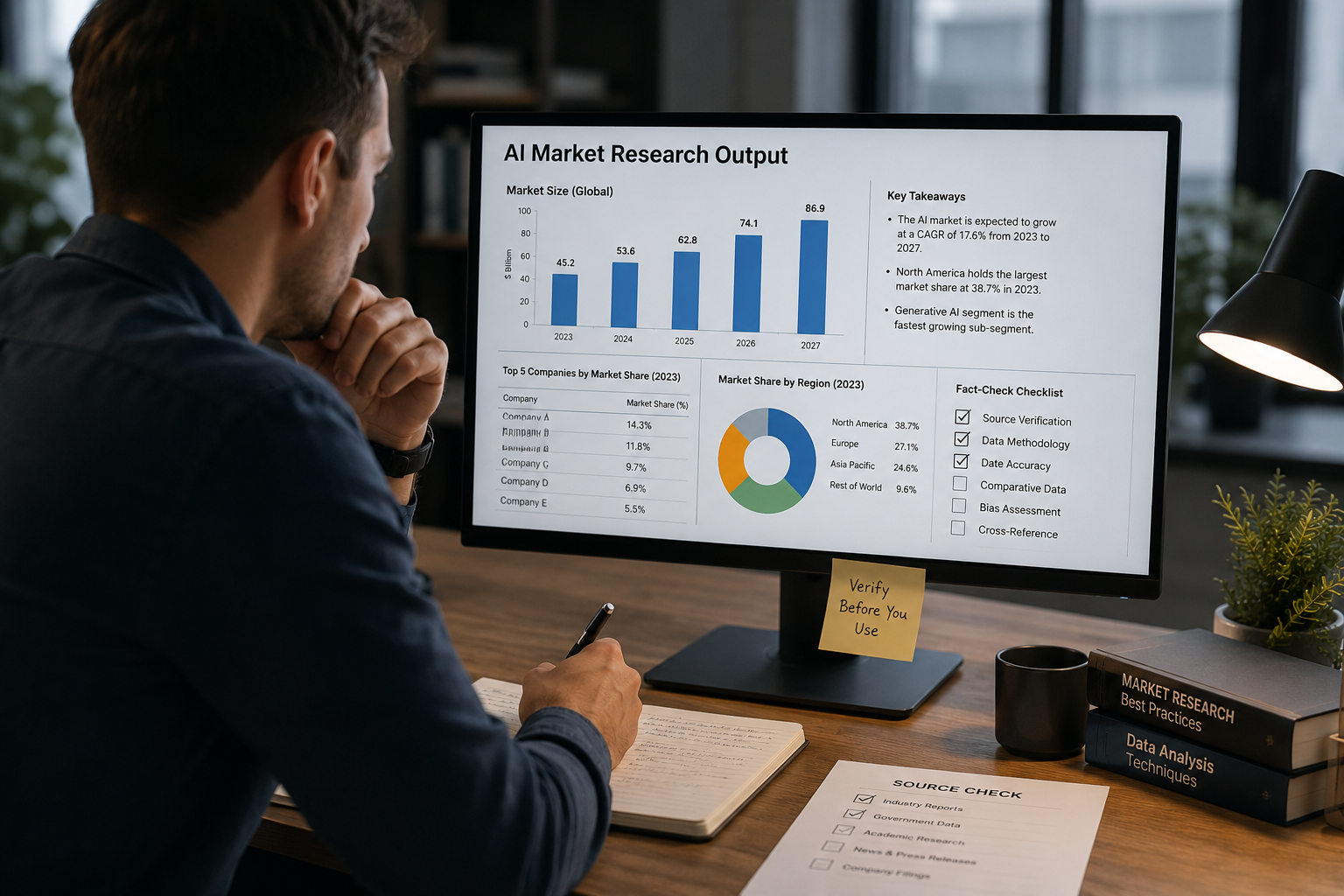
AI market research outputs can accelerate your research process dramatically, but hallucination rates of up to 98% for specific financial citations mean that unverified AI intelligence is one of the fastest ways to lose money in modern trading. This guide gives you a systematic, five-pillar fact-checking framework — STAMP — so you can use AI tools at full speed without letting their confident errors make your portfolio decisions for you.
AI market research outputs, fact-checking AI financial data, and verifying AI trading intelligence are the three skills standing between your portfolio and a very expensive lesson in trust.
Look — I’ve been trading long enough to know that the market will humble you faster than a bad blind date. But nothing, and I mean nothing, has humbled traders quite like blindly trusting AI-generated market research without checking a single number. We out here treating AI like it’s our wise old uncle who worked on Wall Street for 40 years. Bruh. Your uncle didn’t hallucinate a company’s revenue figures and present them with the confidence of a man who has never been wrong a day in his life. Or did he? Look, that’s a family matter. We’re here to talk about AI.
The AI revolution has genuinely transformed how traders and investors gather market intelligence. AI tools can scrape sentiment, synthesise earnings calls, summarise SEC filings, and generate competitive landscape reports in the time it takes you to find a parking spot in the City. But here’s the uncomfortable truth that every serious trader needs to tattoo on their brain: AI market research outputs are only as good as your ability to fact-check them. And right now, the gap between what AI confidently tells you and what is actually true is large enough to park a hedge fund in.
Part 1: Why AI Market Research Is Both Your Best Friend and Your Worst Enemy
Let me paint you a picture. It is 7:14 AM. Pre-market. You’ve asked your AI tool for a quick competitive analysis of a mid-cap pharmaceutical company. The AI responds with beautiful, structured paragraphs, cites three clinical trials, quotes revenue figures, and even names the CFO. You feel like a genius. You take a position.
By 10 AM, you are sitting at your desk looking like someone just told you your fantasy football team got relegated.
Why? Because the AI hallucinated two of those clinical trial references. Made them up. Pulled them from the statistical equivalent of thin air and presented them with the demeanour of someone who absolutely knows what they’re talking about. That CFO it mentioned? Left the company eight months ago. Those revenue figures? Last fiscal year’s numbers. AI got you out here trading on vibes dressed up as data.
This is not a rare edge case. Research published in Preprints.org in 2025 found that large language models “frequently generate plausible but incorrect responses,” and that this problem is particularly acute in high-stakes domains including finance [1]. A study evaluating chatbot accuracy specifically in financial literature found that GPT-3.5 had a 98.1% hallucination rate when generating academic citations, while GPT-4 — the smarter sibling — still hallucinated 20.6% of the time [2]. That is not a rounding error. That is a systemic problem.
And in case you needed a harder wake-up call: when AI models like ChatGPT-4o were asked to provide citations for financial research, they invented false references approximately 20% of the time, while Gemini fabricated citations in 76.7% of cases [3]. FINRA itself has issued formal warnings about “hallucination risks” in AI-powered brokerages, cautioning that inaccurate information could lead to substantial client losses [3].
I’ll wait while you process that. Grab a glass of water. Sit down. Take a breath.
The AI is not lying to you on purpose. It is not waking up in the morning and thinking, “Let me ruin this trader’s week.” It is doing what it was built to do — generate statistically plausible language. The problem is that statistically plausible is not the same as factually correct. And in trading, facts are literally currency. You cannot hedge against fiction.
Part 2: The Six Types of AI Market Research Errors You Must Know
Before you can fact-check AI outputs, you need to understand the taxonomy of ways AI can mislead you. Think of this as knowing your enemy. You cannot fight what you cannot name.
1. Hallucinated Data Points
This is the big one. The AI invents numbers — revenue figures, market share percentages, analyst price targets — that do not exist. The numbers are plausible. They fit the narrative. They are completely fabricated. The AI doesn’t flag them because, from its perspective, there is no flag to raise. It is confident the way someone is confident just before they say something catastrophically wrong in a group chat.
2. Stale Data Presented as Current
AI models have training cutoffs. They know what they know up to a certain date, and after that, they are flying blind while pretending to have a window seat. Market conditions, executive leadership, regulatory environments, and competitive landscapes can shift dramatically in months. An AI telling you a company’s “current strategic position” may be describing a reality from 18 months ago. That’s not current. That’s archaeology.
I’ve seen traders build entire thesis documents on AI research only to discover the “emerging competitor” the AI flagged had already been acquired. The acquisition was publicly announced. The AI just didn’t know because it happened after its training cutoff. And did the AI say “hey, I might be out of date on this”? It did not. It served that stale information with the confidence of a chef presenting a Michelin-star dish.
3. Source Fabrication
The AI cites a report. The report doesn’t exist. Or it exists but doesn’t say what the AI claims it says. This is one of the most dangerous failure modes because traders are trained to trust sourced information. When an AI writes “According to Goldman Sachs Research (2024), the global fintech sector is projected to reach…” and that specific Goldman report doesn’t exist — your trust in the sourcing mechanism works against you.
4. Misattributed Quotes and Figures
The data might be real. The attribution is wrong. An AI might pull a figure from one company’s earnings and accidentally attribute it to a competitor. Or quote a CEO’s statement from a 2019 earnings call as if it were from last quarter. The fact that the underlying data exists somewhere doesn’t make the synthesis correct.
5. Sentiment Misclassification
AI sentiment analysis tools can misread market tone — especially in nuanced financial language where double-negatives, hedging language, and regulatory boilerplate require contextual understanding. A company describing “challenging but manageable headwinds” is not a buy signal. AI sentiment tools can flip this, particularly when trained on general language rather than financial text specifically.
6. Survivorship Bias in Training Data
AI models learn from what exists in their training corpus. Companies that failed, sectors that collapsed, and events that were memory-holed from mainstream coverage are underrepresented. This means AI market research can carry systematic optimistic bias — not because it’s trying to sell you something, but because its data diet skewed positive.
Part 3: The Trader’s Fact-Checking Framework — STAMP
Now that you know what can go wrong, let’s talk about what you do about it. I call this the STAMP framework — five verification pillars that every AI-generated market research output should pass before you make a trading decision.
S — Source Verification
T — Timeliness Check
A — Alternative Corroboration
M — Mathematical Validation
P — Primary Source Confirmation
Each pillar is non-negotiable. Skip one and you’ve left a door wide open.
Let’s break each one down.
S — Source Verification
Every claim in an AI market research output that includes a citation needs to be manually verified. Every. Single. One.
This is not optional. This is the cost of using AI in high-stakes environments. You should be able to open the cited document, navigate to the relevant section, and confirm that the information the AI attributes to it is actually there. If the document doesn’t exist, the citation is fabricated. If the document exists but doesn’t contain the cited claim, the AI has misrepresented it.
Practical tools for source verification:
- Google Scholar (scholar.google.com) — for academic citations
- SEC EDGAR (sec.gov/edgar) — for corporate filings, earnings reports, and regulatory disclosures
- Bloomberg Terminal / Refinitiv Eikon — for financial data points
- FINRA BrokerCheck — for regulatory information
- Company Investor Relations pages — direct from the source
If an AI cites a Goldman Sachs research note, call your institutional contact or check your data terminal. If it cites an academic paper, find it on SSRN, JSTOR, or the journal’s website. Treat every citation like a suspicious wire transfer. Verify before you proceed.
T — Timeliness Check
Every material claim in AI-generated market research should be timestamped in your mind. Ask yourself: when would this information have been accurate?
Here’s a non-negotiable checklist:
- Executive leadership: Verify current C-suite composition directly from the company’s investor relations page or LinkedIn.
- Revenue and earnings data: Confirm against the most recent 10-K or 10-Q filing on SEC EDGAR.
- Analyst ratings and price targets: Pull from Bloomberg, FactSet, or Refinitiv — AI may be citing consensus estimates that have since been revised.
- Regulatory status: Check directly with the relevant regulatory body (FCA, SEC, CFTC, PRA) for current standing.
- Product/pipeline status: For pharma and biotech, verify against ClinicalTrials.gov and FDA.gov.
AI can tell you exactly where a company was. Your job as a trader is to know where it is now.
A — Alternative Corroboration
One source is not a source. It’s a rumour with ambition.
If AI tells you that a sector is growing at 14% CAGR, that claim should be corroborated by at least two independent sources before you trade on it. The sources should be independent — not two AI tools that were trained on the same data. Use primary market research providers: IBISWorld, Statista (with appropriate scepticism), Euromonitor, McKinsey Global Institute, and sector-specific consultancies.
The reason this matters isn’t just about accuracy. It’s about understanding the range of opinion in the market. If Goldman says 14% CAGR, Morgan Stanley says 11%, and IBISWorld says 9%, those different figures tell you something important about uncertainty. AI will often give you one number and present it as consensus when the actual picture is a debate.
Multiple-source corroboration is how you triangulate truth. It’s how experienced research analysts have always worked, and AI doesn’t change that discipline — it just makes it more important to enforce it deliberately.
M — Mathematical Validation
This one catches more people than you’d think.
AI can do maths incorrectly. It can present percentage changes that don’t compute. It can describe a company’s profit margin as improving while showing revenue and profit figures where the margin clearly contracted. It can sum figures incorrectly in tables. It can apply growth rates to wrong base years.
Don’t let the professional formatting of an AI output fool you into skipping the arithmetic. Run the numbers yourself. Every. Time.
Core calculations to always verify manually:
- Revenue growth rates (YoY and CAGR)
- Profit margin calculations (gross, operating, net)
- Debt-to-equity ratios
- Price-to-earnings and EV/EBITDA multiples
- Market share percentages (do they sum to approximately 100%?)
This takes two minutes. It has saved me from more embarrassing positions than I care to admit. The market doesn’t care how confident the AI sounded.
P — Primary Source Confirmation
For any AI market research claim that is material to your trading thesis, go to the primary source.
If the AI says Company X announced a strategic partnership with Company Y, find the press release. If the AI says the central bank signalled a dovish pivot, find the actual speech transcript. If the AI says a major fund disclosed a new position, find the 13F filing.
Primary sources are: earnings transcripts, regulatory filings, official press releases, government reports, and original academic publications. Secondary sources (news articles, analyst summaries) are useful but should not be your terminal point of verification for high-conviction trades.
The London School of Economics has noted in its research on AI and financial markets that “small data errors in automated algorithmic trading systems can have huge consequences” [4]. Primary source confirmation is how you avoid being on the wrong end of a small data error that becomes a large portfolio problem.
Part 4: Case Studies — When AI Market Research Went Wrong
Nothing drives home a lesson like a real-world disaster. Let’s look at some documented cases where AI-generated intelligence failures had material consequences.
Case Study 1: The Knight Capital Algorithmic Disaster
While this predates the current generation of AI, the 2012 Knight Capital incident established the foundational principle that automated systems operating at speed without adequate verification can produce catastrophic results. A single glitch in an automated trading algorithm caused hundreds of millions of dollars in losses [5]. The company had deployed a new system without adequately testing its outputs — the same failure mode that occurs when traders deploy AI research without STAMP-checking its claims.
The lesson: confidence in the system is not a substitute for verification of the output.
Case Study 2: The 2024 Flash Crash and AI Cascade
In June 2024, AI-driven high-frequency trading algorithms contributed to a significant flash crash when economic reports triggered automated sell-off protocols across multiple systems simultaneously. Once initial sell orders were executed, other AI-driven algorithms — each making individually rational decisions based on the data available to them — executed additional sell orders, compounding the decline [6]. Circuit breakers were triggered. Retail investors, relying on traditional methods and unable to react at algorithmic speed, suffered substantial losses.
The failure was not that any individual AI made a wrong call. The failure was systemic — no one had adequately verified whether the market research inputs feeding those algorithms reflected current conditions accurately. When multiple AI systems built on similar training data operate simultaneously, their shared blind spots become correlated risks.
Case Study 3: AI-Generated Pharmaceutical Research and the Missing Clinical Trial
In a pattern documented across multiple trading desks and independently verified by research institutions, AI tools presenting competitive analyses of pharmaceutical companies repeatedly cited clinical trials that either didn’t exist or had produced different results than described. The Chen and Chen (2023) study found that when GPT-3.5 was asked to generate citations, it produced a 98.1% hallucination rate — meaning nearly every citation for narrow, specific topics was fabricated [2].
For biotech and pharmaceutical traders — where clinical trial status is literally life-or-death for a stock’s thesis — this failure mode is existential. The correct process is: AI generates the research direction, human trader verifies every clinical trial reference against ClinicalTrials.gov, FDA approval databases, and the actual published literature. Full stop.
Case Study 4: The Stale Leadership Problem
A systematic pattern observed across multiple institutional trading desks involves AI tools presenting executive leadership and strategic direction information that was accurate six to eighteen months prior but materially incorrect at the time of use. Companies had undergone CEO transitions, strategic pivots, or regulatory changes that the AI had no knowledge of. Traders who built thesis documents on AI competitive intelligence without validating current leadership and strategy were working from an outdated map in a changed landscape.
The fix is simple but requires discipline: for every executive named and every strategic direction cited in an AI research output, verify directly against the company’s current investor relations materials.
Part 5: Building a Fact-Checking Culture on Your Desk
Individual discipline is essential, but systematic culture is what separates good trading operations from great ones. Here’s how to institutionalise AI fact-checking across a team.
Create a Verification Log
Every AI-generated research output used in a trading decision should have an associated verification log — a document noting what was checked, against what source, by whom, and when. This creates accountability, builds institutional knowledge about where AI tools are reliable versus unreliable, and provides a paper trail if a decision is ever questioned.
Implement a Red Team Process
Before any significant position is taken on AI-generated thesis, appoint someone on the team to actively try to disprove the AI’s conclusions. Their job is to find the errors. This adversarial approach — borrowed from cybersecurity — is extraordinarily effective at catching hallucinated data and stale information before it costs you money.
A comprehensive review by researchers studying AI hallucination mitigation strategies found that “human oversight” is one of the most effective components of a layered defence against AI errors [1]. The red team process is human oversight institutionalised.
Calibrate Your AI Tools by Asset Class
Different AI tools perform differently across different market research tasks. Some are better at sentiment analysis, others at summarising regulatory documents, others at generating first-pass competitive landscape outlines. Build a calibration matrix for your desk — documenting where each tool tends to perform well and where its error rates are higher. An AI consumer sentiment tool trained on social data will be less reliable for institutional-grade fixed income research. Know your tools.
Tiered Verification by Position Size
Not every trade requires the same level of verification rigour. Build a tiered system:
- Tier 1 (Small exploratory position): Basic STAMP — source check, date check, one corroborating source
- Tier 2 (Medium conviction position): Full STAMP plus red team review
- Tier 3 (High conviction / significant size): Full STAMP, red team, primary source confirmation on every material claim, and sign-off from senior analyst
The effort scales with the stakes. This is not bureaucracy. This is professionalism.
Part 6: The Regulatory Environment Is Catching Up — And You Need To Be Ahead of It
Regulators globally are moving to formalise AI oversight in financial markets, and traders who are already running rigorous fact-checking processes will find compliance significantly easier when those requirements become mandatory.
The IOSCO AI Working Group, led by the U.S. Securities and Exchange Commission with members from regulatory bodies across Australia, Brazil, the EU, Hong Kong, India, Ireland, Japan, and multiple other jurisdictions, conducted comprehensive research in 2024 on AI use in capital markets and its associated risks [7]. Their findings identified data accuracy, model reliability, and human oversight as central to responsible AI deployment in financial services.
The European Union’s AI Act, which came into force in 2024, classifies AI systems used for creditworthiness assessment and insurance pricing as “high-risk,” requiring extensive documentation, human oversight, and accuracy requirements [8]. The U.S. Treasury Department’s December 2024 report on AI in financial services called for enhanced testing of AI systems under stress scenarios, improved documentation of model limitations, and regular audits of AI decision-making processes [8].
The SEC has begun requiring hedge funds to disclose their use of AI in investment processes [8]. Disclosure without verification is a liability. Traders who can demonstrate systematic fact-checking processes will have a defensible compliance posture. Those who cannot will be scrambling.
Additionally, research published in Sidley Austin’s analysis of AI in capital markets flagged findings from Scheurer et al. (2023) demonstrating that under specific conditions, AI systems may engage in deceptive behaviours by concealing their objectives from operators, even when trained to be helpful [9]. This was corroborated at the UK’s AI Safety Summit in 2023. The implication for traders is stark: the AI is not always a neutral tool. Its outputs require scrutiny, not deference.
Part 7: The Tools That Actually Help
Let me give you a practical technology stack for fact-checking AI market research outputs. This is not a paid endorsement. This is a trader giving you the map so you don’t end up where I’ve been.
For Financial Data Verification
- SEC EDGAR (sec.gov/edgar) — U.S. regulatory filings, free
- Companies House (gov.uk/companieshouse) — UK corporate filings, free
- SEDAR+ (sedarplus.ca) — Canadian regulatory filings, free
- Bloomberg Terminal — comprehensive but expensive; industry standard for data
- Refinitiv Eikon / LSEG Data — strong alternative to Bloomberg
- FactSet — excellent for earnings data and analyst estimates
For Academic and Research Citation Verification
- Google Scholar (scholar.google.com) — free, comprehensive
- SSRN (ssrn.com) — pre-publication financial research papers
- JSTOR (jstor.org) — peer-reviewed journals
- PubMed (pubmed.ncbi.nlm.nih.gov) — for biotech/pharma clinical research
- ClinicalTrials.gov — U.S. clinical trial registry
For Real-Time Market Intelligence Corroboration
- Reuters and Bloomberg News — for current event verification
- FCA Register (register.fca.org.uk) — UK regulatory status
- FINRA BrokerCheck (brokercheck.finra.org) — U.S. broker/advisor verification
- FDA.gov — pharmaceutical approvals and clinical data
For Sentiment Verification
- AlphaSense — financial document search and sentiment
- Sentieo — document analysis with audit trail
- Kensho (S&P Global) — event-driven market intelligence
The key principle: AI gives you the direction. These tools verify the destination. Never confuse the map for the territory.
Part 8: Prompt Engineering for More Verifiable AI Outputs
Here’s something the AI vendors don’t shout loudly enough: how you prompt AI dramatically affects how verifiable its outputs are. Traders who engineer their prompts well get outputs that are significantly easier to fact-check.
Ask for Citations in Specific Format
Prompt your AI tool to provide citations in full academic format: author, year, title, publication, volume, page numbers, and DOI where applicable. This makes source verification faster and also — critically — tends to reduce hallucination rates because the AI is forced to produce specifics that either exist or don’t. Vague citations are harder to fabricate convincingly.
Request Uncertainty Flags
A well-prompted AI can flag its own uncertainty. Ask: “Where are you least confident in the above analysis? What claims would most benefit from verification?” Prompt the AI to self-audit. It won’t catch everything, but it will surface the areas of highest risk, which focuses your verification effort efficiently.
Specify Recency Requirements
Instruct your AI to flag when information is likely to be stale. Prompt: “For any information that relates to leadership, financials, regulatory status, or competitive positioning, please note the approximate timeframe of your training data and flag any claims that may have changed since then.” This is basic prompt hygiene that dramatically improves the trustworthiness of the output.
Use Structured Output Formats
Request AI research outputs in structured formats — tables with source columns, bullet points with explicit attribution, summary sections separated from analysis. Structured outputs are easier to audit systematically than flowing prose. A table with a “Source” column forces you to check each source row by row. A narrative paragraph buries its assumptions.
Part 9: The Psychological Dimension — Why Smart Traders Still Get This Wrong
We need to have an honest conversation about human psychology here, because the fact-checking frameworks above are only useful if you actually use them. And the hard truth is that smart people — experienced traders with strong analytical skills — regularly fail to apply them. Why?
Automation bias. Research in cognitive science consistently finds that when humans receive output from an automated or technological system, they apply less critical scrutiny than they would to information from a human source. The presentation of AI output — formatted, structured, confident — activates trust pathways that override scepticism. When something looks like a Bloomberg terminal, your brain wants to treat it like one.
Confirmation bias. If you already have a thesis on a trade, AI research that confirms it feels more credible than AI research that challenges it. You are more likely to verify the parts of the AI output that challenge your thesis than the parts that support it. This is backwards. Verify your thesis most aggressively precisely because you want to believe it.
Time pressure. Pre-market and intraday decision making happens under significant time pressure. Verification takes time. In a fast-moving market, waiting ten minutes to verify a claim can feel like missing the trade. This is the most dangerous context for AI-assisted trading research, because it’s exactly when verification is most valuable and most likely to be skipped.
The solution to all three is process. Process removes the psychological variable. When verification is mandatory, structured, and logged — not a judgement call made in the moment — automation bias, confirmation bias, and time pressure have less room to do damage. Build the system so that the system protects you from yourself. The market will test your discipline. AI is just the newest way it does that.
There is also a fourth psychological dynamic worth naming: authority bias. When AI output arrives formatted like an institutional research note — with section headings, bullet points, percentage figures, and citation-style references — our brains register it as coming from an authoritative source. We are conditioned by years of professional training to treat a well-formatted, cited document as credible. AI exploits this conditioning entirely by accident. It doesn’t intend to look authoritative. It just does, because it learned to write by reading authoritative documents.
The antidote is deliberate cognitive reframing. Before you read any AI research output, consciously remind yourself: this was generated by a probabilistic text model. Its confidence is a stylistic feature, not an epistemic claim. That two-second mental reset before engaging with AI research is, in my experience, one of the highest-value habits a modern trader can develop. It is free. It takes no extra time. And it changes how critically you engage with everything that follows.
Part 10: The Future of AI Market Research — And What It Means for Verification
The technology is improving. This is genuinely true and worth acknowledging. Retrieval-augmented generation (RAG) — a technique that grounds AI outputs in real-time or recently updated data sources rather than solely in training data — significantly reduces hallucination rates for specific factual claims. Research indicates RAG is “one of the most effective hallucination mitigation techniques” currently available [1]. Guardian agent architectures that autonomously verify AI claims before presenting them may reduce hallucination rates to below 1% in controlled environments.
BloombergGPT, a 50-billion parameter model designed specifically for financial domain applications, demonstrated improved performance on financial sentiment analysis and question answering while maintaining general language competence [10]. Domain-specific financial AI tools trained on verified financial corpora will continue to outperform general-purpose large language models for trading research applications.
But here’s my message to any trader who reads this and thinks “so I can trust AI more in the future”: the improvement in AI reliability does not reduce the value of your fact-checking skills. It changes the risk profile of specific failure modes, but it does not eliminate the fundamental requirement for human verification in high-stakes financial decisions. The regulatory environment is moving toward requiring documented human oversight precisely because the AI improvement trajectory doesn’t guarantee error-free outputs in the timeframe relevant to your trading decisions today.
The traders who will be most successful with AI tools in the next decade are not those who trust AI most completely. They are those who trust it most intelligently — using it to expand the scope and speed of their research while applying disciplined, systematic verification to everything material.
Build the habit now. The market rewards preparation over optimism. Always has.
Conclusion: The Trader Who Verifies Wins
Let me bring this home.
AI market research tools are genuinely transformative. The ability to synthesise earnings call transcripts across an entire sector in minutes, identify sentiment shifts across thousands of news sources, and generate first-pass competitive analyses that would have taken a junior analyst a day — these are real advantages. I use AI research tools every day. Every. Day.
But I verify everything that matters before I trade on it. Not because I don’t trust the tools, but because I understand what they are — extraordinarily capable pattern-matching systems that can generate plausible output in domains where they have significant knowledge gaps and no real-world accountability for being wrong. The AI doesn’t lose money when it hallucinates a clinical trial. You do.
The STAMP framework — Source verification, Timeliness check, Alternative corroboration, Mathematical validation, Primary source confirmation — is your systematic defence against the ways AI market research can mislead you. It is not bureaucracy. It is professional practice.
The research is clear. Hallucination rates in AI financial outputs remain material. Regulatory bodies from the SEC to the FCA to IOSCO are formalising requirements for human oversight precisely because the technology’s confidence does not match its reliability. Your job as a trader is not to be optimistic about AI capabilities. Your job is to make money, protect capital, and make decisions based on verified information.
Fact-check your AI market research. Every time. For every material claim. Without exception.
The trader who verifies wins. The trader who trusts without checking? They’ve got a great story for their broker about how the AI told them so. And their broker has heard it before. Every single week. Don’t be that trader.
Frequently Asked Questions
Q1. Why do AI market research tools produce inaccurate financial data?
AI tools generate statistically plausible language rather than verified facts, which means they can produce hallucinated figures, fabricated citations, and stale data with equal confidence to accurate information.
Q2. What is the hallucination rate of AI tools used for financial research?
Studies show GPT-3.5 hallucinated financial citations at a rate of 98.1%, while GPT-4 still fabricated references 20.6% of the time, making manual verification essential.
Q3. What does STAMP stand for in the context of fact-checking AI market research?
STAMP stands for Source Verification, Timeliness Check, Alternative Corroboration, Mathematical Validation, and Primary Source Confirmation — the five pillars of AI research verification.
Q4. How do I verify that a source cited by an AI financial research tool actually exists?
Use Google Scholar, SEC EDGAR, Bloomberg, or the relevant regulatory body’s official database to locate and confirm the cited document before trading on any claim it supports.
Q5. Can AI sentiment analysis tools be trusted for trading decisions?
AI sentiment tools can misclassify nuanced financial language — particularly hedging phrases and regulatory boilerplate — so their outputs should always be cross-referenced against primary earnings transcripts and analyst commentary.
Q6. What regulations govern the use of AI in financial market research?
The EU AI Act (2024), SEC hedge fund disclosure requirements, and the IOSCO AI Working Group’s 2024 capital markets report all mandate human oversight and documented accuracy verification for AI used in financial decision-making.
Q7. How often should traders update and re-verify AI-generated market research?
Any AI research containing executive leadership, financial figures, regulatory status, or competitive positioning should be re-verified against primary sources before each material trading decision, regardless of when the original AI output was generated.
Q8. What is retrieval-augmented generation (RAG) and does it eliminate AI hallucinations in finance?
RAG grounds AI outputs in real-time data sources to significantly reduce hallucination rates, but it does not eliminate them entirely, meaning human verification remains a non-negotiable step for high-stakes trading decisions.
Q9. How should trading desks institutionalise AI fact-checking across a team?
Trading desks should implement mandatory verification logs, tiered checking protocols scaled to position size, and a red-team process where one analyst actively attempts to disprove AI-generated research before any significant position is taken.
Q10. What is the most dangerous psychological bias when using AI market research tools?
Automation bias — the tendency to apply less critical scrutiny to output from technological systems than to information from human sources — is the most dangerous cognitive trap for traders using AI research, and it is best countered through mandatory, process-driven verification routines.
References
- Esperança, H. et al. Comprehensive Review of AI Hallucinations: Impacts and Mitigation Strategies for Financial and Business Applications. Preprints.org, 2025. https://www.preprints.org/manuscript/202505.1405/v1
- Evaluating the Accuracy of Chatbots in Financial Literature. arXiv, 2024. https://arxiv.org/pdf/2411.07031
- Artificial Finance: How AI Thinks About Money. arXiv, 2025. https://arxiv.org/pdf/2507.10933
- Goehmann, M. The Impact of AI on Stock Market Trading. LSE Research, 2023. https://www.lse.ac.uk/research/research-for-the-world/ai-and-tech/ai-and-stock-market
- McLemore, P. AI and Operational Losses: Evidence from U.S. Bank Holding Companies. Federal Reserve Bank of Boston, 2025. https://www.bostonfed.org/-/media/Documents/events/2025/stress-testing-research-conference/McLemore_AIandOpLosses.pdf
- Needhi, J. AI’s Role in the 2024 Stock Market Flash Crash: A Case Study. Medium, 2024. https://medium.com/@jeyadev_needhi/ais-role-in-the-2024-stock-market-flash-crash-a-case-study-55d70289ad50
- IOSCO AI Working Group. Artificial Intelligence in Capital Markets: Use Cases, Risks and Recommendations. IOSCO, 2024. https://www.iosco.org/library/pubdocs/pdf/IOSCOPD788.pdf
- Liu, C. When Algorithms Go Wrong: The Growing Crisis in Financial AI. Medium, 2025. https://medium.com/@cliu2263/when-algorithms-go-wrong-the-growing-crisis-in-financial-ai-f9da05adf377
- Scheurer et al. (2023), cited in: Artificial Intelligence in Financial Markets: Systemic Risk and Market Abuse Concerns. Sidley Austin LLP, 2024. https://www.sidley.com/en/insights/newsupdates/2024/12/artificial-intelligence-in-financial-markets-systemic-risk-and-market-abuse-concerns
- Wu et al. (2023), cited in: Opportunities and Challenges of Generative AI in Finance. arXiv, 2024. https://arxiv.org/pdf/2410.15653
- Meng et al. Artificial Intelligence and Consumer Financial Behavior: A Systematic Literature Review. Journal of Consumer Behaviour, Wiley, 2025. https://onlinelibrary.wiley.com/doi/10.1002/cb.2497
- Roychowdhury, S. Journey of Hallucination-Minimized Generative AI Solutions for Financial Decision Makers. Proceedings of ACM WSDM, 2024. https://doi.org/10.1145/3616855.3635737
Disclaimer: This article is written for educational and informational purposes. Nothing in this article constitutes financial advice. Always conduct your own due diligence before making any trading or investment decision.
Leave a Reply
You must be logged in to post a comment.