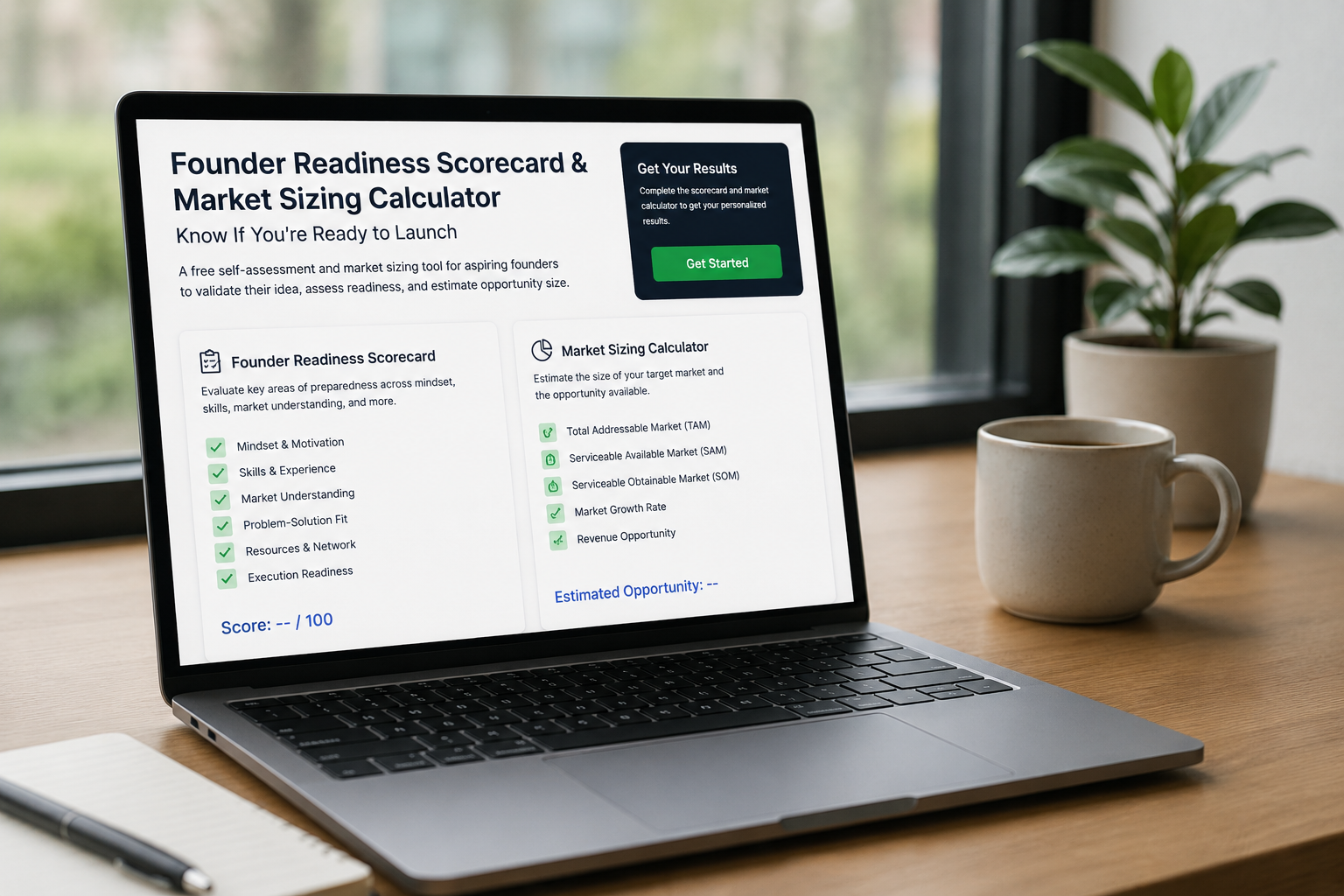
Most founders fail not because their idea was wrong, but because they never honestly assessed their own readiness before committing. This free tool scores you across six founder dimensions and calculates your TAM, SAM, and SOM market opportunity — so you can launch with clarity, not hope.
Are You Ready to Start a Business? Use This Free Founder Readiness Scorecard and Market Sizing Calculator
Starting a business is one of the most significant decisions you’ll ever make — and most aspiring founders get it wrong not because their idea was bad, but because they weren’t honest about their own readiness. Whether you’re sitting on an idea you’ve had for years or actively planning your launch, this free Founder Readiness Scorecard and Market Sizing Calculator gives you a structured, objective way to assess where you stand before you go all in.
What Is a Founder Readiness Scorecard?
A founder readiness scorecard is a self-assessment framework that evaluates the six core dimensions that determine whether a founder — not just an idea — has what it takes to build a successful company. Unlike a business plan or pitch deck, a readiness scorecard turns the lens on you: your knowledge, team, resources, traction, and psychological preparedness.
Investors, accelerators, and startup advisors have used readiness frameworks informally for decades. The best programmes — Y Combinator, Seedcamp, Entrepreneur First — don’t just evaluate markets; they evaluate founders. This tool brings that same rigour into a self-service format.
What Is a Market Sizing Calculator?
A market sizing calculator helps founders estimate the potential revenue opportunity in their target market using the TAM, SAM, and SOM framework:
- TAM (Total Addressable Market): The total global revenue opportunity if every potential customer bought your product.
- SAM (Serviceable Addressable Market): The portion of TAM you can realistically reach given your geography, model, and buyer profile.
- SOM (Serviceable Obtainable Market): What you can actually capture in the next three to five years given your current position.
Getting these numbers right — or at least directionally correct — is essential for fundraising, strategic planning, and deciding whether an opportunity is worth pursuing at all.
How the Tool Works
This combined tool has three sections that work together to give you a complete picture of your launch readiness.
Section 1: Founder Readiness Scorecard
The scorecard assesses you across six dimensions, each scored out of 20, giving a maximum total score of 120:
1. Problem and Vision How deeply do you understand the pain you’re solving? Can you articulate your vision in a single sentence that genuinely excites people? Founders who have lived the problem — not just read about it — consistently outperform those solving problems they’ve only researched.
2. Market and Competition Do you know your competitive landscape inside out? Have you used every competitor? Do you understand why customers churn from existing solutions? And critically: do you have an unfair advantage — a moat — that can’t be easily copied?
3. Traction and Validation Evidence beats conviction every time. This section rewards you for having paying customers, letters of intent, or at minimum waitlist signups. The strongest signal of all: consistent month-on-month growth with retention data.
4. Team and Skills Solo founders face significantly harder odds than complementary founding teams. This section evaluates whether you have the right mix of builder, seller, and domain expert — and whether your team has relevant startup or industry experience.
5. Resources and Commitment Going full-time matters. Having 12 months of runway matters. Having a network that can help you raise matters. This section assesses your financial and operational readiness to sustain the early stages before revenue scales.
6. Resilience and Mindset Startups test founders psychologically in ways that are genuinely hard to prepare for. This dimension looks at how you handle repeated rejection, whether you treat failure as data, and whether the people closest to you support the pursuit — because a founder without a supportive environment burns out faster.
Section 2: Market Sizing Calculator
Once you’ve completed the scorecard, the market sizing tab lets you model your opportunity using real inputs:
- Total potential customers globally and their annual spend
- Your geographic focus and segment fit (to calculate SAM)
- Your realistic market share target over three to five years (to calculate SOM)
- Growth model: linear, hockey stick, or aggressive VC-backed growth
- Gross margin and customer acquisition cost (CAC)
The calculator outputs a visual TAM → SAM → SOM funnel, a three-year revenue projection, and unit economics including your LTV:CAC ratio and CAC payback period.
Section 3: Summary Dashboard
The summary tab brings everything together — your readiness score alongside your market opportunity — so you can see the full picture in one place. It also provides a personalised verdict based on your score:
- Score 90–120 (Ready to Launch): Your fundamentals are solid. The biggest risk isn’t readiness — it’s speed.
- Score 65–89 (Almost Ready): You have the core ingredients but specific gaps to address in the next 90 days.
- Score below 65 (Early Stage): Real gaps exist, and addressing them first will dramatically improve your odds.
How to Use the Founder Readiness Scorecard: A Step-by-Step Guide
Step 1: Be brutally honest. The scorecard only works if you answer truthfully. Every option is designed to reflect where founders actually are, not where they wish they were. If you’re tempted to pick the highest option when the second-highest is more accurate, pick the second-highest.
Step 2: Complete every section. Skipping sections skews your score. Even if a dimension feels less relevant to your specific idea, fill it in — the gaps it surfaces are often the most important.
Step 3: Note your lowest-scoring dimensions. Your total score tells you your tier, but your section breakdown tells you where to focus. A score of 16/20 on Problem and Vision and 4/20 on Team and Skills is a very different situation from the reverse.
Step 4: Fill in the market sizing inputs. Be conservative on SAM and SOM. First-time founders consistently overestimate market penetration. A SOM of 0.5–2% of SAM is realistic for a seed-stage company; anything above 5% needs a very specific distribution thesis.
Step 5: Review the summary and act on it. The tool gives you a verdict, but the verdict is only as useful as what you do next. Use the lowest-scoring dimensions as your 30–90 day priority list.
Why TAM, SAM, and SOM Matter for Founders
One of the most common mistakes founders make is conflating TAM with opportunity. A £50 billion TAM sounds impressive in a pitch deck, but if your SAM is 0.5% of that and your SOM is 10% of your SAM, you’re looking at a £25 million opportunity — still potentially a great business, but a very different fundraising and strategy conversation.
Understanding the distinction matters for three reasons:
Fundraising credibility. Investors hear inflated TAM figures constantly. Founders who present a defensible, bottom-up SAM and SOM with clear logic behind the penetration assumptions stand out as more credible — not less ambitious.
Resource allocation. Knowing your SOM tells you roughly how many customers you need to acquire in year one, two, and three. That drives hiring decisions, CAC budgets, and go-to-market sequencing in a way that top-down TAM figures simply can’t.
Honest decision-making. Some markets, however exciting, may not be big enough to justify the startup path. A thorough market sizing exercise either validates that the opportunity warrants the sacrifice — or surfaces that you should look for a larger wedge or adjacent market before committing.
Understanding LTV:CAC — The Unit Economics Test
The market sizing calculator also outputs your LTV:CAC ratio and CAC payback period, two of the most important unit economics metrics for any early-stage company.
LTV (Lifetime Value) is the total revenue you can expect from a customer over the length of their relationship with you. CAC (Customer Acquisition Cost) is the all-in cost to acquire one customer.
A healthy LTV:CAC ratio is generally considered to be 3:1 or above. Below 3:1 and your business is likely spending more to acquire customers than it can sustainably recover. Above 5:1 and you may actually be under-investing in growth.
CAC payback period — how many months it takes to recoup what you spent acquiring a customer — should typically be 12 months or less for SaaS businesses. Consumer businesses often tolerate longer payback periods, but the shorter the better.
If the calculator shows an LTV:CAC below 3x, that’s a signal to revisit your pricing, acquisition channels, or retention strategy before scaling.
Common Mistakes Founders Make (That This Tool Helps Avoid)
Skipping the readiness check entirely. Most founders jump straight to building before they’ve honestly assessed whether their team, knowledge, or resources are adequate for the challenge ahead. A 15-minute scorecard can surface gaps that would otherwise take 18 months and significant capital to discover.
Using top-down market sizing only. “The global HR software market is $35 billion” is not a market size for your HR tool. Building bottom-up — from your specific buyer profile, in your geography, at a realistic acquisition rate — produces numbers you can actually plan around.
Treating the scorecard as a pass/fail test. A score of 60/120 isn’t a verdict of “don’t start.” It’s a map. It tells you the six most important things to work on before you commit fully. Many successful companies were built by founders who started with significant gaps — but they knew what the gaps were.
Overestimating team completeness. Having a co-founder who also has no startup experience isn’t the same as having a complementary co-founder. The scorecard rewards genuine complementarity — a builder and a seller who have track records in their respective lanes.
Underestimating runway needs. The average time from founding to first meaningful revenue is longer than most founders expect. Planning for 18 months of runway instead of 12 is almost always the right call.
Who Should Use This Tool
This tool is designed for:
- Aspiring founders who are evaluating whether now is the right time to start
- First-time entrepreneurs who want an objective framework before approaching accelerators or investors
- Second-time founders who want to pressure-test a new idea against their current situation
- Side-project builders deciding whether to go full-time on something they’ve been developing
- Career changers moving from corporate roles into entrepreneurship who want to understand their gaps
- Startup coaches and advisors who want a shared assessment framework to use with clients
Frequently Asked Questions
Is there a right score to aim for before starting? A score of 90 or above suggests strong readiness, but many successful founders have launched with scores in the 60–80 range — and some extraordinary companies were built by founders who started with almost nothing in the resources or team columns. The score is most useful as a gap-finder, not a permission slip.
How accurate is the market sizing calculator? The calculator is only as accurate as your inputs. It’s designed to give you directional clarity — whether your opportunity is a £10M business, a £100M business, or a £1B+ business — rather than precise forecasts. Treat the outputs as planning assumptions to be tested, not projections to be promised.
Should I complete the scorecard alone or with my co-founder? Both, separately, and then compare. Divergent scores on the same questions are often more revealing than the scores themselves. Where you disagree is frequently where the real strategic conversation needs to happen.
How often should I redo the scorecard? Every 60–90 days during the early stages of a company is a reasonable cadence. Your situation changes — traction builds, team grows, runway shifts — and a reassessment keeps your attention on the right priorities.
What if my market sizing shows a small opportunity? A small SOM isn’t necessarily a bad thing. Many exceptional companies start with a narrow, deeply-served wedge market and expand from there. The question isn’t whether SOM is large today — it’s whether there’s a credible path to adjacent markets that makes the long-term opportunity compelling.
Start Your Assessment
Use the tool above to complete your Founder Readiness Scorecard and run your market sizing calculation. It takes about 15 minutes for both, and the output gives you more strategic clarity than most founders get from months of planning.
Your readiness score won’t tell you whether your idea is good. What it will tell you is whether you — right now, with your current team, resources, and knowledge — are ready to pursue it. That’s the question that actually determines whether your first year goes well.
Frequently Asked Questions
1. What is a founder readiness scorecard?
A founder readiness scorecard is a structured self-assessment that scores you across the core dimensions — problem knowledge, team, traction, resources, and mindset — that determine whether a founder is prepared to build a successful company.
2. How is my readiness score calculated?
You answer two questions across each of six dimensions, each worth up to 10 points, giving a maximum total score of 120.
3. What is a good founder readiness score?
A score of 90 or above signals strong readiness to launch, 65–89 indicates a solid foundation with specific gaps to address, and below 65 suggests focusing on fundamentals before committing fully.
4. What is the difference between TAM, SAM, and SOM?
TAM is your total global market, SAM is the portion you can realistically reach with your model and geography, and SOM is what you can actually capture within three to five years.
5. How do I calculate my SOM?
Multiply your SAM by a realistic market share percentage — typically 0.5–2% for seed-stage companies — based on your go-to-market strategy and competitive position.
6. What is a healthy LTV:CAC ratio for a startup?
A ratio of 3:1 or above is considered healthy, meaning you recover at least three times what you spent to acquire each customer over their lifetime.
7. Can I use this tool if I don’t have a business yet?
Yes — the scorecard is specifically designed for aspiring and pre-launch founders who want an honest picture of their readiness before committing time and capital.
8. How long does the assessment take?
Most founders complete both the readiness scorecard and market sizing calculator in under 15 minutes.
9. Should I complete the scorecard alone or with my co-founder?
Complete it separately and then compare — where your scores diverge is usually where the most important strategic conversations need to happen.
10. How often should I redo the assessment?
Revisit every 60–90 days in the early stages, as your traction, team, and resources change quickly enough to shift both your score and your priorities.
This tool was built to help founders make better decisions before they commit. Use it honestly, act on what it surfaces, and revisit it as your situation evolves.
Disclaimer: This article was written for informational and educational purposes only. Nothing herein constitutes investment advice. Always conduct your own due diligence and consult a qualified financial professional before making investment decisions.
Leave a Reply
You must be logged in to post a comment.