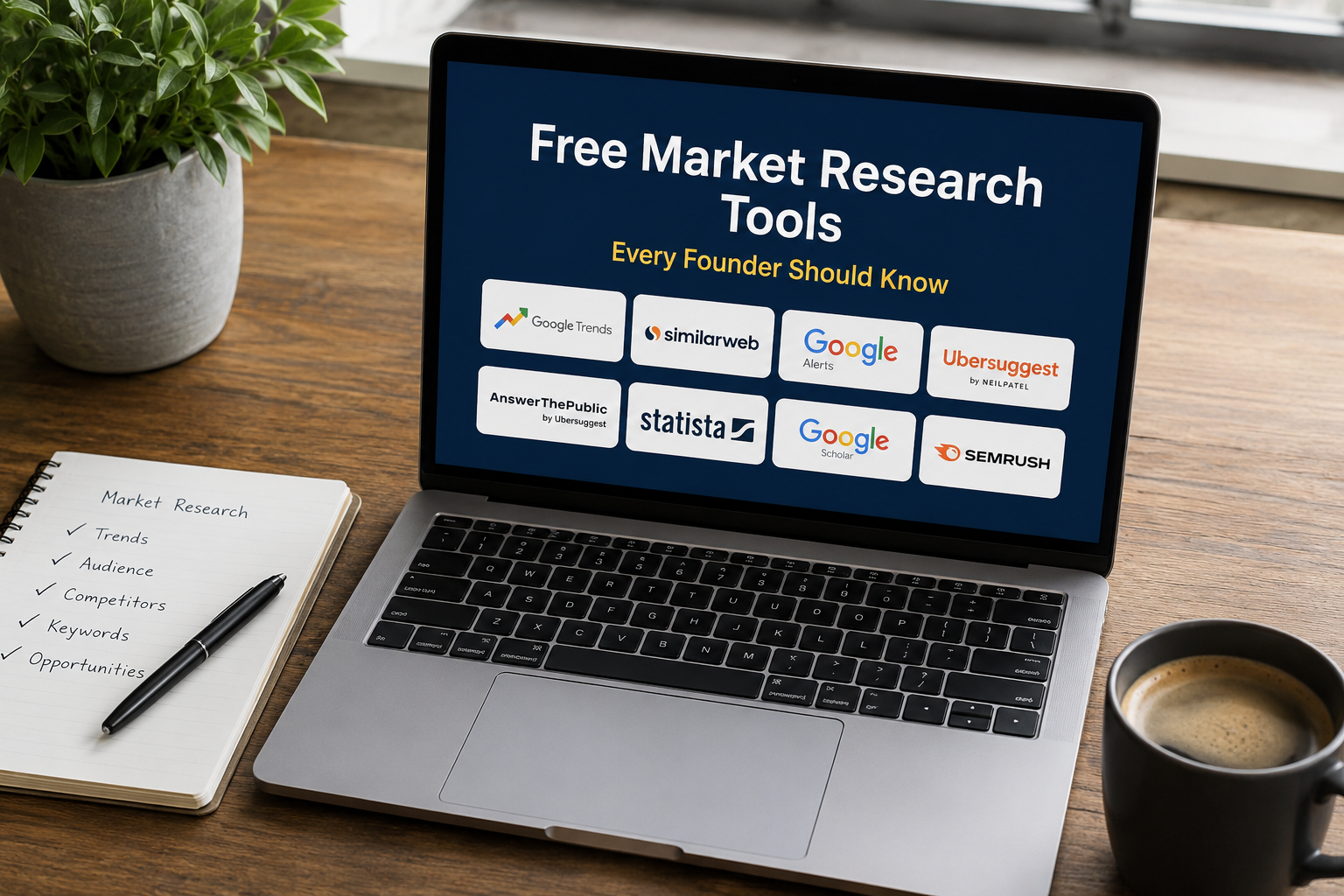
Free market research tools every founder should know include Google Trends, Google Keyword Planner, Answer The Public, Reddit, SurveyMonkey, Statista, Think With Google, LinkedIn, Ahrefs Webmaster Tools, Google Alerts, ONS government data, and Typeform. These twelve tools cover everything from demand validation and competitor intelligence to market sizing and customer research — all at zero cost.
Every single day, founders flush millions of dollars down the toilet building products nobody asked for — and the free market research tools that could have saved them were sitting right there, completely ignored, like gym equipment in January.
We’re here to build something real. And the good news? You don’t need a research budget the size of a hedge fund’s Christmas party to validate your idea. There are free market research tools available right now — powerful, legitimate, used by billion-dollar companies — that every founder should have in their toolkit. Let’s walk through them together. I promise to make it entertaining. And if I don’t, I’ll refund your money. (This article is free, so that’s easy.)
Why Market Research Is the Move Every Founder Is Sleeping On
Let me paint you a picture. You’ve got an idea. It’s 2 a.m., you’re in your kitchen eating cereal, and it hits you: an app that connects dog walkers with retired accountants who want to adopt pets. You write it on a napkin. You tell your mum. She says, “Oh that’s lovely, darling.” You raise £50,000 from your uncle. You hire three developers. Eighteen months later, you’re back eating cereal at 2 a.m., but this time you’re not excited. You’re calculating how much dog food you could have bought with that £50,000.
This is not a hypothetical. This is Tuesday.
According to a landmark analysis of failed startups conducted by CB Insights — one of the most referenced data sources in venture capital — 42% of startups fail because there is no market need for their product [1]. Updated research from CB Insights in 2024, which examined over 431 failed VC-backed companies, found the number sits closer to 43% failing due to poor product-market fit [2]. Nearly half. Gone. Not because they were bad builders. Not because the team wasn’t talented. Simply because nobody wanted the thing.
A peer-reviewed systematic review published in Systems (MDPI, 2024), which analysed startup success factors across studies published between 2004 and 2024 using PRISMA guidelines, confirmed that market validation and product-market fit consistently emerge as the most critical success factors across both developed and emerging markets [3]. Meanwhile, a separate study published in Administrative Sciences (MDPI, 2022) reviewed 60 academic articles on startup failure and found that “lack of market study” and “wrong positioning in the market” were among the most recurring factors in startup post-mortems [4].
Translation: not doing your market research isn’t a bold, contrarian move. It’s financial recklessness dressed in a hoodie.
And before you say “but market research is expensive” — no, honey. Not anymore. Welcome to 2025, where the tools that Fortune 500 companies use are sitting on the internet, free, waiting for you like a gift you refused to open at Christmas.
Let’s open the gift.
1. Google Trends — The Free Oracle You’re Underusing
If Google Trends were a person, they’d be the quiet genius in the corner of every meeting who only speaks when it’s important, but when they do speak, everyone goes quiet and takes notes.
What it is: Google Trends is a completely free tool that lets you see how frequently specific search terms are entered into Google over time, across geographies, and relative to total search volume [5].
What it does for founders: You want to know if your product idea has demand? Check if people are searching for it. Want to know if that demand is growing, plateauing, or dying? Google Trends will show you the trajectory. Want to know where in the world your heaviest concentration of potential customers lives? Done. Want to see how seasonal your business might be — whether people search for “garden furniture” in December or June? Google Trends will make it painfully obvious.
I once watched a founder spend £30,000 building a subscription service for a product whose Google Trends search volume had been in straight decline for four years. Four years of red flags, and they didn’t check. That’s like looking at a stock chart going down-left to up-right and deciding that’s the one to buy. Actually no — it was going down-right. I had the chart backwards. The point is: the data was free and available, and they didn’t use it.
How to use it like a pro:
Start by entering your core product category. Then compare it against alternatives using the “Compare” function. Use the geographic breakdown to see where interest is concentrated — this is invaluable for deciding where to launch first. Use the “Related queries” section to discover what else your audience is searching for; these are gold mines for content marketing and product development.
Case Study — Oatly: Before oat milk exploded globally, its search trajectory on Google Trends was quietly and consistently climbing in Scandinavian markets for several years before reaching the UK and US. Founders who tracked “oat milk” on Google Trends in 2017 had a full 12–18 months of advance signal before mainstream media caught on. Several DTC (direct-to-consumer) plant-based brands used exactly this kind of trending data to time their launches and ride the wave at its peak. By the time the press was writing “oat milk is everywhere,” the smart founders were already profitable.
Pro tip: Don’t just search your product name. Search the problem your product solves. If you’re building a budgeting app, search “how to save money,” “budgeting tips,” “personal finance help.” That’s where the real demand signal lives.
2. Google Keyword Planner — The Tool That Tells You Exactly What People Want
Right. So Google Trends shows you direction. Google Keyword Planner shows you volume. These two tools together are like a compass and a map. Separately, they’re useful. Together, they’re unstoppable.
What it is: Google Keyword Planner is a free tool within Google Ads that shows you the estimated monthly search volume for any keyword, how competitive that keyword is for advertising, and related keyword suggestions [6].
What it does for founders: It tells you, with numerical specificity, whether people are searching for what you’re building. Not just “yeah this seems popular” — actual numbers. “How to reduce back pain” gets searched 40,500 times a month in the UK. If you’re building a physiotherapy app, that’s your market. If you’re building a back-brace delivery service, that’s your customer. If nobody’s searching for what you’re building? That’s important information. It means either you’re creating a brand-new category (risky, expensive, occasionally genius), or you’re building something people don’t know they want yet (Steve Jobs territory — and there was only one Steve Jobs, so slow down).
Now look — I’m not saying that low search volume automatically means no market. Some of the most profitable niches in business are too specific for mass Google searches. But when you’re pre-revenue and trying to validate an idea, finding thousands of people actively searching for your exact solution is the closest thing to “free market research with receipts” that exists.
How to use it: Create a free Google Ads account (you do not need to run any ads). Navigate to “Tools and Settings” then “Keyword Planner.” Use “Discover new keywords” and type in your product, service, or the problem you’re solving. Study the average monthly searches, the three-month change, and the year-on-year change. Pay particular attention to related keywords — this is where you often find adjacent markets you hadn’t considered.
Case Study — Calm App: Before meditation apps were mainstream, searches for “how to reduce anxiety,” “meditation for sleep,” and “breathing exercises for stress” were quietly exploding on Google. Founders who used keyword research at the right time discovered not just that the market existed, but approximately how large it was. Calm, now valued at over $2 billion, operates in a space that was thoroughly validated by search behaviour years before it raised serious capital.
3. Answer The Public — The Tool That Reads Your Customer’s Mind
Okay, this one is my personal favourite, and if you’ve never used it, you’re about to have a moment. I’m talking the kind of moment where you sit back in your chair, look at the ceiling, and go “…oh.”
What it is: Answer The Public is a free (with limits) keyword research tool that visualises the questions, prepositions, comparisons, and searches people make around any keyword [7]. You type in a word or phrase, and it generates a sunburst diagram — or a list — of every question format people are asking about that topic on search engines.
What it does for founders: It tells you exactly what your potential customers are confused about, worried about, curious about, and comparing. If you type “meal prep” into Answer The Public, you’ll see questions like “can meal prep save money?”, “is meal prep healthy?”, “meal prep vs meal delivery” — hundreds of them. This is your content strategy, your FAQ page, your product positioning, your customer onboarding flow, your investor pitch narrative, and your social media calendar. All from one free search.
I once watched someone spend £5,000 on a brand strategy agency to “discover the customer’s emotional journey.” Bro. Answer The Public is free. Five minutes. Done.
The free plan gives you a limited number of daily searches, which is usually enough to validate an idea. If you need more, the paid plan is affordable.
How to use it like a founder, not a tourist:
Don’t just look at the questions in isolation. Group them by theme. You’ll start to see patterns — clusters of concerns that represent real friction points in your market. Those friction points are product features. Those questions are your blog posts. Those comparisons are your competitive positioning.
Case Study — Notion: Before Notion achieved unicorn status, the “notes app vs project management” and “best tools for remote teams” question clusters were massive. Founders building in the productivity space who used tools like Answer The Public could see that customers were desperately searching for an integrated solution. Notion’s rise wasn’t just about great design — it was solving the exact questions people were literally typing into search engines.
4. Reddit — The Most Honest Focus Group on the Planet
Let me tell you about Reddit. Reddit is where people go when they want to say what they actually think, without their name attached, without professional consequences, and without the social performance that comes with being on LinkedIn. On LinkedIn, everyone is “excited to announce” and “humbled to share.” On Reddit, someone posts “I tried every CRM on the market and they’re all garbage and here’s specifically why.”
That second person is your customer. And their honesty is your market research.
What it is: Reddit is a free social platform organised into communities called “subreddits,” each dedicated to a topic. There are subreddits for virtually every industry, profession, hobby, problem, and demographic imaginable [8].
What it does for founders: Reddit gives you unfiltered access to what your target customers actually think, say, and feel — not what they tell a survey researcher, not what they perform on social media, but their raw, unedited frustrations, desires, and buying behaviour.
Search the subreddit for your industry. Read the top posts of all time. Read the comments. Read the complaints. Read what people are asking for. Read what they’ve already tried and abandoned. This is primary qualitative research, and it costs nothing.
I’m telling you — some of the best product ideas I’ve ever seen came directly from Reddit threads where customers were screaming into the void about something nobody had fixed yet. “Why does every [product in this category] do X? Why can’t anyone just do Y?” That’s a business. That’s your business.
Pro tip for founders: Use Reddit’s search function to look for phrases like “I wish,” “why doesn’t,” “is there anything that,” “I hate that,” and “frustrated with.” These are the phrases that live directly upstream of product-market fit.
Case Study — Glossier: Emily Weiss, founder of Glossier, used her blog “Into The Gloss” and community engagement (essentially the analogue equivalent of monitoring Reddit) to deeply understand what beauty consumers wanted before she ever launched a product. Her research revealed customers wanted skincare that felt like skincare, not heavy makeup — a sentiment that was everywhere in beauty forums and Reddit threads. Glossier launched directly into that insight and grew to a $1.8 billion valuation.
5. SurveyMonkey (Free Plan) — Stop Guessing, Start Asking
Here’s a concept so radical it might break your brain: have you tried just… asking people?
I know. I know. It sounds simple. That’s because it is simple. But somehow, founders will build twelve features based on their own preferences and the opinions of three friends who don’t want to hurt their feelings, rather than creating a ten-question survey and sending it to a hundred strangers.
What it is: SurveyMonkey is one of the world’s most popular survey platforms. The free plan allows you to create surveys with up to 10 questions and receive up to 40 responses per survey [9]. It includes over 200 customisable survey templates and is straightforward to set up.
What it does for founders: It gives you structured, quantitative primary research data from real humans who have no social obligation to be nice to you. That last part is crucial. Your mum will tell you your product is brilliant. A stranger completing an anonymous survey will tell you the truth.
Use SurveyMonkey to validate whether your problem is real, how frequently potential customers experience it, what they’re currently using to solve it, and whether they would pay for your solution. Those four questions alone are more valuable than six months of assumptions.
Real Case Study: Jamee Herbert, founder of BridgeCare Finance, used SurveyMonkey Audience in 2025 to validate her childcare business concept with a 28-question survey targeting parents. The results not only confirmed her hypothesis but also helped her win a $20,000 pitch prize and secure venture capital funding [10]. She put it plainly: “We had to have more than just a gut instinct. We needed data.” That data came from a survey tool. A survey tool.
Pro tip: Don’t just ask “would you use this?” People lie when you ask hypothetically. Instead, ask “how do you currently solve this problem?”, “how much do you spend on this each month?”, and “what do you hate about the solutions you currently use?” These questions reveal real behaviour, not imagined behaviour.
6. Statista (Free Basic Account) — The Numbers That Make Investors Nod
Right, here’s where we go from “I have a feeling the market is big” to “the market is £4.7 billion and growing at 12% annually.” Those are two very different conversations with a very different quality of investor reaction.
What it is: Statista is a global data and statistics platform that aggregates data from over 22,000 sources and provides access to more than one million statistics, market reports, consumer insights, and industry data [11]. The free basic account gives you access to a limited but still substantial library of statistics and infographics.
What it does for founders: It gives you real, citable, sourceable market size data. It turns your pitch deck from “we believe the market is large” to “the global market for X was valued at £Y billion in 2024 and is projected to reach £Z billion by 2030 (Statista, 2024).” That sentence is the difference between a founder who feels confident and an investor who feels confident.
Beyond pitch decks, Statista helps you understand your competitive landscape, track consumer behaviour trends, and benchmark your product assumptions against real industry data. It covers markets in over 190 countries and has more than 2.5 million interview-based consumer insights [12].
Pro tip: Even on the free plan, Statista’s charts are often usable if you reference the source correctly. And the preview data — even when the full dataset is behind a paywall — is often enough to validate whether a full subscription or a one-time report purchase is worth it for your specific market.
Case Study — DTC Food Brands: Multiple direct-to-consumer food startups launching in the UK’s plant-based sector in 2021 used Statista data showing the UK plant-based food market was growing at double-digit percentages to anchor their investor pitches. Several raised seven-figure seed rounds partly on the strength of this clearly documented market opportunity. The Statista subscription for that research? A fraction of their monthly operating costs.
7. Think With Google — Market Intelligence From the World’s Largest Search Engine
If Google Trends is the DJ and Keyword Planner is the setlist, Think With Google is the entire music festival. It’s where Google publishes its own research, consumer insights, industry reports, and data tools — all free — for marketers and founders.
What it is: Think With Google is Google’s free research and insights platform that publishes consumer behaviour data, industry benchmarks, digital marketing case studies, and trend reports [13]. It also includes tools like the Market Finder (for international expansion), the Rising Retail Categories tool, and the Consumer Barometer.
What it does for founders: It provides macro-level consumer intelligence that would cost thousands of pounds from a traditional research agency. You can find out how consumer purchasing behaviour is shifting across your industry, what percentage of buyers research online before purchasing in-store, how mobile versus desktop usage breaks down in your category, and emerging market opportunities across geographies.
This is not just for consumer businesses. B2B founders can find valuable insights here too — particularly around how business decision-makers research and evaluate software, services, and suppliers.
Pro tip: Use the “Insights” section and filter by your industry. Set a Google Alert for new publications from Think With Google in your sector. This gives you a steady stream of market intelligence without any effort.
8. LinkedIn (Free Features) — Competitor Research and Customer Intelligence
I know what you’re thinking. “LinkedIn? That’s a networking site.” And you’re right — it is a networking site. But it’s also an absolutely devastating competitive intelligence and customer research tool that most founders are completely sleeping on.
What it is: LinkedIn is the world’s largest professional network, with over one billion members globally [14]. Even on a free account, founders have access to enormous amounts of publicly available professional and business data.
What it does for founders:
First, competitor research. Go to your competitor’s LinkedIn company page. Look at their team size (available publicly). Look at who they’re hiring — job postings tell you exactly where a company is investing and what problems they’re trying to solve. If your competitor is suddenly hiring ten data scientists, you know something about their product roadmap. That’s market intelligence. That’s free.
Second, customer research. Use LinkedIn’s search function to find people in your target customer segment. Look at what content they’re sharing, what articles they’re engaging with, what problems they’re discussing in comments. This is qualitative research at scale.
Third, founder validation. Post about the problem your product solves. Ask questions. Run polls. LinkedIn’s free native poll feature is underrated as a validation tool. Thousands of professionals on LinkedIn will weigh in if you frame the question right.
Case Study — Superhuman: Rahul Vohra, founder of Superhuman (the email client that commands a $30/month fee and has a waiting list), famously used structured customer conversations and professional network analysis to identify his highest-value potential customers before building features. The methodical, research-first approach he championed — now called the Superhuman Product-Market Fit Engine — helped him raise a $33 million Series B from Andreessen Horowitz. Research first. Build second.
9. SEMrush / Ahrefs Free Tools — Peek Inside Your Competitor’s Playbook
Your competitors are already telling you exactly what’s working for them. Their website traffic, their top search rankings, their most-shared content, their backlink strategy — it’s all sitting there. You just need the right tool to read it.
What it is: Both SEMrush and Ahrefs offer limited but genuinely useful free versions of their competitive intelligence platforms. Ahrefs specifically offers “Ahrefs Webmaster Tools,” which provides free access to your own site’s SEO data — and importantly, lets you do a limited amount of competitor keyword research as well [15].
What it does for founders: Even on the free tier, you can find out which keywords your competitors rank for, which pages on their site drive the most traffic, what their backlink profile looks like, and where their organic search growth is coming from. This is market intelligence. If your competitor is getting 40,000 monthly visitors from the phrase “best project management tool for freelancers,” that phrase represents a validated, commercially-active market.
Pro tip: Use SEMrush’s free “Domain Overview” to look up any competitor website and see their traffic trend over the past 12 months. A declining traffic trend on a competitor’s site is a market signal. An exploding traffic trend is a market signal. Both are information you can act on.
10. Google Alerts — The Cheapest Market Intelligence System Ever Built
I want you to set up Google Alerts right now. Right now. Literally open a new tab while you’re reading this. I’ll wait.
What it is: Google Alerts is a completely free monitoring service that sends you email notifications whenever Google indexes new content containing your specified keywords [16].
What it does for founders: Set up alerts for your industry keywords, your competitors’ brand names, your own brand name, and the core problem you’re solving. Every morning, you’ll receive a digest of everything that’s been published about your market — news articles, blog posts, forum discussions, press releases. This is your market intelligence briefing, delivered to your inbox, for free, daily.
This is the tool that no one puts on these lists and everyone should. It’s not glamorous. It doesn’t have a beautiful dashboard. But the founder who reads every piece of market news every day has a structural information advantage over the founder who looks up once a month.
Discipline is the competitive advantage that free tools can’t give you — but they give you the information. What you do with it is on you.
11. Bureau of Labor Statistics, ONS, and Government Data Portals
Okay, stay with me. I know “government data portals” doesn’t sound exciting. I know. But here’s the thing — some of the most accurate, comprehensive, and legally citable market data in the world is published by governments and is completely free.
What it is: In the UK, the Office for National Statistics (ONS) publishes detailed data on consumer spending, employment, industry trends, demographic shifts, and economic indicators. In the US, the Bureau of Labor Statistics (BLS) does the same. The EU has Eurostat. Most developed governments publish equivalent open-data repositories [17].
What it does for founders: Government data is the gold standard for market sizing, particularly in regulated industries, consumer goods, and anything related to demographics. If you’re building a product for the 65+ demographic, ONS data on population projections will tell you exactly how that market is growing over the next twenty years. If you’re building a fintech product, BLS wage data tells you income distribution. If you’re building anything in healthcare, social care, education, or housing — these datasets are essential.
And they’re free. As in, your taxes already paid for them. You’re just not using your receipt.
Pro tip for UK founders: The ONS website has a dedicated business data section and sector-specific research reports. The Consumer Price Index, the Annual Survey of Hours and Earnings, and the Family Spending Survey are particularly useful for consumer product founders.
12. Typeform (Free Plan) — Surveys That People Actually Complete
Last but absolutely not least: Typeform.
Here’s the cold truth about surveys — people don’t finish them. You send out a twenty-question Google Form with radio buttons, and you get a 12% completion rate, and eight of those completions are from your team pretending to be customers. It’s tragic.
What it is: Typeform is a survey tool that uses a conversational, one-question-at-a-time format to create a survey experience that feels more like a conversation and less like a tax form [18]. The free plan allows up to ten questions per survey with unlimited responses.
What it does for founders: It dramatically increases survey completion rates. According to data from within the market research tools industry, founders switching to conversational survey formats like Typeform have seen response rates jump by up to 30% compared to traditional form formats [19]. More completions means more data. More data means better decisions. Better decisions means fewer 2 a.m. cereal moments.
Pro tip: Use Typeform to build your pre-launch waitlist validation sequence. Drive traffic to a landing page, ask three to five Typeform questions before showing the sign-up field, and you’ll qualify your early adopters while simultaneously gathering market research.
Putting It All Together: The Free Market Research Stack
Now, here’s how you combine these tools into an actual process rather than a collection of browser tabs you open, feel productive about, and then never revisit.
Phase 1 — Demand Validation (Days 1–3): Use Google Trends to confirm growing interest, Google Keyword Planner to quantify monthly search volume, and Answer The Public to map the specific questions and friction points in your market.
Phase 2 — Competitive Intelligence (Days 3–5): Use LinkedIn Company Pages to profile competitors and read their hiring signals, Ahrefs/SEMrush free tools to identify where competitor traffic originates, and Reddit to hear unfiltered customer opinions about existing solutions.
Phase 3 — Market Sizing (Days 5–7): Pull Statista data for total addressable market and growth projections, cross-reference with ONS/BLS government datasets for demographic and spending data, and use Think With Google for macro consumer behaviour trends.
Phase 4 — Customer Validation (Days 7–14): Build a Typeform survey (conversational, under ten questions), distribute it via SurveyMonkey, and triangulate results with Reddit threads and LinkedIn polls.
Phase 5 — Ongoing Intelligence (Perpetual): Google Alerts running daily. Google Trends checked monthly. Market awareness maintained as a discipline, not a one-time exercise.
This is the full free market research stack. It costs nothing but time — and the time cost is dramatically less than the cost of building a product nobody wants.
A Word on What Free Tools Can’t Do
Now, before you think I’m out here saying “all market research is free and consultants are frauds” — that’s not the message. Free tools have ceilings. SurveyMonkey’s free plan caps at 40 responses. Statista hides the richest datasets behind a paywall. Ahrefs’ free tier is limited. As your business grows, as your decisions get bigger, as the stakes rise, you will need paid research. You will need primary qualitative interviews. You may eventually need a research agency.
But at the validation stage? At the pre-seed stage? When you’re deciding whether to quit your job and bet two years of your life on an idea? The free tools are more than sufficient to get you from “is this a real market?” to “yes, there’s real demand here, and here’s the data.”
A peer-reviewed study on startup success factors published in Administrative Sciences (2022) found that founders with stronger domain knowledge and market understanding had significantly better startup outcomes — and crucially, that information-seeking behaviour at the validation stage was one of the strongest predictors of long-term success [4]. Using these tools isn’t just a nice habit. It’s a statistically supported success factor.
The Bottom Line
Here’s my trader’s take, stripped of all decoration:
Every market is a trade. When you launch a startup, you are long on demand and short on competition — you’re betting that there’s enough customer desire for what you’re building, and that you can capture it faster and better than anyone else. No serious trader enters a position without looking at the chart. No serious investor deploys capital without reading the prospectus.
And yet founders — intelligent, motivated, ambitious people — routinely build products without checking if the market exists, without reading what customers are saying about the problem, without benchmarking their assumptions against real data. And then they’re surprised when it doesn’t work.
Don’t be that founder. Be the one who shows up to a pitch with five data sources. Be the founder who can say “according to ONS data, the 50+ demographic in the UK grows by 400,000 people per year — and here’s the Google Trends data confirming rising search interest from that demographic.” Be the founder who knows their competitors’ traffic sources and can explain exactly how they plan to take market share.
The tools are free. The data is available. The competitive advantage is yours — if you choose to take it. Now close this article, open Google Trends, and type in your idea. Your research starts now.
Frequently Asked Questions
Q1: What are the best free market research tools for founders?
The best free tools include Google Trends, Google Keyword Planner, Answer The Public, Reddit, SurveyMonkey’s free plan, Statista’s basic account, Think With Google, LinkedIn, Ahrefs Webmaster Tools, Google Alerts, government data portals like the ONS, and Typeform’s free tier.
Q2: Why is market research important for startups?
According to CB Insights, 43% of startups fail due to poor product-market fit — a problem that thorough market research directly prevents.
Q3: Can I do market research without a budget?
Yes — tools like Google Trends, Answer The Public, Reddit, Google Alerts, and government data portals are entirely free and collectively provide demand, competitor, and customer intelligence sufficient to validate most startup ideas.
Q4: How do I use Google Trends for market research?
Enter your core product or problem keyword, analyse the search interest trajectory over time, compare it against alternatives, and use the geographic breakdown to identify where your highest-demand audience is concentrated.
Q5: What is the fastest way to validate a startup idea?
Run a short Typeform or SurveyMonkey survey asking target customers how they currently solve your problem, what they hate about existing solutions, and how much they currently spend — this gives you primary validation data within days.
Q6: How does Reddit help with market research?
Reddit gives founders unfiltered, real-world customer sentiment by letting them search phrases like “I wish,” “why doesn’t,” and “frustrated with” inside industry-specific subreddits to uncover unmet needs and product gaps.
Q7: Is Statista free to use?
Statista offers a free basic account that provides access to a limited but useful library of statistics, charts, and market data across industries and geographies.
Q8: How do I research my competitors for free?
Use LinkedIn to read competitors’ hiring signals, Ahrefs Webmaster Tools to identify their top-ranking keywords and traffic sources, and Google Alerts to monitor every time they’re mentioned in new online content.
Q9: What is Answer The Public used for?
Answer The Public maps every question, comparison, and search phrase people are typing around your keyword — turning a single topic into a complete picture of your audience’s fears, desires, and decision-making process.
Q10: How many free market research tools should a founder use?
A founder should use at minimum five tools spanning demand validation, competitive intelligence, market sizing, and customer feedback to build a reliable, multi-source picture of their market before committing capital.
References
[1] CB Insights. The Top 12 Reasons Startups Fail. CB Insights Research Report. Available at: https://www.cbinsights.com/research/report/startup-failure-reasons-top/
[2] CB Insights (2024). Updated Analysis of 431 Failed VC-Backed Startups. As cited in: Preuve AI (2026). “Why 42% of Startups Fail (And What the Other 58% Get Wrong Too).” Available at: https://preuve.ai/blog/why-startups-fail-market-fit
[3] Lopes, J.M., Oliveira, J., Oliveira, M. et al. (2024). “The Pathway to Startup Success: A Comprehensive Systematic Review of Critical Factors and the Future Research Agenda in Developed and Emerging Markets.” Systems, 12(12), 541. MDPI. Available at: https://www.mdpi.com/2079-8954/12/12/541
[4] Cantón-Croda, R.M. et al. (2022). “Success Factors of Startups in Research Literature within the Entrepreneurial Ecosystem.” Administrative Sciences, 12(3), 102. MDPI. Available at: https://www.mdpi.com/2076-3387/12/3/102
[5] Google. Google Trends. Available at: https://trends.google.com
[6] Google Ads. Keyword Planner. Available at: https://ads.google.com/home/tools/keyword-planner/
[7] Answer The Public. Available at: https://answerthepublic.com
[8] Reddit Inc. Available at: https://www.reddit.com
[9] SurveyMonkey. Free Plan Features. Available at: https://www.surveymonkey.com/pricing/
[10] ThinkUp Global (2025). “Top 5 Market Research Tools for Early-Stage Startups.” Available at: https://thinkup.global/top-5-market-research-tools-for-early-stage-startups/
[11] Statista. Platform Overview. Available at: https://www.statista.com
[12] Brand24 (2024). “The 10 Best Market Research Tools for Startups.” Available at: https://brand24.com/blog/market-research-tools-for-startups/
[13] Google. Think With Google. Available at: https://www.thinkwithgoogle.com
[14] LinkedIn. Available at: https://www.linkedin.com
[15] Ahrefs. Ahrefs Webmaster Tools (Free). Available at: https://ahrefs.com/webmaster-tools
[16] Google Alerts. Available at: https://www.google.com/alerts
[17] Office for National Statistics (ONS). Available at: https://www.ons.gov.uk
[18] Typeform. Free Plan. Available at: https://www.typeform.com/pricing/
[19] GoElastic (2025). “Market Research Tools for Startups: 5 Essential, Powerful Picks.” Available at: https://goelastic.com/market-research-tools-for-startups/
This article was written by The Trader. All data references are cited and linked. For more founder resources and straight-talking market analysis, bookmark this page and share it with the founder in your life who’s about to make a very expensive mistake.
Leave a Reply
You must be logged in to post a comment.