
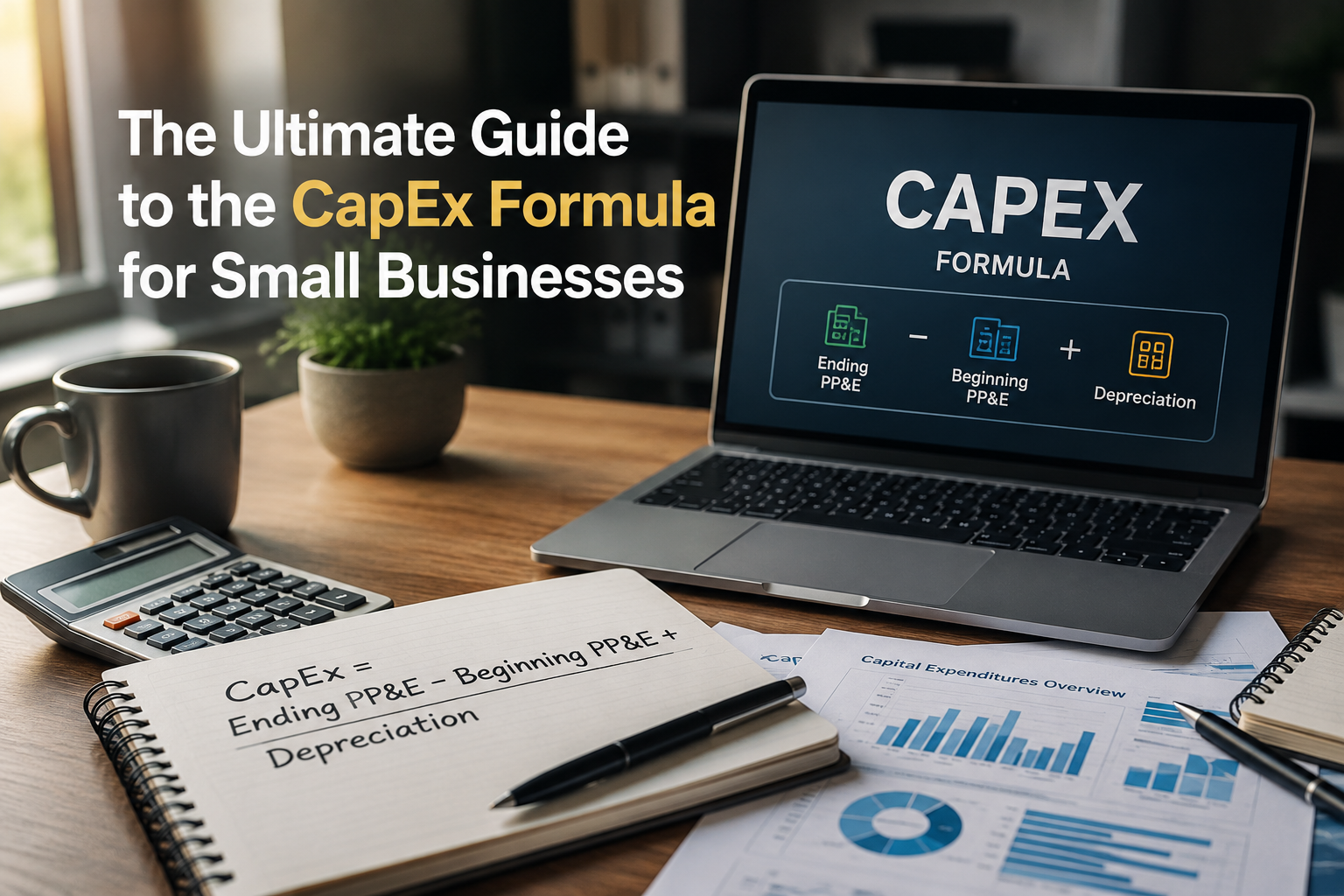
The CapEx (Capital Expenditure) formula — Ending Net PP&E (Property, Plant & Equipment) minus Beginning Net PP&E plus Depreciation — tells small business owners exactly how much they invested in long-term assets during any given period. Master this calculation and you gain the single most important tool for protecting your cash flow, timing asset purchases strategically, and making capital investment decisions that drive sustainable growth rather than silent financial ruin.
📝 TL;DR — Quick Takeaways
- Core Definition: The CapEx (Capital Expenditure) formula — Ending Net PP&E (Property, Plant & Equipment) minus Beginning Net PP&E plus Depreciation — calculates exactly how much your small business invested in long-term assets during any given period.
- Primary Breakdown: Six interlocking formulas govern smart CapEx management: the core CapEx formula, Free Cash Flow (FCF = Operating Cash Flow minus CapEx), the CapEx Ratio (Operating Cash Flow ÷ CapEx), the CapEx-to-Revenue Ratio (CapEx ÷ Revenue × 100), Return on Assets (Net Income ÷ Total Assets × 100), and Cash Flow ROI (Operating Cash Flow ÷ Total Assets × 100).
- Key Takeaway: CapEx (Capital Expenditure) will either be the engine of your business growth or the silent killer of your cash flow — and the only thing that decides which one is whether you calculate it, time it, and finance it correctly.
Jump to the Core Formula Cheat Sheet
What Is CapEx and Why Does It Matter for Small Businesses?
Defining Capital Expenditure in Simple Terms
Capital expenditure — commonly abbreviated as CapEx — is the money a business spends to acquire, upgrade, or extend the life of long-term physical assets. Think buildings, machinery, vehicles, computer systems, and equipment. These are not your day-to-day costs. These are the big-ticket purchases that are expected to generate value for more than one year.
The key word in that definition is long-term. When you buy a laptop that you plan to use for the next four years, that is CapEx. When you buy printer paper for the office, that is an operating expense. One goes on your balance sheet as an asset and depreciates over time. The other hits your income statement immediately and is gone. Same wallet, completely different accounting treatment — and completely different impact on your cash flow.
According to the Corporate Finance Institute, capital expenditures are recorded as assets on the balance sheet and their cost is spread over time through depreciation, rather than being expensed all at once. (Corporate Finance Institute, Capital Expenditure (CapEx)) This matters enormously for small businesses because it means CapEx can quietly crush your cash flow long before it shows up as a problem on your profit and loss statement.
There are two types of CapEx every small business owner needs to understand:
- Maintenance CapEx: Spending required simply to keep your existing operations running. Replacing a worn-out oven in a bakery. Updating aging servers. This is not glamorous spending — it is survival spending.
- Growth CapEx: Investment in new assets that will expand your capacity, increase revenue, or open new markets. Buying a second delivery van. Installing a new production line. Building an extension. This is the exciting stuff — as long as you can afford it.
Both types matter. Both affect your cash flow in big, potentially painful ways. And both require the same rigorous formula to calculate and manage correctly.
Why Poor CapEx Planning Destroys Small Business Cash Flow
Here is a hard truth delivered with love: most small business owners treat capital expenditure like it is a decision they can make with their gut. “Looks like we need a new van, let us buy a van.” No analysis. No timing strategy. No consideration of how that purchase fits into annual cash flow cycles. Just vibes and a finance agreement signed in a moment of optimism.
That approach is fine right up until the moment it is absolutely catastrophic.
Poor CapEx planning is one of the most silent killers in small business finance. You buy the asset, the asset goes on the balance sheet, and on paper everything looks fine. But cash? Cash has left the building. You might have just drained three months of working capital reserves on a piece of equipment that will take two years to generate enough return to justify its cost. Meanwhile, your suppliers still want paying, your staff still want wages, and the heating bill does not care about your depreciation schedule.
Research published in the Small Business Institute Journal highlights that seasonal small businesses in particular carry significantly more financial risk when undertaking capital projects, because the upfront cash outlay happens regardless of whether revenue is high or low. (Kristanto, 2022, cited in Sbij.scholasticahq.com, Thriving Through Seasonal Cash Flow Challenges) That is not an edge case. That is thousands of businesses every single year.
Understand the CapEx formula. Use it. Your future self will thank you.
The CapEx Formula: How to Calculate Capital Expenditure
Right, here is what you came for. The CapEx formula. Let us make this crystal clear.
📐 The CapEx Formula
CapEx = Ending Net PP&E − Beginning Net PP&E + Depreciation Expense
Where: PP&E = Property, Plant & Equipment
Depreciation is Found on the Income Statement or the Operating Cash Flow section.
That is it. Three numbers. One formula. And it will tell you exactly how much capital your business invested in long-term assets during any given period. If your accountant has been making this sound mysterious, you have every right to be suspicious.
According to financial analysis resource HeyGoTrade, this formula estimates how much a company invested in long-term assets during a period — and crucially, it does not immediately reduce profit. Instead, the cost is spread over time through depreciation. (HeyGoTrade, Capital Expenditure (CapEx) Explained) That is exactly why understanding this formula is so powerful for small business owners — it lets you see your real investment activity, not just what your income statement is showing you.
Breaking Down the Components
Let us go through each element of the formula one by one, because each one lives in a specific place on your financial statements and knowing where to find them is half the battle.
Net PP&E (Property, Plant, and Equipment)
PP&E is the collective term for all your physical long-term assets: buildings, machinery, vehicles, office equipment, and computer hardware. Net PP&E means the value after accumulated depreciation has been subtracted — in other words, the book value of your assets today, not what you paid for them when they were shiny and new.
Where to find it: On your balance sheet, under non-current assets. You will typically see a line for gross PP&E and another for accumulated depreciation. Net PP&E = gross PP&E minus accumulated depreciation. Some balance sheets show you the net figure directly. Either way, you need two periods — the beginning of the year and the end of the year — so you can calculate the change.
Think of it this way. Your business is like a gym membership. The gross PP&E is what you paid to sign up. The accumulated depreciation is how much of that membership you have already used. Net PP&E is how much gym value you theoretically still have left — even if, much like your actual gym membership, you have not been going as often as you should.
Depreciation Expense
Depreciation is the accounting mechanism that allocates the cost of a long-term asset across its useful life. If you buy a piece of machinery for £50,000 and it has a useful life of ten years, you depreciate £5,000 per year using the straight-line method. That £5,000 is your annual depreciation expense.
Where to find it: On your income statement as a line item called depreciation expense, or on your cash flow statement under operating activities, where it is added back to net income because it is a non-cash charge.
This is the part that trips people up. Depreciation is not a cash outflow. You are not writing a cheque for £5,000 every year. The cash already went out when you bought the machine. Depreciation is purely an accounting entry that spreads that cost over time. But it is critically important to the CapEx formula because it adjusts for the fact that assets are ageing and losing book value every year — so we need to add it back to see how much new investment actually happened.
Step-by-Step CapEx Calculation Example
Let us walk through a realistic example with a small business that actually makes something people want — because traders love businesses with real products.
Case Study 1: The Rise of Brixton Bakehouse
Brixton Bakehouse is a medium-sized artisan bakery in South London. They have been operating for three years, they have a strong local following, and they want to figure out exactly how much capital they invested last year.
Here are their numbers from the balance sheet and income statement:
| Item | Value |
|---|---|
| Net PP&E (start of year) | £60,000 |
| Net PP&E (end of year) | £85,000 |
| Depreciation Expense (year) | £8,000 |
Applying the CapEx Formula:
CapEx = Ending Net PP&E − Beginning Net PP&E + Depreciation Expense
CapEx = £85,000 − £60,000 + £8,000
CapEx = £33,000
So Brixton Bakehouse invested £33,000 in long-term assets over the year. That is a real number with real cash flow implications. They bought a new industrial bread proofer for £25,000 and upgraded their refrigeration units for £8,000. Makes sense. The formula confirms it.
Now here is where it gets interesting from a trader’s perspective. That £33,000 went out of the door as a cash outflow. But on the income statement? Only £8,000 of depreciation expense showed up — quietly, peacefully, without drama. The remaining £25,000 of asset acquisition sat on the balance sheet and said nothing. Absolutely nothing. This is exactly why you cannot rely on your profit and loss alone to understand your true cash position.
This is confirmed by analysis from BILL.com: managing CapEx comes with a unique set of challenges for small businesses precisely because significant cash flows are not always visible on the income statement in the year they occur. (BILL.com, Capital Expenditure (CapEx) Definition and Formula)
CapEx vs. OpEx: What’s the Difference?
Now that you have the formula down, let us address the confusion that causes more small business accounting headaches than almost anything else: CapEx versus OpEx.
OpEx, or Operating Expenditure, is the money you spend on the day-to-day running of your business. Rent, salaries, utilities, marketing costs, office supplies, software subscriptions. These hit your income statement immediately and reduce your taxable profit in the period they are incurred. Simple. Direct. Immediate.
CapEx, as we now know, is the big stuff. Long-term assets. Capitalised on the balance sheet. Depreciated over time.
The difference matters enormously — not just for accounting accuracy, but for tax treatment, cash flow forecasting, and how investors and lenders view your business.
Comparison Table: CapEx vs. OpEx at a Glance
| Feature | CapEx | OpEx |
|---|---|---|
| Definition | Long-term asset investment | Day-to-day operating cost |
| Timing of expense | Spread over asset’s useful life (depreciation) | Expensed immediately in period incurred |
| Balance sheet impact | Appears as asset, then depreciates | Does not appear on balance sheet |
| Income statement | Only depreciation charge shows up per year | Full cost appears in year incurred |
| Cash flow impact | Large upfront outflow | Regular, smaller outflows |
| Tax treatment | Depreciation is tax-deductible over asset life | Fully deductible in year of expense |
| Examples | Machinery, vehicles, buildings, major software | Rent, salaries, utilities, subscriptions |
How CapEx and OpEx Impact Cash Flow Differently
Here is the core tension that every small business owner eventually discovers — usually at the worst possible moment.
OpEx hits your cash flow immediately and regularly. When you pay rent, that money is gone. When payroll runs on Friday, that money is gone. These are predictable, recurring outflows that you can budget for monthly. They are painful, but they are manageable because they are consistent.
CapEx requires a massive upfront cash outlay but hits your profits slowly over time. You spend £40,000 on a piece of equipment in January. Your bank balance drops by £40,000 in January. But your income statement only sees £4,000 of depreciation expense that year (if it is a 10-year asset). So your reported profit barely moves — but your actual cash? Devastated.
This disconnect between cash flow reality and accounting appearance is one of the most dangerous gaps in small business financial management. Research published in the International Journal of Production Economics demonstrates that improved cash flow management — particularly around understanding the difference between recorded expenses and actual cash outflows — is consistently associated with improved firm liquidity and financial performance. (Fazzari & Petersen, 1993, cited in Scholarworks.boisestate.edu, Cash Flow Management and Manufacturing Firm Financial Performance)
The Small Business Trap: Misclassifying Expenses and Freezing Your Cash
And here is where we have to talk about the trap — the one that catches small business owners who are doing their own bookkeeping, or who have a bookkeeper who learned accounting from YouTube in 2019.
Misclassifying expenses between CapEx and OpEx creates chaos. If you expense a £30,000 asset immediately as an operating cost, you artificially inflate your costs, understate your profit, and destroy your apparent cash position in a single period. Conversely, if you capitalise items that should be expensed — say, you treat regular maintenance as a capital improvement — you inflate your asset base, defer costs, and make your business look more profitable than it is.
Both errors freeze your ability to manage cash flow accurately. And when cash flow visibility is poor, bad decisions follow. You spend when you should be saving. You hold back when you should be investing. You run out of cash on a Tuesday in November and wonder how it happened when the P&L looked fine last week.
The rule of thumb: if the expenditure extends the useful life of an asset or creates a new one — it is CapEx. If it merely maintains the asset in its current condition — it is OpEx.
Strategic Cash Flow Management: Balancing CapEx and Liquid Cash
This is where we move from understanding CapEx to actually using that understanding to run a better, more financially resilient business. And this section, frankly, is where most guides stop being useful and start being theoretical. Not here.
The Golden Rule of CapEx Financing
Here is a rule I live by as a trader, and it applies equally to small business CapEx decisions:
Do not use short-term money to fund long-term assets.
If the asset is going to generate value over five years, finance it over five years. Do not drain your working capital — the money you need to pay suppliers, staff, and operating costs in the next 90 days — to buy a piece of equipment that will not show a return for 18 months.
This is the golden rule of CapEx financing, and it has three practical implications:
- Use cash reserves for CapEx only when those reserves are genuinely surplus to your near-term operational needs. A good rule of thumb: always maintain at least three months of operating expenses in liquid reserves before committing cash to a CapEx purchase.
- Use debt or leasing for growth CapEx that is clearly ROI-positive. If a new machine will save you £10,000 per year in labour costs and costs £30,000 to buy on a 4-year lease, the maths works. Finance it. Your monthly lease payment is an operating expense (or treated as such under most lease accounting), and you preserve your cash. That is a trade I would take every day.
- Use cash for small-ticket maintenance CapEx — replacing a laptop, updating a server — where the amounts are modest and financing costs would be disproportionate.
Research from the Journal of Financial and Quantitative Analysis (Cleary, Povel & Raith, 2007) supports a nuanced approach to CapEx financing, demonstrating that the relationship between investment and financing follows a U-shaped curve — meaning both severely cash-constrained and cash-flush firms sometimes make suboptimal CapEx decisions, while firms that actively match financing type to asset type perform best. (Cleary, Povel & Raith, 2007, cited in Tandfonline.com, Capital Expenditures and Working Capital Management)
Translation: do not be the business owner who is either too scared to invest or too reckless to think about how to invest. The sweet spot is deliberate, matched financing.
Assessing CapEx Affordability: Free Cash Flow (FCF)
Before you commit to any significant CapEx, you need to know one number above all others: your Free Cash Flow. This is the number that tells you whether you actually can afford the investment — not whether you want to, not whether it looks good on a pitch deck, but whether the cold, hard numbers support it.
💰 The Free Cash Flow Formula
FCF = Operating Cash Flow − Capital Expenditures
Or, rearranged to assess CapEx affordability:
Affordable CapEx = Operating Cash Flow − Minimum Required FCF Buffer
Here is how to use this in practice. Say your business generates £120,000 in operating cash flow per year. You want to maintain a minimum FCF buffer of £30,000 — enough to cover unexpected costs, opportunistic investments, and debt servicing. That means you have at most £90,000 available for CapEx in that year.
Now you can evaluate every proposed capital purchase against that budget with discipline and clarity. The new delivery van costs £35,000? That is 39% of your available CapEx budget. Is it the best use of that 39%? Maybe. Maybe not. But at least you are asking the right question.
Free cash flow is also the number that every serious investor, lender, and business valuator will scrutinise. According to the Corporate Finance Institute, the free cash flow calculation — which directly deducts capital expenditures from operating cash flow — is one of the most important calculations in finance and serves as the basis for valuing a business. (Corporate Finance Institute, Capital Expenditure (CapEx)) If your FCF is consistently negative because CapEx is running ahead of operating cash generation, that is a red flag for any external stakeholder — and it should be a red flag for you.
Timing Your CapEx Purchases
Now, I want you to listen to this part very carefully, because this is the kind of insight that costs people thousands in consultancy fees and we are giving it away for free.
The timing of your CapEx purchases can be as important as the CapEx decision itself.
Most small businesses have seasonal revenue patterns. A bakery does its biggest numbers in the run-up to Christmas. A landscaping business peaks in spring and summer. A tax consultancy is run ragged in January and February. An events company earns 60% of its revenue in six months of the year.
If you are one of those businesses — and honestly, most businesses have some seasonality — making a large CapEx purchase during your slow season is financial self-harm. You are draining cash at exactly the moment your inflows are lowest.
The strategy is simple: align CapEx purchases with seasonal revenue highs. Make the investment when cash is flowing in generously, when working capital is at its strongest, and when you can absorb the cash outflow without it threatening operations. If that is not possible — if the asset is urgently needed in a slow period — that is exactly when you reach for leasing or debt financing rather than cash.
Research published in the Small Business Institute Journal on seasonal cash flow management is explicit on this point: seasonal small businesses carry more risk when undertaking capital projects, and owners need strong financial literacy to assess that risk and make sound long-term financing decisions. (Kristanto, 2022, cited in Sbij.scholasticahq.com)
Creating a Capital Budgeting Plan
Right, this is the part where I tell you to do something that nobody ever wants to do until they desperately need it: write a capital budgeting plan.
I know, I know. You opened a bakery to bake bread, not to write financial planning documents. You started a plumbing business because you are good with pipes, not because you wanted to spend your evenings building asset replacement schedules in a spreadsheet. But here is the reality: every piece of equipment your business owns has a lifespan. And when it dies — when that delivery van conks out on the M25, when your commercial espresso machine gives up the ghost on a Monday morning — you need to be ready. Financially ready.
A capital budgeting plan is simply a forward-looking schedule that answers three questions:
- What long-term assets do I currently own, and when were they acquired?
- What is the expected useful life of each asset?
- When will each asset need to be replaced, and what will replacement cost?
If your delivery van was purchased in 2021 for £28,000 and has a 7-year useful life, you know it will need replacing around 2028. You know the replacement will likely cost £35,000 in today’s money. You now have seven years to save, finance, or plan for that £35,000 outflow. That is not a crisis — that is a calendar entry.
Build this plan. Update it annually. Cross-reference it with your free cash flow projections. You will sleep better. Your accountant will love you. And when your competitors are firefighting cash emergencies, you will be calmly executing a plan.
Case Study 2: The Digital Agency That Nearly Imploded
Let us talk about Northgate Digital, a small digital marketing agency in Manchester with eight employees and a solid client base. They had a good year in 2022 — revenue was up 30% — and they decided to reward that success by upgrading their entire technical infrastructure. New MacBooks for every team member. A new server setup. Video production equipment. Total outlay: £72,000, paid entirely from cash reserves.
Here is what they did not account for: their two biggest clients had 90-day payment terms. By the time January 2023 arrived, they had depleted their cash reserves, were owed £95,000 in outstanding invoices, and could not make payroll for February without drawing on a personal credit line.
The assets were real. The growth was real. But the timing and financing strategy were catastrophic.
What should they have done? First, kept at least three months of operating expenses in reserve — roughly £45,000 for Northgate Digital. That means only £27,000 was available for cash CapEx that year. The remainder of the £72,000 should have been financed through equipment leasing or a business loan, matching the long-term nature of the assets with long-term financing.
This is not a hypothetical. A 2022 study reviewing SME cash flow management strategies across multiple global contexts found that cash flow challenges — often triggered by poor capital expenditure timing — remain one of the primary causes of operational disruption and business failure in small and medium enterprises. (Preprints.org, Cash Flow Management Strategies: A Systematic Review, 2026)
Measuring the ROI of Your Capital Expenditures
Understanding how to calculate CapEx is only half the battle. The other half is ensuring that your capital expenditures are actually working — generating returns that justify the cash outflow. This is where small business owners often have a blind spot. They buy the asset, they put it to work, and they never actually sit down and ask: was that a good investment?
As a trader, I will tell you this plainly: if you do not measure your returns, you do not manage your returns. You are just hoping.
Return on Assets (ROA) and Cash Flow ROI
Return on Assets (ROA) measures how efficiently your business generates profit from its assets. It is calculated as:
ROA = Net Income ÷ Total Assets × 100
For a small business evaluating CapEx, ROA is particularly valuable when tracked over time. If you add £50,000 of assets in year one and your ROA drops from 12% to 8%, that is a signal that the new assets are not yet generating the returns that justify their cost. If ROA recovers and climbs to 15% two years later, the investment is proving itself.
But ROA has a limitation: it uses net income, which is influenced by depreciation and other non-cash items. For a more cash-centric view, use Cash Flow ROI:
Cash Flow ROI = Operating Cash Flow ÷ Total Assets × 100
This strips out the accounting noise and shows you what your asset base is actually generating in real cash terms. If your total assets are £200,000 and you generate £40,000 in operating cash flow, your Cash Flow ROI is 20%. Now you buy £30,000 of new equipment. If next year your operating cash flow rises to £47,000 on total assets of £230,000, your Cash Flow ROI is approximately 20.4% — the investment has maintained efficiency. If operating cash flow stays flat at £40,000, your Cash Flow ROI falls to 17.4% — the investment is not yet pulling its weight.
Tracking the CapEx-to-Revenue Ratio
Another powerful metric for benchmarking your CapEx strategy against the realities of your industry is the CapEx-to-Revenue Ratio:
CapEx-to-Revenue Ratio = CapEx ÷ Revenue × 100
This tells you what percentage of your revenue you are investing back into long-term assets. Industry benchmarks vary enormously — capital-intensive businesses like manufacturing or logistics might run CapEx-to-Revenue ratios of 10–20%, while service businesses like consultancies or digital agencies might operate at 1–5%.
According to Financial Edge, the CapEx-to-Sales ratio is the most common metric when benchmarking a target firm against its peers. It ensures that capital investment scales appropriately with company growth, aligning investment with expected revenue generation. (Financial Edge, Capital Expenditure (CapEx)) If your ratio is dramatically higher than your industry peers, you may be over-investing in assets relative to your revenue base — straining cash flow unnecessarily. If it is dramatically lower, you may be under-investing and allowing your asset base to age to a point where maintenance costs start eating into profitability.
Case Study 3: Peaks & Troughs Landscaping
Peaks & Troughs Landscaping is a family-run landscaping business in Yorkshire with annual revenue of approximately £380,000. In 2023, they invested £42,000 in new equipment — a combination of a ride-on mower (£18,000), a new trailer (£9,000), a mini-digger (£15,000).
CapEx-to-Revenue Ratio: £42,000 ÷ £380,000 × 100 = 11.05%
For a capital-intensive trade business like landscaping, this is broadly in line with industry norms. The business owner used the FCF formula to confirm affordability:
- Operating Cash Flow: £78,000
- Minimum FCF Buffer: £20,000
- Available for CapEx: £58,000
At £42,000, the CapEx expenditure was well within the affordable range. The business owner also timed the mini-digger purchase in April — peak season — to ensure cash reserves were at their highest before the outflow. By August, the mini-digger had generated enough additional revenue from sub-contracted excavation work to cover its annual depreciation charge twice over.
That is textbook CapEx management. That is how you do it.
Interestingly, a study published by Waldenu Scholarworks on sustainable cash flow management strategies for small to medium enterprises found that long-term financial sustainability beyond five years was strongly correlated with structured capital planning — businesses that systematically forecasted asset replacement and aligned CapEx with cash flow cycles dramatically outperformed those that relied on reactive, ad-hoc purchasing decisions. (Walden University, Sustainable Cash Flow Management Strategies for Small to Medium Enterprises)
Advanced CapEx Metrics: The CapEx Ratio
Before we move to the conclusion, there is one more tool you need in your CapEx management toolkit: the CapEx Ratio.
CapEx Ratio = Operating Cash Flow ÷ Capital Expenditures
This ratio tells you whether your business generates enough operating cash to fund its capital expenditures without relying on external financing. If your CapEx Ratio is greater than 1, your operating cash flow covers your CapEx — you are in a self-funding position. If it falls below 1, you are spending more on long-term assets than your operations are generating in cash, which is only sustainable if you have strong reserves or access to appropriate financing.
As Pacific Blue Engineering notes in their analysis of manufacturing CapEx: a CapEx Ratio above 1 signals sufficient funds to proceed with capital purchases, while a ratio below 1 should prompt careful consideration of financing alternatives. (Pacific Blue Engineering, Manufacturing CapEx Formula and Success)
For small businesses, tracking this ratio quarterly — not annually — provides an early warning system for cash flow stress before it becomes a crisis.
Putting It All Together: A Trader’s View of CapEx
Let me give you my honest perspective on all of this, from someone who has spent years watching money move and businesses fail — and watching businesses thrive.
CapEx is not the enemy. CapEx, managed well, is the engine of growth. The van that lets you take on three more contracts. The oven that lets you double your production. The server upgrade that allows you to take on enterprise clients. These are the investments that compound over time and build real, durable business value.
But CapEx, managed badly, is a slow-motion cash crisis that looks completely fine on paper right up until the Friday afternoon when you cannot make payroll. And nobody warned you because the profit and loss statement said everything was great.
The difference between those two outcomes is almost entirely a matter of:
- Understanding the CapEx formula and using it consistently
- Knowing your free cash flow before committing to any major expenditure
- Matching the financing type to the asset’s useful life
- Timing purchases to align with your cash flow cycle
- Measuring ROI on assets you have already bought
That is it. Five disciplines. Not complicated. Not expensive. Just consistent, clear-eyed financial management.
Master Your CapEx Formula for Long-Term Cash Flow Health
We have covered a lot of ground in this guide. Let us bring it together with a clean summary of everything you need to take away and start applying in your business today.
Core Formula Summary
| Formula | Purpose |
|---|---|
| CapEx = Ending Net PP&E − Beginning Net PP&E + Depreciation | Calculate capital expenditure from the balance sheet |
| FCF = Operating Cash Flow − CapEx | Assess free cash flow and CapEx affordability |
| CapEx Ratio = Operating Cash Flow ÷ CapEx | Determine if operating cash covers CapEx |
| CapEx-to-Revenue Ratio = CapEx ÷ Revenue × 100 | Benchmark investment intensity vs. industry peers |
| ROA = Net Income ÷ Total Assets × 100 | Measure return on your asset base |
| Cash Flow ROI = Operating Cash Flow ÷ Total Assets × 100 | Measure cash-based return on assets |
The Ten Golden Rules of Small Business CapEx Management
- Always calculate CapEx using the formula — never eyeball it or guess.
- Know your free cash flow before any major purchase — if the maths does not support it, the feelings do not matter.
- Maintain at least three months of operating expenses in liquid reserves before committing cash to CapEx.
- Match financing type to asset life — long-term assets deserve long-term financing.
- Time your purchases to coincide with seasonal cash flow highs wherever possible.
- Build a capital budgeting plan that maps asset replacement timelines for the next five years.
- Track your CapEx Ratio quarterly — below 1 is a warning signal, act before it becomes a crisis.
- Benchmark your CapEx-to-Revenue Ratio against industry peers annually.
- Measure Cash Flow ROI on major assets in the year following acquisition — hold yourself accountable.
- Never misclassify expenses — the difference between CapEx and OpEx is not an accounting technicality, it is the foundation of accurate cash flow management.
Frequently Asked Questions
Q1. What is the CapEx formula? The CapEx formula is: Ending Net PP&E minus Beginning Net PP&E plus Depreciation Expense, and it calculates how much a business invested in long-term assets during a specific period.
Q2. Where do I find the numbers needed to calculate CapEx? Net PP&E comes from your balance sheet under non-current assets, and depreciation expense is found on your income statement or in the operating activities section of your cash flow statement.
Q3. What is the difference between CapEx and OpEx? CapEx is spending on long-term assets that are capitalised on the balance sheet and depreciated over time, while OpEx covers day-to-day running costs that are expensed immediately on the income statement.
Q4. Does CapEx affect cash flow immediately? Yes — CapEx creates a full cash outflow at the point of purchase, even though only the annual depreciation charge appears on the income statement, which is why it can devastate working capital without visibly damaging reported profit.
Q5. How do I know if my business can afford a CapEx purchase? Calculate your Free Cash Flow (Operating Cash Flow minus CapEx) and ensure the planned expenditure still leaves you with at least three months of operating expenses in liquid reserves after the purchase.
Q6. What is the CapEx-to-Revenue Ratio and why does it matter? The CapEx-to-Revenue Ratio (CapEx divided by Revenue, multiplied by 100) benchmarks how much of your revenue you are reinvesting in long-term assets, allowing you to compare your capital intensity against industry peers.
Q7. Should I use cash or financing to fund CapEx? Use financing for growth CapEx on clearly ROI-positive assets with long useful lives, and reserve cash for only modest, short-lived maintenance purchases where financing costs would be disproportionate.
Q8. What is the CapEx Ratio and what does a ratio below 1 mean? The CapEx Ratio is Operating Cash Flow divided by CapEx, and a ratio below 1 signals that your business is spending more on long-term assets than its operations are generating in cash, requiring immediate review of your financing strategy.
Q9. What is the most common CapEx mistake small businesses make? The most damaging mistake is draining working capital reserves to fund a large CapEx purchase at the wrong point in the cash flow cycle, leaving the business unable to meet short-term operational obligations.
Q10. How does depreciation relate to the CapEx formula? Depreciation is added back in the CapEx formula because it reduces the book value of assets on the balance sheet each year without representing a real cash outflow, so it must be included to reveal the true level of new capital investment.
Key References
The research supporting this guide includes the following peer-reviewed and authoritative sources:
- Corporate Finance Institute. Capital Expenditure (CapEx). https://corporatefinanceinstitute.com/resources/accounting/capital-expenditure-capex/
- Kristanto (2022), cited in Thriving Through Seasonal Cash Flow Challenges. Small Business Institute Journal. https://sbij.scholasticahq.com/article/147327-thriving-through-seasonal-cash-flow-challenges-strategies-for-seasonal-small-businesses
- Fazzari, S. & Petersen, B. (1993). Working Capital and Fixed Investment: New Evidence on Financing Constraints. Published in International Journal of Production Economics. https://scholarworks.boisestate.edu/cgi/viewcontent.cgi?article=1040&context=itscm_facpubs
- Cleary, S., Povel, P. & Raith, M. (2007). The U-Shaped Investment Curve: Theory and Evidence. Journal of Financial and Quantitative Analysis. Cited in: https://www.tandfonline.com/doi/full/10.1080/1331677X.2018.1436450
- Walden University. Sustainable Cash Flow Management Strategies for Small to Medium Enterprises. https://scholarworks.waldenu.edu/cgi/viewcontent.cgi?article=19249&context=dissertations
- Preprints.org. Cash Flow Management Strategies: A Systematic Review (2026). https://www.preprints.org/manuscript/202601.1365
- HeyGoTrade. Capital Expenditure (CapEx) Explained. https://www.heygotrade.com/en/blog/capital-expenditure-capex-explained/
- BILL.com. Capital Expenditure Definition and Formula. https://www.bill.com/learning/capital-expenditure
- Financial Edge. Capital Expenditure (CapEx). https://www.fe.training/free-resources/accounting/capital-expenditure/
- Pacific Blue Engineering. Manufacturing CapEx Formula and Success. https://pacificblueengineering.com/manufacturing-capex-formula-success/
Disclaimer: This article was written for informational and educational purposes only. Nothing herein constitutes investment advice. Always conduct your own due diligence and consult a qualified financial professional before making investment decisions.
Leave a Reply
You must be logged in to post a comment.