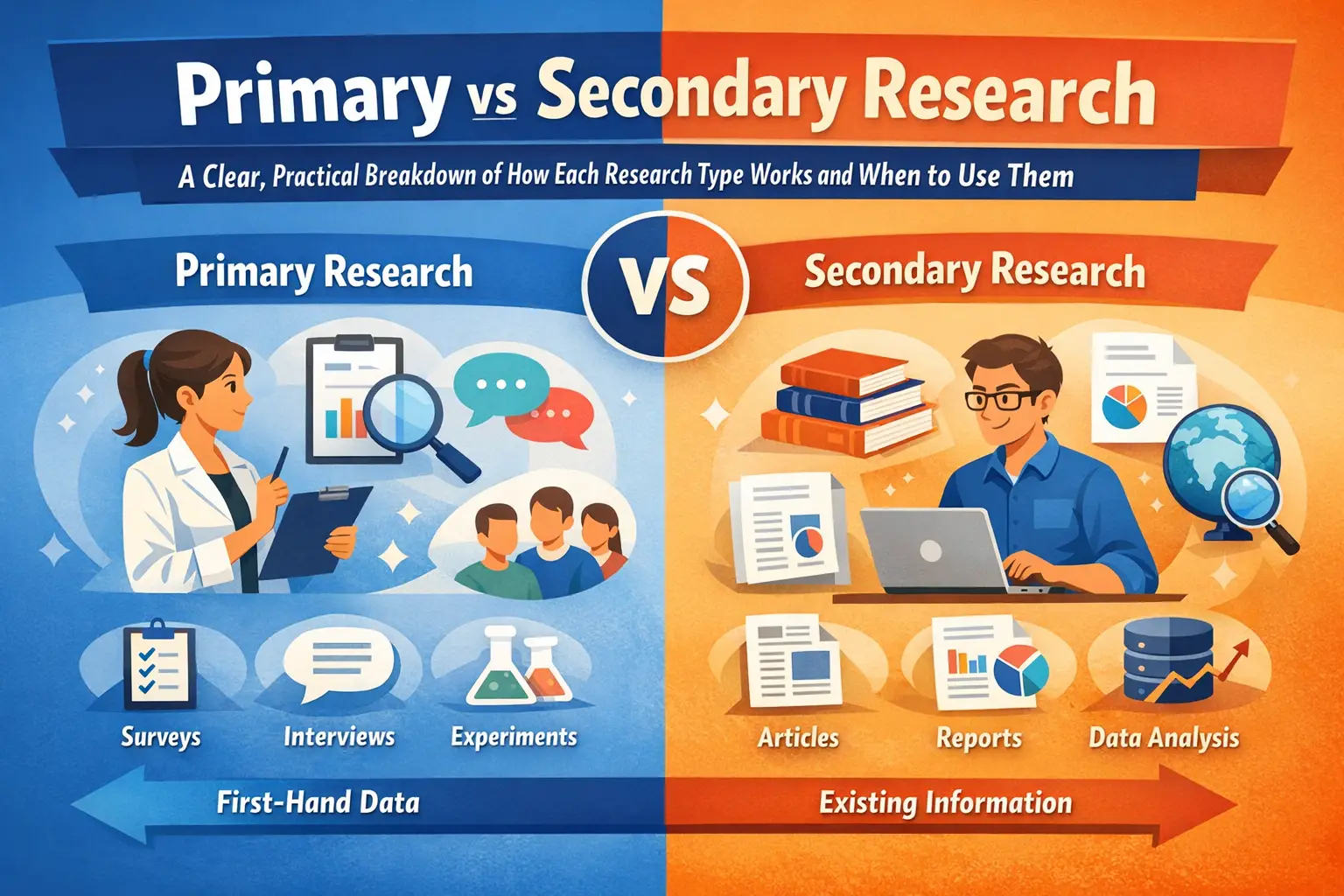
Primary research and secondary research are the two foundational pillars of financial market analysis — and if you don’t know the difference between them, you are literally handing your money to someone who does.
Now look — I’ve been trading long enough to know two types of people walking through the door of this industry. The first type does their research, understands where the data comes from, validates their assumptions, and builds edge. The second type prints out a Reddit post, calls it ‘analysis,’ and is confused why their portfolio looks like it was attacked by a raccoon with a calculator. Don’t be the second type.
This article is your complete, funny, no-fluff guide to understanding the real difference between primary research and secondary research in trading and finance. We’re going to break down definitions, explore real-world case studies, look at peer-reviewed academic evidence, and yes — we’re going to laugh along the way, because if you can’t find humour in the fact that grown adults have lost entire retirement funds chasing a ticker they saw on a Discord server at 2am, then this industry will eat you alive.
Buckle up. Class is in session. The professor has a six-monitor setup and absolutely zero patience for excuses.
Section 1: Defining Primary Research in Financial Markets
What Is Primary Research?
Primary research refers to the process of collecting original, first-hand data directly from the source — data that has never been published, compiled, or interpreted by anyone else before you.
In trading and finance, primary research might look like:
- Conducting direct interviews with company executives or management teams
- Commissioning proprietary surveys of consumer sentiment
- Visiting factories, stores, or operational sites (sometimes called ‘channel checks’)
- Analysing raw earnings call transcripts before analyst summaries are published
- Gathering proprietary order flow data or alternative data sets (satellite imagery, credit card transaction data, shipping data)
- Performing your own quantitative backtests on raw price and volume data
This is the kind of research that makes hedge fund analysts fly business class to Shenzhen to count trucks leaving a factory. No, seriously — that’s a real thing. Analysts have literally counted lorries outside of distribution centres to estimate inventory levels before quarterly earnings. Is that obsessive? Absolutely. Does it generate alpha? Brother, those trucks are paying for the business class seats.
Primary research is expensive, time-consuming, and difficult to replicate. That’s exactly why it’s valuable. If everyone could do it, it wouldn’t be edge. The market loves to price in information that’s widely available — it’s the information asymmetry that creates opportunity.
The Academic Foundation of Primary Research
The academic literature on information asymmetry in financial markets has long established that access to superior information drives abnormal returns. The classic framework was set out by Grossman and Stiglitz (1980) in their landmark paper, which argued that prices cannot be fully informationally efficient precisely because gathering information is costly — creating a natural incentive for primary research. See: Grossman, S.J. & Stiglitz, J.E. (1980). On the Impossibility of Informationally Efficient Markets. American Economic Review, 70(3), 393–408.
More recent empirical work has reinforced this. Chen and Zimmermann (2022) reviewed over 200 published return predictors and found that only 18% of them could be attributed to genuine risk factors — meaning the overwhelming majority reflected information advantages, mispricing, or both. Source: Chen, A.Y. & Zimmermann, T. (2022). Open Source Cross-Sectional Asset Pricing. Critical Finance Review, 11(2).
Translation for those in the back: most of what generates returns in markets is NOT fancy risk theory — it’s having better information than the next person. Primary research is how you get that better information. You’re welcome.
And yes, I know what you’re thinking. ‘But insider trading is illegal!’ Absolutely correct, superstar — that’s a completely different conversation. Primary research in the legal sense involves gathering publicly accessible information more cleverly and more efficiently than your competition. There is a massive difference between calling up your cousin at the SEC and counting delivery trucks. One lands you in federal court. The other lands you on a Bloomberg interview.
Section 2: Defining Secondary Research in Financial Markets
What Is Secondary Research?
Secondary research involves working with information that has already been gathered, compiled, interpreted, and published by someone else. You are, in effect, reading someone else’s homework.
Now before you roll your eyes — secondary research is not lazy research. Done correctly, it is the foundation upon which primary research is built. It would be genuinely unhinged to go commission a thousand-person consumer sentiment survey before you’ve even read the existing industry reports. That’s like showing up to a cooking competition before you’ve learned what a spatula is.
In financial markets, secondary research includes:
- Broker and sell-side analyst reports
- Government and central bank publications (ONS, Federal Reserve, ECB)
- Academic journals and peer-reviewed financial literature
- Company annual reports, 10-Ks, and quarterly filings
- Industry association publications and trade data
- News media, financial press (FT, Bloomberg, Reuters, WSJ)
- Ratings agency assessments (Moody’s, S&P, Fitch)
- Macroeconomic databases (IMF World Economic Outlook, World Bank data)
The critical distinction, as the Qualtrics research methodology framework notes, is that with secondary sources, you are working with interpreted data — meaning someone else’s analytical lens, biases, and assumptions are baked into the numbers before they reach you. See: Qualtrics. Primary and Secondary Market Research.
Secondary research is the equivalent of asking your friend who went to the party to describe it to you the next morning. You get the information — but filtered through their perspective, their memory, and their tendency to exaggerate. Your friend also may have left early, misunderstood what happened, or frankly just made up one of the better stories. We’ve all got that friend.
The Cost-Benefit Reality of Secondary Research
Here’s the honest truth about secondary research in trading: it’s cheap, fast, and widely available — which means it’s already priced in. Every other trader reading the same Bloomberg article is accessing the same secondary data as you. There is no edge in information that 50,000 people received at the same time.
But here’s where traders get this wrong. They think secondary research is therefore useless. Completely backward. Secondary research tells you what the market already knows. And knowing what the market already knows — the consensus view, the priced-in narrative — is absolutely critical for understanding where surprise can come from.
This aligns directly with what the academic literature on market integration finds. Patel et al. (2023) reviewed financial market integration across global equity markets and found that as information becomes more widely disseminated, the gap between integrated and less-integrated markets narrows — reinforcing that information timing, not mere access, drives alpha. See: Patel, R. et al. (2023). Global Financial Market Integration: A Literature Survey. International Journal of Financial Studies, 16(12), 495.
So secondary research gives you the baseline. Primary research gives you the edge above that baseline. Together, they are your complete intelligence operation. Separately, each one has serious limitations that will cost you real money.
Section 3: The Core Differences — A Side-by-Side Breakdown
Speed vs. Depth
Secondary research is fast. You can have a comprehensive industry overview assembled in hours, drawing on reports from major research houses, government data portals, and financial databases. If you needed to understand the European pharmaceutical sector before a meeting tomorrow morning, secondary research is your best friend.
Primary research is slow. Arranging management meetings, conducting expert interviews, commissioning surveys, or building proprietary data sets takes weeks, sometimes months. But the output is exclusive. Nobody else has your data.
Think of it this way: secondary research is the group chat. Everyone in the market is in that group chat. Primary research is the private DM with the person who actually saw what happened. The group chat moves fast. The DM tells you the truth.
Cost vs. Accessibility
Secondary research ranges from completely free (government databases, academic open-access journals) to moderately expensive (Bloomberg Terminal access, industry research subscriptions). Primary research can be extraordinarily expensive — expert network calls through firms like Gerson Lehrman Group or AlphaSights can cost hundreds of dollars per hour, and institutional-grade alternative data sets often run into six figures annually.
Research by SurveyMonkey’s market research division confirms that primary research costs are consistently higher than secondary, and that budget constraints are the primary driver of secondary research adoption among smaller organisations. See: SurveyMonkey. Primary vs. Secondary Research: What’s the Difference?
For individual traders and small funds, this creates an asymmetry that needs to be addressed strategically. You cannot outspend a $50 billion hedge fund on primary research infrastructure. But you can be smarter about which primary research activities actually generate insight versus which ones are just very expensive ways to confirm what you already suspected.
Ownership vs. Interpretation
When you conduct primary research, you own the data. The methodology is yours. The sample is yours. The findings have not been filtered through an analyst’s view, a brokerage’s house bias, or a media outlet’s editorial agenda.
When you use secondary research, you are trusting other people’s methods. Were the survey participants representative? Did the analyst who wrote the report have a vested interest in a bullish conclusion? Is this government data seasonally adjusted in a way that masks the trend you’re looking for? These are not theoretical concerns — these are the exact types of data quality failures that have caused major mispricing events in financial markets.
I once watched a trader make a significant position based on a sell-side report that turned out to have a systematic error in the comparable companies analysis. The error wasn’t malicious — the analyst had just carried a wrong formula through a spreadsheet. But the result was that the implied valuation was off by about 30%. That trade… did not go well. The trader in question had a face like he’d accidentally swallowed a whole lemon. On live television. Twice.
Section 4: Case Studies — When Research Type Determines the Outcome
Case Study 1: The Short Seller Who Counted Parking Spaces
One of the most famous examples of primary research generating genuine market edge comes from the hedge fund short-selling community. In 2010, short-seller firms began using satellite imagery to monitor the car parks of major retailers in the United States — gathering physical evidence of foot traffic trends weeks before comparable store sales data would be published in quarterly earnings.
This was primary research in its purest form. It was original. It was first-hand. It was not based on what an analyst said, or what management guided, or what the sector consensus view was. It was based on observable reality: fewer cars in the car park means fewer shoppers, which means weaker sales, which means a potential miss.
This type of alternative data approach has since become mainstream. The machine learning literature in finance documents how these non-traditional data streams have fundamentally changed the alpha-generation landscape. See: Arroyo, J. et al. (2024). Machine Learning and Deep Learning in Computational Finance: A Systematic Review. arXiv:2511.21588.
The lesson: the traders who acted on the satellite data before the earnings announcement generated significant alpha. The traders who waited for the secondary research — the analyst reports following the earnings call — were buying or selling into information that was already fully priced. The first group saw the movie. The second group read the review after everyone else had already left the cinema.
Case Study 2: The Analyst Report That Moved the Market (Incorrectly)
In contrast, here is a classic secondary research failure. In the mid-2000s, a major Wall Street firm published a bullish initiation of coverage on a mortgage-backed securities issuer. The report relied extensively on secondary data — historical default rates, existing credit ratings, macro housing projections from government databases.
The problem? All of that secondary data was drawn from a period of unprecedented stability and rising house prices. The methodology, borrowed from existing literature and comparable historical periods, did not account for the possibility of a nationwide, correlated housing price decline. The secondary research was technically accurate — it faithfully reported what the existing data said. But what the existing data said was catastrophically incomplete.
The result was a significant overpricing of mortgage-backed securities across the market — contributing to one of the largest financial crises in modern history. The traders and institutions that relied exclusively on secondary research suffered enormous losses. The traders who conducted primary research — who actually interviewed mortgage brokers, who visited housing markets in Arizona and Florida, who talked to borrowers — saw warning signs years in advance.
The academic post-mortem on this period is extensive. Research on financial market stability and contagion highlights that crisis-period research failures were overwhelmingly characterised by over-reliance on historical secondary data that did not adequately capture structural breaks. See: Patel, R. et al. (2022). A Bibliometric Review of Financial Market Integration Literature. International Review of Economics and Finance.
Look — there’s a very specific face that traders make when they realise their entire thesis was built on someone else’s faulty assumptions. It’s somewhere between ‘I just stepped on Lego barefoot’ and ‘I left my phone on a roller coaster.’ I have seen that face. I have worn that face. I am here to help you avoid that face.
Case Study 3: The Retail Investor and the Meme Stock Secondary Research Disaster
Let’s bring this closer to the present moment. During the surge of retail investing activity in 2021, millions of individual investors were making significant trading decisions based almost entirely on secondary research — and not even the good kind. Reddit threads. TikTok trading videos. Twitter stock tips from accounts with a rocket emoji in their username.
This is secondary research in its most degraded form. Not only is it someone else’s analysis — it is often someone else’s analysis with a direct financial incentive to get you to buy what they already own. The information had already been consumed, amplified, and distorted through multiple layers of interpretation before it reached the individual investor.
When the primary reality — actual earnings, actual cash flows, actual market dynamics — asserted itself, the gap between secondary narrative and fundamental truth was priced in violently. Positions built on secondary narrative without any primary validation collapsed rapidly.
The traders who survived and even profited from that period were doing primary research: model building, earnings analysis, understanding the options market structure, quantifying the short interest mechanics. They understood the primary data underneath the secondary noise.
Now, was I personally holding a position that got caught in the wrong direction during one of those squeezes? I’m not going to answer that on the grounds that it may cause me emotional distress. What I will say is that I learned more about the gap between secondary narrative and primary reality in those few weeks than I had in the previous three years. Education doesn’t have to be pleasant to be effective.
Section 5: How Professional Traders Use Both Research Types Together
The Research Hierarchy in Professional Trading
Professional traders and fund managers don’t choose between primary and secondary research — they use them in a structured, layered approach. Here’s how the process actually works at a sophisticated level:
Step 1: Secondary Research for Market Orientation
Before any primary work begins, professional analysts read everything. Annual reports. Sell-side coverage. Macro reports. Industry publications. Competitor filings. This establishes the consensus view — the story the market is already telling itself about this company, sector, or asset class.
This step is not about finding edge. It is about understanding what edge would look like. What does the consensus believe? What assumptions are baked into the current price? Where is the consensus most likely to be wrong?
Step 2: Primary Research to Test the Consensus
Once the consensus is understood, primary research begins. Management meetings. Expert network calls with former executives, suppliers, or customers. Channel checks. Alternative data analysis. The question being asked is always the same: ‘Does the real world support what the secondary research is saying?’
The goal is to find divergence — a material gap between what the market believes (secondary data) and what is actually happening (primary data). That divergence, if real and ahead of the market recognising it, is the trade.
Step 3: Synthesis and Position Sizing
The primary and secondary research are then synthesised into a thesis. How confident is the trader in the primary data? How widely understood is the secondary view? How large is the potential gap between current pricing and fundamental reality? These inputs drive position size and risk management.
This structured approach mirrors what the academic literature describes as the optimal research framework. As noted by TheySaid’s research methodology review: using secondary research to understand market landscape and identify gaps, then conducting primary research to collect specific data that informs strategy directly, represents best practice for rigorous analysis. See: TheySaid. Primary vs Secondary Research — Key Differences.
Section 6: The Technology Revolution in Both Research Types
How AI and Machine Learning Are Changing Primary Research
The trading world has witnessed a fundamental shift in what primary research looks like. Alternative data — credit card transactions, satellite imagery, web scraping, social media sentiment, geolocation data — has created primary data sets of extraordinary richness that were simply unavailable a decade ago.
The systematic review of machine learning in computational finance by Arroyo et al. (2024) documents how ML and deep learning models are now applied across credit risk prediction, cryptocurrency markets, asset pricing, and macroeconomic forecasting — all of which depend heavily on non-traditional, primary-style data inputs. Models including Random Forest, XGBoost, LSTM, and CNN architectures are consistently outperforming traditional models by capturing non-linear dependencies invisible to conventional analysis. See: Arroyo, J. et al. (2024). Machine Learning and Deep Learning in Computational Finance: A Systematic Review. arXiv:2511.21588.
The implication for traders is profound. The cost of certain types of primary research has dropped dramatically. Running a quantitative backtest on raw price data that would have taken a team of analysts weeks in 2005 now takes a Python script and an afternoon. Synthesising earnings call transcripts across thousands of companies to identify sentiment shifts is now an NLP problem, not a person-hours problem.
This democratisation of primary research tools is genuinely exciting. And also, if I’m being honest, slightly terrifying, because it means the competition is getting smarter faster. The edge from having access to the tools is shrinking. The edge from knowing what to do with the tools is expanding. That has always been true in this game, but it’s more true now than ever.
How AI Is Changing Secondary Research
On the secondary side, machine learning algorithms can now scan millions of academic papers, news articles, and filings to surface relevant information with a speed and comprehensiveness that no human team can match. What previously required a research department with six analysts can now be approximated by a well-configured data pipeline.
But here’s the trader’s warning: AI-synthesised secondary research is still secondary research. It is still someone — or something — else’s interpretation of existing data. The fundamental limitations remain. AI can make secondary research faster and broader. It cannot make it primary.
The number of traders who have confused ‘AI said it’ with ‘this is original primary insight’ is genuinely alarming. An AI pulling together secondary sources is like having a very fast, very thorough research assistant who has read everything in the library. Impressive. Useful. Still the library. There is still a real world outside.
Section 7: Common Mistakes Traders Make With Each Research Type
Primary Research Mistakes
Confirmation Bias in Data Collection
The most dangerous mistake in primary research is designing your research to confirm what you already believe. If you’ve already decided a stock is a buy and you conduct ‘primary research’ by selectively interviewing management and choosing the most bullish data points, you haven’t done primary research — you’ve done expensive confirmation of a pre-existing view.
Real primary research is uncomfortable because real reality doesn’t care about your thesis. The satellite data shows what the satellite data shows. The channel check reveals what it reveals. If the primary data contradicts your thesis, the thesis needs to change — not the data.
Sample Size Delusion
Here’s a classic one: a trader visits one retail store, finds it moderately busy, and concludes that the retailer is performing well. One store. One day. One time of day. Extrapolated to a national chain with thousands of locations. This is not primary research — this is anecdote wearing a research costume.
Genuine primary research requires sufficient sample size, representativeness, and methodology rigour to produce valid conclusions. One channel check is a data point. Twenty systematically conducted channel checks across representative geographies and time periods is a finding.
Secondary Research Mistakes
Trusting the Source Without Verifying the Methodology
Not all secondary research is created equal. A peer-reviewed paper in the Journal of Finance and a sponsored white paper produced by a company with a financial interest in the conclusions are not equivalent sources. A government statistical release and a think tank publication funded by an industry lobby are not equivalent sources.
As research.com’s comprehensive guide on primary vs secondary research notes, secondary sources require additional verification steps — understanding the methodology, checking for potential bias, and cross-referencing with independent sources. See: Research.com. Primary Research vs Secondary Research for 2026.
Recency Bias in Historical Data
Secondary research drawn from historical data is only as good as the historical period it covers. If the secondary data set does not include a market regime similar to the one you’re currently navigating, the conclusions it supports may be systematically misleading.
This is not a hypothetical concern. The 2008 crisis, the COVID crash of 2020, and the inflation surge of 2022 all represented regime breaks that invalidated secondary research conclusions derived from the preceding period of relative stability. The traders who updated their models using fresh primary observations survived. The traders who trusted their secondary data until it was too late did not have a good time.
Bad time being a polite way to say they sat there, portfolio in ruins, making that specific face again. You know the one.
Section 8: Practical Framework — Choosing the Right Research for the Situation
When to Lead With Primary Research
Primary research should be your lead when:
- You are taking a large, concentrated position where the research quality directly determines the risk/reward outcome
- The consensus view appears widely held and well-articulated — meaning the secondary data has been fully digested and priced in
- The asset or sector is poorly covered by sell-side analysts, making secondary research thin and potentially unreliable
- You have access to primary research capabilities that your competition does not — a proprietary data source, an expert network, a unique analytical methodology
- The situation involves a catalyst that is time-sensitive and forward-looking, where historical secondary data is of limited relevance
When to Lead With Secondary Research
Secondary research should be your lead when:
- You are forming an initial view on an unfamiliar sector or company — use secondary data to get up to speed before investing primary research resources
- You need to understand the consensus before you can identify where to challenge it
- The position is small and the cost-benefit of conducting extensive primary research does not justify the resource investment
- Time constraints make primary research impractical — secondary research delivers faster orientation even if at the cost of depth
- The research question is about macro factors (interest rate trajectories, regulatory trends, geopolitical dynamics) where broad secondary data sets are genuinely the most appropriate source
The Combined Approach: Intelligence Over Information
The most sophisticated traders do not think about primary and secondary research as competing choices. They think about building an intelligence framework — a continuous process of understanding what the market believes (secondary) and testing that belief against observable reality (primary).
This is the institutional approach, and there’s a reason the best-performing hedge funds consistently invest heavily in both research types. They are buying information superiority. Not just data — the ability to extract signal from data faster and more accurately than the competition.
This reflects the broader evolution documented by Chowdhury et al. (2023) in the Qualitative Research in Financial Markets journal — that investor decision-making is most effective when structured qualitative primary insights are combined with quantitative secondary data frameworks. See: Chowdhury, N.T., Mahdzan, N.S. & Rahman, M. (2023). Investors in the Bangladeshi Stock Market: Issues, Behavioural Biases and Circumvention Strategies. Qualitative Research in Financial Markets. Emerald Publishing.
You want to be the person in the room who not only knows what everyone else knows, but also knows the two things that nobody else has figured out yet. That is the entire game. Primary research gives you those two things.
Section 9: Building Your Personal Research Infrastructure
For the Individual Trader
You don’t need a $50 billion AUM to build a credible research infrastructure. Here’s a practical framework for individual traders:
Secondary Research Stack (Free to Low Cost)
- Company filings: SEC EDGAR (US), Companies House (UK), equivalent regulatory portals
- Macro data: FRED (Federal Reserve Bank of St. Louis), ONS, Eurostat, World Bank Open Data
- Academic research: SSRN, arXiv (quantitative finance), Google Scholar
- News aggregation: Reuters, Bloomberg free tier, Financial Times (subscription), Seeking Alpha
- Regulatory filings: Central bank minutes, BIS working papers, IMF Article IV assessments
Primary Research Capabilities (Time Investment Over Cash)
- Earnings call analysis: Listen to every call for your core holdings — not reading the transcript summary, actually listening
- Management tracking: Follow executive LinkedIn activity, conference presentations, industry event appearances
- Consumer channel checks: For consumer-facing businesses, be a genuine customer and pay attention
- Industry expert networks: Build your own network over time — former executives, industry contacts, academic specialists
- Quantitative primary work: Build your own back-testing infrastructure using raw data; don’t rely solely on pre-packaged factor libraries
Yes, some of this takes time. Yes, it is more work than reading a Substack newsletter and calling it research. But I promise you — absolutely promise — that the traders who build genuine primary research capabilities, even at an individual level, consistently outperform the traders who rely entirely on what’s already publicly summarised and distributed.
Because here’s the thing: information that’s free and widely distributed? Already in the price. Information you had to work to get? That’s where the opportunity lives.
Section 10: The Regulatory and Ethical Dimension
What Primary Research Is NOT
Let’s address the elephant in the room wearing a bespoke suit and looking extremely guilty. Primary research does not mean insider information. Let me be absolutely crystal clear on this distinction because it matters legally, ethically, and practically.
Insider trading — using material non-public information obtained through a position of trust or a breach of fiduciary duty — is illegal in every major jurisdiction. Conducting primary research through legitimate means (channel checks, expert network calls with appropriately screened experts, alternative data derived from public observations) is entirely legal and forms the backbone of legitimate investment research.
The line is: if the information is available to you because of legitimate, legal observation of publicly accessible reality — even if your interpretation of that reality is more insightful than the average market participant — that is primary research. If the information came to you because someone violated a duty of confidentiality or disclosed material non-public information, that is insider trading. The strategy does not matter. The source does.
Expert network firms exist precisely to manage this distinction. Reputable platforms screen their experts, monitor call content, and maintain compliance protocols specifically to ensure that primary research conversations remain on the right side of the regulatory line. The firms that have gotten into trouble in this space are almost universally firms that failed to maintain that discipline.
The Bias Problem in Secondary Research
There is also an ethical dimension to secondary research consumption that sophisticated traders must understand: conflicts of interest are pervasive in the production of financial secondary research.
Sell-side analyst research is produced by firms that want to maintain relationships with the companies they cover, that want to generate investment banking revenue, and that want to keep their institutional investor clients happy. These are not conspiracies — they are structural incentives that systematically influence research output. The phenomenon is well-documented in the academic literature and has resulted in regulatory interventions on both sides of the Atlantic.
The implication: secondary research should never be accepted at face value without understanding the incentive structure of the producer. A buy recommendation from a firm with investment banking exposure to the target company requires substantially more scepticism than the same recommendation from an independent research house with no financial relationship to the company.
Trust but verify. Actually — in this industry — verify, then trust.
Conclusion: The Trader’s Research Manifesto
Let’s bring it home. We’ve covered a lot of ground in this article, and I want to make sure you leave with the core truths that will actually make a difference in how you trade.
Primary research and secondary research are not competitors — they are partners. Secondary research tells you what the market knows. Primary research tells you what the market doesn’t know yet. The gap between those two things is where alpha lives. And alpha is just a fancy word for ‘beating the market,’ which is just a fancy way of saying ‘not leaving your financial future to luck and vibes.’
The traders who consistently outperform over long time horizons are not smarter than you. They are more disciplined in their research process. They use secondary research to understand the landscape. They use primary research to find the terrain features that the map doesn’t show. And they know the difference between the two at all times.
The market will absolutely, every single day, offer you opportunities to be lazy — to read a summary instead of the primary document, to accept the consensus view without testing it, to use last year’s data for this year’s decision. Every time you take that shortcut, someone else who didn’t take it is building edge at your expense. They’re sitting there, in their research, counting trucks and listening to earnings calls and building proprietary data sets, getting ready to take the other side of your trade.
Don’t let them.
Do the primary work. Read the secondary material critically. Build your intelligence infrastructure. Understand where your information came from and what that means for how much you should trust it. And always — always — ask the question: does the real world support what the data is telling me?
That question has saved more money than any indicator, any algorithm, and any hot tip from a guy at a conference who smells slightly of desperation and commission. I know that guy. We all know that guy. He has very nice shoes and a very unfortunate track record.
You, on the other hand, are going to do the research. Properly. With both types. Like a professional.
Now go make it happen. The market’s open.
References
The following peer-reviewed papers, academic sources, and authoritative references informed this article:
- Grossman, S.J. & Stiglitz, J.E. (1980). On the Impossibility of Informationally Efficient Markets. American Economic Review, 70(3), 393–408. [Access via JSTOR]
- Chen, A.Y. & Zimmermann, T. (2022). Open Source Cross-Sectional Asset Pricing. Critical Finance Review, 11(2). Includes analysis of 202 published return predictors. [Access via arXiv]
- Arroyo, J. et al. (2024). Machine Learning and Deep Learning in Computational Finance: A Systematic Review. PRISMA 2020 review of 22 peer-reviewed articles indexed in Scopus (2024–2026). [Access via arXiv]
- Patel, R. et al. (2023). Global Financial Market Integration: A Literature Survey. International Journal of Financial Studies, 16(12), 495. [Access via MDPI]
- Patel, R. et al. (2022). A Bibliometric Review of Financial Market Integration Literature. International Review of Economics and Finance. Covers 260 articles, 1981–2021. [Access via ScienceDirect]
- Chowdhury, N.T., Mahdzan, N.S. & Rahman, M. (2023). Investors in the Bangladeshi Stock Market: Issues, Behavioural Biases and Circumvention Strategies. Qualitative Research in Financial Markets. Emerald Publishing. [Access via Emerald]
- Ahuja, S. & Kumar, B. (2023). An Elicitation Study to Understand Equity Investment Motivation and Decisions Among Indian Millennials. Qualitative Research in Financial Markets. Emerald Publishing. [Access via Emerald]
- SurveyMonkey Market Research Division (2024). Primary vs. Secondary Research: What’s the Difference? [Access via SurveyMonkey]
- Qualtrics Experience Management (2023). Primary and Secondary Market Research. [Access via Qualtrics]
- Research.com (2026). Primary Research vs Secondary Research for 2026: Definitions, Differences, and Examples. [Access via Research.com]
- TheySaid (2025). Primary vs Secondary Research — Key Differences. [Access via TheySaid]
- Journal of Financial Markets, Elsevier. Ongoing peer-reviewed research on market microstructure, information asymmetry, and trading behaviour. [Access via ScienceDirect]
- International Journal of Financial Studies, MDPI. Open access peer-reviewed research on financial econometrics, portfolio theory, and market dynamics. [Access via MDPI]
- Lattanzio, G., Litov, L., Megginson, W. & Munteanu, A. (2023). Private Equity Performance Around the World. Financial Analysts Journal, 80(2). [Access via Taylor & Francis]
Disclaimer: This article is for educational and informational purposes only and does not constitute financial advice.
Leave a Reply
You must be logged in to post a comment.