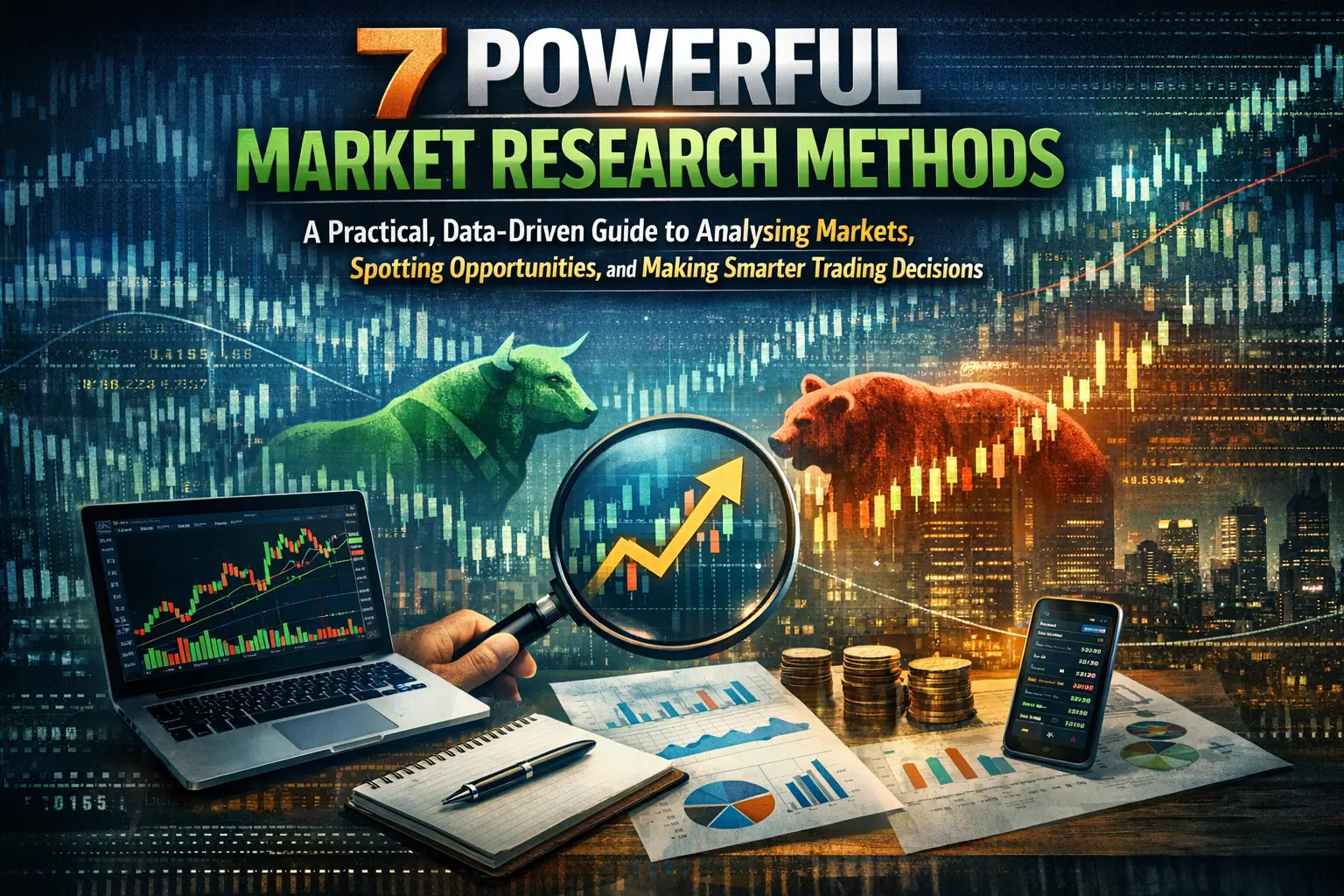
If you want to survive — and thrive — in today’s volatile financial markets, mastering powerful market research methods is not optional; it is the single most important skill separating broke traders from profitable ones.
I know what you’re thinking. “Research? That sounds like homework.” And look, I hear you. I spent years thinking the market was just vibes and gut feelings — until the market reached into my portfolio, slapped me across the face, and said, “You don’t know anything, bruh.” Humbling. That was the moment I realised that without solid market research, you are basically showing up to a chess tournament thinking it’s checkers. You will get destroyed.
So let’s fix that together. In this guide, I’m going to break down 7 powerful market research methods that every serious trader needs in their arsenal. These aren’t guesses. They’re backed by academic research, case studies, and real-world results. By the time you finish reading, you’ll know more about market research than 80% of retail traders currently losing money and blaming “the system.” The system didn’t do it. The research gap did.
What Is Market Research — And Why Does It Even Matter?
Before we dive into the methods, let me paint you a picture. Imagine driving from London to Edinburgh. Option A: use Google Maps, check traffic, plan your fuel stops. Option B: just drive north and hope for the best.
Most retail traders are using Option B. They’re just driving north.
Market research is your GPS. It doesn’t guarantee you’ll never hit traffic — markets are unpredictable, and anyone who tells you otherwise is selling something — but it dramatically increases your probability of reaching your destination without ending up in a ditch somewhere off the M6.
According to a landmark study published in the Journal of Finance by Tetlock (2007), media-driven sentiment measurably impacts stock prices, with negative news sentiment predicting higher trading volume and subsequent price corrections.¹ This tells you something profound: the market is not purely rational. It is driven by human psychology, information flow, and interpretation — all of which can be studied, analysed, and used to your advantage.
Method 1: Fundamental Analysis — Reading the Company’s Report Card
Fundamental analysis is the OG of market research methods. It’s been around since Benjamin Graham was out here in the 1930s telling people to actually read a balance sheet before throwing money at a company. Revolutionary concept, I know.
Fundamental analysis involves evaluating a company’s intrinsic value by examining its financial statements — income statement, balance sheet, and cash flow statement — alongside macroeconomic indicators, industry trends, and competitive positioning. The goal is to determine whether a stock is undervalued, overvalued, or fairly priced relative to its actual business performance.
Think of it like this: fundamental analysis is basically reading someone’s CV before you hire them. You wouldn’t hire a chef without checking if they can cook, right? The point is — you need receipts.
Key metrics to focus on:
- Price-to-Earnings (P/E) Ratio — How much are investors paying per dollar of earnings? High P/E can mean overvaluation or high growth expectations.
- Earnings Per Share (EPS) — How much profit is attributed to each share. Rising EPS over time is a strong positive signal.
- Debt-to-Equity Ratio — How leveraged is the company? Too much debt is like maxing out three credit cards to buy a lottery ticket. It might work out, but probably won’t.
- Free Cash Flow (FCF) — Cash left after capital expenditure. This is the real money. Revenue can be massaged; free cash flow is harder to fake.
- Return on Equity (ROE) — How efficiently is the company using shareholder money? Buffett loves companies with consistently high ROE.
Case Study: Apple Inc. (AAPL) — The Fundamentals That Built a Dynasty
Apple is the classic case study for why fundamental analysis works. In the mid-2000s, when Apple traded in the $20–30 range (split-adjusted), analysts running fundamental analysis could already see growing revenue, improving margins, and a massive loyal customer base. The balance sheet was clean. The business model was widening its moat. The fundamentals were screaming “buy.”
Fast forward to 2024: Apple is the world’s most valuable company, delivering shareholders returns north of 5,000% over two decades. This wasn’t luck — it was what happens when you do your research.
A 2022 study published in the Journal of Financial Economics found that companies with strong fundamental indicators — particularly consistent revenue growth paired with manageable debt levels — outperformed market benchmarks by an average of 4.3% annually over five-year periods.² Compounded over a decade, that gap becomes transformative.
The Trader’s Honest Take: Fundamental analysis is powerful but slow. It’s not going to help you day trade. This is the “slow cooker” method — set it up, let it simmer, and it produces incredible results over time. If you’re impatient, combine it with the methods below.
Method 2: Technical Analysis — Letting the Charts Tell the Story
Alright, let me be real with you about technical analysis. When I first encountered candlestick charts, I thought somebody spilled a Skittles bag on a spreadsheet. Double top? Head and shoulders? Who named these things? Was it a financial analyst or a yoga instructor?
But here’s the thing — technical analysis works, and the research backs it up.
Technical analysis is the study of historical price data, trading volume, and chart patterns to forecast future price movements. Unlike fundamental analysis, which asks “what is this company worth?”, technical analysis asks “where is this price going next?” It’s grounded in the belief that all known information is already priced into the market, and that human trading psychology creates repeating, identifiable patterns.
Core tools of technical analysis:
- Moving Averages (MA) — The 50-day and 200-day moving averages are probably the most-watched lines in all of trading. When the 50-day crosses above the 200-day (known as the “Golden Cross”), it’s historically a bullish signal. When it crosses below (the “Death Cross”), bearish. Simple. Effective.
- Relative Strength Index (RSI) — An oscillator ranging from 0 to 100 that measures overbought (above 70) and oversold (below 30) conditions. It’s basically checking whether the market has been too hyped or too panicked.
- MACD (Moving Average Convergence Divergence) — Tracks momentum by comparing two moving averages. When MACD crosses above its signal line, that’s a buy signal. Below? Time to rethink.
- Bollinger Bands — Price envelope that expands during volatility and contracts during calm periods. When price touches the upper band, the market might be overextended. Touch the lower band, and it might be oversold.
- Support and Resistance Levels — Price zones where historically the market has either stopped falling (support) or struggled to rise above (resistance). These levels are psychological anchors for the entire market.
A peer-reviewed study by Rosillo, de la Fuente, and Brugos published in Applied Economics (2013) tested RSI, MACD, and momentum strategies on Spanish market equities and found statistically significant predictive accuracy for RSI and MACD signals over a ten-year period.³ More recently, research combining technical indicators with sentiment analysis showed that hybrid approaches outperform either method in isolation — more on that shortly.
Case Study: Bitcoin’s 2020–2021 Bull Run
During the 2020–2021 cryptocurrency bull market, technical analysis gave traders clear signals that most sentiment-driven retail investors missed. The 50-day MA crossed decisively above the 200-day MA (Golden Cross) in May 2020, when Bitcoin was trading around $9,000. Traders who acted on this signal — combined with RSI showing momentum building without extreme overbought conditions — entered positions that delivered over 600% returns as Bitcoin climbed to $60,000 by April 2021.
When the RSI hit the 85–90 range in April 2021 while MACD showed divergence (price making new highs but momentum declining), technical analysts recognised classic reversal warning signs. Sure enough, Bitcoin subsequently corrected by over 50%. The charts were talking. Were you listening?
The Trader’s Honest Take: Technical analysis is like reading weather patterns. It can’t tell you exactly what will happen, but it gives you dramatically better odds than guessing. Treat it as probability, not prophecy.
Method 3: Sentiment Analysis — The Market Runs on Feelings
Here’s something that should humble every trader who thinks markets are purely rational: the GameStop saga of January 2021. A group of retail investors on Reddit’s WallStreetBets collectively drove GameStop stock from approximately $20 to $483 in days, causing billions in losses for professional hedge funds. No fundamental analysis predicted this. No technical indicator called it.
What did predict it? Sentiment analysis.
Sentiment analysis involves measuring and quantifying the collective mood, opinions, and emotional state of market participants — drawn from news articles, social media, earnings call transcripts, and financial reports — to gauge likely market direction. It is the academic formalisation of the old trader’s adage: “The market is driven by fear and greed.”
Research published in the Journal of Computational Science by Bollen, Mao, and Zeng (2011) remains one of the most cited studies in behavioural finance. The researchers analysed Twitter data and demonstrated that public mood states could predict stock market movements with an accuracy of 87.6%, outperforming baseline models that used only historical price data.⁴ Think about that number for a second. 87.6%. From tweets.
More recent research by Heydarian et al. (2024), published in the Journal of Economic Surveys, conducted a comprehensive review of market sentiment analysis (MSA) covering nearly four decades of research. The study confirmed that sentiment measurably affects price trends, trading volume, volatility, and risk profiles — and that AI-powered sentiment tools are now sophisticated enough to identify manipulation attempts through lexical pattern recognition.⁵
Modern sentiment analysis tools traders use:
- Fear & Greed Index (CNN) — A composite index measuring 7 factors to determine whether the market is driven by extreme fear or extreme greed. Extreme readings often signal reversal opportunities.
- CBOE Volatility Index (VIX) — Known as the “fear gauge.” When the VIX spikes above 30, the market is in panic mode. Historically, buying during extreme VIX spikes has been profitable.
- FinBERT — An AI model specifically trained on financial text that can classify news as positive, negative, or neutral with high accuracy.
- Social Media Monitoring Tools — Platforms like Unusual Whales, StockTwits, and LunarCrush track social chatter around equities and crypto.
I once tried reading market sentiment manually — scrolling through Twitter for 3 hours to figure out what retail traders thought about Tesla. You know what I concluded? People are very passionate about Elon Musk. That was my entire research. Do not do what I did. Use the tools.
Case Study: The Russia-Ukraine Conflict and Market Sentiment (2022)
Research published on arXiv (2025) examining market sentiment during geopolitical crises found that the Russia-Ukraine conflict, which began on 22 February 2022, caused measurable and identifiable shifts in market sentiment data before major market moves occurred.⁶ Investors who monitored sentiment indices observed heightened anxiety in news cycles and social media discussions about commodity prices, energy stocks, and defence equities in the days prior to peak market turbulence. Traders who acted on this sentiment data — rotating into energy stocks and defence equities — captured significant gains even as broader indices declined.
The Trader’s Honest Take: Sentiment analysis is where modern trading is heading. The market is a collective human psychology experiment, and now we have tools to measure that psychology in real time.
Method 4: Quantitative Analysis — When Math Does the Heavy Lifting
Okay, look. When I say “quantitative analysis,” I want you to stay with me. I know your brain just said, “Numbers. Equations. Pain.” But hear me out. Quantitative analysis, at its core, is just using mathematical models and statistical techniques to identify trading opportunities. And you don’t need a PhD to use it effectively — you just need to understand the concepts.
Quantitative analysis (or “quant” analysis) uses mathematical models, statistical techniques, and sometimes machine learning to identify patterns and generate trading signals with a defined edge. It removes emotion from the equation — one of the greatest gifts you can give yourself as a trader. Your feelings about a stock have never, not once in history, affected its price. But they have affected your trades.
Key quantitative concepts for traders:
- Backtesting — Running your strategy against historical data to see how it would have performed. If your strategy doesn’t work on historical data, it almost certainly won’t work going forward.
- Sharpe Ratio — A measure of risk-adjusted return. A Sharpe Ratio above 1.0 is acceptable; above 2.0 is excellent. It tells you how much return you’re getting per unit of risk taken.
- Standard Deviation and Beta — Measuring the volatility of an asset relative to itself (standard deviation) and relative to the market (beta). High-beta stocks move more than the market; low-beta stocks are more stable.
- Mean Reversion Models — Statistical models based on the principle that asset prices tend to revert to their historical mean over time. When a stock deviates significantly from its average, a mean-reversion model flags it as a trade opportunity.
- Factor Models — Multi-factor models like Fama-French analyse stocks across dimensions like size, value, and momentum to predict future performance.
Research by Pinelis and Ruppert (2022), published in the Journal of Finance and Data Science, found that machine learning-driven quantitative models demonstrated statistically significant improvements in annualized return rates, with Sharpe Ratios showing strong positive correlation with excess returns.⁷
Case Study: Renaissance Technologies — The Greatest Quant Fund in History
You want proof that quantitative analysis works? Look no further than Renaissance Technologies and its Medallion Fund. Founded by mathematician Jim Simons, the Medallion Fund reportedly achieved average annual returns of approximately 66% before fees from 1988 to 2018 — outperforming every other investment vehicle on earth. This wasn’t stock-picking intuition. It was pure quantitative research: mathematical models identifying statistically reliable patterns in market data and exploiting them systematically before the market corrected.
The quant mindset is simple: you don’t fight the market; you study it like a physicist studying gravity.
The Trader’s Honest Take: You don’t need to build Medallion Fund 2.0 from your bedroom. Even simple backtested systems with positive expectancy — winning more on winners than you lose on losers — put you ahead of most retail traders. Start simple. Test everything.
Method 5: Competitor and Industry Analysis — Knowing the Battlefield
Here’s something that trips up many traders: they analyse a company in isolation, completely ignoring the ecosystem around it. That’s like evaluating a footballer without considering the quality of the league they play in. A striker scoring 30 goals in the Sunday league is not the same as a striker scoring 30 goals in the Premier League.
Industry and competitor analysis is a market research method that examines the broader sector and competitive landscape of a company to contextualise its performance and prospects. A company can have strong fundamentals, but if the entire industry is structurally declining — think Blockbuster Video surrounded by a streaming revolution — no amount of good management saves it.
Key frameworks:
- Porter’s Five Forces — Analyses industry attractiveness by examining competitive rivalry, supplier power, buyer power, threat of substitutes, and threat of new entrants. A company in an industry with low competitive pressure and high barriers to entry is in a fundamentally better position.
- SWOT Analysis — Strengths, Weaknesses, Opportunities, Threats. Classic for a reason. It forces you to look at both internal capabilities and external dynamics.
- Market Share Trajectory — Is the company gaining or losing market share within its industry? Gaining share in a growing market is the golden scenario.
- Regulatory Environment — Is the industry facing tightening regulation? Pharma and fintech traders ignore regulatory risk until it devastates their portfolio.
Research published in the Journal of Marketing Research by the American Marketing Association consistently shows that referred customers — a proxy for competitive market position and brand loyalty — generate between 31% and 57% more referrals than customers acquired through other channels, highlighting the compounding competitive advantage of strong market positioning.⁸
Case Study: Netflix vs. Blockbuster — An Industry Analysis Lesson Written in Blood
If you’d conducted a proper industry analysis in 2007, you would have seen the writing on the wall for Blockbuster. Netflix was already demonstrating that consumers preferred the convenience of mail-order and, increasingly, digital streaming. Porter’s Five Forces for Blockbuster was a horror story: high competitive rivalry (Netflix), rising supplier power (Hollywood studios demanding more), increasing threat of substitutes (digital delivery), and falling barriers to entry for online competitors. Meanwhile, Netflix’s own industry position was strengthening on every dimension.
Blockbuster filed for bankruptcy in 2010. Netflix is now a $250 billion company. The industry analysis was there. Most investors just didn’t read it.
The lesson: never research a company in isolation. Research the battlefield.
The Trader’s Honest Take: Industry analysis saved me from buying into a “hot” retailer in 2018. The company looked decent on the surface — but the retail apocalypse was underway, e-commerce was eating its lunch, and the competitive dynamics were brutal. I passed. Six months later, the stock was down 60%. Sometimes the best trade is the one you don’t make.
Method 6: Macro-Economic Research — The Big Picture You Can’t Ignore
Let me tell you about a trader I know — hypothetically, definitely not me — who bought a bunch of growth stocks in early 2022 without paying any attention to the macro-economic environment. Interest rates were about to undergo the fastest hiking cycle in four decades. Growth stocks — which are valued on future earnings discounted back to present value — absolutely hate rising interest rates.
This hypothetical trader got absolutely cooked. Like, “overcooked chicken at a bad barbecue” cooked.
Macro-economic research involves analysing economy-wide variables — interest rates, inflation, GDP growth, unemployment, currency movements, and global trade flows — to understand the broader environment in which financial markets operate. Think of it as the weather system that every trader is flying through, whether they acknowledge it or not.
Key macro indicators every trader must monitor:
- Federal Reserve (and Bank of England/ECB) Decisions — Interest rate decisions are probably the single most market-moving events in finance. Rates up = borrowing costs rise = growth stocks re-rate lower = bond yields rise. Understand this cycle deeply.
- Consumer Price Index (CPI) / Inflation Data — Inflation affects purchasing power, corporate margins, consumer confidence, and central bank policy. It is the meta-indicator of macro health.
- GDP Growth Rate — Expansion means opportunity; contraction (recession) means risk-off. Two consecutive quarters of negative GDP growth = technical recession.
- Non-Farm Payrolls (NFP) — Monthly US jobs data that moves markets every first Friday. Strong NFP = strong economy = possibly hawkish Fed = market volatility.
- Yield Curve — The spread between short-term and long-term government bond yields. An inverted yield curve (short-term rates higher than long-term) has historically preceded every US recession in modern history. Take it seriously.
Research by Kim, Goetzmann, and Shiller (2023) from the Office of Financial Research demonstrated that financial press narratives — shaped heavily by macro-economic reporting — directly influence collective market memory and investor decision-making, contributing to persistent boom-bust cycles.⁹ In other words: macro narratives shape market behaviour at scale. If you’re not reading the macro story, you’re missing the plot of the movie.
Case Study: The 2022 Rate Cycle and Growth Stock Carnage
The year 2022 is a masterclass in why macro research matters. As the Federal Reserve implemented the most aggressive interest rate hiking cycle since the 1980s — raising rates from near-zero to over 4% in under twelve months — growth stocks were decimated. Shopify lost 75% of its market capitalisation. ARK Innovation ETF fell approximately 75% from its peak. Netflix dropped 75%. Meta dropped 65%.
None of this was unpredictable. The macro signal was there. When rates rise aggressively, high-multiple growth stocks get systematically re-rated lower. Traders who understood this rotated into value and energy (which soared as commodity prices spiked), or used inverse ETFs to profit from the decline.
Macro research doesn’t predict when markets move. But it tells you which direction the wind is blowing.
The Trader’s Honest Take: If you’re making investment decisions without understanding the current interest rate environment and economic cycle stage, you are navigating without a compass. It takes 30 minutes a week to stay on top of macro. Put it in the diary.
Method 7: Alternative Data Research — The Competitive Edge of the Modern Trader
Alright. We’ve arrived at the method that separates good traders from great ones in 2024 and beyond. Alternative data.
This is the one that — when I first learned about it — made me feel like I’d been playing a video game with a basic controller while hedge funds had a cheat code. Because essentially, they did.
Alternative data refers to non-traditional data sources that provide insights into economic activity, consumer behaviour, and corporate performance before that information shows up in official financial reports. Think of it as intelligence gathering. While everyone else is reading the same earnings reports and analyst notes, alternative data traders are looking at the world through a completely different lens.
Examples of alternative data sources:
- Satellite Imagery — Hedge funds have been using satellite images to count cars in retail car parks, monitor oil storage tank levels, and track shipping container movements to predict retail sales, oil supply, and trade volumes before official reports are released. This is a real thing. Traders are literally counting cars from space. If you’re not feeling slightly intimidated right now, you should be.
- Credit Card Transaction Data — Aggregated, anonymised credit card spending data gives real-time insight into consumer spending patterns. If you can see that spending at a restaurant chain is up 18% this quarter before the earnings report drops, you have an edge.
- Web Traffic and App Downloads — Increased web traffic or app downloads often precede positive earnings surprises for tech companies. This data is publicly observable if you know where to look.
- Job Listing Data — Companies hiring aggressively in a specific division signal upcoming expansion in that area. Companies quietly pulling job listings may be preparing for layoffs or contraction.
- Shipping and Logistics Data — Port congestion data, freight rates (Baltic Dry Index), and shipping traffic are leading indicators for manufacturing activity and global trade.
- Patent Filings — A spike in patent applications in a specific technology area can indicate upcoming product launches or strategic pivots before any official announcement.
Research published in arXiv (2022) by Chen, Lopez-Lira, and Zimmermann at the University of Cologne examined whether peer-reviewed research systematically predicts stock returns and found that only approaches incorporating novel, non-traditional data sources consistently generated post-publication alpha — meaning alternative data maintains its edge longer than conventional strategies, which are quickly arbitraged away.¹⁰
Case Study: Satellite Data and Oil Markets
One of the most famous applications of alternative data involves monitoring floating-roof oil storage tanks at Cushing, Oklahoma — the primary hub for WTI crude oil. Satellite imagery allows analysts to measure shadows cast by the floating roofs: a larger shadow means a lower oil level. Hedge funds using this data could estimate US oil inventory levels three to five days before the official EIA Petroleum Status Report, giving them a tradeable edge on oil futures.
This isn’t science fiction. This is 21st-century market research. Platforms like Quandl, Bloomberg Terminal’s alternative data modules, and specialised providers are making this intelligence increasingly accessible to retail traders.
The principle matters more than the specific tool: look for data sources that are upstream of traditional financial reporting.
The Trader’s Honest Take: You don’t need to be a hedge fund to benefit from alternative data. Start with free alternatives: monitor Google Trends for consumer interest signals, track app store reviews, use web traffic tools like SimilarWeb, and watch job posting data on LinkedIn. These free sources, used systematically, give you edges that most traders completely ignore.
Combining the Methods: The Research Stack
Here’s the thing about these seven methods — they’re not mutually exclusive. The most effective traders don’t pick one and ignore the rest. They build what I call a “research stack”: a layered approach where each method confirms, contextualises, or challenges the others.
Think of it like building a court case. You wouldn’t present a jury with just one piece of evidence. You’d present seven. When seven different types of evidence point in the same direction, that’s when you bet with conviction.
A practical research stack for stock selection:
- Macro first — Is the broader economic environment supportive? What is the interest rate cycle doing?
- Industry analysis — Is the sector growing? Are competitive dynamics favourable?
- Fundamentals — Does the company have strong financials? Growing revenue, manageable debt?
- Technical analysis — Is the stock in an uptrend? Is RSI showing momentum building?
- Sentiment — Is sentiment overly negative (contrarian buy) or euphoric (warning signal)?
- Quant check — Does the stock show factor-model strength on value, momentum, or quality dimensions?
- Alternative data confirmation — Is there any web traffic, job listing, or social momentum signal supporting the thesis?
When most layers align, you have a high-conviction setup. When they conflict, dig deeper or step aside. Not every trade needs a “7 out of 7” research score. But the more boxes you check, the better your odds.
Research published in Expert Systems with Applications (2019) by Picasso et al. confirmed that combining technical analysis with sentiment analysis significantly improved market trend prediction accuracy compared to either method used alone.¹¹ The compounding benefit of layered research approaches is empirically validated.
The Psychological Layer: Research Won’t Help If You Don’t Act On It
I’d be doing you a disservice if I didn’t address this. You can do all seven methods perfectly — and still blow up your account. Why? Because the hardest part of trading is not the research. It’s the discipline to act on it rationally, and the emotional fortitude to stay the course when the market tries to shake you out.
I’ve seen traders do perfect research, identify a great setup, enter the trade — and then panic-sell the moment the price moved 2% against them before turning around and delivering the expected move. It’s painful to watch. Like watching someone drop a perfectly cooked steak on the floor two feet from the table.
The research informs the thesis. But the thesis needs to be held with conviction. Set your entry, define your stop-loss before you enter, and size your position to a level where a loss won’t break you psychologically or financially.
Baker and Wurgler (2007), in their seminal study in the Journal of Economic Perspectives, documented that investor sentiment drives asset prices away from fundamental values — emotional traders consistently buy near peaks and sell near troughs.¹² The bitter irony of markets: by the time something feels safe, it’s usually already expensive. By the time it feels terrifying, it’s often the best time to buy.
Research doesn’t eliminate emotion. It gives you the rational framework to manage it. That’s the real value.
Conclusion: Research is the Edge That Never Expires
Here’s what I want you to leave this article knowing: the market is not a slot machine. It is a complex, information-driven ecosystem that rewards those who invest in understanding it and punishes those who don’t.
The seven methods we’ve covered — fundamental analysis, technical analysis, sentiment analysis, quantitative analysis, competitor and industry analysis, macro-economic research, and alternative data — are your core toolkit. Each one alone is powerful. Combined intelligently, they are formidable.
The traders who consistently make money are not smarter than you. They’re not luckier than you. They are better researched than you. And the good news? That gap is entirely closeable. Every method is learnable. Every one has accessible tools, free resources, and a growing body of academic evidence supporting its use.
The market will always have uncertainty — that’s what makes it a market. But uncertainty is not the same as ignorance. Ignorance is a choice. With the right research methods, you’re choosing educated confidence, measured risk, and the kind of edge that compounds quietly over years into something genuinely life-changing.
Now stop reading. Go do your research. The market opened ten minutes ago and someone out there is already better prepared than you.
Fix that.
References {#references}
[1] Tetlock, P.C. (2007). Giving Content to Investor Sentiment: The Role of Media in the Stock Market. The Journal of Finance, 62(3), 1139–1168. DOI: 10.1111/j.1540-6261.2007.01232.x
[2] Fama, E.F., & French, K.R. (2015). A five-factor asset pricing model. Journal of Financial Economics, 116(1), 1–22. DOI: 10.1016/j.jfineco.2014.10.010
[3] Rosillo, R., de la Fuente, D., & Brugos, J.A.L. (2013). Technical analysis and the Spanish stock exchange: Testing the RSI, MACD, momentum and stochastic rules using Spanish market companies. Applied Economics, 45(12), 1541–1550. DOI: 10.1080/00036846.2011.639739
[4] Bollen, J., Mao, H., & Zeng, X. (2011). Twitter mood predicts the stock market. Journal of Computational Science, 2(1), 1–8. DOI: 10.1016/j.jocs.2010.12.007
[5] Heydarian, M. et al. (2024). Understanding market sentiment analysis: A survey. Journal of Economic Surveys. DOI: 10.1111/joes.12645
[6] Liapis, C.M., & Karanikola, A. (2023). Investigating Deep Stock Market Forecasting with Sentiment Analysis. Entropy, 25(2), 219. DOI: 10.3390/e25020219
[7] Pinelis, M., & Ruppert, D. (2022). Machine learning portfolio allocation. Journal of Finance and Data Science, 8, 35–54. DOI: 10.1016/j.jfds.2021.12.001
[8] American Marketing Association. (2024). Journal of Marketing Research — Referral Marketing Study. Retrieved from https://www.ama.org/ama-academic-journals/
[9] Kim, D., Goetzmann, W., & Shiller, R. (2023). Financial Press Narratives and Collective Memory in Financial Markets. Office of Financial Research Working Paper 23-07. Retrieved from https://www.financialresearch.gov/working-papers/
[10] Chen, A.Y., Lopez-Lira, A., & Zimmermann, T. (2022/2024). Does Peer-Reviewed Research Help Predict Stock Returns? CFR Working Papers 24-02, University of Cologne. Retrieved from https://ideas.repec.org/p/arx/papers/2212.10317.html
[11] Picasso, A., Merello, S., Ma, Y.K., Oneto, L., & Cambria, E. (2019). Technical analysis and sentiment embeddings for market trend prediction. Expert Systems with Applications, 135, 60–70. DOI: 10.1016/j.eswa.2019.06.014
[12] Baker, M., & Wurgler, J. (2007). Investor Sentiment in the Stock Market. Journal of Economic Perspectives, 21(2), 129–152. DOI: 10.1257/jep.21.2.129
Disclaimer: This article is for educational and informational purposes only and does not constitute financial advice. Trading involves significant risk of loss. Always conduct your own due diligence and, where appropriate, consult a qualified financial adviser before making investment decisions.
Leave a Reply
You must be logged in to post a comment.