
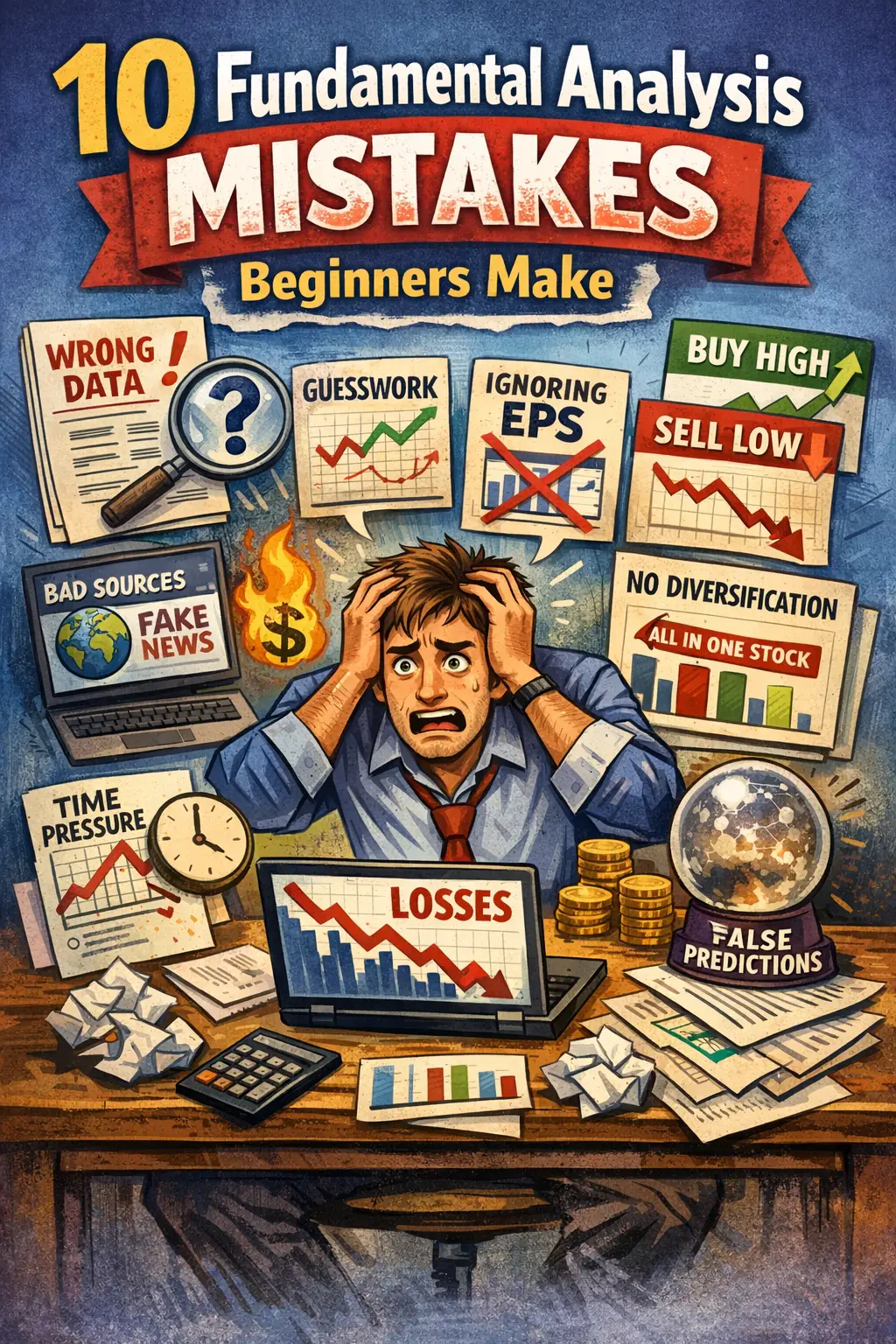
Beginners routinely make mistakes like confusing great companies with great investments, fixating on revenue while ignoring balance sheets, anchoring to purchase prices, and following the crowd into overvalued assets. Understanding these traps — alongside subtler errors like misusing P/E ratios in isolation, ignoring qualitative factors, and abandoning long-term thinking the moment prices move — is the difference between building wealth systematically and paying the market an expensive education.
If you have ever sat in front of a stock chart at 2 a.m., heart pounding, wondering why a company with record earnings just dropped 14% in after-hours trading, then congratulations — you are learning fundamental analysis the expensive way. Fundamental analysis mistakes beginners make cost retail investors billions of dollars every year, and if you do not know the ten most common of them right now, you are almost certainly making at least three of them before breakfast.
I am going to be brutally honest with you — mostly because I have been that person. I have stared at a balance sheet with the confidence of someone who has watched two YouTube videos and one TED Talk, and I have come out the other side looking like I tried to fight the market with a foam sword. But I learned. You can too. The difference is that my tuition was paid in real money. Yours, hopefully, can be paid in reading this article.
And look — I want to be very transparent with you here. I have made mistakes in this market that were so embarrassing, I had to apologise to my brokerage account. I put on a trade once and was so wrong that the stock moved against me the moment I hit confirm — like the market saw my face through my webcam and decided, “Not today, chief.” But those losses taught me more than any win ever did. Pain is the best professor, and the market has a PhD in pain delivery.
Let us get into it.
What Is Fundamental Analysis — And Why Beginners Get It Wrong From the Start
Fundamental analysis is the process of evaluating a company’s intrinsic value by examining related economic, financial, and qualitative factors — everything from earnings reports and revenue growth to competitive positioning and macroeconomic conditions. The goal is simple: figure out what a stock is actually worth, compare that to what the market is charging, and decide whether it is a bargain or a rip-off.
Sounds straightforward, right? That is exactly what makes it dangerous.
The theory is elegant. The execution is where beginners walk confidently off a cliff. The academic literature is stuffed with evidence of just how badly individual investors systematically underperform when left to their own devices. Barberis and Thaler (2003) documented extensively that individual investor behaviour deviates from rational expectations in predictable, repeatable ways — not because investors are stupid, but because human brains are wired for storytelling, not spreadsheets.
So here are the ten mistakes. The ones that drain portfolios. The ones I see beginners make over and over again. Read carefully.
Mistake #1: Confusing a Great Company With a Great Investment
This is mistake number one for a reason. It is so common, so seductive, and so devastating that researchers have studied it formally. Anderson and Smith (2006) tested the classic assumption that investing in admired companies — ones that Fortune magazine named the most admired in America — would produce superior returns. The result? It did not. Why? Because by the time a company is widely recognised as great, the market has already priced in that greatness. You are not buying a secret. You are buying yesterday’s news at tomorrow’s price.
Let me paint you a picture. Apple is an incredible company. Everybody knows this. Your grandmother knows this. The guy selling fruit on the corner probably knows this. So when Apple is trading at 35 times earnings, the question is not “Is this a great company?” The question is “Is paying 35 times earnings for this great company a great investment?” Those are entirely different questions, and beginners collapse them into one.
I personally made this mistake with a tech company whose product I loved so much that I genuinely believed my enthusiasm was a form of research. It was not. My enthusiasm was a bias. The stock corrected 40% over the following eighteen months while I sat there defending my position to myself like a bad lawyer arguing a case he knows he cannot win.
The fix is simple: separate your admiration for a business from your analysis of its valuation. A wonderful company at the wrong price is still a bad trade.
Case Study: Cisco Systems, 2000. At the peak of the dot-com bubble, Cisco was arguably the greatest company in the world — the backbone of the internet. Its stock traded at over 130 times forward earnings. It was a great company. It was not a great investment at that price. Twenty-five years later, its stock still has not recovered to those 2000 levels. The market was not wrong about Cisco being great. It was wrong about the price.
Mistake #2: Ignoring the Balance Sheet and Fixating Only on Revenue
Beginners fall in love with revenue. Revenue is the flashy number. Revenue goes up, everyone gets excited. Revenue is the party. The balance sheet is the morning after.
I have watched beginner investors tweet screenshots of a company’s revenue growth chart with the energy of someone who just discovered fire, completely unaware that the company has been quietly loading itself with debt like it is packing for a move it cannot afford. Revenue without context is just noise. What matters is what the company actually owns, what it owes, and how sustainable its cash position is.
Lakonishok, Shleifer, and Vishny (1994) demonstrated that the market systematically overvalues growth stocks — companies with exciting revenue trajectories — and undervalues value stocks with strong fundamental balance sheets. This overvaluation comes precisely because investors fixate on the story of growth rather than the reality of financial health.
Debt-to-equity ratios, current ratios, working capital — these are the numbers that tell you whether the party can continue or whether the company is quietly borrowing money to buy drinks for everyone. A company drowning in short-term debt obligations while posting impressive revenue growth is not a success story. It is a tragedy in progress.
Case Study: WeWork, 2019. WeWork filed for its IPO having grown revenue from roughly $436 million in 2016 to $1.82 billion in 2018 — an extraordinary trajectory. Beginners saw the revenue and saw a rocket ship. Anyone who looked at the balance sheet saw a company losing $219,000 per hour. The IPO collapsed spectacularly. Revenue told one story. The balance sheet told the truth.
Mistake #3: Overconfidence in Your Own Forecasts
Here is something nobody tells you when you start investing: the more you study, the more confident you become, and the more confidence you have, the more dangerous you are to your own portfolio.
Overconfidence is the single most documented bias in the behavioural finance literature. Kansal and Singh (2018) showed that investors consistently overestimate their own knowledge and predictive abilities, leading to excessive trading, concentration risk, and ultimately poor returns.
I am going to tell you something that hurt my feelings the first time I encountered it: professional fund managers, on average, do not beat the market. People with Bloomberg terminals, Bloomberg salaries, Bloomberg everything — they still, as a group, underperform a passive index fund over a ten-year period. If they cannot consistently forecast the future of publicly traded companies with all those resources, what makes any of us think we can do it from a laptop in our living room?
The answer, for most beginners, is overconfidence. And overconfidence has a very specific flavour in investing. It is not the loud, brash overconfidence of someone who knows nothing — that kind of person does not even bother building a DCF model. Investor overconfidence is quieter and far more insidious. It is the overconfidence of someone who knows enough to feel sure, but not enough to know what they do not know. It is the Dunning-Kruger effect in a blazer.
We build a discounted cash flow model, plug in some assumptions about growth rates, and our spreadsheet tells us the stock is worth 40% more than its current price. We then treat this number as if we received it from a burning bush. We did not. We generated it ourselves, from assumptions we made ourselves, in a model we built ourselves. Every layer of self-constructed certainty is another layer of potential error compounding on top of the previous one. The model says $80 per share. The market says $55. You conclude the market is wrong. And maybe it is. But maybe your terminal growth rate assumption is two percentage points too generous, and when you correct for that, the intrinsic value drops to $52 and now the stock is slightly overpriced. That two-percentage-point difference in a DCF can swing a valuation by 30%. Beginners rarely stress-test this. Beginners trust the number.
The fix is to stress-test your assumptions aggressively. What happens to your valuation if revenue growth is half what you projected? What if margins compress? What if the discount rate needs to go up? If your thesis only works under optimistic conditions, it is not a thesis — it is a wish.
Mistake #4: Using P/E Ratios in Isolation
Ah, the price-to-earnings ratio. The P/E. The metric that every beginner learns first and then immediately misuses with breathtaking regularity.
The P/E ratio tells you how much the market is willing to pay for each dollar of a company’s earnings. A P/E of 20 means investors are paying $20 for every $1 of annual earnings. Simple. Useful. But completely and utterly misleading when used in isolation.
Here is the problem: a P/E ratio is a snapshot. It tells you nothing about the quality of those earnings, the sustainability of those earnings, the growth rate of those earnings, or whether those earnings are being manipulated through accounting choices that would make your accountant break into a cold sweat. Beginners look at a low P/E and think they have found a bargain. Sometimes they have. Other times, they have found a value trap — a company that looks cheap because the market knows something the beginner does not.
Barberis et al. (2018) found in their research on asset pricing models that investors consistently misinterpret valuation signals because they fail to account for context. A P/E of 10 in a dying industry is not a bargain. A P/E of 30 for a company growing earnings at 40% annually might be perfectly reasonable.
The P/E ratio is one ingredient, not a recipe. Always pair it with the PEG ratio (P/E divided by earnings growth rate), the sector average, and a qualitative understanding of why the ratio is where it is. A P/E alone is like diagnosing a patient using only their height. Technically a data point. Not remotely sufficient.
Case Study: Kodak, 2010. Throughout the early 2000s, Kodak’s P/E ratios looked attractive compared to the broader market. Bargain hunters piled in. What the P/E failed to capture was the structural collapse of the film photography industry. The earnings base was eroding. The cheap P/E was cheap for a reason.
Mistake #5: Ignoring Qualitative Factors — The Stuff That Does Not Show Up in Spreadsheets
This is the mistake that really separates the people who are good at finance from the people who are good at investing. They are not the same thing.
Finance is quantitative. Investing is also qualitative. And beginners, having just learned all the quantitative tools with great excitement, proceed to apply them exclusively while ignoring the messy, unstructured, human stuff that actually drives long-term business performance.
What do I mean by qualitative factors? I mean management quality. I mean competitive moat — the sustainable advantages that protect a business from competitors. I mean brand reputation. I mean regulatory risk. I mean whether the CEO is building an empire or building a company. I mean whether the industry is facing technological disruption that no P/E ratio in the world is going to capture.
A CEO who blames every single bad quarter on supply chain issues, macroeconomic headwinds, or geopolitical uncertainty — but never, ever acknowledges any internal failure — is telling you something important about how this company is managed. A CEO who says “we made the wrong call on this product and here is what we are doing differently” is also telling you something important. One of those businesses is going to correct its mistakes. The other is going to repeat them while providing increasingly elaborate explanations for why none of it was their fault. These are qualitative observations. They do not appear in a ratio. But they matter enormously to long-run outcomes.
The behavioural corporate finance research of Malmendier (2018) showed that managerial overconfidence — a qualitative characteristic of company leadership — has measurable, significant effects on corporate investment decisions and ultimately shareholder returns. This is something you cannot read off a balance sheet. You have to read the earnings call transcripts. You have to listen to how the CEO talks about competition, about failure, about uncertainty. Is this person intellectually honest? Or are they the kind of person who blames every bad quarter on forces entirely outside their control?
Warren Buffett has been saying this for fifty years: invest in companies with durable competitive advantages, run by honest and capable managers. Nobody put it better. Nobody puts it into practice less consistently than beginners who just discovered DCF modelling.
Mistake #6: Anchoring to a Purchase Price
You bought a stock at $50. It drops to $35. You tell yourself it is a bargain because it “used to be” $50. You buy more. It drops to $22.
This is anchoring, and it is one of the most psychologically powerful — and financially ruinous — biases in the entire playbook of human irrationality. The purchase price you paid is completely irrelevant to the current investment decision. Completely. Totally. One hundred percent irrelevant.
The market does not know or care what you paid. The stock has no obligation to return to the price at which you acquired it. And yet, beginner investors cling to their purchase price like it is a contractual agreement between them and the universe. “It’ll come back,” they whisper, at month six of a declining trend, averaging down into a broken thesis. They are not averaging down based on fundamentals. They are averaging down based on the price they already paid, which is a sunk cost, which is irrelevant. They might as well be buying more because Mercury is in retrograde. At least that would be entertainingly irrational rather than boringly irrational.
I have been that person. I have had a position go against me and told myself, “I am not selling at a loss.” That sentence — “I am not selling at a loss” — is one of the most expensive sentences in investing. It is not a strategy. It is pride dressed up as discipline. There is a profound difference between holding a losing position because your fundamental thesis remains intact and the price will recover when the market catches up, and holding a losing position because selling feels like admitting you were wrong. One is conviction. The other is ego. Your portfolio cannot tell the difference, but your returns over time absolutely will.
Kahneman and Tversky’s prospect theory — for which Kahneman received the Nobel Prize — explains precisely this behaviour. We experience losses roughly twice as painfully as we experience equivalent gains. So instead of accepting a loss and moving capital to a better opportunity, we hold and hope, paralysed by loss aversion and anchored to a number that has no bearing on the future.
The professional’s approach: evaluate every position as if you were seeing it for the first time today, at its current price. Would you buy it right now, at this price, with this information? If the answer is no, the question becomes why you are still holding it. The purchase price is history. The future is what matters.
Mistake #7: Herding — Following the Crowd Off the Cliff
There is something deeply human about wanting to do what everyone else is doing. It is warm. It is comfortable. It feels safe. In most areas of life, it is an entirely reasonable strategy. In investing, it is a reliable path to buying tops and selling bottoms.
Herding behaviour in financial markets is extraordinarily well-documented. Research published in the Cambridge journal on behavioural public policy by Tan et al. (2008) and Spyrou (2013) found that when large numbers of investors herd into a particular asset, it creates price bubbles that can deviate dramatically from fundamental values. And when the bubble bursts, the people who herded in last are the ones who experience the full force of the correction.
Beginners are uniquely vulnerable to herding for a very simple reason: they have not yet built the conviction in their own analysis to act against consensus. When everyone on Reddit, Twitter, and every financial news channel is screaming about a particular stock, it takes genuine intellectual courage to look at the fundamentals, decide the price already reflects the enthusiasm, and walk away. Most beginners cannot do it. The FOMO is simply too loud.
The GameStop situation of 2021 is perhaps the most spectacular recent example of herding at scale. None of the buyers in the $400-per-share frenzy were making fundamental arguments. They were participating in a collective act of financial behaviour that had entirely decoupled from any analysis of intrinsic value. Some made money. Many did not. The ones who got hurt the most were the ones who arrived last, swept up by the wave.
Case Study: The Dot-Com Bubble, 1999-2001. Retail investors poured money into internet companies with no earnings, no clear business models, and valuations built entirely on projected futures that never arrived. They were herding. Everyone was doing it. By the time the Nasdaq had fallen 78% from its peak, those investors had learned a lesson that no business school charges tuition for.
Mistake #8: Failing to Understand Accounting — The Language of Business
Let me tell you something that took me longer to learn than I would like to admit: financial statements are not neutral documents. They are prepared by management, audited by firms that are paid by management, and structured within a framework of Generally Accepted Accounting Principles that offers more interpretive flexibility than most beginners realise.
Revenue recognition, depreciation schedules, goodwill impairment, off-balance-sheet financing — these are areas where legitimate companies can make choices that meaningfully alter how their financial health appears to outside observers. And then there are the companies where management is not making legitimate choices at all.
Beginners take the numbers on the page as gospel. Experienced analysts question them. Where is the cash flow relative to reported earnings? Companies can manipulate earnings through accruals, but cash is harder to fake. If a company is reporting strong net income but the operating cash flow is consistently weak or negative, that disconnect deserves interrogation, not investment.
Shefrin (2000) noted that practitioners studying finance should learn to recognise their own mistakes and those of others, and that understanding financial statement analysis deeply is foundational to avoiding systematic errors. That is not a suggestion. That is a prerequisite.
The Piotroski F-Score — developed by Joseph Piotroski at the University of Chicago — is a nine-point scoring system that evaluates companies across profitability, leverage, and operating efficiency dimensions. It was specifically designed to help investors avoid the trap of superficial financial reading. Learn the Piotroski score. More importantly, understand what each of its nine components is testing and why.
Case Study: Enron, 2001. Enron was one of the most celebrated companies in America — Fortune’s “Most Innovative Company” for six consecutive years. Its reported earnings looked extraordinary. Its cash flow from operations told a completely different story. Analysts who looked past the headline numbers and asked hard questions about the gap between earnings and cash flow saw warning signs long before the collapse. Most retail investors were not asking those questions.
Mistake #9: Neglecting Macroeconomic Context
You can do a perfect, meticulous, Nobel-Prize-worthy analysis of an individual company and still lose money because you forgot that the company exists inside an economy, and the economy sometimes does very inconvenient things.
Interest rates affect the discount rate used in DCF models — when rates rise, the present value of future earnings falls, and growth stocks get hit hardest. Inflation erodes real returns and squeezes consumer spending. Currency fluctuations devastate exporters. Regulatory changes can overnight alter the competitive landscape of an entire industry. And recessions — those pesky, inconvenient, cyclically inevitable recessions — reduce corporate earnings across the board regardless of how pristine any individual company’s balance sheet looks.
Beginners tend to evaluate companies in a vacuum. They build bottom-up analyses with tremendous detail and precision, and then they forget to look up and notice that the central bank just raised interest rates by 500 basis points in fourteen months. That matters. That matters a lot.
Barberis, Greenwood, Jin, and Shleifer (NBER, 2020) showed that investor expectations about earnings growth are consistently too optimistic when good news arrives, contributing to excess stock price volatility and subsequent underperformance. In other words, investors extrapolate good company news without adequately weighting the macro environment that surrounds it. During a tightening cycle, even genuine earnings beats can produce negative price reactions. Context is everything.
The fix is not to become a macro forecaster — nobody is particularly good at that, including economists whose entire job it is. The fix is to build macro awareness into your risk framework. Understand the interest rate environment. Understand where we are in the credit cycle. Understand whether the sectors you favour are cyclical or defensive. And always ask: what happens to this investment if the macro environment deteriorates meaningfully over the next two years?
Mistake #10: Impatience — Treating Fundamental Analysis Like Day Trading
And here we arrive at the last mistake — the one that makes all the other mistakes worse, the one that ties every other error together into one spectacular act of self-sabotage.
Fundamental analysis is a long-term discipline. It is not designed to tell you what a stock will do next week. It is not a technical indicator. It is not a momentum signal. It is an assessment of intrinsic value — and markets, as the legendary economist John Maynard Keynes observed, can remain irrational longer than you can remain solvent.
Beginners learn about undervalued stocks and then expect the market to agree with their valuation within thirty days. When it does not, they panic. They sell. They declare that fundamental analysis does not work. They pivot to day trading, which is an entirely different discipline they also have not studied, and they lose more money faster.
Lakonishok, Shleifer, and Vishny (1994), in their landmark study on value investing, found that value strategies outperform glamour strategies — but this outperformance typically materialises over three-to-five-year horizons, not three-to-five-week horizons. The market does eventually price companies correctly. It just does so on its own schedule, with absolutely no consideration for your personal timeline or your emotional state.
The uncomfortable truth about fundamental analysis is that being right is only half the battle. You also have to be right for long enough. And to be right for long enough, you need the patience, conviction, and emotional discipline to hold positions through periods of paper losses, periods of market indifference to your thesis, and periods where everyone around you seems to be making money doing something completely different.
That is not a financial skill. That is a psychological skill. And it is one that beginners almost universally underestimate.
Case Study: Berkshire Hathaway Under Warren Buffett. Buffett’s investment in American Express during the 1960s Salad Oil Scandal is a masterclass in fundamental conviction under pressure. The scandal temporarily crushed the stock. Buffett had done his analysis. He understood the fundamental value of the business. He held — and the investment returned multiples of his original stake over the following years. The crowd panicked. Buffett waited. Patience, backed by genuine fundamental understanding, was the edge.
How to Actually Fix These Mistakes: A Practical Framework
Now that I have taken you through every way this can go wrong — and let me be very clear, I have a personal relationship with most of these errors — let me give you something constructive.
Step One: Build a checklist. Before you invest in any company, go through every single one of these ten mistakes as a structured checklist. Am I confusing admiration for analysis? Have I read the balance sheet in full? Am I stress-testing my assumptions? Have I looked at cash flow versus reported earnings? Have I considered the macro environment? Is my timeline realistic?
Step Two: Read the primary documents. The annual report. The 10-K. The earnings call transcript. Not the summary. Not the analyst note. The actual words that management wrote and spoke. There is an enormous amount of information in how management describes its own business — what they emphasise, what they downplay, how they respond to difficult questions from analysts on calls.
Step Three: Seek disconfirming evidence. This is the one most people skip. Once you have built your bull case, actively look for the bear case. Find the most compelling argument against your position. Understand it. If you cannot articulate why the bear case might be wrong, you have not done enough work.
Step Four: Size positions to your conviction and your knowledge. A 20% position in a company whose business model you can only partially describe is a recipe for catastrophic loss. Position sizing should be proportional to the depth of your understanding and the quality of your evidence — not proportional to the strength of your optimism.
Step Five: Set a time horizon and stick to it. If your fundamental thesis requires three years to play out, write that down. Date it. When the stock is down eight months in, go back and read what you wrote. Has anything changed materially about the thesis? If not, the time to reassess has not arrived yet. Do not let short-term price action rewrite your long-term analysis.
Conclusion: The Trader Who Made All These Mistakes Is Writing This for You
I started this article by telling you that I have made every single one of these mistakes — some of them twice, a couple of them with what I can only describe as enthusiastic determination. I once held a position so long past its sell point that the company entered bankruptcy proceedings. Not restructuring. Bankruptcy. I sat there reading the filing with the facial expression of someone who has just discovered that what they thought was chicken was not, in fact, chicken.
And here is the honest truth about where I sit now: I still make some of them. Not all of them, not as badly, not as often — but the psychological pull of overconfidence, of anchoring, of following the crowd when the crowd is loud enough, does not go away. It just becomes more manageable. What changes with experience is not the absence of these impulses — it is the speed with which you recognise them for what they are and choose a different path. That is the entire game. Recognise the pattern, interrupt the pattern, choose the rational response.
Fundamental analysis is not a system that eliminates loss. Nothing does that. It is a framework for making better decisions on average, over time, in the face of genuine uncertainty. The goal is not to be right every time. The goal is to be right more often than the assumptions built into current market prices — and to survive long enough for that edge to compound.
The academic literature is clear: investors who understand behavioural biases, who understand financial statements deeply, who maintain intellectual humility about their own forecasts, and who hold long-term positions with genuine conviction outperform those who do not — not every year, not in every market, but consistently over time. That is the finding of Fama and French (1993), of Shleifer and Vishny (1997), of Barberis and Thaler and every serious researcher who has spent a career studying why markets behave the way they do.
You now know the ten fundamental analysis mistakes beginners make. More importantly, you know why each one happens — the psychological mechanism, the cognitive shortcut, the emotional trap. Awareness does not guarantee immunity. But it is the first and most important step towards becoming the kind of investor who builds wealth systematically rather than the kind who makes spectacular trades and unspectacular overall returns.
Now go read a balance sheet carefully. Then go read another one. Then come back and tell me what you found. That is how this works.
Frequently Asked Questions
1. What is the most common fundamental analysis mistake beginners make?
Confusing a great company with a great investment is the most common mistake, because widespread admiration for a business is almost always already reflected in its price.
2. Why is revenue growth misleading without balance sheet analysis?
Revenue growth without balance sheet context can mask dangerous levels of debt, poor cash conversion, or unsustainable burn rates that make a company far riskier than it appears.
3. What is a value trap in fundamental analysis?
A value trap is a stock that appears cheap on metrics like P/E ratio but is cheap for a legitimate reason — such as structural industry decline or deteriorating earnings quality.
4. How does overconfidence affect investment decisions?
Overconfidence causes investors to over-trust their own forecasts and models, leading to excessive concentration, insufficient stress-testing, and costly errors built on flawed assumptions.
5. Why is anchoring to a purchase price so damaging?
Your purchase price is a sunk cost completely irrelevant to the stock’s future performance, so holding a losing position to avoid “selling at a loss” is an emotional decision, not a rational one.
6. What qualitative factors should investors consider beyond financial statements?
Management quality, competitive moat, intellectual honesty of leadership, and exposure to technological disruption are critical qualitative factors that no ratio or spreadsheet can fully capture.
7. How does herding behaviour lead to investment losses?
Herding drives asset prices far above intrinsic value, meaning investors who arrive late to a popular trade absorb the full force of the correction when sentiment reverses.
8. Why should investors compare cash flow to reported earnings?
Earnings can be manipulated through legitimate accounting choices and accruals, but operating cash flow is far harder to fake and reveals whether profits are genuinely being generated.
9. How do macroeconomic conditions affect fundamental analysis?
Interest rate changes, inflation, and credit cycles directly affect discount rates, consumer spending, and sector performance, meaning even a well-analysed company can underperform in the wrong macro environment.
10. How long does it typically take for fundamental analysis to produce returns?
Academic research shows that value strategies based on sound fundamental analysis tend to outperform over three-to-five year horizons, not days or weeks.
References
- Barberis, N. & Thaler, R. (2003). A Survey of Behavioral Finance. Handbook of the Economics of Finance. https://nicholasbarberis.github.io/ch18_6.pdf
- Barberis, N. (2018). Psychology-Based Models of Asset Prices and Trading. NBER Working Paper No. 24723. https://www.nber.org/system/files/working_papers/w24723/w24723.pdf
- Barberis, N., Greenwood, R., Jin, L., & Shleifer, A. (2020). Expectations of Fundamentals and Stock Market Puzzles. NBER Working Paper No. 27283. https://www.nber.org/system/files/working_papers/w27283/revisions/w27283.rev0.pdf
- Malmendier, U. (2018). Behavioral Corporate Finance. NBER Working Paper No. 25162. https://www.nber.org/system/files/working_papers/w25162/w25162.pdf
- Baker, M. & Wurgler, J. (2009). Behavioral Corporate Finance: An Updated Survey. https://pages.stern.nyu.edu/~jwurgler/papers/bcfsurvey2v20.pdf
- Shefrin, H. (2001). Behavioral Finance: Theories and Evidence. Cannon Financial Institute. https://www.cannonfinancial.com/uploads/main/Behavioral_Finance-Theories_Evidence.pdf
- Lakonishok, J., Shleifer, A., & Vishny, R. (1994). Cited in: Malheiro, A. et al. (2021). What is New in Value Investing? A Systematic Literature Review. Journal of New Finance, Vol. 2, No. 2. https://jnf.ufm.edu/cgi/viewcontent.cgi?article=1018&context=journal
- Kansal, P. & Singh, S. (2018). Cited in: Behavioral Finance Impacts on US Stock Market Volatility: An Analysis of Market Anomalies. Behavioural Public Policy, Cambridge University Press. https://www.cambridge.org/core/journals/behavioural-public-policy/article/behavioral-finance-impacts-on-us-stock-market-volatility-an-analysis-of-market-anomalies/D1CEF34141D03D8BECB2AE42467166B3
- Zhang, L. (2019). q-Factors and Investment CAPM. NBER Working Paper No. 26538. https://www.nber.org/system/files/working_papers/w26538/w26538.pdf
- Advances in Consumer Research (2025). Behavioral Finance and Investor Psychology: Understanding Market Volatility in Crisis Scenarios. https://acr-journal.com/article/behavioral-finance-and-investor-psychology-understanding-market-volatility-in-crisis-scenarios-1763/
Disclaimer: This article is for educational purposes only and does not constitute financial advice. Always conduct your own due diligence and consider consulting a qualified financial adviser before making investment decisions.
Further Reading:
Leave a Reply
You must be logged in to post a comment.