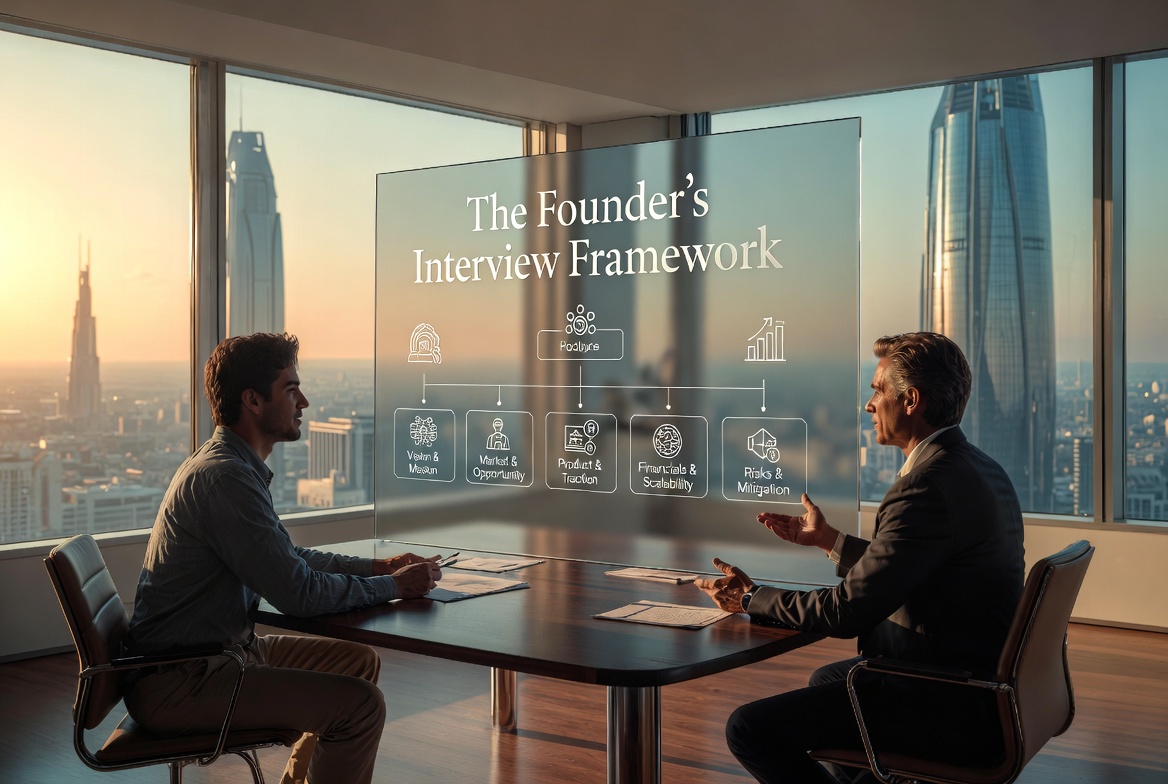
If you want to stop losing money on the wrong founders, the Founder’s Interview Framework gives traders and investors a structured, seven-pillar system for evaluating startup founders before committing capital. Backed by peer-reviewed research and real-world case studies, it replaces gut instinct with a repeatable, scoreable process that reveals who a founder truly is beneath the pitch.
📝 TL;DR — Quick Takeaways
- Core Definition: The Founder’s Interview Framework is a structured, seven-pillar system that gives traders and investors a repeatable, scoreable process for evaluating startup founders before committing capital — replacing dangerous gut instinct with evidence-backed precision.
- Primary Breakdown: The framework scores seven pillars — Origin Story (15%), Market Understanding (20%), Resilience (15%), Financial Literacy (20%), Team Building (10%), Competitive Awareness (10%), and Self-Knowledge (10%) — on a 1–5 scale, with a weighted score above 4.0 signalling a green-light investment.
- Key Takeaway: According to peer-reviewed research by Gompers, Kaplan & Mukharlyamov (2016), the founding team is the single most critical factor in investment outcomes — so the most valuable hour you will ever spend as a trader is the structured interview before you write the cheque.
Jump to the Scoring Matrix ↓
Why the Founder Interview Is the Most Important Due Diligence You Will Ever Do
Here is a fact that will blow your mind and rearrange your furniture: most professional investors will tell you, publicly and on record, that the founding team is the single most important factor in whether an investment succeeds.
This is not a trader’s opinion cooked up to fill a blog post. A landmark survey of venture capitalists by Gompers, Kaplan & Mukharlyamov (2016), published in the Journal of Financial Economics, surveyed 79 private equity investors managing over $750 billion in combined assets under management. The finding? Both prospectively and retrospectively, investors said the quality of the founding team was the most critical factor in deal outcomes. Not the market. Not the technology. Not the deck. The people.
Let me repeat that for the people in the back: the people.
Now, I know what you are thinking. You are thinking, “I already know this. I interview founders all the time.” No you don’t. You have conversations. You have coffee chats. You let founders show you a demo and then you nod along like a bobblehead in a sports car. That is not an interview framework. That is a very expensive episode of Shark Tank where nobody wins.
A real Founder’s Interview Framework is systematic, repeatable, and rooted in behavioural science. It is designed to extract signal from all the noise — and trust me, founders generate a lot of noise. Some of them could talk for six hours straight about their total addressable market without ever answering the question “why are you the right person to build this?”
The Academic Foundation: Why Structure Beats Instinct
Before we get into the actual questions, let us address the elephant in the room: most investors think they are great judges of character. Most investors are wrong.
Research on human decision-making in unstructured interview settings consistently shows that interviewers overestimate their own ability to detect deception, resilience, and capability. Kahneman (2011) famously demonstrated in Thinking, Fast and Slow that unstructured interviews frequently produce decisions dominated by first impressions, confirmation bias, and what he termed the “halo effect” — where one positive attribute (a founder being well-dressed, articulate, or from a prestigious university) causes the evaluator to rate all other attributes more favourably.
In the venture capital context, the Claremont Graduate University study on the Assessment of Founders in Venture Capital Investment (2021) found that human factors are systematically under-appreciated by investors, despite founders having an “outsized role in venture outcomes.” The study, reviewing over four dozen peer-reviewed works on VC decision-making, concluded that financial expertise alone does not confer the ability to make high-quality judgements about people.
In other words: just because you can read a P&L does not mean you can read a person.
I used to think my gut was infallible. My gut has also told me to invest in a founder who described his competitive advantage as “vibes.” My gut and I no longer speak.
The solution is structure. Structured interviews — where the same set of questions, asked in the same order, evaluated against consistent criteria — dramatically outperform unstructured ones. The Springer Nature review on Venture Capital Screening confirms that systematic frameworks evaluating founder attributes alongside market, team, financials, and scalability create the most robust early-stage assessments.
So here is the framework. Seven pillars. Each one designed to tell you something specific about the person sitting across from you — and each one capable of saving or costing you hundreds of thousands of pounds.
The Seven Pillars of the Founder’s Interview Framework
Pillar One: The Origin Story — Why Are You Building This?
The very first thing you need to establish is why this founder is building this business. Not the polished version. Not the rehearsed TED Talk. The real story.
Ask: “Tell me the actual moment you decided to start this company. Not the investor pitch version — the real one.”
What you are listening for is authentic pain. The best founders build companies to solve problems they have personally experienced or witnessed with a level of intensity that makes it unreasonable for them not to act. If a founder’s origin story sounds like they were sitting in a WeWork one day and noticed a “gap in the market” — run. Run like you just checked your portfolio on a Monday morning after a long weekend.
Authentic pain creates obsession, and obsession creates endurance. The NBER Working Paper on Transferable Skills (Gompers et al., 2022) found that successful founder-VCs — those who had been founders before becoming investors — had investment success rates 11.6 percentage points higher than unsuccessful founder-VCs, in part because they recognised the specific kind of irrational commitment that comes from lived experience in a problem space.
Case Study: Airbnb
Brian Chesky and Joe Gebbia did not sit in a café and decide there was a “gap in the hospitality market.” They were broke, couldn’t pay rent in San Francisco, and came up with the idea of renting out air mattresses in their apartment to conference attendees. The origin story was embarrassing, desperate, and completely real. That authenticity — and the pain behind it — is what drove them through five years of rejection, near-bankruptcy, and a global pandemic before eventually emerging as a company worth over $70 billion.
When Chesky tells the story of the early days, you can hear the obsession. That is what you are listening for. That is the signal. A founder who cannot tell you why they are building what they are building, with genuine emotion and specific detail, is a founder who will quit when it gets hard. And it always gets hard.
I once interviewed a founder who gave me a seven-minute origin story and used the word “synergy” four times. I wanted to slide out of my chair and dissolve into the floor.
Pillar Two: Market Understanding — Do You Actually Know Your Customer?
Here is where most interviews go wrong. Traders let founders talk about the market using their own deck. You might as well let a chef review their own cooking. The deck is marketing material. It is not a market analysis.
Instead, probe with this sequence:
- “Who specifically is your customer? Not a demographic. A person. Tell me about the last customer conversation you had.”
- “What did they tell you that surprised you?”
- “What do your customers do when they can’t use your product?”
The third question is devastating. If a founder cannot tell you what the workaround is, they do not truly understand the problem. Every real problem has a workaround, and understanding it tells you three things: the cost of the problem, the sophistication of the customer, and how sticky the solution needs to be.
The NBER Survey of Venture Capital Research (Da Rin et al.) identifies market knowledge as one of the core screening criteria in VC investment decisions, alongside financial projections and the founding team itself. Strong market knowledge — especially at the customer-interview level — is a leading indicator of product-market fit.
Case Study: Slack
Stewart Butterfield and his team built Slack originally as an internal communication tool for their gaming company, Glitch. They were solving a problem they had experienced themselves, in real-time, with real customers (themselves and their team). Before launching externally, Butterfield spent months speaking directly with potential enterprise customers to understand their specific communication pain points. Slack’s early growth — from zero to $7.1 billion in valuation in five years — was built on a deep, almost obsessive understanding of what enterprise workers actually hated about existing communication tools.
If Butterfield had answered “our customer is any company with employees,” I would have escorted him out of the room and asked him to come back when he had done some work.
Pillar Three: Resilience and Adaptability — What Happens When It All Goes Wrong?
Let me be very clear about something: every startup goes wrong. Regularly. Sometimes spectacularly. The question is not whether the founder will face catastrophic obstacles — they will — but whether they have the psychological and strategic toolkit to navigate them.
Ask: “Tell me about the hardest moment in this company so far. Not a challenge — the hardest moment. And tell me what you actually felt.”
Then: “What did you change because of it?”
You are evaluating two things simultaneously. First, resilience: do they have the emotional capacity to describe genuine failure without defensiveness? Second, adaptability: did they actually learn something and change something, or did they just survive and continue on the same path?
The Research on Pre-Investment Due Diligence by Chandra and Singh (IJCRT, 2020) identifies the “antecedents of the core management team including the promoters” as a critical factor in the due diligence framework. They specifically highlight how the history of decision-making under pressure predicts future performance under duress.
I once asked a founder this question and he told me the hardest moment was when his first PR agency didn’t get him the Forbes feature he wanted. I almost fell off my chair. That is not resilience. That is a man who has not yet been tested.
The best answer I ever got to this question came from a founder who told me her hardest moment was discovering, six months after launch, that her core assumption about customer behaviour was completely wrong. She wept at the memory. Then she told me exactly how she rebuilt the product from scratch in nine weeks with half the team. I wrote the cheque before she finished the sentence.
Pillar Four: Financial Literacy — Can This Person Run a Business?
I am a trader. Numbers are my love language. So this section is personal.
A shocking number of early-stage founders cannot tell you their unit economics. They cannot tell you their customer acquisition cost (CAC), their lifetime value (LTV), or their burn rate without squinting at a spreadsheet. This is not acceptable. These are not advanced metrics — they are the vital signs of a business.
Your questions here should be:
- “What is your current monthly burn, and how many months of runway do you have?”
- “What is your CAC and what is your LTV? Walk me through how you calculated both.”
- “At what point does this unit economics model break, and what are you doing about it?”
The last question is the killer. Most founders can tell you their current CAC/LTV ratio. Far fewer have stress-tested it. The ones who have are the ones worth betting on.
Gompers, Kaplan & Mukharlyamov (2016) found that professional investors primarily rely on Internal Rate of Return (IRR) and investment multiples to evaluate opportunities — but the inputs to those calculations depend entirely on how reliably a founder understands and manages their own unit economics. A founder who cannot construct a credible financial model is a founder who cannot give you reliable inputs for your own thesis.
The ResearchGate paper on the Role of Financial Due Diligence (2025) highlights that portfolios subjected to rigorous due diligence — including forensic evaluation of management’s financial competence — outperform others by an average of 15% annually, citing National Bureau of Economic Research (NBER) data from 2022. Fifteen percent. Annually. That is not a small number. That is the difference between a career and a cautionary tale.
Case Study: WeWork
Let us talk about what happens when financial literacy is absent. Adam Neumann was a charismatic, compelling founder who could sell a vision better than almost anyone in Silicon Valley. He also had no real grip on his unit economics. WeWork’s S-1 filing revealed a company burning billions of dollars with a deeply flawed model dressed up in the language of a tech startup. It was, at its core, a real estate company with bad maths and a very expensive CEO.
Investors who ran a rigorous financial literacy assessment on Neumann early in the process would have identified the cracks. Those who were blinded by charisma did not. SoftBank lost approximately $14 billion. Do not be SoftBank.
I will say this only once: a founder who cannot explain their unit economics without a deck is not a founder who has internalised their business. And a business not internalised by its founder is a business that is running on vibes. And vibes, as I have noted previously, are not a competitive advantage.
Pillar Five: Team Building and Leadership — Can They Attract and Keep Talent?
A founder is not the company. Eventually, the company is the people the founder hires, empowers, and retains. The question is: does this founder know how to do that?
Ask: “Tell me about someone on your team who you were initially unsure about but turned out to be exceptional. What did you learn from that?”
And then: “Tell me about someone you had to let go. How did you handle it, and what did you get wrong initially?”
The first question reveals self-awareness in talent assessment. The second reveals courage and accountability. A founder who has never fired anyone — or who describes every departure as “a mutual decision that worked out for everyone” — either has not built a real team or lacks the candour to tell you the truth.
The Springer Nature VC Screening review specifically identifies the “venture team” as a separate and distinct screening criterion from founder attributes alone, because the team a founder assembles is itself a signal about judgment, network quality, and organisational capability.
Case Study: Stripe
Patrick and John Collison built Stripe into a $95 billion payments infrastructure company, and one of the most consistent things you will hear from early Stripe employees is that the brothers were extraordinary talent scouts. They were relentless in hiring people who were, in their own words, “frighteningly good.” That obsession with talent quality, instilled by the founders from day one, became a cultural DNA that the company still carries. Stripe’s talent density at the early stages was a direct predictor of its ability to solve extraordinarily hard technical and commercial problems.
When I interview founders about their team, I am not just asking about who they have hired. I am asking about their theory of talent. Do they believe in paying above market? Do they value generalists or specialists at early stages? Do they know how to retain people through equity structures they can actually explain? These are not abstract questions. They are predictors of survival.
Pillar Six: Competitive Awareness — Do They Know Their Enemies?
A founder who tells you they have “no real competitors” is either lying or dangerously naive. Both are bad.
Every market has competition. Sometimes the competition is not a direct product rival — it is the status quo. It is the spreadsheet people are currently using instead of your software. It is the behaviour pattern your product needs to replace. Dismissing that competition because it is not a VC-backed startup is one of the most common and expensive mistakes founders make.
Ask: “Who is your most dangerous competitor, and why? Not the most obvious one — the most dangerous one.”
The answer to this question tells you an enormous amount. A founder who immediately names a large incumbent and explains exactly what that incumbent would need to do to kill their startup — and why they haven’t done it yet — is a founder who is thinking clearly. A founder who names a tiny startup doing something adjacent and dismisses it as “not really in our space” is not paying attention.
I frame this as asking about “enemies” because the word unlocks something. People are more precise about threats when you frame them as threats. The word “competitor” sounds like a business school exercise. “Enemy” makes them think harder.
The Venture Capital Investment Framework research (ResearchGate, 2025) advocates for combining qualitative founder assessment with rigorous market evaluation — including competitive positioning — as a necessary integration for robust early-stage decision-making.
Pillar Seven: Self-Knowledge — What Are You Bad At?
This is the most important question in the entire framework. Do not skip it. Do not soften it. Ask it directly.
“What are you genuinely bad at, as a founder? Not the things you are working on or the skills you are developing — the things that, if you are honest with yourself, represent real limitations for this company?”
And then: “What have you done to compensate for those limitations?”
This question is designed to measure something that does not appear on any deck or cap table: metacognitive ability. The ability to observe your own thinking, your own blind spots, your own failure modes. In high-stakes environments — and running a startup is about as high-stakes as it gets — metacognitive ability is one of the strongest predictors of adaptive performance.
The best founders I have ever met have answered this question with a speed and specificity that was almost startling. They knew exactly what they were bad at. They could tell me the name of the person they had hired to compensate for it. They had built systems around their weaknesses.
The worst founders gave me some version of “I am too passionate” or “I work too hard.” Which, by the way, is not self-knowledge. That is a LinkedIn bio. That is the CV version of a personality. That tells me nothing except that this person has never truly interrogated their own failure modes, which means when those failure modes inevitably surface — and they will — this founder will be blindsided by them.
The Claremont Graduate University study on founder assessment found that VCs consistently assessed qualities including resilience, adaptability, and leadership ability — but rarely had structured frameworks to evaluate them. The result was inconsistency and bias. Pillar Seven is where a structured approach pays the greatest dividends, precisely because it exposes what unstructured conversations miss.
The Scoring Matrix
A framework without a scoring system is just a list of nice conversations. Traders need numbers. So here is how to convert your founder interview into an actionable assessment.
Score each pillar on a scale of 1 to 5:
| Pillar | Weight | Max Score |
|---|---|---|
| 1. Origin Story (Authenticity) | 15% | 5 |
| 2. Market Understanding | 20% | 5 |
| 3. Resilience and Adaptability | 15% | 5 |
| 4. Financial Literacy | 20% | 5 |
| 5. Team Building | 10% | 5 |
| 6. Competitive Awareness | 10% | 5 |
| 7. Self-Knowledge | 10% | 5 |
Scoring Guide:
- 5: Answer was specific, immediate, emotionally honest, and revealed depth beyond the prepared pitch.
- 4: Answer was good but required prompting for depth.
- 3: Answer was adequate but remained at surface level.
- 2: Answer was evasive or relied on generic language.
- 1: No real answer. Deflection. Reversion to pitch mode.
A weighted score above 4.0 is green. Between 3.0 and 4.0 requires further diligence or a co-investor with specific expertise in the weaker areas. Below 3.0, put your cheque book away. I do not care how good the deck looks.
I once had a founder score 4.7 on this matrix. He ended the meeting by asking me what the exit strategy was for a company he had founded six months ago. I knocked him down to 4.2 on financial literacy. He still got funded. The business was acquired eighteen months later at a 6x return. Sometimes the framework confirms what you already suspect. That is the point.
Common Red Flags That Transcend Every Pillar
There are certain behaviours that, regardless of which pillar they appear in, should stop your due diligence process immediately. I have compiled these from years of interviews and from the kind of painful post-mortems you do when you are staring at a write-off and asking yourself “where did I miss this?”
Red Flag One: The Pivot That Isn’t
Multiple complete pivots with no coherent learning thread connecting them is not adaptability. It is a founder who keeps starting over instead of solving the hard problem.
Red Flag Two: The Vision Without Execution
Some founders are extraordinarily compelling visionaries who cannot execute. They have read every book and attended every conference — but when you ask what the last sprint produced or what specific customer feedback came in last month, they go quiet. Vision without execution is a very expensive hobby.
Red Flag Three: The Single Point of Dependency
Founders who are the only person who can sell, code, or hold the key customer relationships are not building companies. They are building jobs for themselves. Those “companies” do not scale and do not survive the founder’s absence.
Red Flag Four: The Blame Narrative
Listen carefully to how a founder talks about failure. If every setback has an external cause — the market wasn’t ready, investors didn’t believe in us, timing was bad — you are in trouble. The best founders have a remarkable ability to find what they could have done differently, even in genuinely unfair situations. Agency — the belief that your actions shape outcomes — is the fuel that keeps people going when everything is on fire.
How to Conduct the Interview: Logistics and Environment
The framework is only as good as the environment in which you deploy it. Some practical guidance from someone who has made every mistake in this department:
Conduct at least two sessions. The first interview is where the founder presents who they want to be. The second interview — especially if you ask questions they did not expect — is where you meet who they actually are. The Best Ever CRE due diligence guide specifically notes the importance of evaluating “whether communication styles mesh well” over multiple interactions, not just a single meeting.
Ask follow-up questions obsessively. “Tell me more.” “Why?” “What did you do next?” The follow-up question is where the real information lives. The initial answer is often rehearsed. The fifth follow-up is where you hear the truth. I once uncovered a co-founder dispute — one the founder had planned to never mention — by asking “what did your co-founder think about that?” as a follow-up on product strategy. That one question changed my entire investment decision.
Watch for the shift out of pitch mode. Every founder starts selling. Your job is to move them into honest conversation. Watch for the moment when the rehearsed vocabulary disappears and the posture changes. That is when the interview actually starts.
Take notes on process, not just content. How quickly do they answer? Do they pause to think? Do they ask you clarifying questions? Do they change their answer when you push back? Behavioural signals are as informative as the content itself.
Practical Case Study: Applying the Framework in Real Time
Let me walk you through a composite example — drawn from real experience but with names changed because I enjoy not being sued.
I once interviewed the founder of an early-stage B2B logistics software company. Let us call him Marcus. Marcus had an impressive LinkedIn profile, had previously worked at a top-tier consultancy, and had a polished, well-designed deck. He had also already raised a seed round from a respected accelerator.
On Pillar One, Marcus’s origin story was clean and articulate — almost too clean. When I pushed him for the moment of real doubt, he paused, and then told me something he had not told other investors: he had almost quit six months in after losing his first customer. His co-founder had had to talk him back off the ledge. That moment of honesty was worth ten minutes of polished pitch. Score: 4.
On Pillar Two, Marcus knew his customers deeply. He had done over 200 customer interviews personally. He could tell me, unprompted, the name of the logistics manager at his third customer and what specifically she hated about her previous software. Score: 5.
On Pillar Three, he described the customer loss with genuine specificity — what he had done wrong, what he would do differently, what he had already changed. Score: 4.
On Pillar Four, financial literacy was where Marcus wobbled. He knew his burn rate and runway. But when I asked him to walk me through his LTV calculation, he referenced a figure he clearly had not calculated himself. He said “my CFO will know the exact number.” At a seven-person seed-stage company, not knowing your own LTV in intimate detail is a flag. Score: 3.
On Pillar Five, he spoke about his team with obvious pride and specific insight. He described one hire who had been his most valuable employee despite an underwhelming interview, and described a departure that he clearly blamed himself for, at least in part. Score: 4.
On Pillar Six, when asked about his most dangerous competitor, Marcus did not mention the obvious VC-backed rival. He pointed to the incumbent enterprise software players and specifically explained why their sales cycle and pricing structure was actually his biggest barrier to growth — not a direct competitor. That level of market sophistication was genuinely impressive. Score: 5.
On Pillar Seven, self-knowledge, Marcus was refreshingly candid. He said his biggest weakness was impatience with people who thought differently from him. He described a specific incident where it had cost him a key hire. He named the person he had brought in to mediate those situations. Score: 4.
Weighted score: 4.1. Solid green. I invested. The company has since closed a Series A and expanded into three new European markets. Marcus turned out to be exactly the founder his interview suggested: deeply knowledgeable, occasionally impatient, financially not the strongest independently but surrounded by people who were. The framework told me exactly who I was investing in. I just had to trust it.
Why This Framework Makes You a Better Investor, Full Stop
The Founder’s Interview Framework does not just help you avoid bad investments. It makes you a fundamentally better investor.
It makes you more disciplined. When you have a structured framework, you are less susceptible to the charm offensive. I have met founders who could convince me that buying a one-way ticket to the moon was a sound retirement strategy. The framework does not care how charming they are.
It makes you more consistent. Evaluating five founders across five weeks without a framework means you are comparing your mood on Monday versus your mood on Thursday. That is not investing — that is astrology with a spreadsheet.
It makes you more defensible. When LPs ask why you passed on a deal, “our framework score was 3.2, with a particular weakness in financial literacy” is a better answer than “my gut said no.”
And perhaps most importantly: it makes you a better partner. By the time you have run a founder through the framework, you know exactly what they are good at and where they need help. You are not just a cheque — you are an informed partner with a specific view of this specific human being. That is the difference between money and partnership.
Conclusion: The Cheque Is the Easy Part
Here is the truth nobody in venture capital likes to say out loud: writing the cheque is the easy part. The hard part is knowing whether to write it.
The Founder’s Interview Framework — built on seven structured pillars, supported by peer-reviewed evidence, and tempered by years of real-world experience — gives you the best possible basis for that decision. It does not guarantee success. Nothing guarantees success in early-stage investing. A founder who scores 4.8 can still build a business in a market that evaporates. A founder who scores 3.4 might carry a secret superpower no framework can detect.
But what the framework does is remove the noise. It strips away the polish, the charisma, and the carefully rehearsed origin story, and it puts you in a room with the actual human being you are betting your capital on. It asks the questions that matter and demands the kind of honesty that separates the genuinely exceptional from the convincingly adequate.
And in a world where the NBER’s survey of VC research confirms that the founding team is the single most critical variable in investment outcomes — more important than market size, technology, timing, or financial structure — that conversation is the most valuable hour you will spend in this business.
I have sat across from hundreds of founders. I have backed dozens of them. Some built extraordinary businesses. Some became expensive lessons. The difference, more often than not, was not the idea. It was the person.
Use the framework. Take the notes. Score consistently. Trust the process.
And if a founder ever tells you their competitive advantage is “vibes” — please, for the love of compound interest, put the cheque book down.
Frequently Asked Questions
Q1: What is the Founder’s Interview Framework?
It is a structured, seven-pillar system traders and investors use to evaluate startup founders before committing capital, replacing gut instinct with a repeatable, scoreable process.
Q2: Why is interviewing a founder more important than analysing the business plan?
Peer-reviewed research by Gompers, Kaplan & Mukharlyamov (2016) found that the quality of the founding team is the single most critical factor in investment outcomes, outweighing market size, technology, and financial structure.
Q3: What are the seven pillars of the Founder’s Interview Framework?
The seven pillars are: Origin Story, Market Understanding, Resilience and Adaptability, Financial Literacy, Team Building, Competitive Awareness, and Self-Knowledge.
Q4: How should founders be scored using this framework?
Each pillar is scored on a scale of 1 to 5 with individual weightings, producing a weighted total where a score above 4.0 is green, 3.0–4.0 requires further diligence, and below 3.0 means you do not invest.
Q5: What is the most important question to ask a startup founder?
The most revealing question is asking what the founder is genuinely bad at and what they have done to compensate, because it measures metacognitive ability — a leading predictor of adaptive performance under pressure.
Q6: What are the biggest red flags when interviewing a founder?
The four critical red flags are: serial pivoting without a learning thread, visionary thinking without execution capability, single-point-of-dependency on the founder, and a blame narrative that attributes every setback to external factors.
Q7: How many interview sessions should you conduct before investing?
You should conduct at least two sessions, because the first reveals who the founder wants to be, while the second — with unexpected questions — reveals who they actually are.
Q8: Why do unstructured founder interviews produce poor investment decisions?
Kahneman’s research on cognitive bias shows that unstructured interviews are dominated by first impressions, the halo effect, and confirmation bias, causing investors to systematically overestimate their own ability to judge character.
Q9: Can this framework be used for later-stage investments, not just early-stage?
Yes — while the framework was developed for early-stage due diligence, its pillars on financial literacy, team building, and competitive awareness are equally applicable when evaluating management teams in growth-stage and private equity contexts.
Q10: What does rigorous due diligence actually do for investment returns?
According to NBER data cited in the 2025 ResearchGate paper on financial due diligence, portfolios subjected to rigorous due diligence outperform others by an average of 15% annually.
References
- Gompers, P. A., Kaplan, S. N., & Mukharlyamov, V. (2016). What do private equity firms say they do? Journal of Financial Economics, 121(3), 449–476. https://papers.ssrn.com/sol3/papers.cfm?abstract_id=2447605
- Gompers, P. A., Lerner, J., & Kovner, A. (2022). Transferable Skills? Founders as Venture Capitalists. NBER Working Paper No. 29907. https://www.nber.org/system/files/working_papers/w29907/w29907.pdf
- Da Rin, M., Hellmann, T. F., & Puri, M. (2012). A Survey of Venture Capital Research. NBER Working Paper No. 17523. https://www.nber.org/system/files/working_papers/w17523/w17523.pdf
- Chandra, A., & Singh, R. (2020). Pre-investment Due Diligence and Audit Practices of Venture Capital Companies. International Journal of Creative Research Thoughts (IJCRT). https://ijcrt.org/papers/IJCRT2005086.pdf
- Claremont Graduate University. (2021). Assessment of Founders in Venture Capital Investment. CGU Electronic Theses and Dissertations. https://scholarship.claremont.edu/cgi/viewcontent.cgi?article=1612&context=cgu_etd
- Venture Capital Screening. (2024). Springer Nature Link. https://link.springer.com/rwe/10.1007/978-3-031-81653-6_185
- Kaplan, S., & Strömberg, P. (2009). Leveraged Buyouts and Private Equity. Journal of Economic Perspectives, 23(1), 121–146.
- ResearchGate. (2025). The Role of Financial Due Diligence in Safeguarding Investment Portfolios in the U.S. Capital Market. https://www.researchgate.net/publication/389875188_The_Role_of_Financial_Due_Diligence_in_Safeguarding_Investment_Portfolios_in_the_US_Capital_Market
- ResearchGate. (2025). Venture Capital Investment Framework and Valuation Methodologies: A Comprehensive Analysis of Decision-Making Processes and Financial Modeling Approaches. https://www.researchgate.net/publication/395109527_Venture_Capital_Investment_Framework_and_Valuation_Methodologies_A_Comprehensive_Analysis_of_Decision-Making_Processes_and_Financial_Modeling_Approaches
- Best Ever CRE. (n.d.). Essential Due Diligence Checklist for Private Market Investments. https://www.bestevercre.com/blog/due-diligence-checklist-private-market-investments
Disclaimer: This article was written from the perspective of a trader applying market discipline to the startup validation process. It is intended for informational and educational purposes. The author is not a licensed financial or business advisor, and nothing in this article constitutes formal financial or legal advice. Always conduct your own research before making business decisions.
Leave a Reply
You must be logged in to post a comment.