
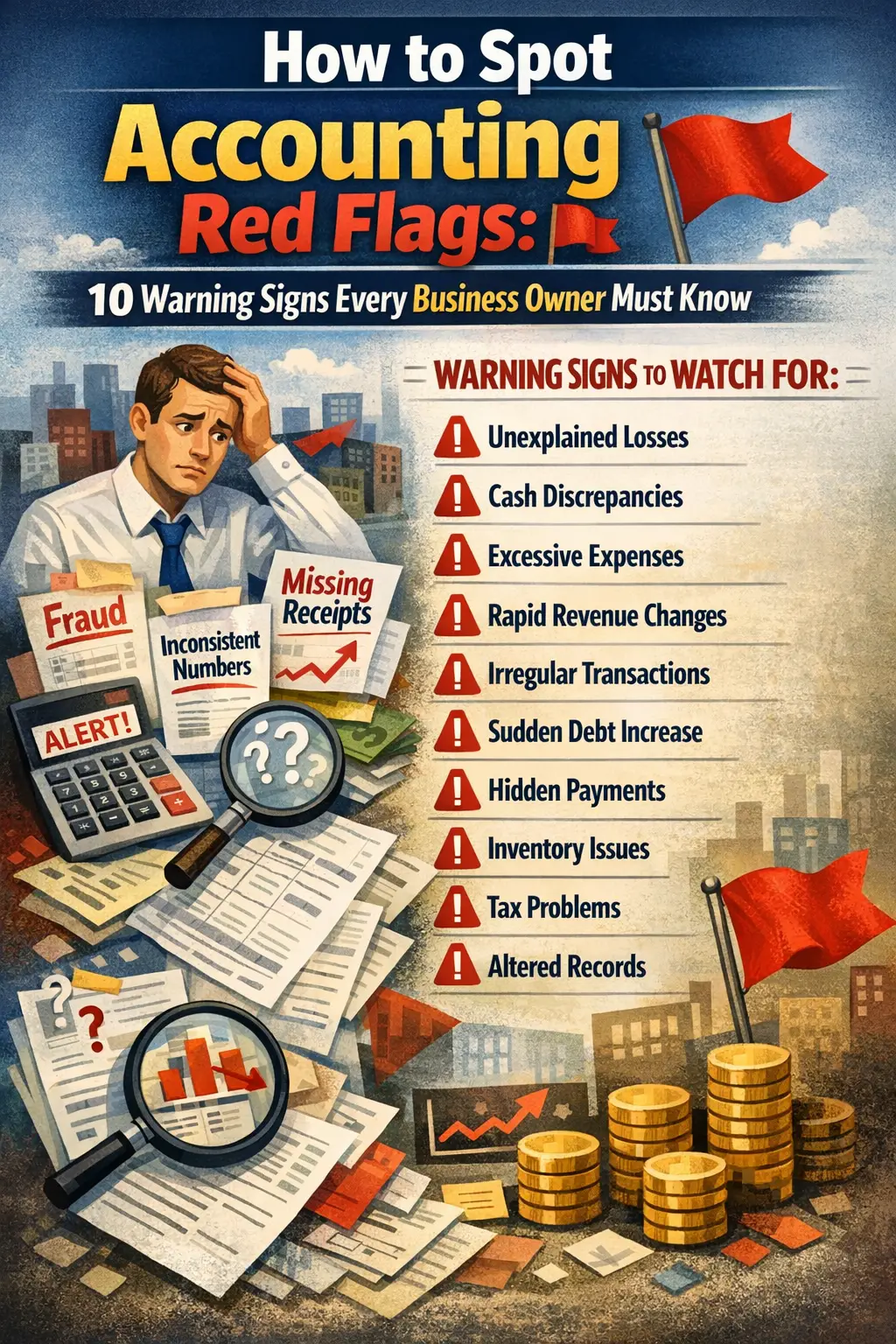
Accounting red flags include revenue growing without matching cash flow, bloated accounts receivable, unexplained inventory, round-number transactions, and suspiciously smooth earnings. The remaining five warning signs every business owner must know are frequent auditor changes, off-balance-sheet entities, concentrated financial authority, vague expense categories, and a narrative that contradicts the numbers.
If your business is bleeding money through accounting fraud, financial statement manipulation, or sneaky bookkeeping red flags that your accountant hopes you’re too busy to notice, this article is the intervention you didn’t know you needed. Pull up a chair. Let’s talk about the ten accounting red flags that every business owner must know — because ignorance isn’t bliss in business. Ignorance is bankruptcy proceedings, HMRC investigations, and calling your solicitor at 11 PM on a Sunday. And nobody wants that call, trust me.
I’m a trader. I’ve sat across tables from companies whose books looked cleaner than my grandmother’s kitchen — until they didn’t. I’ve watched CFOs sweat through expensive suits when the numbers stopped adding up. I’ve seen businesses with gorgeous revenue figures and absolutely zero cash in the bank, looking at me like I’m the problem for asking where the money went.
I’m not here to make you paranoid. I’m here to make you sharp. Because the research is clear: according to the Association of Certified Fraud Examiners (ACFE) 2024 Report to the Nations, organisations lose an estimated 5% of their revenues to fraud every year. For a business turning over £500,000, that’s £25,000 walking out the door every single year. That’s a holiday. That’s a new hire. That’s your peace of mind.
So let’s get into it. Ten red flags. No jargon. Plenty of jokes. All the tea.
Red Flag #1: Revenue Is Growing, But Cash Flow Isn’t Following
Let’s start with the one that catches even experienced investors off guard. Imagine your income statement is glowing — revenue up 30%, gross profit looking healthy, everyone’s smiling at the board meeting. But then you check the cash flow statement and it looks like it’s been on a juice cleanse for six months. Dry. Skeletal. Concerning.
“But the revenue is real!” I hear you. And I believe you believe that. But here’s the thing — revenue and cash are not the same animal. Revenue is when you make a sale. Cash is when you actually get paid. And businesses can manipulate revenue recognition to look profitable while the actual cash situation is, shall we say, crying in a corner.
💬 The Joke: Revenue without cash flow is like someone saying they’re rich because they’ve got a lot of Instagram followers. Congratulations — you can’t pay your suppliers with engagement metrics.
This discrepancy is a classic indicator of earnings manipulation. The landmark academic work underpinning much of modern fraud detection — Beneish (1999) in the Financial Analysts Journal — identified the Days’ Sales Receivable Index (DSRI) as one of the most powerful red flags. When receivables grow faster than revenue, it suggests sales are being recorded before they’re actually collectible — or being recorded at all. Beneish’s M-Score model, which uses eight financial ratios to detect earnings manipulation, remains one of the most cited tools in forensic accounting today.
The Dechow F-Score model (2011), published in the Journal of Accounting Research, extended this work by examining 28 variables across five information types — accrual quality, financial performance, non-financial measures, off-balance-sheet activities, and market-based measures — to predict fraudulent reporting. Both tools flag exactly this scenario: sales growing faster than cash collections is a screaming alarm bell.
What to do: Compare your revenue growth rate to your cash from operating activities over at least three years. If they keep diverging like two people who’ve decided they’re better off as friends, something is wrong.
Red Flag #2: Exploding Accounts Receivable
Accounts receivable is money owed to your business. A small amount aging gracefully? Normal. A massive pile of invoices from six to twelve months ago that somehow never gets collected? That’s a red flag waving so hard it’s going to pull a muscle.
💬 The Joke: If your accounts receivable is older than most of the relationships in your office, we have a problem. Nobody’s going to collect that money the same way nobody’s going back to their ex. It felt real at the time.
Bloated, ageing receivables can indicate several very unpleasant things. First, fictitious sales — revenue recognised for deals that never existed or were never legitimately completed. Second, channel stuffing — forcing product onto distributors under informal agreements that it can be returned, recording the ‘sale’ anyway. Third, simply very poor collections — which isn’t fraud, but is a serious cash flow and operational problem.
Case Study: Luckin Coffee (2020) — The Chinese coffeehouse chain, which grew explosively and even listed on NASDAQ, was found to have fabricated over $300 million in sales transactions. Revenue was recorded that never materialised in cash form, receivables piled up on the books, and the whole edifice collapsed when the investigation caught up with reality. The CEO and COO resigned, the company was delisted, and the SEC launched multiple investigations. As detailed by the CPA Journal’s analysis of financial fraud in the digital age (2024), this case exemplifies how revenue inflation through unearned receivables can hollow out a business that looks healthy on paper.
Action step: Run an aged debtor analysis every single month. Any invoice over 90 days should have a very specific, documented explanation. “We’re chasing it” is not a plan. “We’re chasing it and here is the written communication trail and the expected resolution date” is a plan.
Red Flag #3: Inventory That Nobody Can Explain
I love inventory red flags because they combine comedy and tragedy in equal measure. Picture this: you’re walking through a warehouse with the operations manager, and you ask about a particular line item — let’s say £400,000 worth of a specific product sitting on the books. And the operations manager looks at you like you’ve asked them to recite the periodic table in reverse order. In Mandarin.
💬 The Joke: If nobody in the company can tell you where the inventory is, what it’s worth, or when it last moved — it’s either been stolen, it doesn’t exist, or it’s so old it’s legally antique. None of these are great for your balance sheet.
Inventory manipulation is one of the oldest tricks in the book. You can overstate inventory to inflate assets and reduce cost of goods sold, making gross margin look better than it is. You can misclassify items. You can fail to write down obsolete stock. According to the review published in Lokanan and Sharma’s systematic analysis of two decades of accounting fraud research (2023), asset misappropriation — which frequently involves inventory — remains the most common form of fraud, occurring in over 86% of fraud cases studied, though it tends to produce lower individual losses than financial statement fraud.
Case Study: Toshiba (2015) — Over a seven-year period, Toshiba systematically overstated profits by approximately £1.2 billion. A significant element involved the misrepresentation of costs and inventory values across multiple business divisions. Senior leadership applied pressure to meet earnings targets, creating a culture in which manipulated inventory accounting became normalised. The Beneish M-Score and Altman Z-Score analysis of Toshiba by Bhavani and Amponsah (2017) demonstrated that both models flagged manipulative behaviour in the company’s accounts for multiple years before public disclosure — the warning signs were there, hiding in plain sight.
What to do: Physical inventory counts should happen regularly and be conducted by someone who doesn’t report to the person responsible for inventory accounting. Separation of duties is not optional — it is the difference between catching a problem and funding someone’s second property.
Red Flag #4: Round-Number Transactions Everywhere
This one is about Benford’s Law — a fascinating mathematical principle that states the leading digits of naturally occurring numbers follow a predictable distribution. The number 1 appears as the leading digit about 30% of the time; 9 appears only about 5% of the time. Real financial transactions tend to follow this pattern naturally.
Fraudulent transactions? They often don’t. When people fabricate numbers, they tend to pick round figures — £5,000, £10,000, £25,000 — because round numbers feel authoritative. Or they stay just under approval thresholds — £4,995 when the approval limit is £5,000 — which is a technique called structuring and it’s a red flag the size of a football pitch.
💬 The Joke: If your expense report is full of £500, £1,000, and £2,500 entries, one of two things is happening. Either your team is extraordinarily good at spending exact amounts — which has literally never happened in the history of business — or someone is making up numbers and doing the absolute minimum to seem believable. Spoiler: it’s the second one.
The academic underpinning here is robust. The systematic literature review on fraud detection published in Management Review Quarterly (2025) confirms that Benford’s Law analysis remains one of the most practically deployable tools for detecting irregularities in large transaction datasets, particularly in expense claims, accounts payable, and vendor payments. Auditors apply it to tens of thousands of transactions simultaneously, which is why good forensic accountants can find problems that basic reviewing misses entirely.
Action step: Run a Benford’s Law analysis on your expense claims, vendor payments, and petty cash transactions annually. There are free Excel templates available. If the numbers diverge significantly from the expected distribution, flag it immediately for further investigation.
Red Flag #5: Consistently Meeting — But Never Beating — Earnings Targets
If your business consistently meets its earnings targets within a very tight range — say, always exactly 2-3% above the forecast — and never meaningfully beats or misses them, that should make you curious. Not congratulatory. Curious.
Real businesses are messy. Markets shift. Customers are unpredictable. Costs spike. Windfalls happen. A company that constantly threads the needle with surgical precision is either extraordinarily well-managed — which is rare — or managing its reported earnings to hit a target — which is less rare than we’d like.
💬 The Joke: If your business hits its targets with the consistency of a sniper and the predictability of a Swiss train, people should be suspicious. Nature doesn’t work like that. Business definitely doesn’t work like that. And if it does, someone is pulling levers you haven’t been introduced to yet.
This phenomenon — known as earnings management — sits on a spectrum from aggressive-but-legal accounting choices to outright fraud. Dechow et al.’s (2011) seminal research demonstrated that firms subject to SEC enforcement actions for earnings manipulation showed patterns of suspiciously smooth earnings in the periods preceding discovery. The F-Score model they developed specifically targets accruals-based manipulation — discretionary adjustments that smooth earnings without necessarily involving outright falsification.
For business owners, the lesson is clear: scrutinise the assumptions behind your forecasts and your reported actuals equally. Ask how estimates for items like warranty provisions, bad debt allowances, and depreciation were arrived at. If the answer is “to hit budget,” that’s a conversation that needs to happen right now.
Red Flag #6: Frequent and Unexplained Auditor Changes
Changing your auditors is a normal thing that businesses do. Auditors have relationships with companies that can become too cosy over time, fresh perspectives are valuable, and sometimes firms grow out of their original audit relationship. All perfectly reasonable.
What is not reasonable is changing auditors every two or three years, particularly when the changes are unexplained, happen shortly before or after contentious audit findings, or coincide with changes in financial performance. The technical term for this is ‘auditor shopping’ — finding someone who’ll sign off on what you want signed off on.
💬 The Joke: Changing your auditor more often than you change your car is suspicious. Changing your auditor more often than you change your socks is a federal investigation waiting to happen. Probably just me, but I’d want to know why.
The research published in the Journal of Accounting Literature review on auditor-enforcer interplay (Emerald Publishing, 2025) demonstrates that poor governance mechanisms — including compromised audit committee independence and irregular auditor relationships — are among the most reliable predictors of subsequent fraud discovery. Farber’s (2005) analysis found that compared to control samples, fraud firms consistently exhibited weaker governance in the period preceding discovery.
Case Study: Wirecard AG (2020) — The German payments company had a complex audit relationship with EY for years while allegedly hiding a €1.9 billion hole in its balance sheet. The auditors repeatedly flagged concerns, but the company’s explanations were accepted. When the fraud finally unravelled in 2020, the company filed for insolvency within weeks. As documented in the CPA Journal’s digital-age fraud analysis (2024), Wirecard’s collapse represents one of the largest accounting scandals in European history and a masterclass in how inadequate external scrutiny enables fraud to persist for years.
Action step: Any auditor change should be formally documented with clear, business-driven reasons. The incoming auditor should always communicate directly with the outgoing firm. And if your auditor is raising concerns — listen. That’s what they’re there for, not just to stamp the accounts.
Red Flag #7: Off-Balance-Sheet Activities and Mystery SPVs
We need to talk about Enron. I know, I know — it’s the accounting fraud example that has been done to death. But it keeps coming up because the lesson still hasn’t been fully learned.
Enron used special purpose vehicles (SPVs) — off-balance-sheet entities — to hide billions in debt. The company looked incredibly profitable and asset-rich on its main financial statements because the liabilities had been quietly parked somewhere else. When reality caught up with the balance sheet, one of America’s largest companies collapsed in the space of weeks.
💬 The Joke: Off-balance-sheet entities are the financial equivalent of hiding your mess in a cupboard before guests arrive. Sure, the living room looks great. But open that cupboard door and an avalanche of embarrassing stuff comes tumbling out. And the guests? They’re called auditors.
The phenomenon of off-balance-sheet abuse is extensively documented. The two-decade review of financial statement fraud detection in the Journal of Financial Crime (Emerald, 2023) traces the lineage of research from the post-Enron Sarbanes-Oxley reforms through to present day, noting that while regulatory improvements have reduced some forms of off-balance-sheet abuse, new forms consistently emerge — particularly through lease arrangements, variable interest entities, and synthetic securitisation structures.
For business owners reviewing financials or due diligence on a potential acquisition, always ask: are there any related party entities, joint ventures, or structured arrangements that affect the company’s liabilities or obligations? If the answer is complex or evasive, keep digging. If there are entities you’ve never heard of that share an address or director with the company, ask exactly what they do and why they exist.
Action step: Related party transactions should be disclosed clearly and at arm’s length. If a supplier, customer, or landlord shares a director or owner with your business or a business you’re evaluating, it needs to be disclosed and independently verified that the terms are commercially reasonable.
Red Flag #8: The CFO or Bookkeeper Has Unusual Authority and No Oversight
Here’s a scenario that plays out in small and medium businesses with depressing regularity. A trusted, long-serving financial controller or bookkeeper has, over time, accumulated enormous authority. They process payments. They approve invoices. They do the bank reconciliation. They prepare the management accounts. And the business owner trusts them completely because they’ve been there for fifteen years and they always bring homemade biscuits to the Monday meeting.
💬 The Joke: Look, I’m not saying your bookkeeper is stealing from you just because they’re the only person who knows the bank passwords AND approves their own expense claims AND does the reconciliation AND hasn’t taken a holiday in three years. I’m just saying that’s exactly what someone who’s been stealing from you for three years looks like. And the homemade biscuits are probably guilt biscuits.
Separation of duties is a foundational internal control principle precisely because concentration of financial authority in one person — regardless of how trustworthy they seem — creates an environment where fraud can occur and remain undetected. The person who approves payments should not be the same person who reconciles the bank account. The person who processes expenses should not approve their own claims.
According to the ACFE’s longitudinal research, cited in the financial statements fraud identifiers study published in Economic Research (Taylor & Francis, 2023), the smallest organisations suffer the highest median losses from fraud precisely because they lack the headcount to implement proper segregation of duties. A business with five employees genuinely cannot separate every function — but the business owner themselves must be involved in financial review processes. Not delegating them. Actively reviewing them.
Action step: At minimum, the business owner or a non-finance director should independently review bank statements every month. Not the reconciliation — the actual bank statement. Look at the payments. If something’s unfamiliar, ask about it. This simple step catches more fraud than any sophisticated system.
Red Flag #9: Expenses Categorised Inconsistently or Vaguely
Pull up your management accounts and look at the expense categories. Now ask: does each category actually make sense? Are there items described simply as ‘sundry,’ ‘miscellaneous,’ or ‘general overheads’ that represent significant sums? Are similar expenditures categorised differently from month to month?
Vague or inconsistent expense categorisation is a red flag for two reasons. First, it makes it easy to hide personal expenses in business accounts — ‘entertainment’ and ‘marketing’ are particularly popular because they’re inherently variable and difficult to scrutinise. Second, it suggests either poor financial management or, more concerningly, deliberate obscuring of where money is going.
💬 The Joke: If your expense categories include ‘general stuff,’ ‘the thing from last month,’ and ‘you know, business things,’ your accountant needs a spreadsheet and possibly therapy. Vague categories exist for two reasons: laziness and mischief. Neither is acceptable.
The data mining-based financial fraud detection review by Gupta and Mehta (2024) highlights how clustering algorithms applied to expense data can identify transactions that fall outside normal patterns for their purported category — items miscategorised intentionally to avoid scrutiny. Even without sophisticated software, a human review of any single expense category exceeding 10% of total costs, conducted quarterly, can surface problems quickly.
Case Study: Personal Expenses Hidden in Business Accounts — A 2018 HMRC investigation into a £2 million turnover construction firm found that the director had expensed over £180,000 in personal costs through the business over five years — holiday accommodation listed as ‘site accommodation,’ restaurant bills as ‘client entertainment,’ and home renovation costs as ‘equipment maintenance.’ The vague categorisation wasn’t interrogated by the bookkeeper because the director approved the categorisation. Perfect storm.
Action step: Every expense over £500 should have a clear description, business purpose, and supporting receipt. Anything vague should be queried. Annual accounts should use consistent categories — if a category changes, document why. And ‘miscellaneous’ should never exceed 2% of total expenses. Ever.
Red Flag #10: The Story and the Numbers Don’t Match
This is the big one. The meta red flag. The flag above all flags.
When you sit in a meeting and someone tells you the business is performing well, growing, winning new clients, expanding into new markets — but then you look at the actual numbers and the revenue is flat, the margins are deteriorating, and the cash is declining — that’s a problem. Not a spreadsheet problem. A truth problem.
Good financial reporting tells a consistent story. The numbers should confirm the narrative. When they don’t — when a supposedly thriving business has accounts that look like the aftermath of a hostile takeover — something is wrong with either the narrative or the numbers. And in my experience, it’s almost always the numbers.
💬 The Joke: When the CEO is on stage at the company away-day talking about record growth and the management accountant is in the back row quietly googling “what to do if you disagree with your CFO” — the CEO does not know what record growth looks like. Or the management accountant is about to have a very interesting week.
The foundational framework here is what academics call the Fraud Triangle — developed by criminologist Donald Cressey and widely applied in forensic accounting — which identifies three conditions that enable fraud: Opportunity, Pressure, and Rationalisation. When the narrative doesn’t match the numbers, it often means someone under pressure (to hit targets, to keep investors happy, to maintain personal compensation) has had the opportunity (weak controls, concentrated authority) to manipulate the reporting and rationalised it (just this once, just to bridge the gap).
The comprehensive review published in the Journal of Accounting Literature on auditors and enforcers (Emerald, 2025) notes that narrative inconsistency with financial results is one of the earliest observable indicators of management under fraudulent pressure. Governance mechanisms — specifically strong, independent audit committees with genuine financial expertise — are the most reliable structural defence against this form of misrepresentation.
Action step: Read your company’s accounts alongside your narrative reporting. Does the story you told your investors, your bank, and your board match what the numbers say? If there’s a gap, close it — either by improving performance or by improving honesty. One is harder. Both are necessary.
Bringing It All Together: The Trader’s Playbook for Accounting Red Flags
Let me be real with you for a moment — well, as real as someone who just compared your bookkeeper to a biscuit-bearing fraudster can be.
These ten red flags are not exotic, theoretical scenarios. They are things I have personally witnessed across trading floors, board rooms, due diligence processes, and M&A negotiations. They are the things that accountants, auditors, and forensic specialists have documented in hundreds of peer-reviewed papers, tracked across thousands of enforcement actions, and seen destroy businesses that should have survived.
The research consensus is clear. Lokanan and Sharma’s review of 208 studies on accounting fraud (SAGE Journals, 2023) found that fraud is simultaneously an individual and organisational phenomenon — meaning it takes both a person willing to do it and a structure that allows it to happen. You can’t control human nature. But you absolutely can control your structures, your oversight, and your vigilance.
Your 10-Point Accounting Red Flag Checklist
| # | Red Flag | Key Action |
|---|---|---|
| 1 | Revenue vs Cash Flow Divergence | Compare growth rates over 3+ years |
| 2 | Ageing Accounts Receivable | Monthly aged debtor analysis; 90-day rule |
| 3 | Unexplained Inventory | Independent physical counts regularly |
| 4 | Round-Number Transactions | Annual Benford’s Law analysis |
| 5 | Suspiciously Smooth Earnings | Apply Beneish M-Score or Dechow F-Score |
| 6 | Unexplained Auditor Changes | Document every change; ensure handover |
| 7 | Off-Balance-Sheet Entities | Disclose and verify all related party transactions |
| 8 | Concentrated Financial Authority | Separate payment and reconciliation duties |
| 9 | Vague Expense Categories | £500+ receipts required; miscellaneous < 2% |
| 10 | Narrative-Numbers Mismatch | Cross-reference reporting with actuals every quarter |
A Final Word on Why This Matters
You went into business to build something. To create value, provide jobs, serve customers, and generate wealth for yourself and your family. Every pound lost to fraud, every year of misdirected management time spent untangling manipulated accounts, every investor relationship destroyed by a scandal that good controls would have caught early — that is a direct attack on everything you built.
The ACFE’s 2024 Report to the Nations found that the median time from fraud commencement to detection is 12 months. That’s a year. In a £500,000 business losing 5% of revenue — that’s £25,000 gone before anyone even knows there’s a problem. Implement the controls, run the analyses, review the accounts yourself. Not because you distrust your people. But because good systems protect good people too, by removing the temptation and the opportunity entirely.
💬 The Trader’s Final Joke: The best time to implement accounting controls was when you started the business. The second best time is right now, before you finish reading this article and convince yourself it’ll never happen to you. It happened to Enron. It happened to Wirecard. It happened to that construction firm I told you about. Spoiler: they all thought it wouldn’t happen to them either.
Stay sharp. Review the numbers. Ask the uncomfortable questions. And if the answers you get feel like a toddler explaining why there’s crayon on the wall — trust your instincts.
Now go check your bank statement. I’ll wait.
Frequently Asked Questions
1. What is the most common accounting red flag in small businesses?
Concentrated financial authority — where one person controls payments, reconciliation, and approvals — is the most prevalent and dangerous red flag in small businesses.
2. What is the Beneish M-Score and how does it detect fraud?
The Beneish M-Score is an eight-ratio financial model that identifies earnings manipulation by flagging anomalies like receivables growing faster than revenue.
3. How does Benford’s Law help detect accounting fraud?
Benford’s Law identifies fabricated transactions by comparing the leading-digit distribution of a company’s numbers against the mathematically expected natural pattern.
4. Why is revenue growing without matching cash flow a red flag?
It suggests revenue is being recognised before cash is actually collected — or that fictional sales are inflating the income statement while real cash remains absent.
5. How often should business owners review their bank statements?
Business owners should personally review actual bank statements — not just reconciliations — every single month to catch unfamiliar or unauthorised payments early.
6. Is changing auditors always a warning sign?
Frequent, unexplained auditor changes — especially those following contentious findings or coinciding with performance shifts — indicate potential “auditor shopping” for a more compliant sign-off.
7. What is channel stuffing and why does it matter?
Channel stuffing is the practice of forcing excess product onto distributors under informal return agreements while recording those shipments as legitimate completed sales.
8. What is the Fraud Triangle?
The Fraud Triangle, developed by criminologist Donald Cressey, identifies the three conditions that enable fraud: opportunity, financial or professional pressure, and personal rationalisation.
9. How much do businesses typically lose to fraud each year?
According to the ACFE’s 2024 Report to the Nations, organisations lose an estimated 5% of annual revenues to fraud, with a median detection lag of 12 months.
10. What should trigger immediate concern about expense categorisation?
Any significant sums described vaguely as “miscellaneous” or “sundry,” or expenses categorised inconsistently month to month, warrant immediate scrutiny and documentation requests.
References
- Beneish, M.D. (1999). The Detection of Earnings Manipulation. Financial Analysts Journal, 55(5), 24–36.
- Dechow, P., Ge, W., Larson, C., & Sloan, R. (2011). Predicting Material Accounting Misstatements. Contemporary Accounting Research, 28(1), 17–82.
- Lokanan, M.E., & Sharma, P. (2023). Two Decades of Accounting Fraud Research: The Missing Meso-Level Analysis. SAGE Open, 13(3).
- Gupta, S., & Mehta, S.K. (2024). Data Mining-Based Financial Statement Fraud Detection. Management Studies (SAGE).
- Kasztelnik, K. (2024). Financial Statement Fraud Detection in the Digital Age. The CPA Journal.
- Bilic, I., et al. (2023). Financial Statements Fraud Identifiers. Economic Research — Ekonomska Istrazivanja, Taylor & Francis.
- Knechel, W.R., et al. (2025). The Roles and Interplay of Enforcers and Auditors in Accounting Fraud. Journal of Accounting Literature, Emerald.
- Hosseini, S.A., et al. (2023). Two Decades of Financial Statement Fraud Detection: Bibliometric Analysis. Journal of Financial Crime, Emerald.
- Raza, A., et al. (2025). How to Detect Fraud in an Audit: A Systematic Review. Management Review Quarterly, Springer.
- Association of Certified Fraud Examiners (ACFE). (2024). Report to the Nations: Global Study on Occupational Fraud and Abuse.
- Bhavani, G., & Amponsah, C. (2017). M-Score and Z-Score for Detection of Accounting Fraud. Cited in GAP GYAN Financial Statement Fraud Detection Models.
- Azeez, Z.F. (2025). The Role of Financial Statement Analysis in Detecting Corporate Fraud and Earnings Manipulation. IRE Journals, 8(11), 831–844.
Disclaimer: This article was written for educational and informational purposes. It does not constitute financial, legal, or accounting advice. Business owners should consult qualified professionals for specific guidance relevant to their situation.
Leave a Reply
You must be logged in to post a comment.