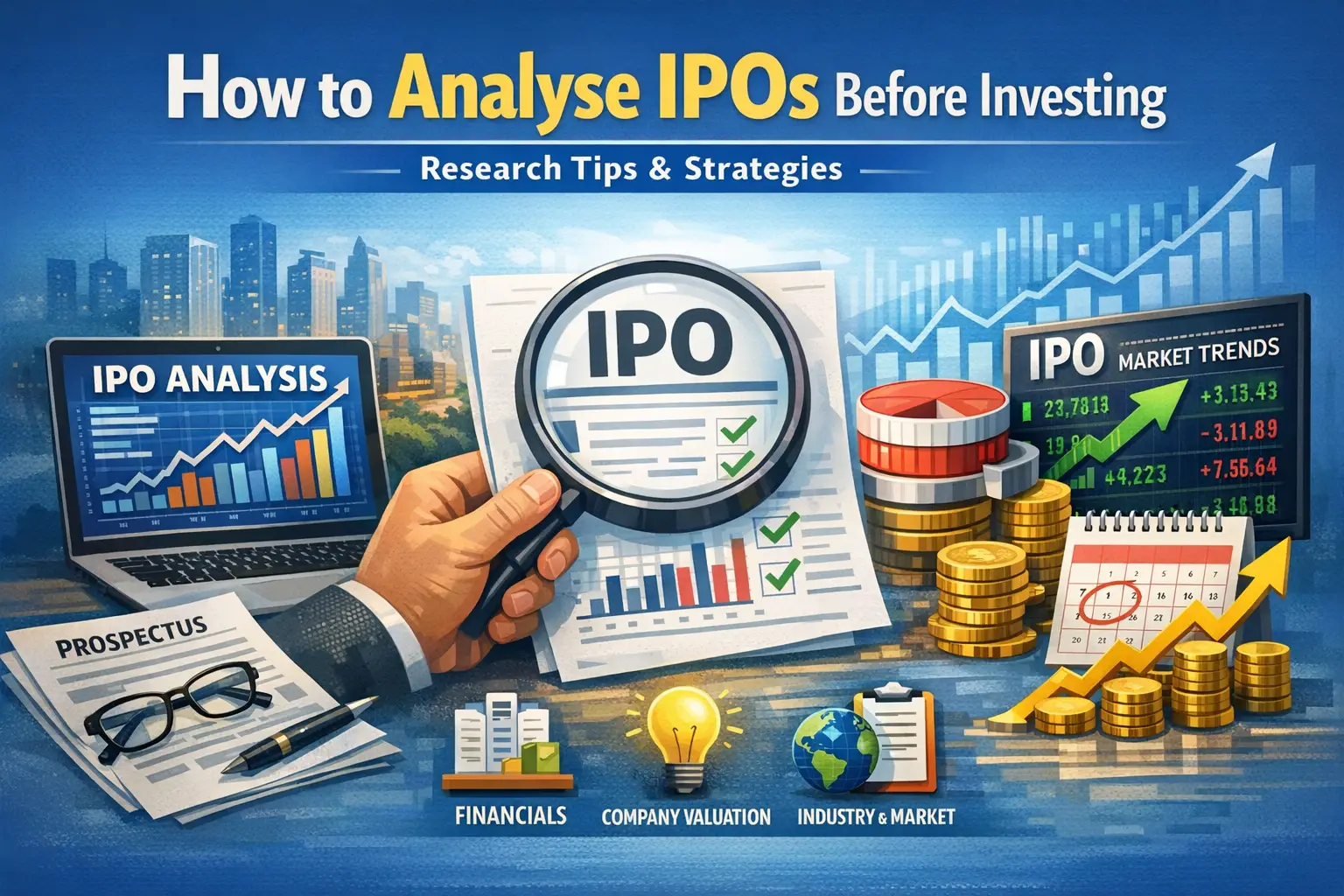
Analysing IPOs before investing requires a disciplined, research-backed framework covering valuation, prospectus scrutiny, competitive moats, and psychological bias — not excitement alone. This guide walks you through every stage of that process, with real academic research and case studies from Airbnb, WeWork, and Deliveroo.
Analysing IPOs before investing is the single most important skill a retail investor can develop — and yet nine out of ten people who throw money at a hot initial public offering do so with the same research strategy as a toddler picking lottery numbers: excitement, a vague feeling of destiny, and absolutely zero due diligence.
Let me be real with you. The day a company announces an IPO, the hype machine kicks into overdrive. The bankers are smiling. The founders are on TV in their best hoodies. The financial press is saying things like ‘generational opportunity’ and ‘the next Amazon.’ And somewhere in a flat in Leeds, a retail investor is refreshing their brokerage app like it owes them money.
I have been that person. I sat there in my dressing gown — no, not a nice silk one, a fluffy old thing that had seen better days — staring at a blinking ‘BUY’ button thinking: ‘This is it. This is my moment.’ I pressed it. Three months later, the stock was down forty-two percent, and I was staring at my portfolio like, ‘Why did I do that to myself? WHY?’
So this article is my gift to you. A real, research-backed, academically grounded, occasionally hilarious guide to how to properly analyse IPOs before investing. We are talking valuation methods, underwriter reputation, lock-up periods, S-1 filings, competitive moats, case studies, red flags, and everything in between.
We will use actual peer-reviewed academic research — because your money deserves better than a Reddit thread — and we will walk through real-world case studies of IPOs that soared and IPOs that crashed so hard they left a crater. By the end, you will have a repeatable analytical framework. You are welcome.
1. What Is an IPO and Why Does Everyone Lose Their Mind About It?
An Initial Public Offering — IPO — is the process by which a private company sells shares to the public for the first time, listing on a stock exchange. It is how companies like Google, Facebook, and Alibaba went from private enterprises to publicly traded behemoths. It is also how a lot of investors lost a lot of money buying into the hype.
Here is the basic mechanism: a company decides it wants to raise capital — or its early investors want to cash out (politely known as ‘liquidity events’ and impolitely known as ‘the founders are running for the exits’). They hire investment banks, known as underwriters, to help price and sell the shares. The underwriters do a roadshow — where executives travel around pitching to institutional investors — and then a final price is set. That price is the IPO price.
Then the stock starts trading. And that is where things get interesting. Or terrifying. Depending on which side of the trade you are on.
The academic literature on IPOs is vast and absolutely wild. Ritter and Welch’s landmark 2002 review in the Journal of Finance documented three systematic anomalies in IPO markets: underpricing on the first day of trading, hot issue markets where IPO volume spikes, and long-run underperformance over the three to five years following listing. Think about that last one. The average IPO underperforms the broader market over the long run. That is not me being negative. That is peer-reviewed finance saying: slow down, friend.
Underpricing is particularly fascinating. Beatty and Ritter’s foundational 1986 paper in the Journal of Financial Economics established that IPOs are systematically priced below their true market value on the first trading day. The average first-day return in U.S. IPOs historically runs between 10 and 20 percent. Sounds great if you got the IPO allocation. But here is the kicker: most retail investors cannot get IPO allocations at the offer price. They buy at the open, which is already elevated, and then they wonder why returns disappoint.
I want you to read that paragraph again and let it fully land. The party started without you. You showed up late and bought the inflated balloons.
2. Reading the Prospectus: The S-1 Filing Is Your Best Friend (Seriously, Read It)
Before an IPO in the United States, the company must file an S-1 registration statement with the Securities and Exchange Commission. In the UK, this is equivalent to the IPO prospectus filed with the Financial Conduct Authority. This document is the closest thing to X-rays you will get of the company’s financial skeleton. And some of those skeletons have a suspicious number of extra bones.
What to Look For in the Prospectus
The prospectus contains the company’s audited financial statements, a description of the business model, risk factors, information on how the proceeds will be used, and details about management and major shareholders. Here is what to focus on:
Revenue Growth and Gross Margin: Is revenue growing? At what rate? What is the gross margin — the percentage of revenue left after direct costs? A software company should have gross margins above 60 percent. A logistics company might have margins of 20 percent. Know the benchmarks for the industry.
The Risk Factors Section: Most people skip this. Most people are wrong. The risk factors section is where companies are legally required to disclose everything that could go badly wrong. A company that lists ‘we have never been profitable and may never be profitable’ as a risk factor is telling you something important. It is basically the corporate version of texting back ‘I’m fine’ when clearly not fine.
Use of Proceeds: Where is the money going? If 80 percent of IPO proceeds are going to pay off existing debt rather than fund growth, that is a red flag waving at you from the other side of the room.
Related-Party Transactions: Is the CEO’s nephew the company’s main supplier? Are there sweetheart deals with entities connected to the founders? These disclosures, buried in the notes to the accounts, can reveal conflicts of interest that explain a lot about how the company is managed.
Insider Selling: Are the founders and early investors selling significant amounts of stock in the IPO? Some selling is normal — they are entitled to liquidity — but if the founder is selling 80 percent of their stake while telling the public it is a great investment, you have to ask yourself why they are so eager to hand those shares to strangers.
Loughran and Ritter’s 2004 paper in Financial Management on why IPO underpricing has changed over time is enlightening here. They found that in the dot-com era, issuers became less upset about leaving money on the table because analysts at underwriting banks were implicitly compensating them through favourable research coverage. The entire system had incentives baked in that did not serve retail investors. That has changed somewhat with regulatory reforms, but the principle stands: understand whose interests are aligned with yours, and whose are not.
3. Valuation Methods: How Do You Know If the Price Is Fair?
This is where people’s eyes glaze over. Please stay with me, because this is genuinely where the money is made or lost. The single biggest mistake retail IPO investors make is ignoring valuation entirely and just vibing with the hype. Do not vibe with the hype. Analyse the hype.
Price-to-Earnings (P/E) Ratio
The P/E ratio compares the share price to earnings per share. If a company earns £1 per share and trades at £20, the P/E is 20. The question is whether that is cheap or expensive for its industry. A fast-growing tech company might justifiably trade at a P/E of 50. A mature utility company trading at a P/E of 50 is either revolutionary or ludicrously overpriced — and spoiler: it is usually the latter.
The problem with many IPOs is that they have no earnings at all. Loss-making companies cannot be valued on a P/E basis. Which is how we ended up in the bizarre situation of analysts putting billion-dollar valuations on companies whose primary achievement was spending money faster than they made it.
Price-to-Sales (P/S) Ratio
For pre-profit companies, the price-to-sales ratio — share price divided by revenue per share — is widely used. A P/S of 10 means investors are paying £10 for every £1 of annual revenue. In high-growth software, a P/S of 10 to 20 might be reasonable if growth is exceptional. A P/S of 50 for a slow-growing business is basically a prayer dressed up as analysis.
Discounted Cash Flow (DCF) Analysis
DCF analysis projects future cash flows and discounts them back to present value using a required rate of return. It is the most theoretically rigorous valuation method. It is also an exercise in making assumptions, and as any trader will tell you, making assumptions is a lot like making plans — the market has a wonderful way of laughing at both.
That said, DCF forces discipline. You have to specify your revenue growth assumptions, your margin assumptions, and your terminal growth rate. When you plug in realistic numbers rather than the founders’ PowerPoint fantasies, the resulting valuation is often significantly lower than the IPO price.
Comparable Company Analysis
Comps analysis — comparing the IPO company to publicly traded peers — is the most common method used by bankers. Find companies with similar business models, growth rates, and margins, and see what multiples the market assigns them. If the IPO is priced at a significant premium to its peers with no obvious justification, be very careful.
Campbell, Rhee, Du, and Tang’s 2008 working paper available via SSRN on market sentiment, IPO underpricing, and valuation found no evidence of systematic over- or undervaluation of IPOs based on peer firm accounting ratios. However, they found that underpricing is significantly higher for overvalued IPOs, and that better underwriter reputation leads to higher IPO valuations. Translation: the bank’s name on the deal matters, and the hype cycle can disconnect prices from fundamentals in both directions.
4. The Underwriter and the Roadshow: Follow the Reputation
Not all underwriters are equal. Goldman Sachs, Morgan Stanley, JPMorgan — these are the bulge-bracket banks whose imprimatur carries weight. When a top-tier bank underwrites an IPO, it signals (though does not guarantee) quality. When a company goes public with an unknown regional bank and three firms you have never heard of, ask why the big names passed.
Benveniste and Spindt’s pivotal 1989 paper in the Journal of Financial Economics established the book-building theory of IPO pricing: underwriters use the roadshow process to extract private information from institutional investors about the true value of the deal. Institutions that reveal positive information are rewarded with allocations at the offer price. This process is meant to improve price discovery. In practice, it also means the deck is somewhat stacked in favour of the institutions who participate in book-building, not the retail investors who buy on day one.
During the roadshow, management presents the company’s business plan to institutional investors. The tone, conviction, and quality of answers to tough questions matter enormously. A management team that cannot clearly explain its path to profitability in a room full of professional sceptics is going to have a rough time meeting guidance.
I once watched a CEO give a roadshow presentation where he described the company’s competitive advantage as ‘vibes.’ I am only slightly exaggerating. The stock was down 60 percent within eighteen months. Vibes are not a moat. Vibes are a candle in the wind. Actually, no — vibes are a wet match.
5. Lock-Up Periods: The Countdown Clock You Cannot Ignore
A lock-up period is a contractual restriction that prevents company insiders — founders, early employees, venture capital investors — from selling their shares for a specified period after the IPO. In most cases, this is 90 to 180 days.
Why does this matter? Because when the lock-up expires, a flood of insider shares can hit the market, putting significant downward pressure on the stock price. This is one of the most reliably negative technical events in IPO investing, and yet retail investors frequently forget about it entirely.
The dynamic is painfully predictable. Company goes public. Stock pops on day one. Three months later, lock-up expires. Every venture capitalist and early employee who has been watching their paper gains is now legally allowed to sell. And they do. With great enthusiasm. Because they have been waiting for this moment for years, and they are not sentimental about their spreadsheets.
Always note the lock-up expiry date before you invest. Always check what percentage of total shares outstanding will be unlocked. If 70 percent of the float is held by insiders whose lock-up expires in 90 days, that is a significant overhang. Factor it into your timing.
The Rossovski 2025 paper in the British Journal of Management on determinants of IPO overpricing noted that 21.61 percent of U.S. IPOs between 2000 and 2020 exhibited negative first-day returns. Among the factors contributing to overpricing — and subsequent investor losses — was the relationship between insider ownership structure and pricing inefficiency. Understanding who owns the stock and when they can sell it is fundamental analysis, not trivia.
6. Competitive Positioning and the Moat
Warren Buffett famously talks about economic moats — sustainable competitive advantages that protect a business from competition. When evaluating an IPO, the question is simple: why will this company still be winning in five or ten years?
Common types of moats include network effects (the product becomes more valuable as more people use it), switching costs (it is painful and expensive for customers to leave), cost advantages (the company produces at a lower cost than competitors), and intangible assets (patents, brands, regulatory licences).
Many IPOs, particularly in technology, claim network effects as their primary moat. And many of those claims are, to use a technical financial term, optimistic. A dating app has network effects. A project management tool has some switching costs. A company that sells artisanal hot sauce online has… enthusiasm. Enthusiasm is not a moat.
Ask yourself honestly: if a well-funded competitor entered this market tomorrow, how long would it take them to replicate what this company does? If the answer is ‘eighteen months and a decent engineering team,’ the moat is a puddle.
Market Size and Addressable Market
The prospectus will invariably contain a section projecting the company’s ‘total addressable market’ (TAM). These numbers are almost comically large. ‘The global market for cloud-enabled artisanal condiment logistics is estimated at $47 billion by 2030.’ Right. Every company seems to be in a $47 billion market.
The relevant question is not the total addressable market. It is the serviceable addressable market — the portion the company can realistically reach — and the serviceable obtainable market — the portion it can realistically win. A company addressing 0.01 percent of a $47 billion market is in a $4.7 million business, and that is not a heroic story.
7. Management Quality: Betting on People
Ultimately, you are not just buying a business — you are buying a management team’s ability to execute. A mediocre business with brilliant management can surprise you. A brilliant business with mediocre management will disappoint you.
Look at the management team’s track record. Has the CEO run a public company before? Have they navigated a downturn? Have they managed through rapid growth without destroying the culture or the balance sheet? Have any of them previously been associated with companies that blew up spectacularly? These things are in the public domain. Look them up.
Board composition matters too. Is the board genuinely independent, or is it stacked with the founder’s university friends and the lead investor’s associates? Genuine independent directors who will ask hard questions and hold management accountable are a governance signal. A board that is there to validate rather than scrutinise is a governance risk.
The corporate governance literature is clear on this. Armstrong, Core, and Guay’s work cited in the Journal of Financial Economics found that independent directors are associated with improved firm transparency. Transparency is particularly valuable at the IPO stage, when information asymmetry between insiders and external investors is at its highest.
Also: does the CEO have a history of promising the moon and delivering a medium-sized rock? Check their earnings call transcripts from previous companies. Check how guidance compared to actual results. Some executives are serial optimists. That is fine in life. It is less fine when your money is on the line.
8. The Market Environment: Timing Is Not Everything, But It Is a Lot
IPO markets are cyclical. They cluster in periods of market optimism — the so-called ‘hot markets’ — and dry up during downturns. Lowry’s 2003 paper in the Journal of Financial Economics documented that IPO volume fluctuates dramatically over time and is positively correlated with recent market returns and economic expansion.
The implication for investors is straightforward: be more sceptical during hot markets. When everyone is going public and everyone is excited and the newspaper headlines are declaring the dawn of a new era, that is precisely the moment to slow down and ask hard questions. The best time to analyse an IPO is when the market is cold and only the genuinely confident companies are pushing through the process.
Interest rates matter enormously. In a low-rate environment, investors discount future cash flows at a lower rate, making high-growth, loss-making companies look more valuable. When rates rise, those valuations compress rapidly. The 2021-2022 IPO and SPAC bubble — followed by the brutal reset as rates climbed — was a masterclass in this dynamic. Companies that had been valued at 40 times revenue in a zero-rate world found that valuation was not sustainable when the risk-free rate moved to five percent.
Sector sentiment also matters. Technology IPOs will command premium multiples during periods of tech optimism. Healthcare IPOs will benefit from narrative momentum around a particular disease area or therapeutic modality. Understand not just where the company sits, but where investor enthusiasm currently sits in that sector. You want to be early to the enthusiasm, not late.
9. Case Study One — The Triumph: Airbnb (ABNB, December 2020)
Airbnb listed on the Nasdaq in December 2020, pricing at $68 per share. The IPO was met with extraordinary demand. Shares opened at $146 on the first day of trading — more than double the offer price — and closed at $144.71, giving the company a market capitalisation of around $86 billion.
Was this a great investment at the offer price? Absolutely, if you could get it. Was it a great investment at the open? That depends on your time horizon and entry strategy.
What made Airbnb a fundamentally sound IPO to analyse (though very expensive to value):
- Clear two-sided network effect: Every additional host makes the platform more valuable to guests, and every additional guest makes hosting more attractive. This is a genuine, well-documented network effect moat.
- Brand strength: Airbnb had become a verb. ‘I’ll just Airbnb it’ is a sentence people said without thinking. Brand recognition at that level is an intangible asset of real value.
- Path to profitability: Despite the pandemic year, the S-1 clearly showed that the underlying unit economics were sound. The business had been profitable before COVID, and the recovery thesis was coherent.
- Management credibility: Brian Chesky had navigated the company through the catastrophic revenue collapse of 2020 without destroying the business, cutting costs while preserving the brand. That was an observable data point about management quality under pressure.
The lesson from Airbnb is not ‘all IPOs are great.’ It is that when you apply rigorous analysis — moat, management, financials, market — you can distinguish between a company worth owning and one worth avoiding, regardless of the hype level.
10. Case Study Two — The Disaster: WeWork (Attempted 2019)
WeWork is one of the greatest IPO cautionary tales in financial history. In 2019, the co-working company attempted to go public at a valuation of $47 billion. The S-1 filing was… a document. A remarkable document. A document that would become required reading in finance schools for decades.
Let me walk you through the red flags that were visible to anyone who read the prospectus carefully:
- Losses accelerating, not narrowing: WeWork lost $1.9 billion in 2018 on revenue of $1.8 billion. That is a company losing more than it earns. In 2019, losses were on track to be even larger. For a real estate leasing company dressed up as a technology firm, the path to profitability was not clear.
- ‘Community-adjusted EBITDA’: The company invented a metric that excluded costs they found inconvenient. This is like me saying my net worth is higher if you ignore all my debt. The metric added back things like marketing and new opening costs — you know, the costs of actually running and growing the business.
- Related-party transactions: The S-1 disclosed that the company had paid rent to buildings owned by the founder. The founder had also trademarked the word ‘We’ personally and then charged the company $5.9 million for the right to use it. The company. He founded. That, my friend, is next-level audacity.
- Governance structure: Adam Neumann held super-voting shares that gave him near-absolute control. The board had limited ability to constrain management decisions. Red flag. Red flag. Red flag.
- Business model misclassification: WeWork consistently described itself as a technology company, justifying a premium valuation. But it was a commercial real estate sub-leasing company with a nice design aesthetic. The technology premium was entirely without basis.
Institutional investors saw through it. The IPO was withdrawn. WeWork’s valuation collapsed to under $10 billion within weeks. SoftBank, the primary backer, wrote down billions. Neumann walked away with a reported $1.7 billion exit package — because that is how founder agreements sometimes work, and no, I am not okay about it either.
The WeWork saga is proof that reading the prospectus, checking the numbers, questioning the narrative, and applying basic analytical scepticism would have saved investors enormous sums of money. The information was there. People just did not want to read it because the story was too exciting.
I always say: the more exciting the story, the harder you should look at the numbers. Because numbers do not get excited. Numbers just sit there being true.
11. Case Study Three — The Mixed Bag: Deliveroo (April 2021)
Deliveroo listed on the London Stock Exchange in April 2021, pricing at 390p per share. It was the largest UK IPO in a decade, and it fell 26 percent on its first day of trading. By any measure, this was a deeply damaging debut.
What went wrong? The red flags were visible in the S-1 equivalent:
- Worker classification risk: Deliveroo’s entire business model depended on classifying riders as independent contractors rather than employees. Multiple court cases and regulatory threats to this model had been documented. The UK Supreme Court had ruled against Uber’s similar model just weeks before the IPO. Investors who paid attention to the risk factors section saw this coming.
- Dual-class share structure: Founder Will Shu held shares with twenty times the voting rights of ordinary shares. Many large institutional investors — particularly those with ESG mandates — refused to participate on governance grounds, reducing demand.
- Path to profitability unclear: Despite years of operation and massive scale in multiple markets, the company had never turned a profit and had no credible near-term timeline for doing so.
Deliveroo has subsequently stabilised and made progress toward profitability, but investors who bought at the IPO price endured years of paper losses before recovering. The lesson: even well-known, high-profile companies with genuine brand recognition can be expensive IPO investments if the fundamental analysis is not supportive of the pricing.
12. A Practical IPO Analysis Checklist
Here is your repeatable, practical framework for analysing any IPO before you invest:
1. Read the full prospectus. Not the summary. The full document. Yes, it is long. Yes, it is boring in places. No, you cannot skip the risk factors or the related-party transactions.
2. Assess revenue growth and unit economics. Is revenue growing rapidly? Are gross margins improving over time? Is the cost to acquire a customer falling relative to the lifetime value of that customer?
3. Value the company on at least two methods. Use P/S, P/E (if applicable), and DCF with your own conservative assumptions. Compare the result to the IPO price. If the price is only justified by optimistic scenarios, price in that risk.
4. Research the underwriter. Is this a reputable institution with a track record of successful IPOs in this sector? Who else has used them? How have those companies performed post-IPO?
5. Check the lock-up period and insider ownership. When does the lock-up expire? How many shares will be released? Is there an overhang risk?
6. Identify the moat. Network effects? Switching costs? Cost advantage? Intangible assets? Be brutally honest about whether the moat is real or marketing.
7. Evaluate management. Previous roles and track records? Any governance red flags? Are insiders selling significant amounts in the IPO itself?
8. Assess market conditions. Are we in a hot market? What are interest rates doing? How is sector sentiment? Be more conservative in euphoric conditions.
9. Compare to peers. What multiples do comparable public companies trade at? Is the IPO at a premium or discount? Is the premium justified?
10. Wait and watch. You do not have to buy on day one. You do not have to buy in the first week. Watching how the stock trades in its first 30 to 90 days — how management handles the earnings call, how the business performs against IPO guidance — is entirely valid and often very smart.
13. The Psychology of IPO Investing: Your Brain Is Not Your Friend
Let us be honest about something. We have covered analysis, valuation, governance, competitive dynamics — all the intellectual stuff. But the real reason most retail investors get hurt by IPOs is not lack of knowledge. It is psychology.
The hype machine around a high-profile IPO is extraordinarily powerful. FOMO — fear of missing out — is a documented psychological force that causes investors to abandon rational valuation and chase price momentum. The social proof of everyone around you being excited about an IPO makes it harder to apply scepticism. When your group chat is blowing up with ‘are you buying??’ energy and the financial news is doing a ten-minute segment on the founder’s inspirational origin story, calm rational analysis is working against a powerful emotional current.
Anchoring bias is another trap. If you hear that an IPO was ‘priced at’ $20 and is now trading at $25, your brain anchors on the $20 and perceives $25 as cheap. But $20 was an arbitrary number set by bankers. It has no fundamental significance whatsoever. The relevant question is whether $25 represents fair value based on the company’s financial prospects. The IPO price is not a floor, a fair value reference, or anything other than what the underwriter thought institutional investors would accept.
The research on this is clear. Engelen and van Essen’s 2010 paper in the Journal of Banking and Finance found that firm-specific, issue-specific, and country-specific characteristics all contribute to IPO underpricing, and that behavioural factors among investors play a meaningful role. The irrationality is baked in at a systemic level. Your job as an investor is to swim against that current with disciplined analysis.
And look — I know it is hard. Believe me. I once sat in front of a screen watching a stock I had passed on triple in three months and questioned every life decision I had ever made. That feeling is real. But the same discipline that made me pass on that deal also made me pass on three others that fell 70 percent. The process protects you over time, even when individual outcomes sting.
14. The Long-Run Performance Reality Check
Here is something the IPO marketing brochure will absolutely not tell you: the long-run performance of IPOs is, on average, disappointing.
Loughran and Ritter’s foundational research on the ‘new issues puzzle,’ published in the Journal of Finance in 1995 documented that companies going public significantly underperform matched non-issuing companies over the five years following their IPO. The benchmark-adjusted underperformance averaged around 20 to 35 percent depending on the methodology used.
This does not mean every IPO underperforms. It means the average does. And the distribution is wide. Some IPOs generate spectacular long-run returns — Amazon, Google, Nvidia. Many more quietly decline. The challenge is identifying which side of that distribution you are looking at before you invest.
The IPO underpricing study from the Tandfonline Journal on Emerging Markets found that the average first-day underpricing across emerging markets was 30.29 percent, with China showing the highest levels. Technology sector IPOs showed the most underpricing due to valuation uncertainty — a finding consistent across multiple markets and time periods. The implication is that tech IPOs may look spectacular on day one but face the greatest valuation uncertainty, and therefore the greatest risk of long-run disappointment, especially for investors who buy after the first-day pop.
Long-term investors should ask: at this valuation, what does the company need to achieve to justify the price in five years? Model it out. Stress-test the revenue growth assumptions. Price in execution risk, competitive risk, and macro risk. If the valuation still makes sense under conservative assumptions, you have a potentially interesting long-term investment. If it only works under best-case assumptions, you are speculating, not investing. Speculation is fine, but name it honestly.
15. Alternative Entry Strategies: You Do Not Have to Buy on Day One
One of the biggest misconceptions about IPO investing is that if you do not buy at the offer price or on day one, you have missed the trade. This is categorically false and has cost retail investors enormous amounts of money.
Here are several alternative approaches that history shows can deliver better risk-adjusted returns:
Wait for the first earnings report: Within 90 days of listing, the company will report its first quarterly results as a public company. This is when management’s guidance meets reality. Companies that beat expectations on the first report and raise guidance are demonstrating execution. Those that miss and lower guidance reveal that the IPO narrative was more optimistic than the fundamentals supported. Watching the first earnings call gives you enormous information.
Wait for lock-up expiry: As discussed, lock-up expiry often creates selling pressure and a temporary dip in the stock price. If your fundamental analysis supports ownership, buying after lock-up expiry at a lower price is often a smarter entry than buying at the IPO pop.
Scale in over time: Rather than committing your full position on day one, consider an initial small position and adding as the company demonstrates execution against its stated milestones. This approach reduces the risk of being fully invested at the moment of maximum hype and maximum pricing.
Pass entirely and watch: There is no shame in watching. The market will present many opportunities. Not every IPO needs to be in your portfolio. A watched and avoided IPO that subsequently falls teaches you as much as a watched and bought one that succeeds.
Conclusion: The Framework Is the Discipline
Let us bring it all together. Analysing IPOs before investing is a disciplined, repeatable process that combines financial analysis, qualitative assessment, competitive intelligence, and psychological self-awareness. It is not exciting in the way that chasing a hot stock tip is exciting. But it is the kind of not-exciting that actually builds wealth over time.
The key principles:
Read the prospectus completely, especially the risk factors and related-party disclosures. Value the company using multiple methodologies and challenge yourself to use conservative assumptions. Understand the underwriter’s reputation and the book-building process. Know the lock-up expiry date and the insider ownership structure. Identify whether the competitive moat is real and durable. Evaluate management quality and governance through observable evidence. Account for market conditions and sector sentiment. Manage your own psychological biases — FOMO, anchoring, social proof — with the same discipline you apply to the numbers. And remember: you do not have to buy at the IPO.
The academic evidence is unambiguous: the average IPO underperforms in the long run. But averages contain extremes. The best IPOs in history have been transformative investments for those who applied rigorous analysis and invested with conviction at the right time and the right price. Your framework is what separates you from those who just bought because the hype was loud.
The market is going to keep producing IPOs. Companies will keep going public. Bankers will keep building the excitement. The financial press will keep running breathless profiles of founders with compelling origin stories. The only thing that changes is whether you show up to those opportunities with a clipboard and a sceptical eye, or with your wallet open and your analysis absent.
Bring the clipboard. Always bring the clipboard.
Frequently Asked Questions
1. What is an IPO? An IPO (Initial Public Offering) is when a private company sells shares to the public for the first time, listing on a stock exchange to raise capital or provide liquidity for early investors.
2. Why do most retail investors lose money on IPOs? Most retail investors buy at the inflated open-market price rather than the offer price, missing the first-day pop that institutional investors capture through book-building allocations.
3. What is an S-1 filing and why should I read it? An S-1 is the registration document filed with regulators before a US IPO, containing audited financials, risk factors, insider ownership details, and use of proceeds — essential reading before investing.
4. What is a lock-up period? A lock-up period is a contractual restriction, typically 90 to 180 days, preventing insiders from selling their shares after an IPO, after which increased supply can push the stock price down.
5. What valuation methods should I use when analysing an IPO? You should use at least two methods — such as price-to-sales, price-to-earnings (where applicable), discounted cash flow, and comparable company analysis — to test whether the IPO price is justified.
6. Do IPOs tend to perform well over the long run? Academic research, including Loughran and Ritter’s landmark studies, shows that the average IPO underperforms matched non-issuing companies by 20–35% over the five years following listing.
7. What is a competitive moat and why does it matter for IPO investing? A competitive moat is a durable advantage — such as network effects, switching costs, or brand strength — that protects a company from rivals and determines whether strong returns can be sustained long term.
8. What were the key red flags in WeWork’s failed 2019 IPO? WeWork’s S-1 revealed accelerating losses exceeding revenue, an invented profitability metric, founder self-dealing transactions, and a governance structure that gave insiders near-total control.
9. Do I have to buy an IPO on the first day of trading? No — waiting for the first earnings report, lock-up expiry, or a period of post-IPO price stabilisation often gives retail investors a better risk-adjusted entry point than buying on day one.
10. How do interest rates affect IPO valuations? Rising interest rates increase the discount rate applied to future cash flows, compressing the valuations of high-growth, loss-making companies — as dramatically demonstrated during the 2021–2022 IPO market crash.
References
4. Loughran, T., & Ritter, J. R. (1995). The new issues puzzle. Journal of Finance, 50(1), 23–51.
9. Rossovski, A. (2025). Determinants of IPO Overpricing. British Journal of Management.
Disclaimer: This article is for educational and informational purposes only and does not constitute financial advice. Always conduct your own due diligence and consult a qualified financial adviser before making investment decisions. Past performance of IPOs is not indicative of future results.
Leave a Reply
You must be logged in to post a comment.