
The best product market research tools for solo non-tech founders include Google Trends, AnswerThePublic, Typeform, SurveyMonkey, SimilarWeb, SparkToro, SEMrush, Statista, Think With Google, Perplexity AI, Gumroad, and Carrd — all requiring zero coding knowledge and ranging from completely free to under $50 per month. Together these tools cover every stage of research, from spotting market trends and analysing competitors to surveying real customers and validating whether anyone will actually pay for your product before you build it.
If you’re a solo non-tech founder desperately searching for the best product market research tools, congratulations — you’ve already made the smartest move most founders never make before they spend six months building something nobody asked for.
Let me set the scene. You’ve got a business idea. You’ve told your cousin about it. Your cousin said, “Oh, that’s fire.” Your cousin also once microwaved a foil-wrapped burrito, so maybe — just maybe — we need a second opinion.
This is not shade at your cousin. This is an intervention. A loving, data-driven intervention.
Market research is the difference between building a product people will actually pay for and building a beautiful app that gets downloaded by your mum, your best friend, and a bot from Eastern Europe. And as a solo non-tech founder — meaning you can’t code your way out of a parking ticket — you need tools that do the heavy lifting without requiring a computer science degree or a second mortgage.
I’m going to walk you through the best product market research tools available right now, give you real case studies, link you to the academic receipts, crack a few jokes along the way (because if we can’t laugh at ourselves, we’re going to cry, and crying dehydrates you), and by the end of this article you’re going to have an actual roadmap. Not a vibe. A roadmap.
Let’s get into it.
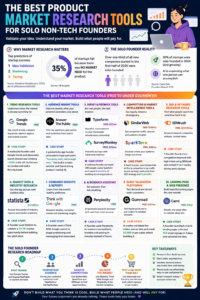
The inforgraphic below is a summary of this article:
Why Market Research is the Most Skipped Step in Entrepreneurship (And Why That’s Hilarious and Tragic)
Here’s a stat that should make everyone in the room uncomfortable: according to research published in Administrative Sciences by Almodóvar-González et al. (2022), the top seven predictors of startup success include idea validation, marketing, and timing — in that order — yet most founders skip straight to building (doi:10.3390/admsci12030102). Skipping market research as a founder is like showing up to a job interview dressed for a pool party. You feel great. Everyone else is confused.
CB Insights consistently reports that around 35% of startups fail because there was no market need for the product. No market need. Not bad execution. Not bad team. Not bad luck. Nobody wanted it. They built something nobody asked for. That is the entrepreneurial equivalent of cooking a five-course meal for someone who already ate.
And yet, here we are. Thousands of founders — especially solo, non-tech founders who are doing this without a co-founder to talk them out of their worst ideas — launch into product development like they’re racing to a finish line that doesn’t exist yet.
The good news? You’re reading this. Which means you’re already smarter than the version of you who was about to spend four months building a “LinkedIn but for dog walkers” app without checking if anyone wanted it.
Let’s fix that.
The Solo Founder Reality Check
Before we get into the tools, let’s talk about who this article is actually for, because context is everything.
According to Carta’s Solo Founders Report 2025, over one-third of all new companies started in the first half of 2025 were solo-founded. That number is growing. Solo founders represented 30% of startups founded in 2024 and that share is climbing, partly because AI has expanded what one person can accomplish in a finite amount of time (Carta, 2025).
Solo founders are out here doing everything — marketing, customer service, product design, legal compliance, accounting, and crying in the car. (The last one isn’t in the report. That’s just industry knowledge.)
The challenge for solo non-tech founders in particular is that the market research tools built for enterprise companies are overkill — they cost as much as a used car and require a dedicated analyst just to set up. What you need are tools that are:
- Affordable (free or cheap)
- No-code or low-code (you shouldn’t need Stack Overflow to set up a survey)
- Actionable (gives you real insight, not just pretty charts you can’t interpret)
- Fast (because you have seventeen other things to do today)
This list covers exactly that. I’ve organized it by category, because structure is beautiful and chaos is stressful, and you’ve already got enough chaos.
Category 1: Trend Research Tools — Understanding What the Market Is Already Screaming About
1. Google Trends (Free)
Google Trends is the most underused free tool in the founder arsenal. It shows you the search volume and trajectory of any keyword over time, across geographies, and compared to competing terms.
Why does this matter? Because if you’re about to build a product in a market that’s trending downward, you deserve to know that before you quit your job. If your product idea aligns with a search term that’s been climbing for 18 months, that’s a green light backed by data, not just vibes.
How to use it as a solo founder:
Type in your product category. Then type in your competitor’s brand name. Then look at the relative interest over time. If your competitor’s brand is flatlined and the category keyword is spiking, there’s opportunity there. If the category keyword looks like a heart monitor reading for someone who just ate bad chicken — flat, then suddenly dead — reconsider.
Google Trends also shows you regional interest, which is great if your product is location-specific, and related queries, which is basically free market research telling you what else your potential customers are thinking about.
Case Study — The Kombucha Clarity: A solo founder in Manchester (let’s call him Darren, because his name was Darren) was planning to launch a premium kombucha delivery brand. Before spending a single pound on packaging, he ran a Google Trends analysis comparing “kombucha delivery UK,” “gut health drinks UK,” and “probiotic drinks UK” over a 5-year period. The data showed that “gut health drinks” was trending sharply upward while “kombucha delivery” had already peaked and plateaued. Darren pivoted his branding from kombucha-specific to gut health broadly, launched with a wider product range, and hit profitability in month eight. That’s the power of a free tool used properly. Darren didn’t need a data scientist. Darren just needed Google Trends and the humility to listen to the data instead of his ego.
2. Answer The Public (Free + Paid Plans)
AnswerThePublic is a search listening tool that pulls data from search engine autocomplete to show you exactly what questions people are typing into Google about any topic.
It visualizes these questions in a beautiful (and slightly overwhelming) radial chart — like a flower, if a flower had anxieties about your business idea.
Why is this useful? Because the questions people type into search engines are unfiltered truth. Nobody performs for a search bar. When someone types “is [product category] worth it” or “why does [competitor name] cost so much,” they’re giving you direct insight into customer pain points, objections, and desires.
As a non-tech founder, you can use this to inform your product positioning, your FAQ page, your social media content, and your sales messaging — all before you’ve built a single thing.
Pro tip: Search your direct competitor’s brand name and see what questions come up. If “why is [Competitor X] so expensive” shows up, you know pricing is a pain point in the market. That’s your opening.
3. Reddit (Free, But Emotionally Taxing)
This one is free but it’ll cost you your feelings.
Reddit is the most honest focus group on the internet. People on Reddit will tell you exactly what they think about your product category without being asked, without being paid, and without the polite filter of a formal survey. Sub-reddits like r/Entrepreneur, r/smallbusiness, r/startups, and niche community forums are goldmines of unfiltered customer sentiment.
Search for your product category on Reddit and read the threads. Don’t post yet. Just read. Look for patterns in complaints. Look for what people wish existed. Look for the products they’ve abandoned and why. This is qualitative research that money can’t easily buy.
The only caveat: don’t take individual Reddit comments as gospel. One person saying your idea is terrible doesn’t mean it is. But if fifty people in different threads are saying the same thing, that’s a pattern worth respecting.
Also, Reddit users will roast your idea like it owes them money. Be prepared for that. Thick skin is a business asset.
Category 2: Customer Research Tools — Actually Talking to (or Surveying) Real Humans
4. Typeform (Free + Paid from $25/month)
Typeform is a survey tool that makes asking questions feel like a conversation rather than a form from your GP. Its conversational design naturally increases survey completion rates — meaning more people finish the survey instead of abandoning it halfway through because it felt like filing taxes.
For solo non-tech founders, Typeform is ideal because:
- It requires zero technical knowledge to set up
- It integrates with tools you probably already use (Slack, Mailchimp, Google Sheets)
- Its free plan is genuinely useful for basic research
What should you ask? Customer research surveys for pre-launch founders should focus on the problem, not your solution. Ask people about their current experience with the problem your product solves. Ask about frequency, frustration level, what they currently do to manage it, and what they’d pay for a better solution. Do NOT pitch your product in the survey. You’re listening, not selling. There’s a time for selling. That time is not right now.
Academic Support: A peer-reviewed study published in Procedia Computer Science (Velasco et al., 2024) found that web-based market validation tools significantly improved the quality of startup decision-making, particularly for founders in resource-constrained environments — i.e., solo founders on a budget (doi:10.1016/j.procs.2024.03.096). In other words, the research says: use a survey tool or pay the consequences later.
5. SurveyMonkey (Free Basic + Paid from $39/month)
SurveyMonkey is the older sibling of Typeform — more traditional in design, but with a killer feature: access to a built-in respondent panel. This means if you don’t have an audience yet (which, as a solo non-tech founder just starting out, is extremely likely), you can pay SurveyMonkey to recruit survey respondents matching your target demographic.
This is genuinely powerful. You can say “I want 100 responses from women aged 25–44 in the UK who own a pet” and SurveyMonkey’s panel will make that happen. You don’t have to harass your LinkedIn connections. You don’t have to post in Facebook groups and pray. You get targeted data from real people in your target market.
The free plan works for collecting responses from people you already know. The paid plan unlocks advanced logic, data exports, and the panel feature.
6. Interviews (Free, Just Uncomfortable)
Look, I know you didn’t come here for someone to tell you to talk to people. But I have to tell you to talk to people.
The single most valuable market research you can do as a solo founder is conducting 10–15 structured customer interviews. Not casual chats. Not “hey what do you think?” texts. Actual 30-minute conversations with people who represent your target customer, following a structured interview guide.
The goal is to understand their current reality — not to validate your idea. There’s a critical difference. If you go into an interview trying to get someone to confirm your idea is brilliant, you will unconsciously steer the conversation that way, and you’ll come out with useless data and false confidence. (We’ve all been that person. It’s embarrassing for everyone involved.)
Use Calendly (free) to schedule interviews. Use Otter.ai (free tier available) to transcribe them. Use a simple Google Doc template for your interview guide. This costs you nothing but time — and the insight you gain is worth more than any paid tool on this list.
Case Study — The Meal Kit Miracle: A solo founder named Priya was building a meal kit service targeting elderly people who lived alone. Before building anything, she interviewed 12 people aged 65–80 from her local community. What she expected to hear: “I want easy recipes.” What she actually heard: “I’m lonely. The meal kit is just an excuse to have something to look forward to.” That insight shifted her entire product — she added a weekly postcard from a real chef, a community phone call feature, and recipe cards with stories. Her retention rate at 6 months was 74%, compared to an industry average of around 40%. She didn’t discover that in a spreadsheet. She discovered it by listening.
Category 3: Competitor Analysis Tools — Knowing What You’re Up Against
7. SimilarWeb (Free + Paid)
SimilarWeb estimates website traffic, engagement metrics, traffic sources, and audience demographics for virtually any website. It uses a panel of 100M+ devices to generate its estimates.
For you, this means you can go look at your competitor’s website and see:
- How much traffic they’re getting
- Where that traffic comes from (Google search, social media, direct)
- Which keywords are driving traffic to them
- What their audience demographics look like
This is competitive intelligence that used to cost thousands of pounds and take weeks to compile. Now it takes about four minutes. The free version gives you limited data that’s still extremely useful. The paid version unlocks full historical data and export functionality.
If you’re a non-tech founder in a market with 2–3 established players, start by SimilarWebbing all of them. Look for gaps in their traffic sources. If they’re all getting traffic from paid Google ads but nobody’s winning on organic search, that’s an SEO opportunity. If they’re all getting traffic from one specific social platform and ignoring another, that’s a channel advantage waiting to be claimed.
8. SparkToro (Free + Paid from $50/month)
SparkToro is an audience intelligence tool that tells you what your target customers read, watch, listen to, and follow online. You input a description of your audience and it tells you which podcasts they listen to, which YouTube channels they watch, which social accounts they follow, and which websites they visit.
For a solo non-tech founder, this is pure gold because it tells you exactly where to find your customers before you spend money trying to reach them. Instead of running ads to everyone on the internet and hoping your target customer is in there somewhere (expensive, exhausting, ineffective), SparkToro tells you where they already hang out.
The free plan gives you limited searches. The paid plan, starting at $50/month, is worth every penny for a founder trying to build a marketing channel from scratch.
9. SEMrush (Free Limited + Paid from $139/month)
SEMrush is the Swiss Army knife of digital market research. It does keyword research, competitor analysis, backlink tracking, content gap analysis, and social media monitoring all in one place.
Yes, the paid plan is expensive for a bootstrapped solo founder. But here’s the hack: the free version gives you 10 requests per day, which is plenty to do meaningful competitor keyword research. You can look up what keywords your competitors are ranking for, which ones are driving the most traffic, and which ones are within reach for your own content strategy.
Alternatively, use the 14-day free trial aggressively. Map out 2 weeks of intensive competitor research before the trial ends. Export everything. You just got $278 worth of research for free. You’re welcome.
Category 4: Market Sizing and Data Tools — Finding Out If the Market is Big Enough to Bother
10. Statista (Free Limited + Paid from $199/month)
Statista is the gold standard for curated industry statistics. It aggregates data from over 22,500 sources across 80,000+ topics and covers more than 190 countries. When you need to know the size of a market, the growth rate of a category, or the demographic breakdown of a consumer segment, Statista is the first place to look.
For non-tech founders who need to present a business case to investors, create a pitch deck, or simply sanity-check whether their market is large enough to build a business in, Statista provides the kind of sourced, credible data that makes your research look professional.
The free plan gives access to basic statistics. The paid plans are expensive for a solo founder, but many public libraries in the UK provide free Statista access with a library card. Yes, really. Check your local library before you pay.
11. Think With Google (Free)
Think With Google is an often-overlooked resource that provides consumer insights, market research reports, and industry data based on Google’s own search and advertising data.
It includes tools like the Market Finder (helps identify new geographic markets for your product), Consumer Barometer data, and industry-specific insight reports. All of it is free. All of it is sourced from one of the largest data companies in human history.
If you haven’t spent an afternoon on Think With Google just exploring your market, you’re missing out on legitimate market intelligence that competing founders are using right now.
12. Statista + Google Scholar Combo (Free)
Here’s a workflow that costs you nothing but time and pays dividends in credibility: pair Statista’s market size data with supporting research from Google Scholar.
Google Scholar gives you access to peer-reviewed academic research across every field imaginable. As a non-tech founder, you can search for academic studies on your target market, customer behaviour patterns, pricing sensitivity research, and industry trend analyses.
Why does this matter? Because when you’re pitching to investors, presenting to a bank, or writing a business plan, citing peer-reviewed research alongside industry statistics transforms you from “founder with a feeling” to “founder with evidence.” That transition is worth more than you think.
Academic Support: A systematic review published in Systems (MDPI, 2024) examining startup success factors across developed and emerging markets found that market validation and marketing effectiveness were consistently among the most critical predictors of startup survival — not technical sophistication, not team size, but understanding the market (doi:10.3390/systems12120541). If you’re skipping market research to “move faster,” you’re not moving faster. You’re just failing faster.
Category 5: AI-Powered Research Tools — Welcome to the Future, It’s Cheaper Than You Think
13. Perplexity AI (Free + Paid from $20/month)
Perplexity AI is an AI-powered search engine that synthesizes information from across the web and provides sourced answers in real-time. Unlike standard search engines that return a list of links you then have to read and synthesize yourself, Perplexity does the synthesis for you and cites its sources.
For a solo non-tech founder doing market research, this dramatically speeds up the process of understanding a new industry, gathering competitor information, and getting up to speed on market trends.
Ask it things like: “What are the biggest customer complaints about [competitor category]?” or “What does the market for [product type] look like in the UK in 2025?” and it will give you a synthesized, sourced answer in seconds.
The free version is powerful. The paid plan adds access to more advanced AI models and real-time data. Either way, this tool should be in your daily workflow.
14. Claude AI / ChatGPT for Qualitative Analysis (Free + Paid)
Once you’ve collected survey responses, interview transcripts, or Reddit threads, you have a pile of qualitative data that needs to be synthesized into actionable insights. This is where AI tools like Claude and ChatGPT become your personal research analysts.
Paste in your survey responses and ask: “What are the top 5 themes in these responses?” Paste in your competitor’s product reviews and ask: “What are the most common complaints customers have?” Paste in your interview transcripts and ask: “Based on these interviews, what problems are people most frustrated by?”
This turns hours of manual qualitative analysis into minutes. And before anyone asks — no, AI doesn’t replace the need to actually conduct the research. It just helps you make sense of the research once you have it. You still have to do the work. AI is the chef’s knife, not the chef.
Case Study — The EdTech Epiphany: A solo founder named Marcus was building an online platform for adult literacy education in the UK. He collected 60 survey responses from potential users and was completely overwhelmed trying to find patterns manually. He pasted all 60 responses into an AI chat tool and asked it to identify common themes, emotional language, and barriers to engagement. The AI identified that the dominant emotion across responses was shame — not just a desire to learn, but a deep fear of being judged. Marcus completely redesigned his onboarding flow to be private, judgment-free, and anonymous by default. Conversion rates during his beta test doubled compared to his original design. A spreadsheet never would have caught the word “shame” appearing seventeen times in different forms. The AI did in 30 seconds what would have taken Marcus two days.
Category 6: Validation Tools — Testing If People Will Actually Pay
15. Gumroad (Free to Start)
Gumroad lets you sell digital products immediately, with no technical setup required. But here’s its market research use case: before you build a product, create a landing page on Gumroad describing what the product will be and its price, and see if people click “buy.”
This is called a “smoke test” or a “pre-order validation,” and it’s one of the most honest forms of market research available. Opinions are free. Wallets are not. If people hand over actual money for something that doesn’t exist yet, you have validated demand. If they visit the page and bounce without buying, you’ve saved yourself months of wasted development time.
This is not deceptive if you’re transparent: set up the page as a pre-order or waitlist, be clear about the timeline, and refund anyone who pays if you decide not to proceed. This is standard practice in product validation.
16. Carrd (Free + $19/year)
Carrd is the most underrated tool in the solo founder stack. For $19 a year — literally less than a cinema ticket — you can build a clean, professional one-page website that serves as a landing page for your product idea.
Use it to create a landing page, run some traffic to it (from social media, Reddit, or cheap paid ads), and track how many people sign up for a waitlist. Email signups are the second most honest market signal after actual payment. If people are willing to give you their email address for a product that doesn’t exist yet, they’re expressing real intent.
A non-tech founder can build a Carrd site in under an hour with no coding required. It integrates with Mailchimp and other email tools. And at $19/year, it’s the cheapest validator you’ll ever find.
Putting It All Together: The Solo Founder Market Research Stack
Here’s a practical, affordable research stack for a solo non-tech founder validating a new product idea:
Week 1 — Understanding the Market (Free Tools)
- Google Trends: Validate that your market is growing
- AnswerThePublic: Understand what questions your potential customers have
- Reddit: Read threads in relevant communities for unfiltered sentiment
- Think With Google: Pull market data and consumer insights
Week 2 — Understanding the Customer (Low-Cost Tools)
- Typeform or Google Forms: Create a 10-question customer research survey
- Distribute the survey through LinkedIn, relevant Facebook Groups, and Reddit
- Conduct 5–10 customer interviews via Zoom, transcribed by Otter.ai
- Use AI tools to synthesize qualitative findings
Week 3 — Understanding the Competition (Free to Low-Cost)
- SimilarWeb: Analyse competitor website traffic
- SparkToro free plan: Understand where your target audience lives online
- SEMrush free tier or trial: Analyse competitor keywords
Week 4 — Validation (Very Low Cost)
- Build a Carrd landing page (under an hour, $19/year)
- Run a smoke test: collect waitlist signups or pre-orders
- Iterate on your offering based on real signals
Total cost for this entire 4-week process? Potentially under £50 if you use free plans strategically. The insight you gain? Invaluable.
A Note on Using Multiple Tools Together (The Stack Mentality)
One tool is a flashlight. A stack of tools is stadium lighting.
No single research tool gives you the full picture. Google Trends tells you if people are searching for something but not why. Typeform tells you what customers say they want but not necessarily what they’ll actually pay for. SimilarWeb tells you where your competitor’s traffic comes from but not what their customers think of the product.
When you layer tools together, the picture sharpens dramatically. The methodology is called triangulation — using multiple independent data sources to confirm or challenge the same hypothesis. It’s a foundational principle in academic research and the best founders apply it instinctively.
For example, if Google Trends shows rising interest in your category, AND your Typeform survey shows strong willingness to pay, AND Reddit is full of complaints about existing solutions, AND SimilarWeb shows your competitors have traffic but mediocre engagement — those four signals together form a compelling green light. Any one alone is a nudge. All four together is a shove.
A meta-analysis published on arXiv (2025) examining predictors of startup success referenced Gompers, Kaplan, and Strebulaev’s foundational NBER work, showing that structured data collection and market analysis are among the strongest early indicators of eventual success (Gompers et al., 2016).
The takeaway: don’t pick one tool and call it research. Build a stack. Run the signals. The truth lives in the overlap.
The Mindset That Makes All of This Work
Tools are only as powerful as the mindset of the person using them. And here’s the mindset that separates the founders who do market research correctly from the ones who do it as performance art.
Curiosity over confirmation. You are not trying to prove your idea is good. You are trying to find out what is true. These are very different goals leading to very different outcomes. The founder who enters research seeking confirmation will find it — because the human brain is extraordinarily talented at discovering what it wants to see. The founder who enters genuinely curious will find something far more valuable: the truth.
Speed over perfection. You do not need a six-month research project. You need enough data to make a better decision than you’d make with no data at all. Two weeks of structured research using the tools in this guide will get you there. Done is better than perfect. Imperfect data acted upon beats perfect data that arrives six months too late.
Humility over ego. The hardest part of market research isn’t finding the data. It’s accepting what the data tells you — especially when it contradicts what you hoped to hear. The founders who succeed at this, the ones who hear “nobody will pay for that” and pivot immediately rather than spending another six months convincing themselves the market is wrong, are the founders who build things that actually matter.
You are not your idea. Your idea is a hypothesis. Hypotheses are meant to be tested, challenged, refined, and sometimes discarded. That’s not failure. That’s the scientific method applied to entrepreneurship. And it dramatically improves your odds of building something real.
The Biggest Market Research Mistakes Solo Founders Make
Let’s close out with the pitfalls, because knowing what not to do is half the battle.
Mistake 1: Asking the wrong people. Your family loves you. Your friends support you. Neither group will give you honest market research. Ask potential customers — people who actually have the problem your product solves. Everyone else is background noise.
Mistake 2: Asking leading questions. “Don’t you think this is a great idea?” is not market research. That’s a hug in question form. Ask open-ended questions about the problem, never closed questions about your solution.
Mistake 3: Confirmation bias. A solopreneur study in Scientific Reports (2025) using data from 4,470 solo-founded ventures found that conscientiousness — methodically following evidence rather than gut feeling — significantly increased the likelihood of long-term profitability (doi:10.1038/s41598-025-21807-8). Translation: following data even when it contradicts your hopes is proven to make you more profitable. Stop ignoring what disagrees with you.
Mistake 4: Doing research once. The market is a living thing. Customer needs evolve. Trends shift. Successful founders build a continuous feedback loop. They never stop doing market research — they just get faster at it.
Mistake 5: Mistaking activity for insight. Completing five surveys and compiling a 40-page document is impressive. It is not market research. Market research produces a specific, actionable insight that changes a decision. If your research doesn’t change anything, you’re not researching. You’re procrastinating with extra steps.
The Final Word: You Don’t Need to Be Technical. You Need to Be Curious.
There is a myth in entrepreneurship that the best founders are the ones who can code. This myth is useful for coders and not useful for anyone else.
The best founders understand their customers. Full stop. The most technically sophisticated product in the world will fail if nobody wants it. The simplest, most unsexy product will succeed if it solves a real problem for real people willing to pay for the solution.
As a solo non-tech founder, you are not at a disadvantage. You are at an advantage — because you’re forced to be close to your customers in a way that deeply technical founders sometimes aren’t. Use that. Be in the field. Talk to people. Listen. Then use the tools in this guide to systematically validate what you’re hearing.
Market research isn’t glamorous. You know what’s less glamorous? Spending 18 months building something nobody buys. You know what’s genuinely humiliating? Realising six months into your “pivot” that you’re still building something nobody asked for because you skipped the research the first time.
Don’t be that founder. The tools are cheap. The data is out there. The only thing standing between you and real market insight is the decision to go get it.
Now close Twitter, open Google Trends, and go find out what the market has actually been trying to tell you.
It’s been talking this whole time. You just haven’t been listening.
Frequently Asked Questions
Q1: What is the best free product market research tool for solo founders?
Google Trends is the best free starting point because it shows whether your market is growing, shrinking, or already dead — before you spend a penny.
Q2: Do I need to be technical to do product market research?
No — every tool in this guide requires zero coding knowledge and can be set up by any founder within a single afternoon.
Q3: How long should product market research take for a solo founder?
A structured four-week research sprint using free and low-cost tools is enough to make confident, evidence-based product decisions.
Q4: What is a smoke test in product validation?
A smoke test is a landing page or pre-order page that lets real customers signal intent to buy before you’ve built anything.
Q5: How do I find out what my target customers actually want?
Conduct 10–15 structured customer interviews using open-ended questions about their problems, not your proposed solution.
Q6: Can I do competitor research for free?
Yes — SimilarWeb’s free tier, Google Trends, and SEMrush’s 14-day trial give you substantial competitor intelligence at no cost.
Q7: What is the cheapest way to validate a product idea?
A Carrd landing page ($19/year) combined with a free Typeform waitlist survey is the most cost-effective validation method available to solo founders.
Q8: Why do most startups fail at the market research stage?
Most founders skip research entirely or ask biased questions that confirm what they already believe rather than revealing what the market actually needs.
Q9: How do I use AI tools for market research?
Paste customer survey responses, interview transcripts, or competitor reviews into an AI tool and ask it to identify the top themes, pain points, and objections.
Q10: What is triangulation in product market research?
Triangulation means using three or more independent data sources — such as Google Trends, customer surveys, and Reddit sentiment — to confirm or challenge the same hypothesis before making a product decision.
Reference List
- Almodóvar-González, M., Fernández-Portillo, A., & Díaz-García, C. (2022). Success factors of startups in research literature within the entrepreneurial ecosystem. Administrative Sciences, 12(3), 102. https://doi.org/10.3390/admsci12030102
- Velasco, L. C. P., Rentucan, M. X. D., Largo, J. J. M., & Racaza, N. A. M. (2024). A web-based market validation tool for the modified Startup Business Company Validation Methodology. Procedia Computer Science, 234, 937–945. https://doi.org/10.1016/j.procs.2024.03.096
- Hagenauer, W., & Zipko, H. T. (2025). A study of individual and market level factors to estimate key determinants of financial success among solopreneurs. Scientific Reports. https://doi.org/10.1038/s41598-025-21807-8
- Cano-Marin, E., Mora-Cantallops, M., & Sánchez-Alonso, S. (2024). The pathway to startup success: A comprehensive systematic review of critical factors and the future research agenda in developed and emerging markets. Systems, 12(12), 541. https://doi.org/10.3390/systems12120541
- Gompers, P. A., Gornall, W., Kaplan, S. N., & Strebulaev, I. A. (2016). How do venture capitalists make decisions? (NBER Working Paper No. 22587). National Bureau of Economic Research. https://doi.org/10.3386/w22587
- Carta. (2025). Solo founders report 2025. Carta. https://carta.com/data/solo-founders-report/
- Azoulay, P., Jones, B. F., Kim, J. D., & Miranda, J. (2018). The average age of a successful startup founder is 45. Harvard Business Review. https://hbr.org/2018/07/research-the-average-age-of-a-successful-startup-founder-is-45
Leave a Reply
You must be logged in to post a comment.