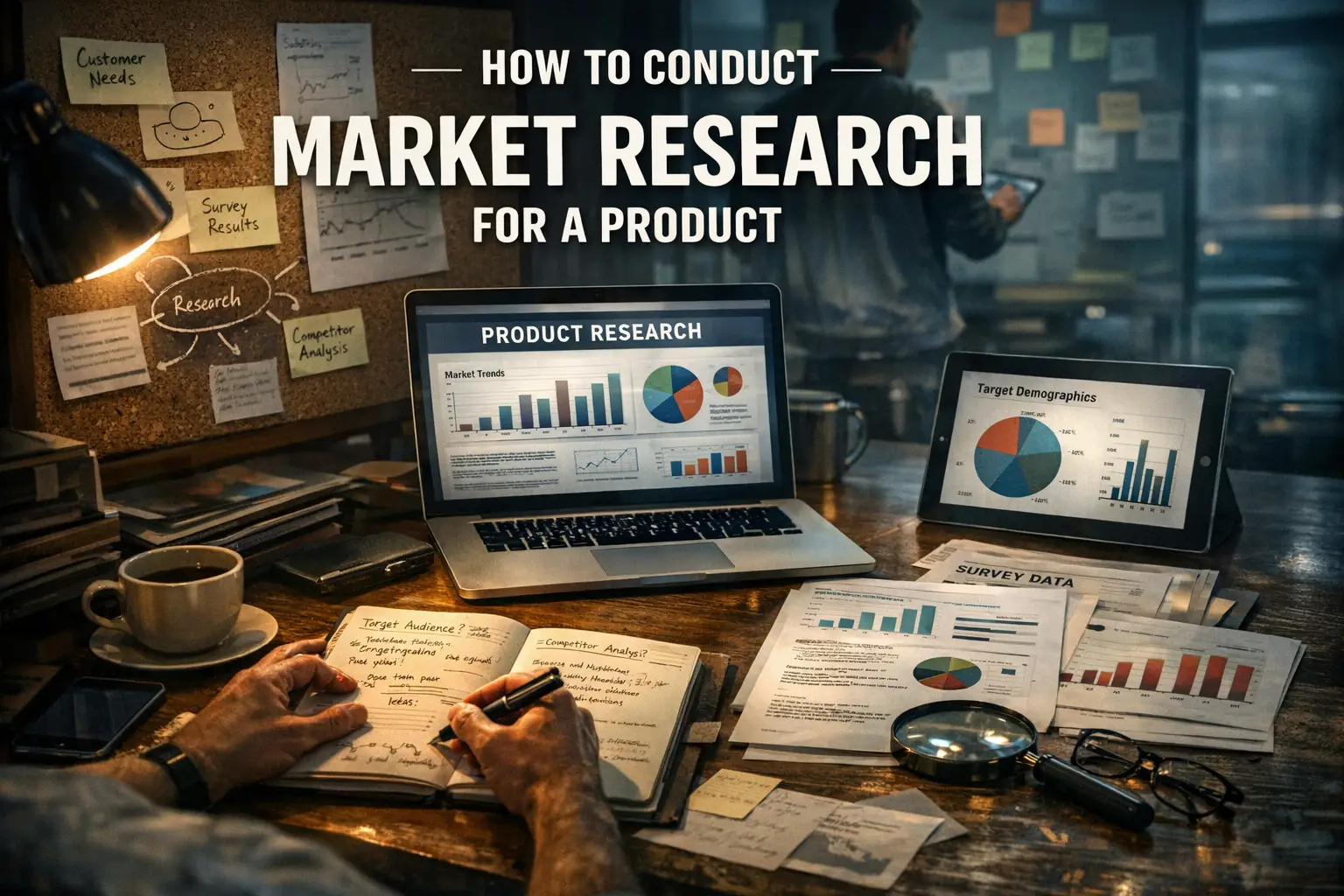
Market research for a product is the single most important thing you will do before spending a single penny — and I say that as a trader who has watched good money chase bad ideas faster than a man chasing a bus he knows he’s going to miss.
I’m going to walk you through the complete, end-to-end process of how to conduct market research for a product — because the difference between a product that sells and one that sits in your garage collecting dust is not luck. It’s not talent. It’s not even capital. It’s knowledge. Specifically, it’s knowing your market before your market gets a chance to know how unprepared you are. And trust me, markets are ruthless. They will expose you like a bad Wi-Fi signal in the middle of an important Zoom call.
So grab a pen, a coffee, and maybe a therapist on standby — because we’re about to get into the information that separates traders who thrive from traders who have to explain to their families why the side hustle didn’t work out. Again.
What Is Market Research and Why Should You Care?
Market research is the systematic process of gathering, analysing, and interpreting information about a market, including your target customers, your competitors, and the broader industry environment. It is the foundation upon which every successful product launch is built.
Here’s what I need you to understand: skipping market research is like showing up to a job interview in a tracksuit because you “felt confident.” You might think it’s fine. The market will let you know otherwise. Loudly. With your money.According to a seminal study published in the Journal of Marketing Research, companies that invest consistently in market research before product launches experience significantly higher rates of market success and are better positioned to anticipate shifts in consumer demand (Moorman, C., Zaltman, G., & Deshpandé, R., 1992, “Relationships Between Providers and Users of Market Research,” Journal of Marketing Research, 29(3), 314–328). That study is over thirty years old and it still holds. Markets change. Human nature doesn’t. People want what they want, and your job is to find out what that is before you spend your savings finding out the hard way.
Market research sits at the intersection of psychology, economics, sociology, and data science. It is not a box to tick — it is a discipline. And if you treat it like a box to tick, the market will tick you right off the list of viable businesses.
Step 1: Define Your Research Objectives
Before you research anything, you need to know what you are trying to find out. This sounds obvious. And yet, I cannot tell you how many traders I have seen sit down with a Google form, send it to their group chat, and call it “market research.” That’s not research. That’s asking your cousin Tyrone if he’d buy your product. Tyrone will say yes because he loves you. The market does not love you. The market does not even know your name yet.
Your research objectives should be specific, measurable, and tied directly to the decisions you need to make. For example:
- Who is the target customer for this product?
- What price point would they accept?
- Why would they choose this product over existing alternatives?
- Where do they currently shop for similar products?
- When do they make purchasing decisions?
These are not rhetorical questions. These are the questions your business will live or die on. Write them down. Pin them to your wall. Tattoo them on your forearm if necessary. Just don’t go into research without them.
The importance of clear research objectives is underscored by work published in the Journal of Consumer Research, which demonstrates that businesses with well-defined research goals are substantially more likely to extract actionable insights from their data (Moorman, C., 1995, “Organisational Market Information Processes: Cultural Antecedents and New Product Outcomes,” Journal of Marketing Research, 32(3), 318–335).
Step 2: Identify Your Target Market
A target market is the specific group of people most likely to buy your product. It is not “everyone.” If your target market is “everyone,” your target market is no one. I say this with love. You are not selling oxygen. You are selling a product, and products have audiences.
Segmenting your market means breaking it down into meaningful sub-groups based on characteristics like:
- Demographics: age, gender, income, education, occupation
- Geographics: where they live, what urban or rural environment they occupy
- Psychographics: lifestyle, values, personality traits, attitudes
- Behavioural: purchase history, brand loyalty, usage rate, benefits sought
This is where the real work begins. And this is also where traders get it wrong all the time. I once watched a man spend £40,000 developing a premium dog accessory line and then discover — after manufacturing — that his target demographic didn’t actually have disposable income for premium dog accessories. They loved dogs. They just loved their savings account slightly more. He didn’t do the psychographic research. Classic.
A foundational academic reference on market segmentation remains Wendell R. Smith’s original paper, which introduced the concept to modern marketing: (Smith, W. R., 1956, “Product Differentiation and Market Segmentation as Alternative Marketing Strategies,” Journal of Marketing, 21(1), 3–8). The framework has been refined significantly since then, but the core logic — that different customers want different things and should be addressed differently — remains as relevant now as it was in the 1950s.
Step 3: Conduct Primary Research
Primary research is research you collect yourself, directly from your target audience. This is original data. First-hand intelligence. The stuff no competitor has because you went and got it yourself.
Surveys
Surveys are one of the most cost-effective tools in your market research arsenal. When done properly — and that means with carefully constructed, unbiased questions — they can reveal consumer preferences, price sensitivity, and purchasing behaviour at scale.
Now, I’m going to be honest with you about surveys. Most people write terrible survey questions. They write leading questions like “Don’t you think this product is great?” and then wonder why 94% of people said yes. That’s not data. That’s your ego in a spreadsheet.
Good survey questions are:
- Neutral in tone — no leading language
- Specific — one idea per question
- Varied in format — Likert scales, multiple choice, and open-ended questions
- Tested — always pilot your survey with a small group first
Tools like SurveyMonkey, Typeform, and Google Forms make distributing surveys inexpensive and accessible. But the quality of your data depends entirely on your questions and the representativeness of your sample. Sending a survey only to your existing followers is not research. That’s a fan club meeting.
Interviews
In-depth interviews give you qualitative insight that surveys simply cannot capture. When you sit down (or video call) with a potential customer and ask them open-ended questions about their lives, their challenges, and their habits, you get texture. You understand not just what they do, but why they do it. And why is the most valuable word in product development.
The key to a good interview is to shut up and listen. I know that sounds simple. You’d be surprised. Traders are passionate people. We love talking about our products. But in a research interview, your job is to ask questions and then — and this is the hard part — actually listen to the answers without jumping in to defend your idea.
Focus Groups
Focus groups bring together six to twelve members of your target audience for a structured discussion facilitated by a moderator. They are particularly useful for testing product concepts, packaging ideas, or advertising messages because they allow for group dynamics — people build on each other’s ideas and reactions in ways that individual interviews cannot replicate.
I have to warn you, though: focus groups can go sideways fast. Put one very opinionated person in the room and watch everybody else’s honest opinions disappear like free samples at a market stall. This is called the “HiPPO effect” — where the Highest Paid Person’s Opinion dominates the room. It’s a real phenomenon, well documented in consumer research, and it is the reason skilled facilitation matters enormously.
Step 4: Conduct Secondary Research
Secondary research uses data that already exists — studies, reports, industry data, competitor analysis, government statistics, and academic research. It is faster and cheaper than primary research, though it lacks the customisation of first-hand data.
Industry Reports
Industry reports from IBISWorld, Statista, Mintel, and Nielsen give you macro-level data about your sector: market size, growth rates, key players, regulatory environment, and emerging trends. For a trader entering a new market, these reports are essential reading — not because they tell you everything, but because they establish the baseline. You need to know how big the pond is before you start fishing.
Competitor Analysis
Understanding your competitors is not optional. It is a survival skill. You need to know:
- Who are the major players in your category?
- What do they charge?
- What do customers love and hate about them? (Check their reviews — customer reviews are pure, unfiltered market research, and most of your competitors are ignoring them.)
- Where are the gaps in their offerings?
The gap in a competitor’s offering is where your opportunity lives. Look at what customers consistently complain about with existing products. That is your brief. That is your market entry strategy.
I once knew a trader who launched a food product into a category dominated by big brands. He didn’t try to outspend them on marketing. He read every single one-star review on their Amazon listings for three months. Every single one. And he built his product specifically to address every complaint those customers had. He launched. It sold. Because it did exactly what the market had been screaming for — and nobody was listening. He was listening.
Academic and Government Data
Academic journals, census data, and government economic reports are enormously valuable and criminally underused by small traders. The Office for National Statistics in the UK, for instance, publishes detailed data on consumer spending, household income, and demographic trends — all for free.
Academic research published in journals like the Journal of Marketing, the Journal of Consumer Psychology, and the Journal of Consumer Research provides evidence-based frameworks for understanding buyer behaviour. This kind of research is not just for academics. It is intelligence. Use it.
Step 5: Analyse Your Competition Using Frameworks
One of the most widely used frameworks for competitive and market analysis is Porter’s Five Forces, developed by Michael E. Porter of Harvard Business School. It analyses five structural forces that determine the competitive intensity and attractiveness of a market:
- Threat of New Entrants — How easy is it for new competitors to enter your market?
- Bargaining Power of Suppliers — How much leverage do your suppliers have over pricing?
- Bargaining Power of Buyers — How much power do customers have to demand lower prices or better quality?
- Threat of Substitute Products — Are there alternative products that could make yours obsolete?
- Competitive Rivalry — How intense is the competition among existing players?
This framework was formally introduced in Porter’s landmark paper and book: (Porter, M. E., 1979, “How Competitive Forces Shape Strategy,” Harvard Business Review, 57(2), 137–145).
Using Porter’s framework before you launch a product gives you a structured view of the battlefield. And yes — I am calling it a battlefield. Because if you enter a market without understanding the forces at play, you will get eaten alive. I’ve seen it happen. It’s not pretty. It is, however, very educational.
Another invaluable tool is the SWOT Analysis — identifying your product’s Strengths, Weaknesses, Opportunities, and Threats. It’s been around so long that some people dismiss it as basic. Those people have usually lost money on a product that a SWOT analysis would have saved them from.
Case Study 1: Innocent Drinks — Research-Led Success
Innocent Drinks is one of the most instructive case studies in UK product market research history. Before launching their smoothies, the founders — three Cambridge graduates — did something brilliantly simple. They set up a stall at a music festival in 1998, sold smoothies, and placed two bins next to their stand. One bin was labelled “Yes” and the other “No.” The question above the bins asked: “Should we quit our jobs to make smoothies?”
At the end of the festival, the “Yes” bin was full. They quit their jobs.
That was primary market research. Crude? Yes. Effective? Absolutely. They tested consumer demand in a real-world environment with real money — customers were paying with their pounds, which is the most honest vote a market can cast.
Innocent went on to build a business worth hundreds of millions of pounds. They continued to invest heavily in consumer research as they scaled, testing new flavours, packaging, and marketing messages continuously. Their growth was not accidental. It was research-driven. (Innocent Drinks Company History).
Step 6: Understand Consumer Behaviour and Psychology
Here’s something they don’t teach in enough business courses: people do not make decisions the way they think they make decisions. Consumers are not rational agents calmly evaluating every purchase on its merits. They are emotional, habitual, and deeply susceptible to cognitive biases that shape their buying decisions in ways they are rarely aware of.
Understanding behavioural economics is not just interesting — it is commercially critical.
Key behavioural insights for product market research:
Anchoring: The first price a consumer sees becomes a reference point for all subsequent evaluations. If you show someone a £200 version of your product before a £80 version, the £80 feels like a bargain. If you show only the £80 version, it might feel expensive. This is not a trick. This is how human brains process relative value.
Social Proof: People look to what others are doing to guide their own behaviour, particularly in situations of uncertainty. This is why reviews matter, why testimonials convert, and why “bestseller” labels increase sales even on products that were perfectly good before the label was applied.
Loss Aversion: Research by Kahneman and Tversky established that people feel the pain of a loss roughly twice as intensely as the pleasure of an equivalent gain. This has profound implications for how you frame your product’s value proposition. Don’t just tell people what they’ll gain. Tell them what they’ll lose by not buying it. (Kahneman, D., & Tversky, A., 1979, “Prospect Theory: An Analysis of Decision under Risk,” Econometrica, 47(2), 263–292).
The Paradox of Choice: Barry Schwartz’s research, and related work in consumer psychology, demonstrates that too many options can actually reduce purchase likelihood. When consumers are overwhelmed with choice, they often choose nothing at all. This is why product range architecture — how many variants you offer — is a research question, not just a creative one. (Iyengar, S. S., & Lepper, M. R., 2000, “When Choice is Demotivating: Can One Desire Too Much of a Good Thing?” Journal of Personality and Social Psychology, 79(6), 995–1006).
These are not abstract theories. They are money. Understanding them will save you from making expensive mistakes and help you design products and marketing messages that actually connect with how people genuinely make buying decisions.
Step 7: Assess Market Size and Commercial Viability
You can have the best product in the world. If the market for it is too small, you cannot build a sustainable business. Market sizing is not glamorous, but it is essential.
There are two primary approaches:
Top-Down Sizing: Start with the total size of your industry or category, then estimate your realistically achievable market share. For example: “The UK healthy snack market is worth £X billion. We are targeting health-conscious adults aged 25–45 in urban centres. If we capture 1% of that segment in year one, our revenue would be £Y.”
Bottom-Up Sizing: Build your revenue estimate from the ground up. How many potential customers are there in your target market? How often would they buy? At what price? Multiply it out. This approach is generally more reliable because it forces you to think about the mechanics of actual purchase behaviour rather than working backwards from an industry figure.
Both approaches should be used together, as a cross-check. If your top-down estimate says there are 500,000 potential customers but your bottom-up model requires you to sell to 2 million to break even, something is wrong. Either the market is smaller than you think, your price point is too low, or your cost base is too high. Better to find this out in a spreadsheet than in a warehouse.
Academic frameworks for market sizing and commercial viability assessment include the work of Lehmann and Winer in their foundational text: (Lehmann, D. R., & Winer, R. S., 2005, Product Management, 4th ed., McGraw-Hill).
Step 8: Test Your Product Concept Before You Build It
Here is one of the most valuable pieces of advice in this entire article, and I want you to read it slowly: do not build the full product before testing the concept.
I know. You’re excited. You have the vision. You can see it all perfectly in your head. And your head is the only place it exists right now — which is exactly why you need to test it before investing serious capital.
Concept testing is the process of presenting your product idea — through descriptions, mock-ups, prototypes, or minimum viable products — to members of your target market and gauging their genuine interest and willingness to pay.
This can be done through:
- Landing pages: Build a simple website describing your product and drive traffic to it. If people click “buy” (even to a waitlist), that’s a signal.
- Crowdfunding campaigns: Platforms like Kickstarter and Indiegogo are essentially paid concept tests. If real people put real money down before the product exists, the market is telling you something important.
- Pilot launches: Launch a small, limited run of your product into a test market before committing to full-scale production.
The point is to get real signal from real people making real decisions. Not hypothetical answers in a survey. Not your mates saying “yeah, mate, I’d buy that.” Real purchasing intent. That is the gold standard.
Case Study 2: Airbnb — Validating Demand Before Scaling
Before Airbnb became the global giant it is today, its founders — Brian Chesky and Joe Gebbia — did something that felt almost laughably small. They rented out air mattresses in their San Francisco apartment to conference attendees when local hotels were fully booked. Three guests paid. The concept worked.
That was their concept test. They did not build technology. They did not raise venture capital. They did not hire staff. They tested whether any human being on earth would pay to sleep in a stranger’s apartment. Turns out, they would.
That minimal concept validation led to one of the most significant business model disruptions in the history of hospitality — a company that now operates in over 220 countries and territories, with over 7 million listings worldwide. The market research, such as it was, happened in a San Francisco apartment. The lesson is about the power of testing before scaling. (Gallagher, L., 2017, The Airbnb Story, Houghton Mifflin Harcourt).
Step 9: Analyse and Interpret Your Data
You have done your research. You have surveys, interviews, competitor analysis, market sizing estimates, and concept test results. Now comes the part where most people fall apart: actually making sense of it all.
Data without analysis is just noise. And I’ll be real — data analysis is not everyone’s favourite activity. I have met traders who spent £5,000 on a research study, read the executive summary, and threw the rest away. That is like buying a whole chicken and only eating the leg. Respectful of nobody — not the chicken, not the data.
Here is a structured approach to data analysis:
Quantitative data (from surveys, sales data, web analytics) should be analysed for patterns, frequencies, and correlations. Use tools like Excel, Google Sheets, or dedicated platforms like SPSS or Tableau. Look for what the majority is telling you — but also look for the outliers. Outliers sometimes tell you more than the average.
Qualitative data (from interviews, focus groups, open-ended survey responses) should be coded thematically. This means reading through the responses, identifying recurring themes, and grouping them. What do people keep coming back to? What words do they use repeatedly? The language of your customers is the language your marketing should speak.
Triangulation is the process of cross-referencing your different data sources to identify consistent findings. If your survey data, your interview insights, and your competitor analysis all point to the same gap in the market, that convergence is a signal worth acting on. One data point is a suggestion. Three data points in agreement is a strategy.
Step 10: Build Your Market Research Into Ongoing Business Strategy
Here is the mistake I see most often among traders: they do their market research once, at the start, and then they never do it again. They treat it like a prescription — take once, done. Market research is not a prescription. It is a lifestyle.
Markets change. Consumer preferences shift. New competitors emerge. Regulations evolve. Trends rise and fall faster than we can track with the naked eye. The traders who stay ahead of these changes are the ones who build continuous market intelligence into the fabric of how they operate.
This means:
- Regularly monitoring customer reviews across your own and competitor products
- Tracking social media conversations in your category using tools like Brandwatch, Sprout Social, or even basic hashtag monitoring
- Running annual customer surveys to track how preferences and satisfaction levels are evolving
- Attending industry events and trade shows to stay close to emerging trends
- Reading academic and industry research in your sector — yes, I said it again, because most of you still aren’t doing this
The concept of market orientation — the degree to which a business continuously generates, disseminates, and responds to market intelligence — has been linked directly to business performance in numerous peer-reviewed studies. The landmark paper establishing this connection is: (Kohli, A. K., & Jaworski, B. J., 1990, “Market Orientation: The Construct, Research Propositions, and Managerial Implications,” Journal of Marketing, 54(2), 1–18).
Businesses with high market orientation outperform their competitors. That is not an opinion. That is an empirical finding, replicated across industries and geographies. Being close to your market is the most reliable competitive advantage available to any trader.
Case Study 3: Nike — Continuous Research Driving Product Innovation
Nike is not just a shoe company. It is one of the most sophisticated market research organisations on earth — and it also happens to sell shoes.
Nike’s investment extends well beyond product design into deep consumer insight work. Their internal Consumer and Market Intelligence team conducts ethnographic research, observing how athletes use their products in real-world conditions rather than just asking them. This distinction — between what people say they do and what they actually do — is one of the most important in all of consumer research.
When Nike developed Flyknit technology, the insight came from athlete feedback about the weight and rigidity of traditional running shoes. Runners wanted something that felt like a sock but performed like a shoe. The research revealed the aspiration. The R&D team built the solution. The product launched to enormous success because it was grounded in genuine consumer need — not a design team’s best guess.
Nike’s ongoing investment in market research is a core reason the brand has maintained cultural and commercial dominance across decades of intense competition. Their approach exemplifies the market-oriented organisation: responsive, data-driven, and continuously learning. (Nike Inc. Annual Report 2023).
Step 11: Common Market Research Mistakes to Avoid
I have been trading long enough to know that mistakes in market research are common, expensive, and — crucially — preventable. Here are the ones I see most often:
Confirmation Bias: Researching to confirm what you already believe rather than to discover the truth. If you go into research hoping to prove your idea works, your brain will find a way to interpret ambiguous data as validation. Research with an open mind. Be genuinely willing to discover that your idea needs changing — or needs killing.
Sampling Bias: Drawing conclusions from a sample that is not representative of your actual target market. Asking only your existing customers what they think is not market research for a new product. Existing customers are not the same as prospective ones. Their behaviour and preferences may differ in important ways.
Ignoring Negative Feedback: People hear what they want to hear. If 30% of your survey respondents say they would not buy your product, that is not a rounding error. That is important data. Understand why they wouldn’t buy, and you will either improve your product or realise you’ve been pitching it wrong.
Over-relying on Self-Reported Behaviour: People consistently misrepresent their own behaviour in surveys — not because they’re dishonest, but because they genuinely don’t know what they would do in a hypothetical situation. “Would you pay £25 for this product?” is a different question from presenting a real product at a real checkout. Where possible, test actual behaviour rather than predicted behaviour.
Doing It Once: As I said. Research is ongoing. Do it once and you’re flying blind within twelve months.
The Tools of the Trade: Your Market Research Toolkit
Let me give you a practical toolkit so you can actually do this, not just read about it and nod enthusiastically.
Free and Low-Cost Tools:
- Google Trends — track search interest in your category over time and across geographies
- Google Forms / SurveyMonkey — create and distribute surveys
- Answer the Public — reveals what consumers are searching around your product category
- Reddit and Quora — unfiltered consumer conversations, often more honest than any survey
- Amazon Reviews — the most underrated competitive intelligence tool at zero cost
- Facebook Audience Insights — understand the demographics of audiences related to your market
Paid Tools (worth the investment at scale):
- Statista — aggregates market data across virtually every industry
- SEMrush / Ahrefs — competitive digital analysis, keyword research, content gap identification
- Brandwatch — social listening and sentiment analysis
- SurveyMonkey Audience — access to pre-screened survey panels for targeted research
Academic Resources:
- JSTOR — access to thousands of peer-reviewed academic papers
- Google Scholar — free search engine for academic literature
- Office for National Statistics — UK demographic, economic, and consumer data
Conclusion: Research Is Respect for Your Market
Let me leave you with this: conducting thorough market research for a product is ultimately an act of respect. Respect for your potential customers, whose time and money you are asking for. Respect for the market, which operates by rules that do not bend for enthusiasm or wishful thinking. And respect for yourself — because you deserve to know whether your idea has real legs before you bet your savings on it.
The traders who build lasting, profitable businesses all share one thing: they were genuinely curious about their customers. Not just what those customers would buy, but who they were, what they cared about, and what would make their lives a little easier or better. That curiosity, translated into structured research practice, is the engine behind every product that has ever found its market.
And the traders who skipped the research? The ones who said they already knew what the market wanted? I see them sometimes. They’re usually very busy explaining to someone why it “almost worked.” I don’t want that for you.
Do the research. Know your market. Build on evidence, not hope.
Because hope is free — but it doesn’t pay the bills.
References
- Moorman, C., Zaltman, G., & Deshpandé, R. (1992). Relationships Between Providers and Users of Market Research: The Dynamics of Trust Within and Between Organizations. Journal of Marketing Research, 29(3), 314–328. https://doi.org/10.1177/002224379202900303
- Moorman, C. (1995). Organisational Market Information Processes: Cultural Antecedents and New Product Outcomes. Journal of Marketing Research, 32(3), 318–335. https://doi.org/10.1177/002224379503200307
- Smith, W. R. (1956). Product Differentiation and Market Segmentation as Alternative Marketing Strategies. Journal of Marketing, 21(1), 3–8. https://doi.org/10.1177/002224295602100102
- Porter, M. E. (1979). How Competitive Forces Shape Strategy. Harvard Business Review, 57(2), 137–145. https://hbr.org/1979/03/how-competitive-forces-shape-strategy
- Kahneman, D., & Tversky, A. (1979). Prospect Theory: An Analysis of Decision under Risk. Econometrica, 47(2), 263–292. https://doi.org/10.2307/1914185
- Iyengar, S. S., & Lepper, M. R. (2000). When Choice is Demotivating: Can One Desire Too Much of a Good Thing? Journal of Personality and Social Psychology, 79(6), 995–1006. https://doi.org/10.1037/0022-3514.79.6.995
- Lehmann, D. R., & Winer, R. S. (2005). Product Management (4th ed.). McGraw-Hill. https://www.mheducation.com/highered/product/product-management-lehmann-winer/M9780073381282.html
- Kohli, A. K., & Jaworski, B. J. (1990). Market Orientation: The Construct, Research Propositions, and Managerial Implications. Journal of Marketing, 54(2), 1–18. https://doi.org/10.1177/002224299005400201
- Innocent Drinks. Our Story. https://www.innocentdrinks.co.uk/us/our-story
- Gallagher, L. (2017). The Airbnb Story. Houghton Mifflin Harcourt. https://www.hmhbooks.com/shop/bookdetails/9780544952669
- Nike Inc. (2023). Annual Report. https://investors.nike.com/investors/financial-information/annual-reports/default.aspx
- Peighambari, K., Sattari, S., Kordestani, A., & Oghazi, P. (2016). Consumer Behavior Research: A Synthesis of the Recent Literature. SAGE Open, 6(2). https://journals.sagepub.com/doi/10.1177/2158244016645638
Final Word from the Trader
I know what some of you are thinking. “This is a lot of work.” Yes. It is. But so is explaining to your family why the product didn’t sell. So is liquidating inventory at a loss. So is going back to a job you left because you believed in an idea that the market, quietly and efficiently, rejected.
The work of market research is not glamorous. Nobody makes a documentary about the trader who spent three weeks reading one-star Amazon reviews and rebuilt their product accordingly. But that trader is profitable. That trader sleeps well.
You came here because you want to do this right. That impulse is correct. Trust it. Act on it. Do the research. Build something the market actually wants.
Now get to work.
Disclaimer: This article is intended for educational and informational purposes. All referenced works are the intellectual property of their respective authors and publishers.
Leave a Reply
You must be logged in to post a comment.