Most traders and business owners lose money not because the market is against them — but because they never bothered to find out what the market actually wanted in the first place.
Let me be brutally honest with you right now: if you are making trading and business decisions without doing proper market research, you are basically showing up to a poker game wearing sunglasses in a pitch-black room thinking you look cool. You don’t look cool. You look lost. And your wallet? Your wallet is crying in the parking lot.
I have been trading and studying markets for years. I have watched smart people make dumb decisions, watched brilliant strategies collapse because nobody thought to ask, “Wait — does anyone actually want this?” Market research is not glamorous. It does not come with a hype reel or a viral moment. But it is the single most powerful competitive advantage available to any trader, entrepreneur, or business owner operating in today’s volatile, fast-moving economy.
Here is the good news: you do not need a PhD, a massive budget, or a team of analysts in matching polo shirts to do effective market research. You need five methods, a little discipline, and the willingness to listen to what the data is telling you — even when it hurts your feelings.
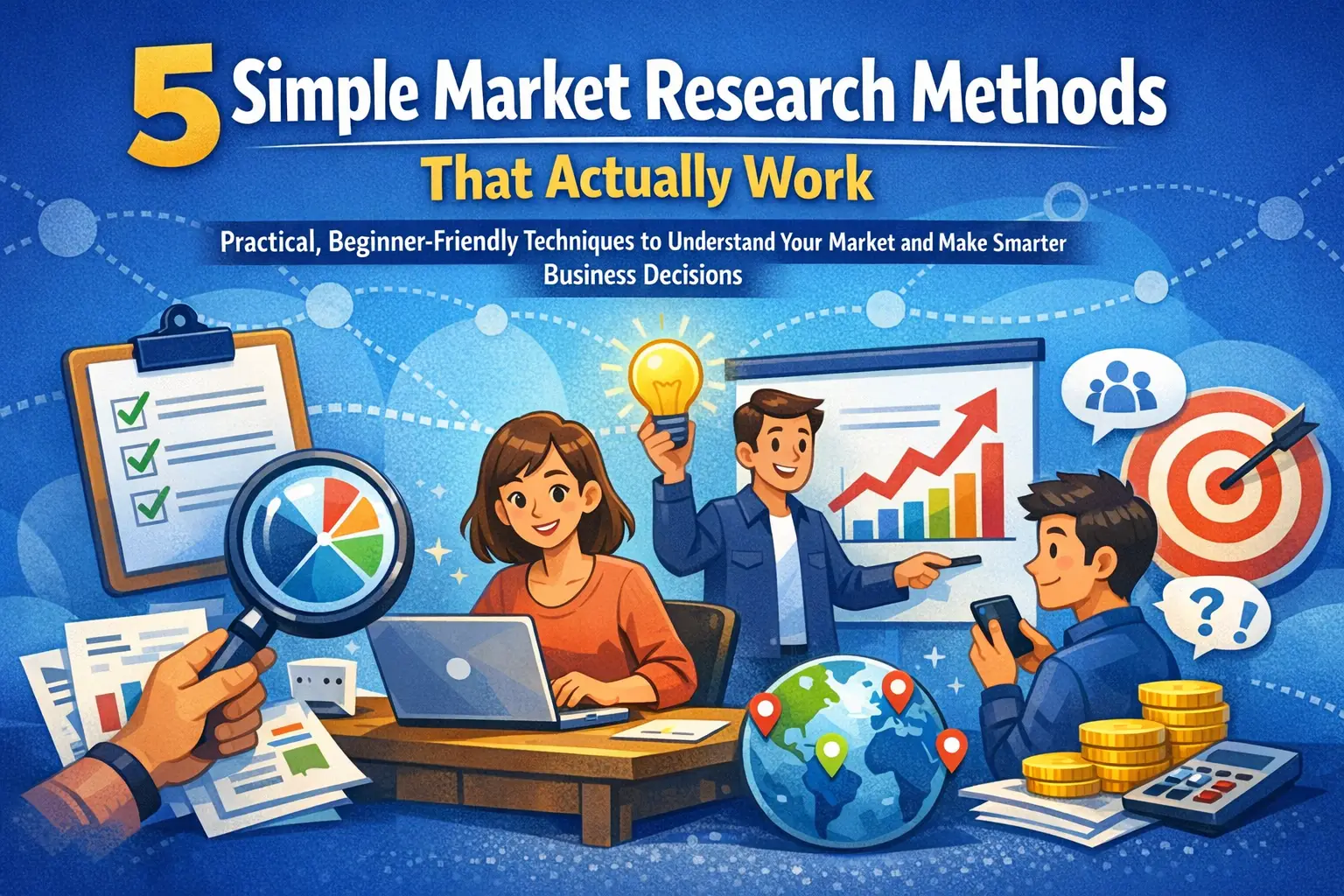
This article will walk you through 5 simple market research methods that actually work, backed by peer-reviewed academic research, illustrated with real-world case studies, and delivered by someone who has made every mistake in the book so that you do not have to. We are going to cover surveys, interviews, competitor analysis, social listening, and observational research — and by the time you finish reading this, you will know exactly how to apply each one to your trading or business strategy.
Let us get into it.
Why Market Research Is Non-Negotiable in 2025 and Beyond
Before we dive into the methods, let us talk about why this matters so much right now.
The market has never been more competitive. Consumer preferences shift faster than a day trader dumps a losing position. New products enter and exit the scene at breakneck speed. Algorithms, AI, and social media have disrupted almost every industry on the planet. In this environment, operating on gut feeling alone is not brave — it is reckless.
A landmark review published in Marketing Letters — the journal of the American Marketing Association — documented the entire evolution of consumer research and concluded that the field is at a turning point, with technological disruption creating both unprecedented data opportunities and dangerous blind spots for those who fail to adapt (Ding et al., 2020, Marketing Letters). Translation: the researchers who adapt their methods win. The ones who do not get left behind.
And yet, I still see traders walking into markets the way I once walked into a buffet after skipping breakfast — fast, hungry, and completely undiscerning. I grabbed everything. I paid for it later. Market research is the discipline of not doing that.
The five methods I am going to share with you are:
- Customer Surveys — The fastest way to ask your audience what they want
- One-on-One Interviews — Going deep where surveys cannot
- Competitor Analysis — Learning from what others are already doing right and wrong
- Social Listening — Eavesdropping legally and profitably on your target market
- Observational Research — Watching real behaviour instead of relying on what people say they will do
Each one serves a different purpose. The best traders and business owners use a combination. Let us break them down.
Method 1: Customer Surveys — The Bread and Butter of Market Intelligence
If market research were a starter pack, surveys would be the hoodie, the sneakers, and the laptop charger. They are foundational. They are versatile. And when done right, they generate the kind of data that can completely transform your strategy.
A survey is simply a structured set of questions designed to gather information from a specific group of people. They can be distributed online, via email, through social media, or even in person. The rise of digital tools like Google Forms, SurveyMonkey, and Typeform has made surveys more accessible than ever.
But here is what most people get wrong: they design surveys as if they are writing a school exam — long, tedious, and filled with questions that serve the researcher’s ego rather than the business’s actual intelligence needs. Respondents have the patience of a cat watching someone else’s cat video. You have got maybe 5–8 minutes of their genuine attention. Use it wisely.
What the Research Says
The academic literature on survey methodology is clear that quality beats quantity every single time. A comprehensive guide published in the Journal of Strategic Marketing outlined thirteen distinct stages of best-practice survey analysis and emphasised that surveys remain “at the forefront of the broader marketing discipline — mostly because they are relatively cheap, can quickly reach a large number of people, and are likely to generate findings that advance knowledge” (Cadogan & Lee, 2023, Journal of Strategic Marketing). In other words: done right, surveys are both cost-effective and academically rigorous.
A National Bureau of Economic Research working paper on survey design also reinforced that surveys are “an essential approach for eliciting otherwise invisible factors such as perceptions, knowledge, expectations, and preferences” that no other method can capture (NBER Working Paper No. 30527). So even in an age of big data and AI, surveys remain irreplaceable.
How to Do It Right: A Practical Framework
Here is my personal survey framework, honed after years of getting it wrong first:
Step 1 — Define your objective. Before you write a single question, write one sentence that answers: “What decision will this survey help me make?” If you cannot answer that, you are not ready to write the survey yet. Go get some coffee. Think about it. Come back.
Step 2 — Keep it short. Aim for 10 questions or fewer. Use a mix of multiple choice (for quantifiable data) and one or two open-ended questions (for qualitative insight). Nobody wants to write three paragraphs about your product at 9pm on a Tuesday. They have things to do.
Step 3 — Avoid leading questions. “Don’t you think our product is amazing?” is not a question. That is a cry for validation. Ask neutral, clear questions: “How would you rate your satisfaction with this product on a scale of 1–10?” Now that is data.
Step 4 — Incentivise responses. Discounts, giveaways, or exclusive content can dramatically boost response rates. People are busy. Respect their time by rewarding it.
Step 5 — Analyse and act. A survey that sits in a spreadsheet forever is just expensive data therapy. Review the results, identify the top three insights, and make at least one concrete decision based on the data.
Case Study: How SurveyMonkey’s Own Data Transformed Dropbox’s Go-to-Market Strategy
When Dropbox was preparing to scale globally, the team ran a series of customer surveys to understand not just who was using the product, but why people chose Dropbox over alternatives. The surveys revealed that a majority of users cited “ease of sharing files across devices” as the primary value driver — not storage capacity, as the team had assumed. This insight fundamentally shifted Dropbox’s entire marketing messaging. Instead of leading with storage size, they led with seamless collaboration. The result was a user base that grew to over 700 million registered users. The lesson here is simple: surveys told them something their gut could not. They listened. They won.
Method 2: One-on-One Interviews — When You Need to Go Deeper
Surveys are wide. Interviews are deep. If surveys are the helicopter view of your market landscape, interviews are the boots-on-the-ground expedition that shows you exactly what is growing in the dirt.
A one-on-one interview involves sitting down with a member of your target audience — either in person, over the phone, or via video call — and having a guided but conversational discussion about their experiences, frustrations, motivations, and needs. There is no algorithm between you and them. No multiple choice box limiting their answer. Just a human being telling you, in their own words, exactly what is happening in their world.
Let me tell you something: the stuff people tell you in an interview that they would never write in a survey will make your jaw drop. The first time someone told me exactly why they stopped using a service I was involved with, I felt like I had just been shown a secret door in a room I thought I knew perfectly. It was uncomfortable. It was also priceless.
What the Research Says
The Journal of Consumer Research published a systematic analysis of consumer decision-making research between 2020 and 2024, finding that qualitative methods — including interviews — consistently surfaced insights that quantitative tools missed, particularly around motivational and emotional drivers of behaviour (Journal of Consumer Research, 2020–2024 Systematic Review). The researchers noted that understanding why consumers behave the way they do — not just what they do — requires depth of inquiry that only qualitative methods can provide.
Furthermore, the landmark paper by Ding, DeSarbo, Hanssens et al. in Marketing Letters — appropriately titled “The Past, Present, and Future of Measurements and Methods in Marketing Analysis” — explicitly highlighted the growing importance of combining quantitative surveys with qualitative depth interviews to triangulate findings and reduce researcher bias (Ding et al., 2020).
Translation: the smartest researchers do not choose between surveys and interviews. They use both.
How to Structure an Effective Market Research Interview
Think of an interview as a jazz performance, not a classical recital. You have a structure — but you leave room to improvise where the conversation takes you somewhere interesting.
Opening (5 minutes): Build rapport. Ask easy, non-threatening warm-up questions about the person’s background and daily life. Nobody opens up to someone who jumps straight into “Tell me your deepest frustrations.” Ease in.
Core Questions (20–30 minutes): Focus on three to five key themes. Ask open-ended questions beginning with “Tell me about a time when…” or “Walk me through how you typically…” These prompts invite stories, not yes/no answers. Stories contain the richest data.
Probing (Ongoing): When someone says something interesting, go deeper. “Can you say more about that?” is the most valuable question in any researcher’s arsenal. It costs nothing and delivers everything.
Closing (5 minutes): Ask if there is anything they wish you had asked about. Some of the best insights come from what the participant volunteers at the end of their own accord.
Target a minimum of 5–8 interviews per audience segment. Once you start hearing the same themes repeated, you have reached saturation — you are not learning new things, which means you have enough data to draw conclusions.
Case Study: Airbnb’s Early Interview Strategy
In Airbnb’s earliest days, the founders were struggling to grow. Their apartments listed on the site had mediocre photos and were not converting to bookings. Rather than running a survey, they flew to New York City, knocked on the doors of their own hosts, and conducted face-to-face interviews. During those conversations, they discovered that hosts had no idea how to take appealing photos of their spaces. The solution was elegant: Airbnb loaned professional cameras to hosts and helped them photograph their listings properly. Bookings doubled within weeks. No algorithm identified that problem. A human conversation did.
Method 3: Competitor Analysis — Steal Smart, Not Hard
Now listen, I am not telling you to steal. That would be illegal and honestly below your character. What I am telling you is this: your competitors have already paid tuition on the lessons you are about to face. Why not study their report card?
Competitor analysis is the systematic process of researching, evaluating, and learning from the businesses already operating in your market space. It tells you what is working, what is failing, where the gaps are, and how you can position yourself to fill them.
This is not snooping. This is strategy. The military has been doing this for centuries. The smartest businesses in the world do it every single day. The only people who skip competitor analysis are the ones who are also skipping lunch — broke and confused about why.
What the Research Says
A comprehensive systematic review published in the Journal of Business & Industrial Marketing analysed 219 papers on competitive market behaviour and concluded that firms that systematically study competitor behaviour and customer responses to competitor offerings significantly outperform those operating without competitive intelligence (Bilro & Loureiro, 2023, Journal of Business & Industrial Marketing). The research found that understanding how competitors solve customer problems is particularly valuable for identifying unmet needs in the market.
The strategic implication is clear: knowing what your competitor does well tells you the floor of the market’s expectations. Knowing what your competitor does badly tells you exactly where your opportunity lives.
The Competitor Analysis Framework: Four Dimensions
Dimension 1 — Product/Service Analysis. Study exactly what they offer. Features, pricing tiers, delivery mechanisms, user experience. Sign up for their free trials. Use the product. Be a real customer. You will notice things no external analysis can reveal.
Dimension 2 — Customer Reviews Mining. This is where it gets golden. Read every one-star and two-star review of your competitors’ products across Amazon, Google, Trustpilot, and App Store. Those reviews are free customer interviews. Every complaint is a gap in the market screaming to be filled. I once spent an afternoon reading one-star reviews of a competitor’s trading software platform and found the same three complaints repeated across hundreds of reviews. We built our next feature set around solving exactly those three problems. It took one afternoon and cost exactly nothing.
Dimension 3 — Marketing and Messaging Analysis. Study their ads, their website copy, their email newsletters, their social media posts. What stories are they telling? What emotions are they activating? What problems are they claiming to solve? This tells you how they perceive the market — and where their blind spots might be.
Dimension 4 — Pricing Strategy Analysis. Understand not just their price points but their pricing logic. Are they competing on value? On volume? On premium positioning? Pricing tells you everything about how a company understands its own customers.
Case Study: How Pepsi Used Competitor Intelligence to Create the “Pepsi Challenge”
In the 1970s, Pepsi conducted systematic research into Coca-Cola’s market position and discovered a critical vulnerability: in blind taste tests, more people preferred Pepsi’s sweeter flavour profile — but Coke’s brand dominance was so powerful it was overriding taste preference in non-blind settings. This single competitive insight led to the “Pepsi Challenge” campaign, one of the most disruptive marketing strategies in consumer goods history. Pepsi’s market share surged, forcing Coca-Cola into the infamous “New Coke” crisis of 1985. All of it started with systematic competitor analysis and one well-designed taste test.
Method 4: Social Listening — The Market Research That Never Sleeps
Here is my favourite market research method of the modern era, and I will tell you why: it is the only method where the respondents do not know they are in your study. They are just being themselves — complaining, celebrating, asking questions, making jokes — and you get to watch all of it from behind a one-way mirror made of search algorithms.
Social listening is the practice of monitoring social media platforms, online forums, review sites, and community spaces to gather unfiltered consumer sentiment about your market, your product category, and your competitors. Done right, it is like having the world’s largest ongoing focus group — one that runs 24 hours a day, 365 days a year, and costs you nothing but time and attention.
Think about that for a second. Millions of people are, right now, expressing exactly what they want, what frustrates them, what they wish existed, and what they would pay for. They are posting it on Twitter/X. On Reddit. On YouTube comment sections. On TikTok. On LinkedIn. All you have to do is look.
Wait — but you were not looking? My brother in commerce. You have been sitting on a gold mine and wondering why your bank account looks like a gas station receipt.
What the Research Says
A sweeping systematic literature review of 117 peer-reviewed articles on artificial intelligence and consumer behaviour, published in Cogent Business & Management, found that social media and online communities have become one of the richest and most reliable sources of real-time consumer sentiment data available to marketers today (AI and Consumer Behavior Systematic Review, 2025, Cogent Business & Management). The research confirmed that social listening platforms combined with natural language processing can identify consumer trends faster than any traditional research method.
A parallel review of 127 peer-reviewed articles on big data and consumer behaviour, published in the Journal of Marketing Analytics, found that text mining of user-generated content — the backbone of social listening — consistently uncovers implicit consumer motivations that self-reported surveys and interviews often miss, because people online are not performing for a researcher; they are expressing genuine, real-time sentiment (Journal of Marketing Analytics, 2025).
That is the magic of social listening. People lie to researchers — not always intentionally, but the act of being studied changes behaviour. Online, unsolicited, they tell the truth.
How to Build a Social Listening Practice
Step 1 — Identify your keywords. Start with the obvious: your product category, your brand name, your competitors’ names, the problems your product solves. Then go deeper — the jargon your customers use, the slang, the hashtags.
Step 2 — Choose your monitoring tools. Hootsuite, Brandwatch, Mention, and Sprout Social all offer social listening functionality. Google Alerts is free and covers news mentions. Reddit’s own search function is criminally underused by researchers — the comments on relevant subreddits are treasure troves of unfiltered opinion.
Step 3 — Categorise what you find. As you collect mentions and posts, organise them into categories: pain points, feature requests, positive experiences, comparisons to competitors, questions. Patterns will emerge quickly.
Step 4 — Act on the signal, not the noise. Not every tweet is a research insight. One angry person on social media is anecdote. Fifty angry people expressing the same frustration in the same language? That is a pattern. That is data. That is your next product improvement, your next marketing angle, your next competitive move.
Case Study: How Gatorade Built a Real-Time Social Intelligence Hub
Gatorade was one of the early pioneers of large-scale social listening in the sports beverage market. They built an internal “Mission Control Centre” — a dedicated room with multiple screens monitoring all social media mentions in real time. What they found transformed their product development and marketing strategy: conversations about specific sports occasions, specific athletes, and specific performance moments were driving spikes in brand discussion that their traditional market research had completely missed. They began responding to social conversations in real time and developing targeted content around the moments their consumers were already discussing. Their digital engagement increased dramatically, and the insights from social listening fed directly into product innovation and partnership decisions. The approach was so successful it became a case study taught in business schools globally.
Method 5: Observational Research — Watching Real Behaviour in the Wild
Alright, we have arrived at the final method, and it is the one most people skip because it feels uncomfortable, slow, or unnecessarily old-fashioned in a world of dashboards and data analytics. Those people are wrong. Let me tell you why.
Observational research is exactly what it sounds like: you watch how real people actually behave in relevant contexts, without interfering or asking questions. You are the researcher in the corner taking notes. You are not nudging, prompting, or framing. You are just watching reality happen.
And here is the uncomfortable truth about all the other methods we have discussed: they all capture what people say they do, say they want, or say they think. Observational research captures what people actually do — and those two things are often dramatically, hilariously, sometimes heartbreakingly different.
I have sat in rooms where traders said they would “absolutely” execute stop-losses at a certain level, then watched them refuse to hit that button when the moment came because their emotions took over. I have heard business owners claim their customers “definitely” read every word of their email newsletter, then looked at the click-map data and found 90% of people stopped at the second paragraph. What people say and what people do are two different datasets. Both are valuable. Only one shows you the truth of behaviour.
What the Research Says
The systematic review of consumer behaviour published in Marketing Letters specifically highlighted observational data — including biometric responses, eye-tracking, and in-context behavioural observation — as an increasingly critical tool for capturing “subconscious physiological reactions that offer a deeper layer of implicit behavioural evidence” that self-report methods simply cannot access (Journal of Marketing Analytics, Big Data in Consumer Behavior Review, 2025).
Research from the Journal of Consumer Research further reinforced that the gap between stated preferences and revealed preferences — what people say they want versus what they actually choose — is one of the most persistent and significant challenges in consumer behaviour research (Journal of Consumer Research, 2020–2024). Observational methods bridge that gap more directly than any other approach.
How to Implement Observational Research Without Being Weird About It
Let me be clear: good observational research is ethical, transparent where required, and focused on behaviour patterns rather than individual surveillance. Here is how to do it right.
In-Person Observation: If you run a physical business — a store, a trading floor, a service environment — spend time simply watching how customers interact with your space, your products, and your staff. Where do they pause? Where do they look confused? Where do they leave without completing a transaction? Every one of those moments is a data point.
Usability Testing: For digital products, tools like Hotjar and FullStory let you record anonymised sessions of real users navigating your website or app. Watching a real person struggle to find your pricing page is more instructive than a hundred survey responses about it. You will redesign things faster than I changed my trading strategy after my first blown account.
Field Research: Go to the environments where your target customers live their relevant lives. Visit the stores they shop at. Attend the events they attend. Watch them interact with products and services in the category you operate in. This is the research that generates breakthrough insights, because most of your competitors are sitting in offices while you are out in the field.
Ethnographic Research: More structured observational research — sometimes called ethnography — involves spending extended time with a group of consumers to understand their rituals, language, and contextual behaviour. This is time-intensive but produces the deepest possible insights into how your product fits (or does not fit) into people’s real lives.
Case Study: IDEO and the Shopping Cart Redesign
One of the most famous examples of observational research in product development comes from the design firm IDEO. When ABC’s Nightline challenged them to redesign the supermarket shopping cart in five days, the team did not sit in a boardroom. They went to grocery stores and observed shoppers using carts in real time. They watched parents struggling with child safety. They saw people abandoning carts when they became unwieldy. They observed theft patterns and damage from improper stacking. The design they produced — modular, safety-focused, adaptable — emerged directly from watching real human behaviour in context. No survey could have generated those insights. Only direct observation could. The IDEO shopping cart redesign became a landmark case study in human-centred design and is taught in business and engineering schools worldwide.
Combining the Five Methods: A Practical Integration Framework
Here is where the magic happens. Each of these five methods generates a different kind of intelligence. The most effective market researchers — and the most successful traders and business owners — do not pick one and call it a day. They layer them strategically.
Think of it this way. You would not make a major trading decision based on a single indicator, right? You triangulate. You look for convergence across multiple signals before committing. Market research works the same way.
Here is how to think about integration:
Surveys give you scale and quantification. They tell you how many people feel a certain way.
Interviews give you depth and narrative. They tell you why people feel that way.
Competitor Analysis gives you context and positioning intelligence. It tells you what the market already offers and where the gaps are.
Social Listening gives you real-time, unfiltered sentiment. It tells you what people are actually saying when they think no one is studying them.
Observational Research gives you behavioural truth. It tells you what people actually do, as opposed to what they say they do.
Combine all five and you get a 360-degree picture of your market that no single method — no matter how well designed — can provide on its own. This is the difference between trading with one eye open and trading with full binocular vision, a satellite feed, and a solid internet connection.
Common Market Research Mistakes and How to Avoid Them
Before I let you go, let us briefly talk about the mistakes. Because I have made all of them, and watching you make them too would keep me up at night.
Mistake 1 — Researching to confirm, not to discover. This is called confirmation bias, and it is the research world’s equivalent of only reading headlines that agree with your existing opinion. If you go into research looking to prove your idea is great, you will find evidence that it is — and you will miss all the evidence that it is not. Approach every research project with genuine curiosity and a willingness to be wrong.
Mistake 2 — Sampling the wrong audience. Asking your mother if your product is good is not market research. It is a compliment factory. Survey and interview the people who represent your actual target market, not the people who love you unconditionally. Unless your target market is people who love you unconditionally, in which case, that is a different kind of business and this is not the article for it.
Mistake 3 — Collecting data without acting on it. Research that sits in a Google Drive folder and never influences a decision is just an expensive hobby. Every research project should end with a clear list of decisions it informed, changes it inspired, or hypotheses it validated or disproved.
Mistake 4 — Asking what people want instead of what they do. Henry Ford reportedly observed that if he had asked people what they wanted, they would have said faster horses. Steve Jobs made a similar point about customer desire and innovation. People are bad at articulating what they want in hypothetical terms. They are much better at showing you through their behaviour. Balance stated preference research (surveys, interviews) with revealed preference research (observational, behavioural data).
Mistake 5 — Doing research once and never again. Markets change. Consumer preferences evolve. A research report from three years ago is not market intelligence — it is market history. Build research into your ongoing operations, not just your launch strategy.
The Trader’s Final Word: Research Is Risk Management
Let me close with the most important thing I can tell you, trader to trader, business mind to business mind.
Every decision you make without market research is a bet placed without understanding the odds. Sometimes you win those bets. But you win by luck, not by skill — and luck is not a business model. Luck is not a trading strategy. Luck is a nice thing that happens to you on your birthday.
Market research is risk management. It reduces the range of possible bad outcomes by replacing assumption with evidence. It does not guarantee success — nothing does, and anyone who tells you differently is selling something overpriced. But it dramatically improves the probability that your next product launch, your next campaign, your next trade, your next move is grounded in what is actually happening in the market rather than what you hope is happening.
The five methods in this article — surveys, interviews, competitor analysis, social listening, and observational research — are not exotic. They are not expensive. They do not require a degree or a team or a big budget. They require curiosity, discipline, and the willingness to let the data challenge your assumptions.
That willingness, more than any method or tool, is what separates the traders and business owners who consistently win from the ones who consistently wonder why they are not winning.
So go do the research. Your market is waiting to tell you exactly what it needs.
You just have to ask.
References
- Ding, Y., DeSarbo, W. S., Hanssens, D. M., Jedidi, K., Lynch Jr., J. G., & Lehmann, D. R. (2020). The past, present, and future of measurements and methods in marketing analysis. Marketing Letters, 31, 175–186. https://doi.org/10.1007/s11002-020-09527-7
- Cadogan, J. W., & Lee, N. (2023). Analyzing survey data in marketing research: A guide for academics and postgraduate students. Journal of Strategic Marketing, 31(1), 203–215. https://doi.org/10.1080/0965254X.2023.2176533
- Stantcheva, S. (2022). How to run surveys: A guide to creating your own identifying variation and revealing the invisible. NBER Working Paper No. 30527. National Bureau of Economic Research. https://www.nber.org/system/files/working_papers/w30527/w30527.pdf
- Bilro, R. G., & Loureiro, S. M. C. (2023). A systematic review of customer behavior in business-to-business markets and agenda for future research. Journal of Business & Industrial Marketing, 38(13), 122–141. https://doi.org/10.1108/jbim-12-2021-0563
- Jain, E. K., & Eastman, J. K. (2024). Artificial intelligence consumer behavior: A hybrid review and research agenda. Journal of Consumer Behaviour, 23(2), 676–697. https://doi.org/10.1002/cb.2233
- Rajan, V. (2024). Big data in consumer behavior research: A systematic review of data sources, analytical methods, and research questions. Journal of Marketing Analytics. https://doi.org/10.1057/s41270-026-00470-6
- Understanding Modern Consumer Decision-Making: A Systematic Literature Review of the Journal of Consumer Research, 2020–2024. (2025). Presented at AMTP Proceedings. Georgia Southern University. https://digitalcommons.georgiasouthern.edu/cgi/viewcontent.cgi?article=1018&context=amtp-proceedings_2025
- Ganjre, A., & Pathak, N. (2025). AI and consumer behavior: Trends, technologies, and future directions from a Scopus-based systematic review. Cogent Business & Management, 12(1). https://doi.org/10.1080/23311975.2025.2544984
- Sajwan, D., & Tripathi, N. (2024). Unveiling consumer behavior patterns: A comprehensive market basket analysis for strategic insights. 2024 Sixth International Conference on Computational Intelligence and Communication Technologies (CCICT). https://www.researchgate.net/publication/381772611
- Deighton, J., & MacInnis, D. J. (2020). The past, present, and future of consumer research. Marketing Letters, 31(2), 137–149. https://doi.org/10.1007/s11002-020-09526-8
Disclaimer: This article is for educational purposes only and does not constitute financial or trading advice. Always conduct your own research before making investment decisions.
Leave a Reply
You must be logged in to post a comment.