
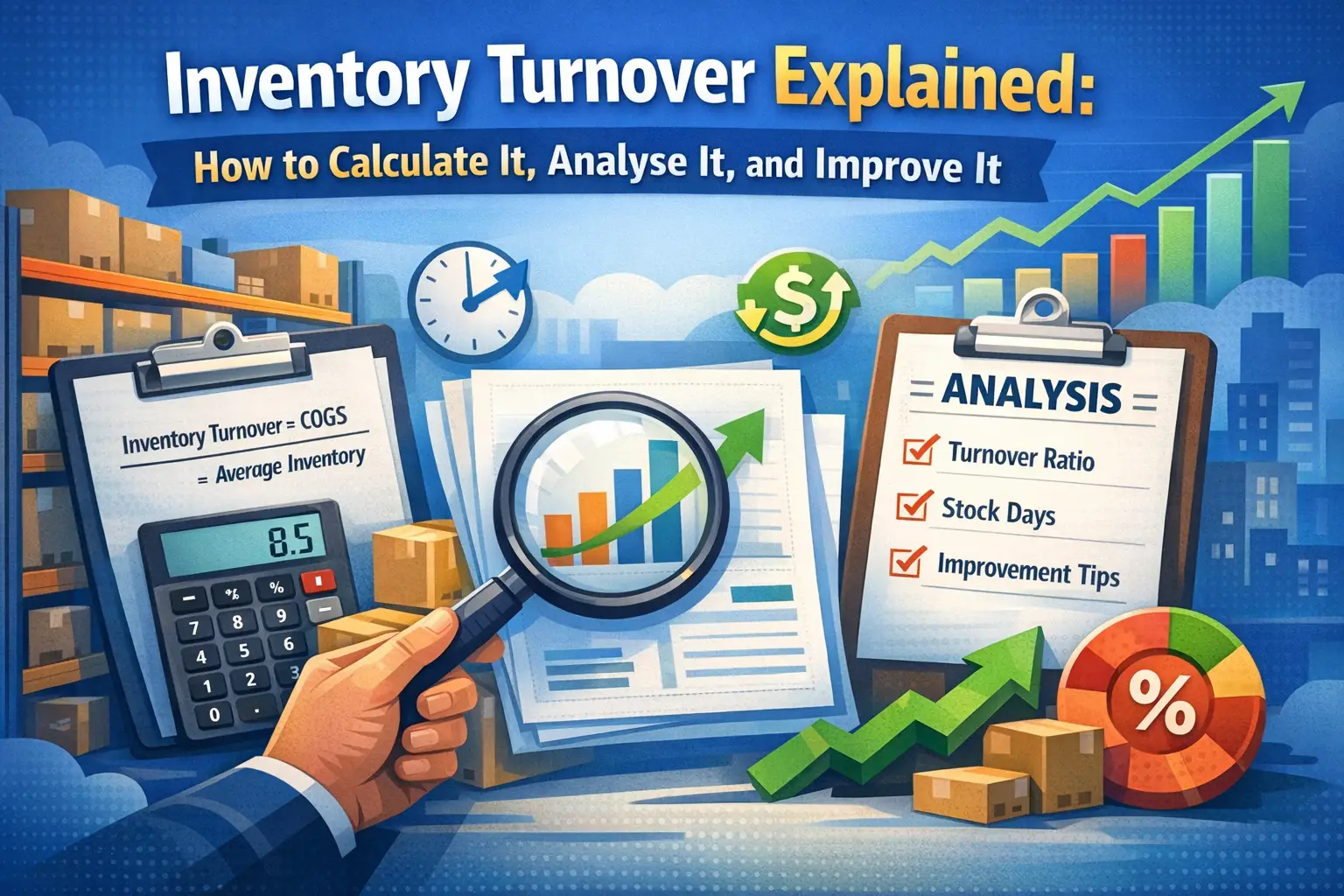
Inventory turnover measures how many times you sell and replace your entire stock in a given period, calculated by dividing your Cost of Goods Sold by your average inventory. To analyse it, compare your ratio against industry benchmarks and segment by category to find what’s dragging it down; to improve it, prioritise fast-moving stock, clear slow movers early, and tighten your supply chain.
If your inventory turnover ratio is so low it needs a coffee and a motivational speech just to move off the shelf, you have a serious problem — and understanding, calculating, and improving your inventory turnover is the single most powerful thing you can do to rescue your cash flow, sharpen your supply chain, and stop your warehouse from looking like a museum of things nobody wanted.
I walked into my own stockroom last year and I swear — the dust on those boxes had its own business cards. The pallet in the corner had been there so long it had squatter’s rights. I’m not saying my old inventory turnover was bad, but archaeologists were leaving me voicemails.
Welcome. I’m your host, The Trader. I’ve spent more years than I care to admit buying, selling, shifting, stacking, counting, and occasionally crying over stock. And if there’s one metric I wish someone had sat me down and explained properly from day one — with real numbers, peer-reviewed evidence, belly laughs, and zero corporate waffle — it’s inventory turnover. So that’s exactly what we’re going to do today.
By the end of this article, you will know precisely what inventory turnover is, why it matters more than you think, how to calculate it without a maths degree, how to benchmark it against your industry, and — most importantly — how to improve it so your business moves faster, breathes easier, and profits harder.
Let’s get into it.
1. What Is Inventory Turnover? (And Why Should You Care?)
Inventory turnover, also known as the inventory turnover ratio or stock turnover ratio, measures how many times a business sells and replaces its entire inventory over a given period — typically one financial year. It is one of the most fundamental efficiency ratios in financial management, sitting right at the intersection of operations, cash flow, and profitability.
Think of it this way: if you run a greengrocers and you sell every apple, pear, and mango you have in stock and restock completely twelve times a year, your inventory turns twelve times. If you run a furniture showroom and your leather sofa sits on the floor for eight months before someone buys it, your turnover is considerably lower. Neither is automatically bad — context is everything. But knowing your number is non-negotiable.
My mate Dave runs a sandwich shop and a furniture store. His sandwich shop turns inventory roughly 365 times a year. His furniture store? He told me last Christmas that one particular velvet chaise longue has been there since the Brexit referendum. He’s started calling it ‘Gerald.’ Gerald has his own section of the showroom now. Gerald is not moving. Gerald is an inventory management failure wearing velvet.
Inventory turnover matters because unsold stock is frozen cash. Every item sitting on a shelf represents money you have already spent — on purchasing, on warehousing, on insurance, on handling — that is not yet returning any value to your business. The longer it sits, the more it costs you. And not just in obvious ways. There is also the opportunity cost: that capital tied up in slow-moving stock could be deployed elsewhere, invested, or used to buy faster-moving lines.
According to the foundational research of Gaur, Fisher, and Raman (2005), published in Management Science, inventory turnover in US retail varies enormously not just across firms but within the same firm year-on-year, with one study finding Best Buy’s annual turnover ranging from 2.85 to 8.53 over a fourteen-year period. This variation — and its causes — is one of the most studied areas in operations management.
So whether you are a sole trader managing a van full of plumbing supplies, a mid-sized manufacturer running a production line, or the finance director of a listed retailer, your inventory turnover ratio is telling you a story. The question is whether you’re listening.
2. How to Calculate Inventory Turnover
The Basic Formula
The inventory turnover ratio is calculated using one of two widely-accepted formulas:
Formula 1 (Most Common): Inventory Turnover = Cost of Goods Sold (COGS) ÷ Average Inventory
Formula 2 (Alternative): Inventory Turnover = Net Sales ÷ Average Inventory
The COGS-based formula is preferred in most academic and professional settings because it avoids distortions caused by profit margins. Using net sales inflates the ratio if your margins are high, making you look more efficient than you actually are. We’ll use the COGS formula throughout this article.
Average Inventory is calculated as: (Opening Inventory + Closing Inventory) ÷ 2
A Worked Example
Let’s say you run a sports equipment shop. Here are your numbers for the year:
- Cost of Goods Sold (COGS): £480,000
- Opening Inventory (1st January): £60,000
- Closing Inventory (31st December): £40,000
- Average Inventory: (£60,000 + £40,000) ÷ 2 = £50,000
- Inventory Turnover: £480,000 ÷ £50,000 = 9.6
This means you turned over your entire inventory 9.6 times during the year. In practical terms, roughly every 38 days you sold through and replaced your entire stock. That’s a solid number for a sporting goods retailer.
I showed this calculation to my nephew who wants to be an accountant. He looked at me, completely straight-faced, and said: ‘Uncle, why didn’t they just sell more stuff?’ I love the boy. I really do. But I’ve hidden all the calculators.
Days Inventory Outstanding (DIO)
Closely related to inventory turnover is a companion metric: Days Inventory Outstanding, also called Days Sales in Inventory (DSI). This tells you the average number of days it takes to sell through your inventory:
DIO = 365 ÷ Inventory Turnover Ratio
Using our example above: 365 ÷ 9.6 = 38 days. So on average, each item of stock was held for 38 days before being sold. The lower this number, the faster your stock moves and the less capital is tied up at any given time.
The peer-reviewed study by Chuang, Oliva and Zhao (2013) in the Journal of Operations Management confirms that DIO is one of the most actionable day-to-day operational metrics available to inventory managers — particularly when benchmarked against industry norms over rolling quarterly periods.
A Note on Inventory Valuation Methods
Your inventory turnover calculation will vary depending on which inventory accounting method your business uses. The three most common are FIFO (First In, First Out), LIFO (Last In, First Out), and Weighted Average Cost. In the UK, LIFO is not permitted under IFRS, but FIFO and Weighted Average are both standard. Be consistent when comparing figures year-on-year or against competitors.
3. What Does a Good Inventory Turnover Ratio Look Like?
Here is where people get confused and — frankly — where a lot of otherwise sensible business owners make poor decisions. There is no single ‘good’ inventory turnover number that applies to every business. A ratio of 3 might be excellent for a yacht dealer and catastrophic for a supermarket.
I once met a guy at a trade show who told me his inventory turnover was 1.2 and he was proud of it. I said, ‘What do you sell?’ He said, ‘Fresh fish.’ I said nothing. I just slowly backed away and never made eye contact again. Sir, your fish should not be sitting around long enough to establish a ratio. Your fish should be gone by Tuesday at the latest.
Industry Benchmarks
Here is a general guide to typical inventory turnover ratios by sector. These figures are drawn from composite industry data and should be used as a starting reference only — always benchmark against direct competitors where possible:
Industry Typical ITR Range Implication
Grocery / Supermarkets 15 — 30x Very fast, perishable goods, thin margins
Pharmaceuticals 4 — 8x Regulated, longer shelf life, steady demand
Electronics / Consumer Tech 4 — 10x Product cycles matter enormously
Apparel / Fashion Retail 4 — 6x Seasonal swings, fast fashion drives higher
Automotive Dealers 3 — 6x High-value, slower-moving stock
Manufacturing (General) 4 — 9x Varies widely by product complexity
Restaurants / Hospitality 20 — 40x Perishables, daily replenishment essential
Furniture / Home Goods 2 — 5x Long purchase cycles, high unit value
Construction / Hardware 4 — 8x Project-driven demand fluctuations
Luxury Goods 1 — 3x Deliberate scarcity is part of the model
The breadth of these ranges underscores a key finding from Gaur, Fisher, and Raman (2005): gross margin, capital intensity, and sales surprise are the dominant factors influencing inventory turnover ratios in retail. A high-margin retailer can sustain a lower turnover; a low-margin, high-volume operator cannot.
Low margin, low turnover. That’s like running a race in flip flops. Uphill. In January. In Leeds. While someone is explaining to you why your KPIs are suboptimal.
High vs Low Turnover: What Does It Actually Mean?
A high inventory turnover ratio generally signals strong sales, efficient purchasing, and lean stock management. It means your business is not tying up excessive capital in unsold goods, and your customers are getting what they want when they want it.
However, a ratio that is too high can also indicate understocking — meaning you run out of popular items frequently, frustrate customers, and lose sales. There is such a thing as turning too fast if your supply chain cannot keep up.
A low inventory turnover ratio generally signals slow sales, overstocking, or the presence of obsolete goods. It can also indicate poor demand forecasting, weak marketing, or a mismatch between what you are buying and what your customers actually want. Cash is tied up, storage costs mount, and the risk of write-offs increases.
I had a low turnover problem once with a batch of novelty USB drives shaped like hot dogs. Don’t ask why I bought them. I bought 2,000 of them on the basis of what I can only describe as a fever dream of optimism. My inventory turnover for novelty hot dog USBs that year was 0.3. My therapist says I have to stop bringing it up. I’m bringing it up.
4. The Financial Evidence: What Research Tells Us About Inventory Turnover
It is one thing to talk about inventory turnover as a useful metric. It is another to understand the weight of peer-reviewed evidence that demonstrates just how deeply it connects to overall business performance.
Inventory Turnover and Profitability
The landmark paper by Park and Kim (2021) published in the Tourism Economics journal examined publicly traded US restaurant companies between 1999 and 2015 and found a statistically significant positive relationship between inventory turnover and corporate financial performance. The study also found that commodity price risk moderated this relationship — reinforcing that inventory management does not operate in isolation from the broader market environment.
Similarly, Hu, Ye, Chi, and Flynn (2014) from Indiana University’s Kelley School of Business analysed Chinese manufacturers and found that supply chain characteristics — including geographic proximity to suppliers, continuity of supplier relationships, and relative bargaining power — all had a significant impact on inventory turnover, which in turn drove return on sales. In other words, how you manage your supply chain determines your inventory performance, which determines your profitability. It’s a chain reaction.
Your supply chain is basically your ex. When it’s reliable, communicative, and shows up on time, everything runs smoothly. When it ghosts you and sends the wrong thing six weeks late, your inventory piles up and your cash flow cries in a corner. The difference is you can fire your supply chain.
Inventory Leanness: A More Nuanced View
Not all research points in one direction. Eroglu and Hofer (2014) demonstrated that the relationship between inventory leanness (low inventory levels relative to sales) and financial performance is in fact curvilinear — meaning there is an optimal level of inventory leanness beyond which profitability actually declines. Running too lean creates stockout risks, lost sales, and customer dissatisfaction. The sweet spot is neither bulging warehouses nor permanently empty shelves.
This finding is echoed by Shin and Eksioglu (2015) who found in their analysis of US manufacturing firms that the benefits of lean inventory management were strongest in industries with high product variety and short product life cycles — such as electronics — and weaker in stable commodity sectors where holding larger buffers made strategic sense.
Inventory and Stock Market Performance
Chen et al. (2005, 2007), cited extensively in Hu et al. (2014), found that manufacturers with abnormally high inventories had abnormally poor long-term stock returns. This is a remarkable finding: your inventory management decisions do not just affect your operational cash flow — they affect how the market values your company. Investors notice when shelves are too full.
Let me get this straight. If I stuff my warehouse with unsold goods, my stock price goes down, my cash flow dries up, and my profit margins shrink? Yes. That’s correct. And yet every January, I watch traders order six months of supply because ‘they got a good deal.’ A good deal on stuff nobody’s buying isn’t a deal. It’s a hostage situation.
5. Case Studies in Inventory Turnover
Case Study 1: Walmart — The Gold Standard
Walmart is the most cited example in inventory management literature, and for good reason. The company consistently achieves inventory turnover ratios in the range of 8 to 9, extraordinary for a mass-market retailer operating at such scale. The key drivers of this performance are well-documented: a supplier collaboration network that shares point-of-sale data in real time, a cross-docking logistics strategy that minimises warehouse holding time, and a relentless focus on everyday low prices that drives consistent sales volume.
The Harvard Business School case study on Walmart, referenced in Gaur et al. (2005), demonstrates how their systems integration with suppliers allowed them to reduce days inventory outstanding from over 50 days to under 40 days between 1988 and 2000 — a period in which their revenues grew from under $10bn to over $165bn. Scale and efficiency, built simultaneously. That is the dream.
Walmart shares real-time sales data with their suppliers so the trucks are practically already in the car park before the product sells. Meanwhile, I’m still sending fax orders in 2019 and wondering why I had a three-week stockout on garden furniture in June. Different leagues, different planets, different galaxies.
Case Study 2: Zara — Fashion at the Speed of Demand
Zara, the Spanish fashion retailer owned by Inditex, has built its entire competitive model around inventory turnover. Rather than the traditional fashion industry model of two seasons per year with massive advance orders, Zara designs, manufactures, and ships new lines every two weeks. Its inventory turnover ratio typically sits between 10 and 15 — astonishing for a fashion retailer.
The secret is vertical integration and speed. Zara manufactures the majority of its products in Europe, close to its supply chain, rather than outsourcing exclusively to lower-cost regions. This costs more per unit but enables near-real-time response to what is actually selling in stores. When a design does not move, production stops. When one is flying off the rails, more is made within days.
The result? Minimal unsold stock, minimal markdowns, and extremely healthy margins despite not competing on price. Zara does not discount because it rarely needs to. Its inventory is almost always fresh.
Zara’s designers once created a new collection because customers in Madrid were wearing more olive green on a Tuesday. I have items in my warehouse I bought because a bloke at a trade show said ‘trust me, these will fly.’ They did not fly. They did not walk. They did not crawl. They sit there in a box, judging me silently.
Case Study 3: Dell — Build-to-Order Brilliance
In the late 1990s and early 2000s, Dell Computers pioneered what became known as the ‘direct model’ — selling computers directly to consumers and building each unit to order only after the sale was confirmed. This approach eliminated finished goods inventory almost entirely.
At its peak, Dell was achieving negative working capital on inventory — meaning it collected payment from customers before it had to pay its suppliers. Its inventory turnover ratio reached extraordinary levels, exceeding 60 in some quarters. This was not just operationally efficient — it was a source of significant competitive advantage, allowing Dell to pass on lower prices while maintaining strong margins.
This model is referenced in Isaksson and Seifert (2014) as a canonical example of how inventory management strategy can transcend mere operational efficiency to become the foundation of an entire business model.
Negative inventory days. Dell literally got paid before it bought anything. I’m sitting here trying to remember if I paid for that pallet of umbrellas I ordered in April. I did. I definitely did. They’re still in the back. It has not rained in my sales pipeline since.
6. Common Causes of Poor Inventory Turnover
Before you can fix a low inventory turnover ratio, you need to understand why it is low. In my experience — and supported by the academic literature — there are six primary culprits:
1. Inaccurate Demand Forecasting
You ordered too much of something because your forecast was wrong. This is the most common cause. It can result from over-reliance on historical data without accounting for market shifts, seasonality errors, product lifecycle miscalculations, or simply gut instinct trumping data. Poor forecasting leads to overstocking of slow movers and understocking of fast movers simultaneously.
2. Supplier Relationship and Lead Time Issues
If your suppliers have long, unpredictable lead times, you are forced to hold larger safety stocks to avoid stockouts. This inflates your average inventory balance and depresses your turnover ratio. As Hu et al. (2014) found, supply chain proximity and relationship continuity are statistically significant predictors of inventory turnover performance.
3. Product Proliferation
Too many SKUs (Stock Keeping Units) spread demand thinly, making it harder to move any individual line quickly. Retailers and manufacturers who expand their product ranges without pruning slow movers consistently see their inventory turnover ratios deteriorate over time.
I once stocked 47 varieties of the same type of training shoe in slightly different colourways ‘to give customers choice.’ Do you know what customers actually chose? The two basic ones they always wanted. The other 45 colourways are still in my stockroom, forming what I have come to call ‘The Rainbow of Regret.’
4. Pricing and Markdown Strategy
If your pricing is too high relative to market demand, products slow down. A reluctance to mark down end-of-season or obsolete stock to clear it compounds the problem. Many traders hold out for full margin on stock that has clearly passed its commercial moment. Pride is expensive.
5. Poor Warehouse Organisation and Visibility
You cannot sell what you cannot find, and you will keep buying what you already have if your stock records are inaccurate. Businesses without robust inventory management systems — even simple ones — consistently suffer from phantom inventory (stock recorded but not actually there) and dark inventory (stock present but not recorded or accessible).
6. Seasonality Without Planning
Every trader knows some products are seasonal. But knowing it and planning for it are different things. Buying too deep before a season, failing to sell down in time, and carrying excess inventory into the off-season is an extraordinarily common and entirely avoidable source of poor turnover.
7. How to Improve Your Inventory Turnover Ratio
Enough diagnosis. Let’s talk solutions. Here are the most evidence-backed, practically tested strategies for improving your inventory turnover ratio — whether you’re a sole trader or a FTSE 250 operation.
Strategy 1: Implement ABC Analysis
ABC analysis categorises your inventory into three tiers based on revenue contribution and sales velocity:
- A-Items: Top 10-20% of SKUs generating 70-80% of revenue. These need the tightest management, most accurate forecasting, and preferably the shortest replenishment cycles.
- B-Items: Middle tier. Moderate attention, automated reorder points.
- C-Items: The long tail. Low revenue, low velocity. Review regularly for discontinuation.
By focusing your ordering precision and supply chain investment on A-items, you move the needle fastest on turnover where it counts most.
I categorised my stock using ABC analysis for the first time in 2021. I discovered that 18% of my SKUs were generating 76% of my revenue and 82% of my profit. The remaining 82% of SKUs? Passengers. Dead weight. I called them the C-Team, and I said it with love but also with a clearance sale.
Strategy 2: Improve Demand Forecasting
Modern inventory management software — even entry-level tools like Brightpearl, Cin7, or Unleashed — offers demand forecasting built on historical sales patterns, seasonality adjustments, and trend analysis. Upgrading from a spreadsheet to a dedicated system can reduce forecast error by 20-40% and directly improve inventory turnover.
For larger businesses, machine learning-based forecasting is increasingly accessible. Studies consistently show that data-driven forecasting outperforms human intuition — particularly for businesses with large, complex product ranges where pattern recognition at scale is beyond any individual’s capacity.
Strategy 3: Negotiate Better Supplier Terms
Shorter lead times, smaller minimum order quantities, and more frequent delivery schedules all reduce the need for large safety stocks. This is not always possible — particularly with overseas suppliers — but even partial improvements have measurable impacts on average inventory levels.
Consider moving towards vendor-managed inventory (VMI) arrangements with key suppliers, where the supplier takes responsibility for maintaining agreed stock levels at your premises. This shifts forecasting risk upstream and reduces your average inventory holding.
I once asked my main supplier if they could deliver twice a week instead of once a fortnight. They looked at me like I’d asked them to personally deliver each unit on a white horse. We negotiated. We compromised. They now deliver every ten days. Progress. Slow, slightly ridiculous progress, but progress.
Strategy 4: Adopt Just-In-Time (JIT) Principles
Just-In-Time inventory management — pioneered by Toyota and studied extensively in the academic literature, including Billesbach and Hayen’s (1994) long-term impact analysis — aims to receive goods only as they are needed in the production or sales process, dramatically reducing holding costs and improving turnover.
JIT is not suitable for every business — it requires reliable, responsive suppliers and stable demand. But even a modified JIT approach, reducing buffer stocks on fast-moving lines while maintaining safety stock only on truly unpredictable items, can yield significant turnover improvements.
Strategy 5: Aggressive Clearance of Slow Movers
This one is uncomfortable for most traders. The psychology of sunk costs makes it painful to mark down stock you paid full price for. But the math is unambiguous: holding slow-moving stock costs you storage space, management time, cash tied up, and eventual write-off risk. An early markdown that clears the stock is almost always more profitable than holding out for a price that may never come.
Practical clearance strategies include: bundling slow movers with fast movers; creating time-limited promotions; selling excess stock through secondary channels such as marketplaces, discount retailers, or liquidators; and — where appropriate — returning stock to suppliers under negotiated terms.
I held onto a pallet of novelty garden ornaments for eleven months hoping they’d sell at full price. They did not. I eventually sold the whole lot for 30p each at a car boot sale on a cold Sunday in November. The lady who bought them said she was going to use them as doorstops. I went home and had a very serious talk with myself about the sunk cost fallacy.
Strategy 6: Rationalise Your Product Range
SKU rationalisation — systematically reviewing your product range and discontinuing lines that are not generating adequate turns — is one of the highest-impact, lowest-cost interventions available. Most businesses, if they are honest, are carrying 20-30% of SKUs that are genuinely not pulling their weight.
A structured rationalisation process involves ranking every SKU by a combined score of revenue contribution, gross margin, and turnover speed; identifying candidates for discontinuation; and redirecting buying budget towards reinforcing your strongest performers.
Strategy 7: Leverage Technology and Automation
Modern inventory management platforms offer automated reorder point calculation, real-time stock visibility across multiple locations, integration with e-commerce platforms for live inventory updates, and reporting dashboards that surface slow movers before they become problems.
For businesses operating across retail, wholesale, and e-commerce channels simultaneously, platforms like NetSuite or SAP Business One offer enterprise-grade inventory intelligence. For SMEs, even a well-configured Shopify or Xero integration with a dedicated stock management plugin represents a transformative upgrade from manual processes.
8. Inventory Turnover in Context: The Bigger Picture
Connecting Inventory Turnover to the Cash Conversion Cycle
Inventory turnover does not exist in isolation. It is one component of the Cash Conversion Cycle (CCC), which measures how long it takes your business to convert its investments in inventory and other resources into cash flows from sales. The CCC formula is:
CCC = Days Inventory Outstanding + Days Sales Outstanding − Days Payable Outstanding
A lower CCC means your business is converting purchases into cash more quickly. Improving your inventory turnover (reducing DIO) directly shortens your CCC — one of the most powerful levers in working capital management.
The Relationship with Gross Margin
Research consistently finds an inverse relationship between gross margin and inventory turnover. Gaur et al. (2005) found this to be one of the strongest empirical relationships in retail performance data: high-margin businesses tend to turn inventory more slowly, because they can afford to. Low-margin businesses must turn faster to generate adequate returns on their invested capital.
This means that when benchmarking your inventory turnover against competitors, you should always control for margin differences. An apples-to-apples comparison requires similar margin profiles.
Margin and turnover are the yin and yang of retail. You either sell a lot of cheap things quickly or a few expensive things slowly. The people who go wrong are the ones trying to sell expensive things quickly and cheap things slowly. That’s not a strategy. That’s a cry for help.
Inventory Turnover Across Business Size
The Norwegian retail study by Dreyer et al. (2021) in the International Journal of Logistics Research and Applications found that larger firms consistently achieved higher inventory efficiency than smaller firms, even within the same retail chain. This is consistent with the economics of scale in procurement, logistics, and systems investment. However, the study also found significant regional variation — stores in more remote locations faced inherent disadvantages due to longer supply lead times.
The implication for small and medium-sized businesses is important: you may face structural disadvantages in inventory efficiency relative to large competitors, but those disadvantages are not insurmountable. Superior local knowledge, agility, and supplier relationships can partially compensate for scale limitations.
9. Measuring, Monitoring, and Reporting Inventory Turnover
Calculating your inventory turnover ratio once a year is better than never doing it. But it is not enough. For inventory management to be genuinely useful, turnover needs to be tracked frequently, segmented by category, and reviewed in trend.
How Frequently Should You Calculate It?
- Annual: Minimum standard. Useful for year-end reporting and comparison with prior years.
- Quarterly: Better. Captures seasonal patterns and allows timely intervention.
- Monthly: Best practice for most retail and distribution businesses. Enables responsive management.
- Weekly or Daily: Appropriate for fast-moving perishable goods businesses such as food retail.
Segmented Analysis
Your overall inventory turnover ratio is an average, and averages hide the truth. A single slow-moving category can drag your whole number down while the rest of the business runs efficiently. Break your analysis down by:
- Product category or department
- Supplier or brand
- Sales channel (retail vs. wholesale vs. e-commerce)
- Location (if multi-site)
- Individual SKU for your highest-volume lines
This granularity allows you to identify precisely where the problems are and direct your interventions accordingly.
I ran a segmented inventory analysis last quarter and discovered that one specific subcategory — safety equipment accessories — had a turnover ratio of 0.8. My response was equal parts alarm and confusion. Turns out my buying manager had misread a discount offer and ordered fourteen months of supply at once. He is no longer my buying manager. He is now in marketing. Do not ask.
Key Performance Indicators to Track Alongside Inventory Turnover
- Gross Margin Return on Investment (GMROI): (Gross Margin ÷ Average Inventory Cost) — measures how much gross profit you generate per pound invested in inventory.
- Stockout Rate: Percentage of time a SKU is out of stock when demanded. Tracks the downside risk of running too lean.
- Dead Stock Percentage: Proportion of inventory that has not moved in 90+ days. Early warning of obsolescence risk.
- Sell-Through Rate: Percentage of received inventory sold within a given period. Particularly useful for seasonal and fashion businesses.
- Forecast Accuracy: How closely your demand forecasts match actual sales. The root cause metric for most inventory problems.
10. The Trader’s Final Word
I’ve been in trade long enough to have made every mistake in this article at least once. I have bought too much, held too long, priced too high, forecast too optimistically, and ignored data in favour of what I felt was going to sell. Every single one of those decisions cost me money and sleep.
Inventory turnover is not a number on a report. It is a vital sign. It tells you whether your business is moving or stagnating, whether your capital is working or sleeping, whether your customers are being served or being let down by empty shelves. Get it right, and your cash flow improves, your margins hold, and your warehouse breathes. Get it wrong, and your working capital suffocates under the weight of things nobody’s buying.
Here’s my final thought on inventory management. Your warehouse is like a gym membership. Paying for it doesn’t make you fit. You have to actually use it, move things through it, keep it fresh. A warehouse full of stuff that isn’t moving isn’t an asset. It’s a very expensive storage unit that you’ve convinced yourself is a business. I say this as a man who once owned both. The gym membership and the stagnant warehouse. Neither was working out.
Calculate your inventory turnover today. Compare it to your industry benchmarks. Find the drag — the slow movers, the phantom stock, the categories where your capital is asleep — and start moving. Literally. The fastest businesses are usually not the ones with the most stock. They are the ones with the rightest stock, in the right amounts, moving at the right speed.
Now go turn some inventory. And remember: if your stock is sitting there long enough to develop a personality, it’s been there too long.
Frequently Asked Questions
1. What is inventory turnover?
Inventory turnover is a financial ratio that measures how many times a business sells and replaces its entire stock during a given period, typically one year.
2. How do you calculate inventory turnover ratio?
Divide your Cost of Goods Sold (COGS) by your average inventory (opening inventory plus closing inventory, divided by two).
3. What is a good inventory turnover ratio?
It depends entirely on your industry — supermarkets typically need 15–30x, while furniture retailers may be perfectly healthy at 2–5x.
4. What does a low inventory turnover ratio indicate?
It usually signals slow sales, overstocking, poor demand forecasting, or the presence of obsolete goods tying up your working capital.
5. Can inventory turnover be too high?
Yes — an excessively high ratio can indicate chronic understocking, leading to frequent stockouts, lost sales, and frustrated customers.
6. What is Days Inventory Outstanding (DIO)?
DIO is a companion metric calculated as 365 divided by your inventory turnover ratio, telling you the average number of days it takes to sell through your stock.
7. Which inventory valuation method should I use when calculating turnover?
Use whichever method your business applies consistently — FIFO or Weighted Average Cost — and never switch methods mid-comparison, as it distorts your results.
8. How does inventory turnover affect cash flow?
Faster turnover means less capital tied up in unsold stock at any given time, directly improving your working capital and shortening your Cash Conversion Cycle.
9. What is the quickest way to improve a poor inventory turnover ratio?
Running an ABC analysis to identify your fastest-moving stock and aggressively clearing slow movers with markdowns or bundling delivers the fastest measurable improvement.
10. How often should I calculate my inventory turnover ratio?
Monthly is best practice for most retail and distribution businesses, though fast-moving perishable goods businesses should track it weekly or even daily.
References
The following peer-reviewed papers and academic sources were consulted in the preparation of this article. Clickable links are provided to each source:
[1] Gaur, V., Fisher, M.L., & Raman, A. (2005). An Econometric Analysis of Inventory Turnover Performance in Retail Services. Management Science, 51(2), 181–194. View Paper
[2] Hu, S., Ye, Q., Chi, W., & Flynn, B.B. (2014). Supply Chain Structure, Inventory Turnover, and Financial Performance: Evidence from Manufacturing Companies in China. Kelley School of Business, Indiana University. View Paper
[3] Dreyer, H.C., Strandhagen, J.O., & Hoff, A.V. (2021). Measuring Inventory Turnover Efficiency Using Stochastic Frontier Analysis: Building Materials and Hardware Retail Chains in Norway. International Journal of Logistics Research and Applications. View Paper
[4] Park, E., & Kim, W.H. (2021). The Effect of Inventory Turnover on Financial Performance in the US Restaurant Industry: The Moderating Role of Exposure to Commodity Price Risk. Tourism Economics. View Paper
[5] Kwak, D.W., Seo, Y.J., & Mason, R. (2018). Analysis of Inventory Turnover as a Performance Measure in Manufacturing Industry. Processes, 7(10), 760. MDPI. View Paper
[6] Panchal, H., Solanki, N., & Patel, A. (2025). Analysis of Inventory Turnover as a Performance Measure in Manufacturing Industry. International Research Journal of Modernization in Engineering, Technology and Science. View Paper
[7] Kumar, S., & Patel, R. (2026). A Study on Using Ratio Analysis to Evaluate a Company’s Performance. International Journal of Research & Technology, 14(S1), 562–568. View Paper
[8] Eroglu, C., & Hofer, C. (2014). Lean, Leaner, Too Lean? The Inventory-Performance Link Revisited. Journal of Operations Management, 29(4), 356–369. Referenced via Dreyer et al. (2021).
[9] Isaksson, O.H.D., & Seifert, R.W. (2014). Inventory Leanness and the Financial Performance of Firms. Production Planning & Control. Referenced via Dreyer et al. (2021) and Hu et al. (2014).
[10] Billesbach, T.J., & Hayen, R. (1994). Long-Term Impact of JIT on Inventory Performance Measures. Production and Inventory Management Journal. Referenced via Gaur et al. (2005).
Disclaimer: This article is for educational and informational purposes only and does not constitute financial advice.
Leave a Reply
You must be logged in to post a comment.