To read annual reports start with the auditor’s report and cash flow statement to verify financial integrity, then work through the five key metrics — revenue growth, gross margin, free cash flow, debt-to-equity, and return on equity — before using Ctrl+F to hunt for red flags like “going concern,” “related party,” and “restatement” in the footnotes. Cross-reference management’s narrative in the CEO letter and MD&A against the actual numbers, and if the story they’re telling doesn’t match what the figures show, trust the figures.
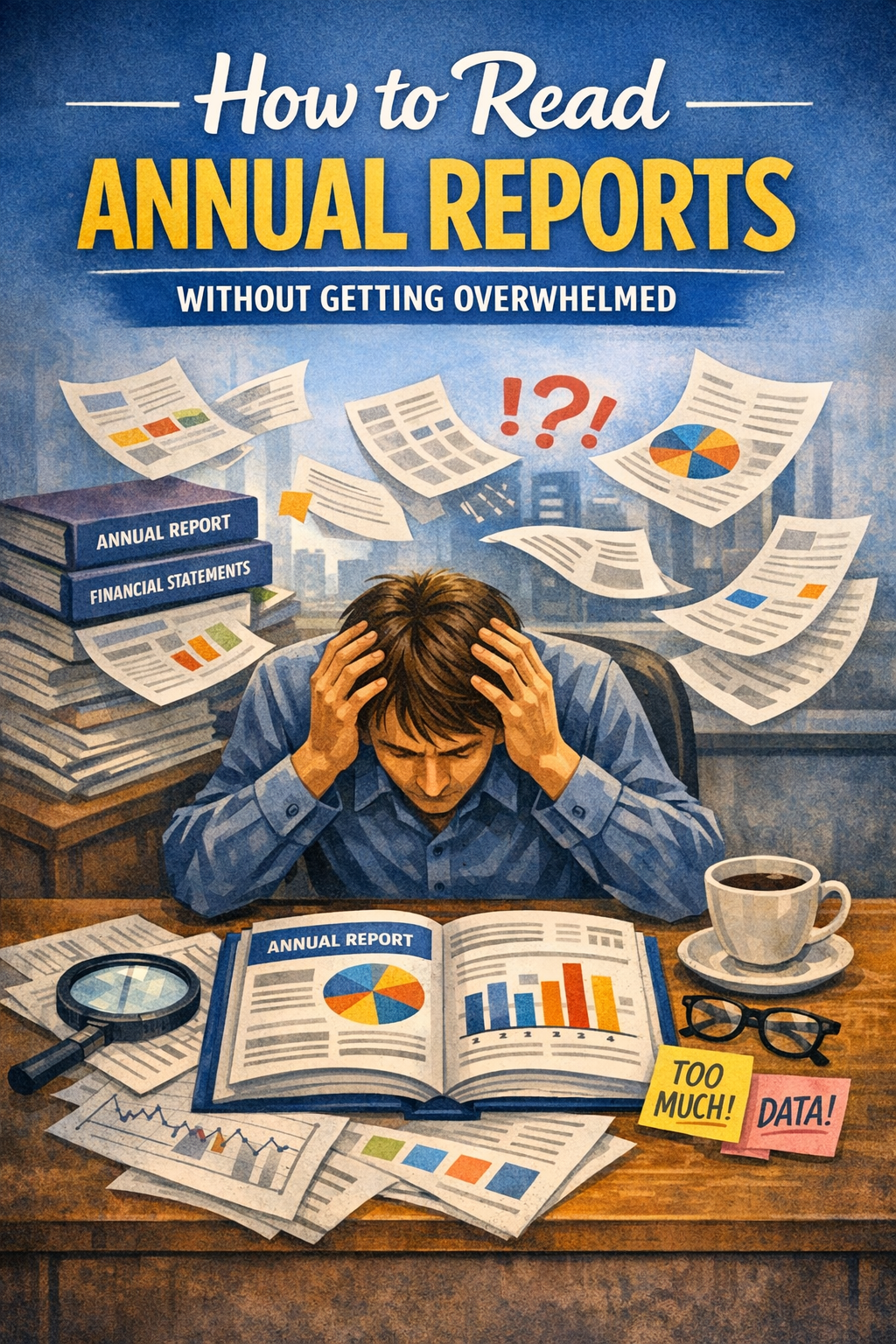
Reading annual reports is the single most powerful skill for stock market investing, yet most investors treat the corporate annual report like a dentist appointment — they know they should go, they keep postponing it, and when they finally sit down with it, everything hurts. You open the PDF: 200 pages. Sections called “Management Discussion and Analysis.” Footnotes written in a font size your optometrist would sue somebody over. Risk disclosures so long and vague they might as well say, “Bad things could happen. We cannot legally promise they won’t.” You close the document. You make a cup of tea. You question your life choices. Sound familiar?
Listen — I have been there. I have stared at an annual report so dense I genuinely started reading the acknowledgements section just to feel like I was making progress. I once spent forty-five minutes on a footnote about “deferred revenue recognition” only to discover it was basically the company saying, “We got paid but we haven’t done the work yet.” That’s it. Four hundred and fifty words to tell me what any waiter in a restaurant could explain in ten seconds. “We got the order. We’re cooking it.”
But here’s the truth — and this is the part where I stop cracking jokes for exactly one paragraph — annual reports are goldmines. They are the closest thing you will ever get to a company sitting across from you at a table and being legally required to tell you the truth. Not the marketing truth. Not the press release truth. The actual, audited, stakes-are-real truth. Once you know how to read one without your brain melting, you will have an edge that most retail investors — and honestly, quite a few professionals — simply do not have.
Research published in the Journal of Finance confirms what experienced traders already know: annual report readability directly affects investor decision-making quality and stock price accuracy. [Loughran and McDonald (2014)]showed that less-readable 10-K filings are significantly associated with higher return volatility — meaning, when companies write confusing reports, markets misprice their stock. When you can read the report clearly, you see the mispricing before the market corrects it. That’s money on the table. And we are here to pick it up.
So grab something to drink (I recommend something strong — this is financial literacy, not a spa day), and let me walk you through the entire annual report, section by section, with zero fluff, maximum jokes, and enough research citations to make your old economics professor weep tears of joy.
Section 1: What Actually Is an Annual Report, and Why Should You Care?
An annual report — also called a 10-K in the United States, or simply the Annual Report and Accounts in the UK — is a comprehensive document every publicly listed company must publish each year. It covers financial performance, business operations, risks, governance, and strategy. It is the company talking to its shareholders, which now includes you, by the way. You are the boss. Act like it.
The annual report is legally required and must be audited by an independent accounting firm. This is not the company’s blog. This is not the company’s Instagram caption reading “Great year! So grateful! 🙏.” This is a document where if they lie, people go to prison. Suddenly it’s a lot more interesting, isn’t it?
Think of the annual report as a report card — except instead of maths and PE, you’re grading Revenue Growth, Debt Management, and Cash Flow. And instead of a stern teacher writing “Could do better,” you have a CEO writing twelve pages about how “macroeconomic headwinds presented challenges to our strategic operational framework.” That means they had a bad year. We’ll translate all of it. Keep reading.
Academic research from [Li (2008)] published in the Journal of Accounting and Economics found a striking pattern: firms with persistently positive earnings tend to write more readable annual reports, while firms with poor performance deliberately write more complex, harder-to-read ones. In other words — when a company’s report reads like someone fed a thesaurus through a shredder and reassembled it at random, that is often intentional obfuscation. They’re hoping you’ll get tired and give up. Don’t give up.
Section 2: The Anatomy of an Annual Report — A Map So You Don’t Get Lost
Every annual report follows roughly the same structure. Knowing this structure means you’ll never again spend twenty minutes scrolling trying to find the actual financial numbers while accidentally reading the Chairman’s golf club membership letter.
2.1 The Chairman’s / CEO’s Letter
This is the opening act — the company’s cheerleader section. The CEO writes a letter to shareholders summarising the year. Read it, but read it with a healthy amount of scepticism. This letter has no legal requirement to be accurate in the way financial statements do. It can be spun, polished, and dressed up like it’s attending the Oscars.
What to look for: Does the CEO acknowledge specific challenges? Do they give actual numbers, or do they speak entirely in adjectives? “Transformative,” “resilient,” “dynamic” — these are red flags. A CEO who says “Revenue declined 12% due to supply chain disruption which we address in detail on page 47” is someone you can trust. A CEO who writes three paragraphs about “our people” and never mentions the revenue decline? That CEO thinks you won’t turn to page 47.
Turn to page 47.
2.2 Business Overview and Strategy
This section describes what the company actually does and where they plan to go. Read it even if you think you already know the business. Companies evolve. A company you think makes shoes might now derive 40% of its revenue from licensing. A company you think is a bank might now be primarily a technology platform. The strategy section also tells you how management thinks about competitive advantage. Is their “moat” genuine? Are their growth plans concrete or vibes-based? Vibes-based growth plans are more common than you’d think.
2.3 The Operating and Financial Review (OFR) / Management Discussion and Analysis (MD&A)
This is where the company narrates its own financial performance. Think of it as the company grading its own exam. They will highlight what went right and, with variable enthusiasm, explain what went wrong. The MD&A is strategically important — [research by Mayew et al. (2015)] found that the quality and transparency of MD&A disclosure is directly linked to a company’s ability to continue as a going concern. In plain English: if the MD&A section is unusually vague or unusually long, something might be getting buried. Read the MD&A and ask yourself: does this feel like someone explaining something, or does it feel like someone explaining their way around something? There’s a difference.
2.4 The Financial Statements — The Only Section Written in Math
Here we go. The three musketeers of corporate finance. The holy trinity. The Destiny’s Child of financial documents (yes, all three matter equally, and yes, the footnotes are the Michelle):
- The Income Statement — Shows revenues, costs, and profits over the year. Did the company make money? How much? After what costs?
- The Balance Sheet — A snapshot of what the company owns (assets), what it owes (liabilities), and what belongs to shareholders (equity) on a specific date.
- The Cash Flow Statement — Where did actual cash come from and where did it go? Profits can be manipulated; cash is much harder to fake.
The Cash Flow Statement is your polygraph test for the Income Statement. Many a corporate fraud has been spotted because someone noticed the company was reporting profits but mysteriously had no cash. Where did the money go? Good question. Ask it every time.
2.5 The Notes to the Financial Statements
Ah, the footnotes. The footnotes are where the real secrets live. They’re written in a font size that suggests the company wants you to read them about as much as airlines want you to read the full safety card. But read them. [Li (2008)] specifically found that in underperforming firms, the Notes section (rather than the MD&A) is more aggressively used as a tool of obfuscation — the negative correlation between poor performance and readability is actually stronger in the Notes. Fascinating. Horrifying. But useful to know.
Look for: related party transactions (the CEO’s cousin’s firm gets £50m in contracts every year — that’s a problem), contingent liabilities (lawsuits, fines, and investigations that haven’t hit the income statement yet), and accounting policy changes. If the accounting policies changed this year, ask why. Companies don’t typically change how they count revenue because they’re bored.
2.6 The Auditor’s Report
The auditor’s report is the part where an independent accounting firm confirms whether the financial statements give a “true and fair view.” A standard unqualified opinion (“clean audit”) is what you want to see. Anything else — qualified opinion, emphasis of matter, going concern doubt — requires immediate attention. An auditor who is uncomfortable is telling you something. Listen.
Section 3: The Five Numbers That Actually Matter (And the Ones That Are Just Decoration)
Let me save you a significant portion of your life. Of the hundreds of numbers in an annual report, five categories will tell you most of what you need to know about whether a company is genuinely healthy or simply very good at looking healthy. It’s like the difference between someone who is actually fit and someone who just wears a lot of Under Armour. The clothes can fool you. The 5K time cannot.
3.1 Revenue Growth (But Verify the Quality)
Is the company selling more this year than last year? Is the growth organic (they earned more customers/sold more product) or acquisition-driven (they bought another company and counted its revenue)? Organic growth is generally better — it means the core business is actually getting stronger, rather than the company spending money on acquisitions to mask a weak core business.
Ask: Is revenue diversified across many customers, or does one customer represent 40% of sales? Concentration risk is a very real and very underappreciated danger. If that one big customer leaves, the revenue goes with them. Watch this number like a hawk wearing reading glasses.
3.2 Gross Margin
Gross margin is (Revenue minus Cost of Goods Sold) divided by Revenue, expressed as a percentage. It tells you how much money the company keeps from every pound or dollar of sales before paying for operations, marketing, and everything else. High gross margins mean the company has pricing power. Apple has gross margins above 40%. Grocery retailers might operate at 20-25%. Neither is inherently good or bad — what matters is whether the gross margin is stable or improving over time. A declining gross margin is a company quietly telling you that competition is eating into its pricing power. That is not a comfortable place to be as an investor.
3.3 Free Cash Flow
Revenues are what management says happened. Cash flow is what actually happened. Free cash flow (operating cash flow minus capital expenditure) is the money the business generates after paying to keep itself running and invest in its future. [A study by Abbassi et al. (2025) in Financial Management] confirms that lower readability in financial statements leads to greater information asymmetry — and nothing strips away information asymmetry like going straight to the cash flow statement. If a company reports soaring net profits but declining or negative free cash flow, you need to understand why. Sometimes there’s a perfectly good reason. Sometimes the reason is fraud. Your job is to find out which.
3.4 Debt-to-Equity Ratio
How much does the company owe relative to what shareholders own? A moderate amount of debt is fine — it’s actually efficient use of capital when debt is cheap. But excessive leverage means that if business gets tough, the company might not survive. The COVID-19 pandemic taught this lesson brutally: companies with strong balance sheets survived and often thrived; companies with excessive debt were destroyed. Businesses that looked incredibly profitable in 2019 were bankrupt by 2020 because they had borrowed too much to fund buybacks and dividends instead of building financial resilience.
A Debt-to-Equity ratio above 2.0 for most non-financial businesses is worth scrutinising closely. For utilities and real estate companies, higher leverage is more normal given the stable, predictable nature of their cash flows. Context matters — but debt always matters.
3.5 Return on Equity (ROE)
Return on Equity measures how efficiently the company generates profit from shareholders’ money. Formula: Net Income / Shareholders’ Equity. Consistently high ROE (above 15-20%) over many years is one of the hallmarks of a genuine quality business. It’s the kind of number that made Warren Buffett say yes to Coca-Cola in 1988. Be careful, though — a company can inflate ROE by taking on debt (which reduces equity) without actually improving profitability. Always check ROE alongside the debt levels.
Section 4: Red Flags — The Annual Report’s Way of Whispering “Run”
I am going to give you a list of things that, when spotted in an annual report, should make every alarm bell in your body go off simultaneously. Think of it as the financial equivalent of seeing a text from your ex that begins with “Hey, so don’t be mad, but…”
4.1 Frequent Changes in Accounting Policies
If a company is changing how it recognises revenue, how it values inventory, or how it depreciates assets — especially if it happens multiple times in a few years — that is a serious red flag. [Lo, Ramos, and Rogo (2017)] found that earnings management — deliberately manipulating earnings to appear more attractive — increases the complexity of annual reports. Complexity is often the cover. Accounting changes are often the mechanism. Pay attention.
4.2 Auditor Changes
Companies changing their auditor — particularly the signing audit partner — without an obvious explanation is concerning. Sometimes there’s a legitimate reason: cost, a firm merger, mandatory rotation. But sometimes the auditor became too uncomfortable asking questions about that odd entry on line 47b of the cash flow statement, and the company decided they preferred an auditor with more… flexible standards. Watch auditor tenure and watch auditor changes.
4.3 Related Party Transactions
If the CEO’s brother-in-law’s logistics company happens to be the company’s primary distribution partner, that bears scrutiny. Related party transactions are disclosed in the notes (another reason to actually read the notes). Some are completely innocuous. Some represent the company’s cash quietly flowing to insiders via artificially inflated contracts. Read them. Evaluate them. And if they seem enormous relative to the company’s size, ask whether those are genuinely arms-length prices.
4.4 Auditor’s Going Concern Emphasis
If the auditors have included a “going concern” note — meaning they have doubts about whether the company can continue to operate — that is about as loud a warning as the corporate world allows. Auditors, by professional nature, are conservative with their language. An auditor saying “there are material uncertainties relating to going concern” is the financial equivalent of your doctor walking in, sitting down very carefully, and saying “So. Let’s talk.” [Mayew et al. (2015)] found that MD&A disclosure quality is strongly predictive of whether a going-concern opinion follows. If the MD&A starts to sound evasive or unusually optimistic without any evidence of operational improvement — that’s often the tell that a going concern opinion is on its way.
4.5 Rapidly Growing Receivables Relative to Revenue
If sales are growing at 15% but accounts receivable (money owed to the company) are growing at 40%, something is off. Either the company is extending extremely generous credit terms to win business (which costs them cash), customers are struggling to pay (which means future revenue might not materialise), or the revenue recognition is aggressive. WorldCom and Enron both showed warning signs in their receivables before their eventual collapse. The numbers told the story before the headlines did.
Section 5: Case Studies — Annual Reports That Told the Truth (And Some That Really Didn’t)
Case Study 1: Berkshire Hathaway — The Gold Standard of Annual Reports
Warren Buffett’s annual letter to Berkshire Hathaway shareholders is the most widely read annual communication in investing. It is written in plain English. It uses humour. It admits mistakes without deflection. Buffett once opened a letter by listing all the specific decisions he got wrong during the year, quantifying the cost to shareholders, and then — only then — discussing the successes. This is not modesty as performance art. This is the deep confidence of someone who knows that honest communication builds long-term trust and long-term shareholder value.
Berkshire’s annual reports demonstrate what research confirms. [A study published in Cogent Economics and Finance (2023)] found that higher annual report readability is positively associated with increased firm investment — meaning companies that communicate clearly are trusted with more capital. Buffett has been proving this empirically for fifty years. The lesson: clear communication is not just nice to have; it is a competitive financial advantage.
Case Study 2: Enron — The Annual Report That Lied With Complexity
Enron’s annual reports from the late 1990s and early 2000s were masterpieces of deliberate complexity. Special purpose entities (SPEs), mark-to-market accounting, and a web of related-party transactions buried the reality of a deeply troubled company beneath layers of financial engineering that even sophisticated analysts struggled to penetrate. The SEC’s plain English mandate of October 1998 — which specifically targeted the obfuscation practices that Enron later embodied — turned out to have been inadequate.
What the reports did not say clearly: Enron was losing money, hiding debt off-balance-sheet, and booking revenue from deals that hadn’t yet generated actual cash. The 2000 annual report was 59 pages long, densely written, and relied on the assumption that readers would either trust management or find the complexity too daunting to interrogate. For most investors, that assumption was correct. For the few analysts who persisted — notably Bethany McLean at Fortune magazine — the complexity itself became the red flag. When a profitable company can’t explain in simple terms how it makes money, that is your answer right there.
Research published in ScienceDirect confirms this pattern formally. [A 2023 study on annual report readability and equity mispricing] found that firms with less-readable annual reports are associated with greater equity mispricing — both overpricing and underpricing. Enron was spectacularly overpriced right up until it wasn’t. The complexity was not accidental.
Case Study 3: Apple Inc. — When the Numbers Tell a Story
Apple’s 10-K filings are technically dense — the company operates across multiple product lines, geographies, and service categories — but they are also models of structured, logical presentation. The company’s segment reporting has evolved significantly as services (App Store, Apple Music, iCloud) became strategically central, and the annual reports have reflected that evolution clearly and early. Investors who read Apple’s 2016 10-K carefully would have noticed the explicit language around the Services segment growth trajectory well before it became the dominant investment thesis for the company in the subsequent years.
The lesson from Apple: even when a report is complex by necessity, look for consistency between the CEO’s narrative and the financial statements. When management says “Services is our growth engine” and then you open the financials and see Services revenue growing at 30% year-on-year while iPhone revenue flattens — the story is coherent. Internal consistency between the narrative and the numbers is a sign of honest, high-quality reporting.
Case Study 4: Patisserie Valerie (UK) — When the Balance Sheet Lied
The Patisserie Valerie accounting scandal, which emerged in 2018, is a masterclass in why you must cross-reference different parts of the annual report. The UK cafe chain appeared profitable and solvent on its income statement. But the balance sheet and, critically, the cash flow statement told a different story. The company had been secretly running up large overdrafts, with massive discrepancies between the cash reported on the balance sheet and actual cash available. KPMG, the company’s auditor, later faced investigation for its failure to detect the fraud.
The key warning sign, in retrospect, was visible in the notes to the accounts — specifically in the bank facility disclosures. The company had far more credit facility headroom than most comparable businesses of its size typically maintain. For some analysts, that was the anomaly worth investigating. The lesson: when a profitable company has unusually large credit facilities and unusually high reported cash balances, it is worth asking whether those cash balances are real. Sometimes — as Patisserie Valerie demonstrated — they are not.
Section 6: How to Build Your Annual Report Reading System (Without Destroying Your Weekends)
Right. You now know what’s in an annual report, what numbers matter, what red flags look like, and what happens when companies decide that financial honesty is optional. Now let’s talk about process, because even the most brilliant investment insight is useless if you never actually sit down and read the document. Here is a practical system for integrating annual report reading into a regular routine without it consuming your entire existence.
Step 1: The Five-Minute Pre-Screen
Before committing to reading an entire annual report, do a five-minute pre-screen. Open the document. Go straight to the auditor’s report — is it a clean opinion, or are there qualifications? Check the going concern note (Ctrl+F “going concern”). Then scan the first paragraph of the MD&A. If the auditor is worried and the MD&A opens with language that would get a C+ in a creative writing class for its inventive vagueness, you might not need to read further. You’ve already learned something important: proceed with extreme caution or avoid the stock.
Step 2: The Twenty-Minute Deep Dive on Numbers
If the pre-screen passes, spend twenty focused minutes on the financial statements. Build yourself a simple mental (or physical) scorecard: Revenue growth? Gross margin direction? Free cash flow positive? Debt-to-Equity ratio acceptable for the sector? ROE above 15%? These five questions will give you a solid quantitative foundation for the company’s health in twenty minutes. If four or five answer favourably, read on. If two or fewer answer favourably, you need to understand why, and whether the company has a credible plan to address the weaknesses.
Step 3: The Strategic Read
Now read the CEO letter and the strategy section with your financial scorecard in hand. Does what management is saying align with what the numbers show? A CEO who talks about pricing power but whose gross margins are declining is either wrong, optimistic to the point of delusion, or not entirely straight with you. Cognitive dissonance between narrative and numbers is one of the most valuable signals in the entire document.
Step 4: The Notes Audit
Set aside another fifteen minutes specifically for the notes. Run a search for: related party transactions, contingent liabilities, accounting policy changes, debt covenants, and segment performance. These five searches will uncover most of the material risks that management would prefer to discuss less prominently. Think of it as going through someone’s texts after they told you the evening went great. The main narrative is always edited. The notes are where the real story lives.
Step 5: Build a Comparison File
Great investors don’t read annual reports in isolation — they read them over time. Create a simple spreadsheet (or notebook) where you track the five key financial metrics for each company you follow across three to five years. Trends tell you far more than a single year’s figures. A company with declining gross margins every year for four years is a company with a structural problem, even if any individual year’s number looks acceptable. Time is the great revealer in financial analysis.
Section 7: The Research Behind Why This Matters More Than You Think
Let’s pause the practical advice for a moment and ground all of this in the academic evidence. Because if I’m asking you to spend real time reading documents that were originally designed, in some cases, to discourage you from reading them, you deserve to know that the effort is genuinely and measurably worth it.
The evidence is overwhelming. [Loughran and McDonald (2014)] established that the linguistic complexity of annual filings is directly linked to information asymmetry and stock return volatility. Simpler filings mean more accurate market pricing. More complex filings mean prices are more likely to be wrong — in both directions. As an informed investor reading what others are skipping, you are fishing in mispricings that complexity creates.
A landmark experimental study — [Rennekamp (2012) in the International Journal of Finance], demonstrated that disclosure readability affects investor judgments through processing fluency: easier-to-read disclosures lead to more confident, more extreme investment judgments. The practical implication is that investors reading difficult text are systematically less confident and less decisive, which means they act more slowly and frequently miss the opportunity window.
There is also a remarkable finding from [a 2023 ScienceDirect study on annual report readability and equity mispricing]: less-readable annual reports are associated with greater equity mispricing, both overpricing and underpricing, and the effect is magnified when individual investor share ownership is high. This means that in companies where retail investors are dominant shareholders, the market is most prone to mispricing from readability effects. This is, in many ways, the small investor’s market inefficiency — and it is exploitable through disciplined annual report reading.
Furthermore, [research on annual report readability and financial flexibility (EFMA, 2020)] found that firms providing easily readable financial disclosures receive improved credit ratings and access to lower-cost debt. In other words, readability is not just a nicety for investors — it is a financial quality signal that correlates with a company’s overall governance and management discipline. Companies with readable reports tend to be better-managed companies. That correlation is not accidental.
Finally — and this is the one that should motivate you more than any other — [a 2016 study in the International Journal of Financial Studies] found that investors with higher financial literacy make systematically more accurate judgements when given more readable disclosures. The research shows that readability and financial literacy interact: investing the time to build your reading skills compounds your returns, because each annual report you read makes you better at reading the next one. Financial literacy is a skill with increasing returns. That is the deal of a lifetime.
Section 8: Tools, Tricks, and Hacks for the Modern Annual Report Reader
We live in a magnificent time for annual report analysis. You no longer need to print 200 pages and attack them with a highlighter (though if you do, I respect the commitment). Here are the tools that make this process materially faster and more effective.
- EDGAR (edgar.sec.gov): The SEC’s free database of all US company filings. Every 10-K ever filed is here. Search by company, compare across years, and download full filings in minutes. If you invest in US stocks and have not bookmarked EDGAR, I do not know what to tell you.
- Companies House (companies.gov.house): The UK equivalent for British companies. Annual accounts, confirmation statements, and director filings, all free. A deeply underused resource for UK retail investors.
- The Gunning Fog Index: A readability formula used in academic research (including the studies cited in this article) to measure how difficult a text is to read. Some tools allow you to paste text and get a readability score. If a company’s MD&A scores higher than a typical academic journal article, that is telling you something.
- Macrotrends.net and Wisesheets: For tracking financial metrics across multiple years without manually building spreadsheets from annual reports. These tools automate the historical comparison work and let you focus your attention on qualitative analysis.
- Ctrl+F (the most underrated analytical tool in finance): Search for “going concern”, “material weakness”, “restatement”, “related party”, “covenant breach”, and “impairment” in every annual report you read. If none of these terms appear, excellent. If they do appear, now you know exactly where to spend your reading time.
One final tool worth mentioning: your own judgement, trained over time. The more annual reports you read, the better your pattern recognition becomes. You develop a sense — a trader’s intuition — for when a document feels evasive, when the numbers feel too clean, when the optimism is genuine versus performative. This intuition cannot be bought, subscribed to, or algorithmically generated. It is built through repetition. And it is worth more, over a career, than any Bloomberg terminal subscription.
Section 9: A Brief Word on Tone — What the Language Tells You
Annual reports are not just financial documents; they are communications. And like all communications, the way something is said tells you as much as what is said. Here is a quick guide to the translator’s dictionary for corporate annual report language.
“We continue to invest in our people and culture.”
Translation: We have high staff turnover and we are hoping a line about “culture” will distract you from the HR costs.
“Macroeconomic headwinds presented challenges to our strategic operational framework.”
Translation: We had a bad year and the economy is getting some of the blame for decisions that were mostly ours.
“We are confident in our ability to navigate the current environment.”
Translation: We are not confident at all, but we are legally prevented from saying “we have no idea what happens next.”
“We have identified certain material weaknesses in our internal controls.”
Translation: Someone somewhere wasn’t doing their job correctly, and our accounting may not be as reliable as we previously suggested. This one is serious. Put down whatever else you’re reading.
The academic term for analysing language patterns in annual reports is “textual analysis” and it’s an active research field. [Loughran and McDonald (2014)] developed a finance-specific word list of positive, negative, uncertain, and litigious words that appear in SEC filings, and showed that the tone of annual report language has significant predictive power for stock returns and volatility. Language is data. Treat it as such.
Conclusion: Go Read an Annual Report. Seriously. Right Now.
We have covered a lot of ground. You now know what an annual report contains and what each section actually means. You know the five financial metrics that matter most, and the five red flags that should prompt either deep investigation or hasty retreat. You have seen real-world case studies of reports that told the truth beautifully (Berkshire Hathaway), reports that lied with complexity (Enron), reports that rewarded patient reading (Apple), and reports that concealed fraud in plain sight (Patisserie Valerie). You have a five-step reading system that won’t consume your weekends. And you have academic research confirming that this effort has a measurable, documented financial return.
The annual report is the company’s most honest document. Not perfect — companies are run by human beings, and human beings have an extraordinary capacity for selective honesty — but the most honest. It is audited. It is legal. It is the place where, if you look carefully enough and read critically enough, the truth surfaces.
Most investors won’t read it. Most traders won’t read it. Most people who own shares in a company have never read that company’s annual report in its entirety. That is your advantage. In financial markets, your edge is almost never about being smarter than everyone else. It’s about being more disciplined, more thorough, and more willing to do the unglamorous work that everyone else is avoiding.
Reading annual reports is unglamorous work. It involves accounting jargon, dense footnotes, and the occasional soul-crushing sentence structure that makes you question whether the author has ever met a human being. But it is also the work that separates investors who understand what they own from investors who are essentially just renting lottery tickets.
You came here for help reading annual reports without getting overwhelmed. I hope I delivered. And I hope I also delivered on making you laugh at least once, because if you can chuckle through the footnotes, you can get through anything. Including the full 200 pages of a Berkshire Hathaway 10-K. Which, for the record, is the best thing you could possibly do with a Saturday afternoon. Buffett has been telling you how it’s done for fifty years. He writes it down every year. Read it.
Now go open EDGAR. Search for a company you own. Find last year’s annual report. Press Ctrl+F. Type “going concern.” Pray you get zero results. And then keep reading. Because this — right here, right now — is where the real money gets made.
Frequently Asked Questions
1. What is an annual report?
An annual report is a legally required, independently audited document that every publicly listed company must publish each year, covering its financial performance, strategy, risks, and governance.
2. What is the difference between an annual report and a 10-K?
A 10-K is the US term for the annual report filed with the SEC, while UK companies file an Annual Report and Accounts — both serve the same purpose but follow different regulatory formats.
3. Which section of an annual report is most important?
The Cash Flow Statement is arguably the most important section because, unlike profits, cash is extremely difficult to manipulate and acts as a polygraph test for the Income Statement.
4. What are the biggest red flags in an annual report?
The most serious red flags include auditor going-concern warnings, frequent accounting policy changes, rapidly growing receivables relative to revenue, and unexplained related party transactions.
5. How long does it take to properly read an annual report?
Using a structured system — a five-minute pre-screen, a twenty-minute numbers review, a strategic read, and a fifteen-minute notes audit — you can complete a thorough analysis in under an hour.
6. Why do some companies write deliberately complex annual reports?
Academic research by Li (2008) found that companies with poor financial performance tend to write more complex, harder-to-read reports as a way to obscure bad results and discourage scrutiny.
7. What is free cash flow and why does it matter?
Free cash flow is operating cash flow minus capital expenditure, and it represents the real money a business generates after funding its own operations — making it a far more reliable measure of health than reported profits.
8. What does a going concern note in an auditor’s report mean?
A going concern note means the auditor has material doubts about whether the company can continue operating, and it is one of the most serious warnings you can find in any annual report.
9. Where can I find annual reports for free?
US annual reports (10-Ks) are freely available on the SEC’s EDGAR database at edgar.sec.gov, while UK company accounts can be accessed free of charge via Companies House.
10. Does reading annual reports actually improve investment returns?
Yes — research by Loughran and McDonald (2014) confirms that investors who can interpret complex filings accurately gain an advantage by identifying mispricings that less-informed investors consistently miss.
References
7. [Annual Report Readability and Equity Mispricing. (2023). Accounting and Finance, ScienceDirect.]
Disclaimer: For educational purposes only. Not financial advice. Always consult a regulated financial advisor before making investment decisions.
Further Reading:
Leave a Reply
You must be logged in to post a comment.