
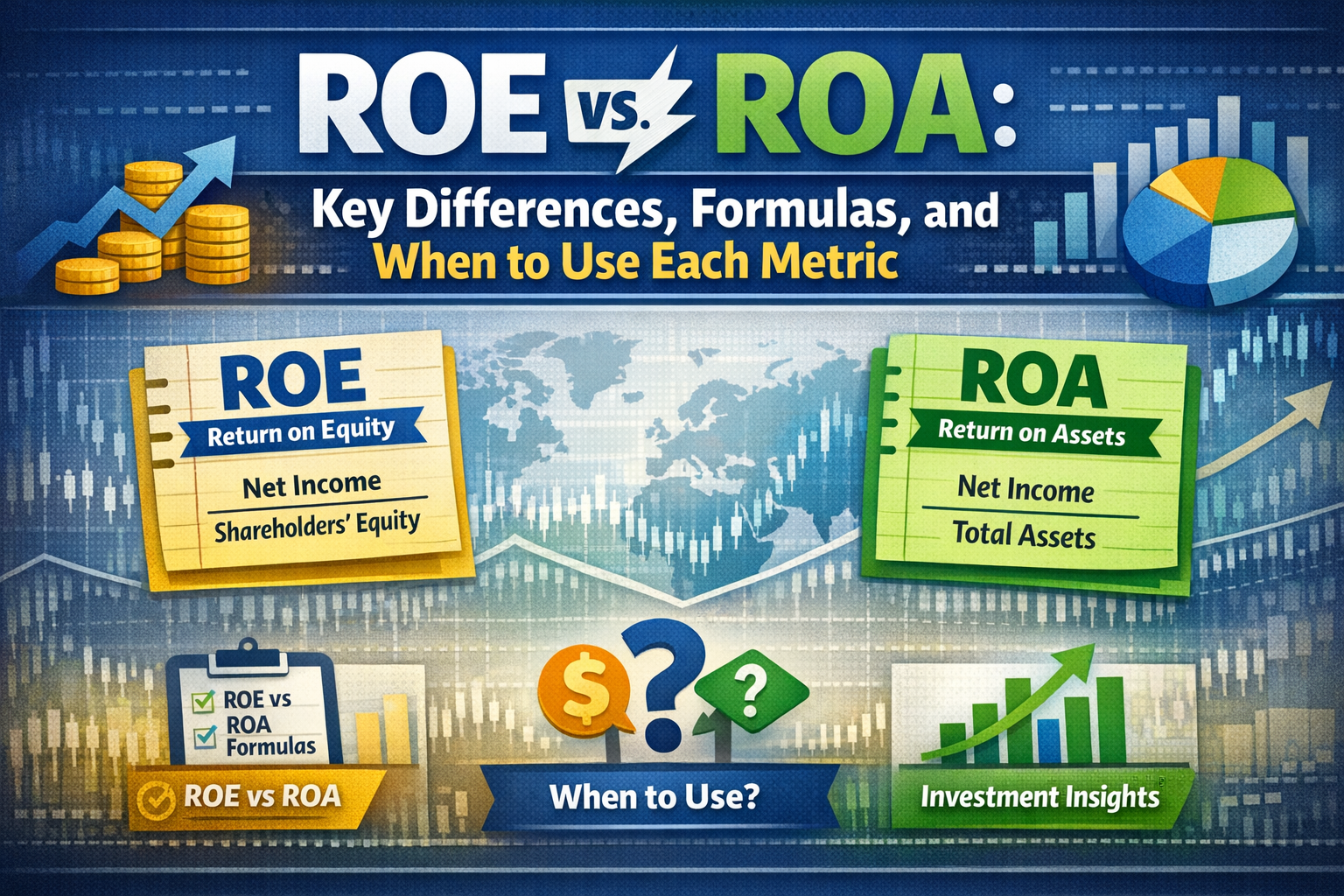
ROE (Return on Equity) and ROA (Return on Assets) are two complementary profitability metrics that together reveal whether a company’s financial performance reflects genuine operational excellence or simply clever use of borrowed money. Understanding both — and the leverage gap between them — is essential for any investor serious about evaluating a business beyond its headline numbers.
📝 TL;DR — Quick Takeaways
- Core Definition: ROE measures how profitably a company uses shareholders’ money, while ROA measures how profitably it uses all its assets — and the gap between them reveals how much debt is doing the heavy lifting.
- Primary Breakdown: Use the DuPont formula (ROE = Net Profit Margin × Asset Turnover × Equity Multiplier) to diagnose whether a company’s returns are driven by genuine operational strength, pricing power, or simply borrowed money.
- Key Takeaway: Never trust a high ROE in isolation — if ROA isn’t rising with it, the company is taking on more debt, not becoming a better business.
Jump to the Decision Framework ↓
If you have ever stared at a company’s financial statements trying to figure out whether you should invest your hard-earned money or run for the hills, then Return on Equity (ROE) and Return on Assets (ROA) — two of the most powerful profitability metrics in finance — are the exact tools you need in your arsenal. And if nobody told you that already, consider this article your official financial intervention.
Let me set the scene. Imagine you are at a restaurant. Two chefs both claim to cook the best jerk chicken in Bradford. Chef A uses premium ingredients, five sous chefs, and a commercial kitchen with every gadget imaginable. Chef B uses a hot plate, one pan, and sheer audacity. They both put out the same plate. Now who is actually the better chef? That right there is the difference between ROE and ROA — and if you do not understand that distinction, you are probably losing money on investments right now. I said what I said.
ROE tells you how efficiently a company generates profit from its shareholders’ equity. ROA tells you how efficiently a company generates profit from ALL of its assets — including the debt-financed ones. Understanding both metrics, when to use them, and how they interact is not optional knowledge for a serious investor or trader. It is mandatory. Like wearing a seatbelt. Or checking a company’s financials before yelling at your broker.
This article will walk you through the formulas, the differences, the case studies, the peer-reviewed research, and — because your trader narrator absolutely cannot help himself — the jokes. By the end, you will know exactly when to use ROE, when to use ROA, and why sometimes you need both like you need two eyes to see the full picture. Per Chao and Goldberg (2022) of the University of Virginia Darden School of Business, “ROA captures the operational aspects of the firm while ROE captures the financing decisions of the firm.” That one sentence is worth £10,000 in tuition fees. You are welcome.
Section 1: What Is ROE (Return on Equity)?
The Definition
Return on Equity (ROE) measures how much net profit a company generates for every pound (or dollar) of shareholders’ equity. Think of it like this: if you gave a company £100 of your own money, ROE tells you how much profit they made with it. A 20% ROE means for every £100 you put in, they made £20 back. A 5% ROE means you might as well have left it in your mattress.
And before someone in the comments says “but what about inflation” — yes, I see you. We will get there. For now, let us understand the basic formula.
The ROE Formula
ROE = Net Income ÷ Shareholders’ Equity × 100
It is that simple on the surface. But like most things that look simple — cooking rice, parallel parking, understanding your partner — there is more going on underneath.
For example, if a company has a net income of £5 million and shareholders’ equity of £25 million, the ROE is: £5m ÷ £25m × 100 = 20%. That is considered a strong ROE in most industries. A consistent ROE above 15–20% is generally seen as a hallmark of a well-run, competitive business.
The DuPont Decomposition of ROE
Here is where it gets spicy. ROE can be broken down into three components using what is called the DuPont Analysis, developed by the DuPont Corporation in the 1920s (yes, the same decade as the Charleston and bathtub gin — they were clearly busy). According to Chao and Goldberg (2022), DuPont decomposition allows for a more detailed performance analysis by breaking ROE into its component parts.
ROE = Net Profit Margin × Asset Turnover × Equity Multiplier
Breaking it down:
- Net Profit Margin = Net Income ÷ Revenue (How much profit per sale?)
- Asset Turnover = Revenue ÷ Total Assets (How efficiently are assets used to generate revenue?)
- Equity Multiplier = Total Assets ÷ Shareholders’ Equity (How much leverage is being used?)
The Equity Multiplier is where things get sneaky. A company can have a sky-high ROE not because they are brilliant operators, but because they borrowed so much money that they have barely any equity left. Their ROE looks amazing on paper, but their balance sheet looks like my cousin’s credit card statement — terrifying. This is precisely why ROE alone is not enough.
A 2021 study published in the Journal of Management Research and Analysis by researchers comparing HUL and ITC (two major FMCG companies) found that “the use of financial leverage was mainly responsible for the whole decrease in return on equity” — confirming that ROE can swing dramatically based on how a company is financed, not just how well it operates.
Industry Benchmarks for ROE
| Industry | Typical ROE Range | Notes |
|---|---|---|
| Technology | 20–35% | High margins, asset-light |
| Banking & Finance | 10–15% | Leverage-driven returns |
| Retail | 15–25% | High turnover model |
| Utilities | 8–12% | Capital intensive, regulated |
| Healthcare | 15–20% | Strong IP moats |
Section 2: What Is ROA (Return on Assets)?
The Definition
Return on Assets (ROA) measures how much net income a company generates relative to its total assets. Unlike ROE, ROA does not care where the money came from — equity or debt. It only cares what the company does with everything it has. Think of it as grading the whole operation, not just the shareholders’ portion.
Here is my favourite way to think about it: ROE is like judging a footballer on how many goals they score per pound of their own boot money. ROA is like judging them on how many goals they score per pound the entire club has spent — boots, training, wages, the fancy grass, everything. Different lens. Same footballer.
The ROA Formula
ROA = Net Income ÷ Total Assets × 100
If a company has net income of £4 million and total assets of £80 million: £4m ÷ £80m × 100 = 5% ROA. Whether that is good or bad depends entirely on the industry. A 5% ROA is exceptional for a bank and embarrassing for a software company. Context is king. And so is knowing your sector benchmarks.
Interestingly, a 2023 critical review published on SSRN by Singh, Gupta, and Chaudhary examined 100 scholarly articles from 2001 to 2021 and found that over 34% of papers used the wrong numerator when calculating ROA — using net income (after tax and interest) instead of the theoretically correct EBIT (earnings before interest and tax). The researchers found this error even in prestigious journals including the Journal of Financial Economics. If the academics cannot agree on how to calculate it, you know it is complicated. Don’t feel bad if you have been confused this whole time. Even the professors are out here doing it wrong.
Why ROA Is a Purer Operational Metric
ROA strips out the financing structure. It tells you: regardless of whether a company borrowed half its assets or raised them through equity, how good is management at converting those assets into profit? Per Chao and Goldberg (2022), ROA “can be shown to be equal to profit margin multiplied by asset turnover,” meaning it inherently captures both pricing efficiency and operational speed.
So when you see two competing businesses with very different balance sheet structures — one loaded with debt, one debt-free — ROA lets you compare them on neutral ground. It is the financial equivalent of a level playing field. Which, as any trader knows, is extremely rare and should be cherished when you find it.
Industry Benchmarks for ROA
| Industry | Typical ROA Range | Key Driver |
|---|---|---|
| Technology / Software | 10–20% | High margins, low assets |
| Banking | 0.5–1.5% | Massive asset base (deposits) |
| Retail / FMCG | 5–10% | High turnover |
| Manufacturing | 3–8% | Heavy equipment costs |
| Real Estate | 1–3% | Property-heavy balance sheets |
Section 3: Key Differences Between ROE and ROA
The Relationship — It Is Complicated (Like Most Relationships)
ROE and ROA are related through leverage. The mathematical relationship looks like this:
ROE = ROA × Equity Multiplier (where Equity Multiplier = Total Assets ÷ Shareholders’ Equity)
This means if a company has the same ROA as a competitor but a higher ROE, the likely explanation is that it has more debt. More leverage. More risk. The ROE is being inflated like a balloon at a kid’s party — impressive from a distance, liable to pop without warning.
A useful quick test? Compute ROE minus ROA. If that gap is large and growing, question what is driving it. Is it operational excellence — or is the company just borrowing money and hoping for the best? Because hope is not a financial strategy. I cannot stress this enough.
Per researchers at the Federal Reserve Bank of New York (Begenau and Stafford, as cited in New York Fed Staff Report No. 855), banks with low ROA sometimes attempt to maintain high ROE by using higher leverage — and stock market investors, sometimes irrationally, reward them for it. This is what I call the financial equivalent of putting on a nice shirt for a Zoom call while wearing pyjama bottoms — you look profitable from one angle only.
Side-by-Side Comparison
| Feature | ROE | ROA |
|---|---|---|
| Formula | Net Income ÷ Equity | Net Income ÷ Total Assets |
| What it measures | Equity efficiency | Asset efficiency |
| Affected by leverage? | Yes, significantly | No (mostly) |
| Best for comparing | Companies with similar capital structures | Cross-sector comparisons |
| Risk indicator | Can mask debt risk | Better operational purity |
| Ideal user | Equity investors | Management, analysts, cross-sector |
The Leverage Trap — A Warning Your Broker Probably Never Gave You
Here is something that should genuinely make you pause. Imagine two companies: Company Alpha and Company Beta. Both earn £10 million in net income.
- Company Alpha: £50m equity, £50m debt → Total Assets: £100m → ROE = 20%, ROA = 10%
- Company Beta: £20m equity, £80m debt → Total Assets: £100m → ROE = 50%, ROA = 10%
Company Beta’s ROE is 50%! Sounds incredible, right? You would be screaming at your broker to buy it. But wait — their ROA is identical to Company Alpha. The only difference is that Company Beta is carrying four times as much debt. In a rising interest rate environment (like, say, the one most of us have been living through), Company Beta is dangerously exposed. High ROE. Same operational quality. Much more risk. If ROE alone was on your screen, you would have missed that entirely.
This is why traders — real ones, not the Instagram ones — use both metrics together. Always. No exceptions. Not sometimes. Always.
Section 4: Case Studies — ROE and ROA in the Real World
Case Study 1: Apple Inc. — When ROE Gets Silly (In a Good Way)
Apple is famous for its astronomical ROE. In recent years, Apple has reported ROE figures north of 100% — which sounds impossible until you realise that Apple has been aggressively buying back its own shares, reducing shareholders’ equity dramatically. Less equity denominator = higher ROE. But Apple’s ROA has also been strong, typically ranging from 15% to 28%, which tells you that this is not purely a leverage story. Apple is genuinely converting its assets into profit at an exceptional rate.
The DuPont breakdown of Apple reveals fat profit margins, efficient asset usage, and moderate-to-high leverage — a combination that reflects an elite business. But the lesson? Do not see 100%+ ROE and assume it is leverage trickery. Check the ROA. If it is also high, you are looking at a real performer. If ROA is low and ROE is sky-high, run.
I am not saying run literally. Though you could. Exercise is good. But definitely exit the investment quickly.
Case Study 2: UK Banking Sector — Low ROA, Higher ROE
Banks are a perfect illustration of why you cannot use ROA and ROE interchangeably across sectors. As noted in the New York Federal Reserve Staff Report, banks operate with enormous asset bases — primarily customer deposits — which crushes their ROA to the 0.5–1.5% range. But because equity is a small portion of those assets, their ROE can look quite respectable (10–15%).
A retail bank with £500 billion in assets and £30 billion in equity earning £5 billion net income has: ROA = 1%, ROE = 16.7%. Looks great on the ROE line. Looks terrifying if you do not understand that leverage is baked into the business model. Compare that bank’s ROA to a FTSE 100 tech company with a 20% ROA and you might think the bank is barely surviving. But that 1% is perfectly normal — even good — for a bank. Context is everything in finance. Context and coffee.
Case Study 3: HUL vs ITC — A Peer-Reviewed Head-to-Head
A real-world peer-reviewed case study published in the Journal of Management Research and Analysis (2021) compared two giants of India’s FMCG sector: Hindustan Unilever Limited (HUL) and ITC Limited.
The researchers found that HUL had a significantly higher Total Asset Turnover Ratio (TATR) than ITC, suggesting HUL was generating more revenue per unit of assets. However, ITC’s equity multiplier showed different leverage patterns. The study concluded that “financial leverage was mainly responsible for decreases in ROE” — meaning that when leverage shifts, ROE shifts dramatically even if core operations have not changed.
Lesson: two companies in the same industry, same country, similar scale — and yet ROE and ROA told completely different stories about their performance. This is exactly why analysts always run both.
And if you are thinking “I just check the stock price” — respectfully, come on, bro. The stock price is the result. ROE and ROA help you understand the cause. You would not only look at the score of a football match without watching any of the play. Would you? Actually, do not answer that.
Case Study 4: Retail Sector — The Debt-Fuelled ROE Mirage
Consider a hypothetical mid-size UK retailer — let us call it “BargainWorld PLC.” In 2019, BargainWorld reported a 25% ROE, which had analysts nodding approvingly. But a closer look at the ROA revealed only 4% — well below the sector average of 7–9%.
The gap: BargainWorld had taken on significant debt to fund store expansions and a new supply chain system. Their ROE looked healthy because equity had been thinned out relative to profits. But their ROA told the real story: the assets were not being put to efficient use. When interest rates rose in 2022–2023, the debt burden ate into net income, ROE collapsed to 9%, and the company had to close 80 stores.
If investors had been watching ROA alongside ROE, the warning signs were there. The ROE was a magician’s trick. The ROA was the truth.
Section 5
When to Use ROE vs ROA — The Decision Framework
Use ROE When…
- You are an equity investor specifically interested in shareholder returns.
- Comparing companies within the same industry with similar capital structures — so leverage is not distorting the comparison.
- Evaluating management’s ability to generate profits from the money shareholders have entrusted to them.
- Assessing dividend capacity and share buyback sustainability — both depend on equity generation.
- Screening for Buffett-style moat businesses — consistently high ROE over multiple years is evidence of durable competitive advantage.
Use ROA When…
- Comparing companies across different industries or with significantly different capital structures.
- Evaluating operational efficiency independent of financing decisions — you want to know how well management uses what they have.
- Analysing capital-intensive businesses like manufacturers, utilities, and airlines, where total assets tell a crucial story.
- Assessing management quality at companies where heavy borrowing makes ROE unreliable.
- Running merger and acquisition analysis where you need to understand underlying operational profitability before assessing capital structure changes.
Use BOTH When…
Honestly? Use both all the time. The gap between ROE and ROA is itself informative. A widening gap over time — even if both numbers look fine individually — can signal increasing leverage and accumulating risk. Think of it as the financial equivalent of watching two people who are drifting apart. Individually they look fine. Together, something is clearly off.
As researchers at Daloopa’s financial analytics platform note: a large difference between ROE and ROA often reflects heavy debt usage, and if that difference balloons from 5 percentage points to 15 percentage points over a year, it is time to question whether debt pays off long term or just inflates short-term profit metrics. That is the professional standard. Five-year trend lines. Peer comparisons. DuPont decomposition. That is how serious analysts roll.
Section 6: Common Mistakes Investors Make with ROE and ROA
Mistake #1: Ignoring the Leverage Component of ROE
We have beaten this one up already, but it deserves its own slot in the hall of shame. Seeing a 30% ROE and buying without asking “what is the equity multiplier?” is like buying a house because the living room looks nice and ignoring that it is built on a sinkhole. Do the full DuPont. Every time. It takes five minutes. Your future self will thank you.
Mistake #2: Cross-Sector Comparisons Using Only ROE
Comparing a bank’s ROE to a tech company’s ROE is like comparing a submarine’s speed to a sports car’s speed. They operate in completely different environments with completely different asset structures. A bank with 12% ROE might be exceptional. A tech firm with 12% ROE might be underperforming spectacularly. Always compare within sectors, and use ROA when you need to cross sector lines.
Mistake #3: Looking at a Single Year in Isolation
One year of great ROE or ROA can be a one-off. An asset sale, a tax refund, an extraordinary gain — any of these can spike metrics temporarily. The smart approach is to look at five-year trends. Consistent ROE above 15% over five years? That is a moat. One year of 40% ROE followed by 3% the next? That is a red flag wearing a Halloween costume.
Mistake #4: Not Adjusting ROA for Industries with Abnormal Structures
The definition of ROA itself is contested. As noted in Singh, Gupta, and Chaudhary’s 2023 SSRN paper, over 34% of academic papers used net income rather than EBIT in the ROA numerator — producing a mathematically inconsistent result. When using ROA for comparison, ensure you and any data source you reference are using the same definition. Mixing EBIT-based ROA with net-income-based ROA in a comparison is like measuring one room in feet and another in metres — technically you have numbers, but the comparison is meaningless.
Mistake #5: Forgetting About Negative Equity
If a company has negative shareholders’ equity — which happens when accumulated losses or share buybacks wipe out equity — ROE becomes mathematically meaningless. Per Professor Aswath Damodaran of NYU Stern, “when [negative book value of equity] occurs, the return on equity becomes a meaningless number.” Switch to ROA or ROIC in these situations. ROE has left the building. It cannot help you here.
Section 7: Advanced Applications — ROE, ROA, and the DuPont Framework in Practice
The Full Three-Stage DuPont Model
The three-stage DuPont model breaks ROE into:
ROE = (Net Income ÷ Revenue) × (Revenue ÷ Total Assets) × (Total Assets ÷ Equity)
= Net Profit Margin × Asset Turnover × Equity Multiplier
Each component reveals a different dimension of business quality:
| Component | What It Tells You | Good Sign |
|---|---|---|
| Net Profit Margin | Pricing power and cost control | Consistent and growing |
| Asset Turnover | Operational efficiency | High relative to sector |
| Equity Multiplier | Leverage intensity | Stable and explainable |
The DuPont framework allows you to diagnose exactly WHY ROE has changed year-over-year. Did profitability improve? Did the company speed up its asset usage? Or did it just borrow more? Those are three very different stories with very different investment implications. And only the DuPont breakdown will reveal which one is true.
ROE, ROA, and ROIC — The Full Picture
For the truly serious analyst, Return on Invested Capital (ROIC) completes the trinity:
ROIC = Operating Income (after tax) ÷ (Debt + Equity)
ROIC captures returns on ALL invested capital — both debt and equity — making it arguably the purest measure of management quality. If ROIC consistently exceeds the company’s Weighted Average Cost of Capital (WACC), the company is creating genuine shareholder value. If ROIC < WACC, the company is destroying value, regardless of what the ROE or ROA headline numbers say. Per Damodaran’s return measures analysis, ROIC is preferable when comparing companies with fundamentally different financing structures.
Here is the hierarchy of metric usefulness depending on your question:
- “Is this company rewarding shareholders well?” → Use ROE
- “Is management using assets efficiently?” → Use ROA
- “Is this company creating genuine economic value?” → Use ROIC vs WACC
- “Should I compare two companies in different industries?” → Use ROA or ROIC, not ROE
Section 8: Practical Steps for Calculating and Interpreting ROE and ROA
Step 1: Find the Right Numbers
You need net income from the income statement, total assets from the balance sheet, and shareholders’ equity from the balance sheet. For a full DuPont, you also need revenue. All of these are in any company’s annual report. In the UK, companies listed on the London Stock Exchange file annual reports through the Regulatory News Service (RNS). In the US, they file 10-Ks with the SEC. Both are publicly available. There is no excuse for not looking.
Step 2: Use Average Rather Than Year-End Figures
A common best practice is to use average equity and average assets (beginning of year + end of year, divided by 2) rather than just the year-end snapshot. This smooths out seasonal fluctuations and acquisitions that may skew the denominator. Some analysts even use quarterly averages for greater precision. The point is consistency — pick a method and stick to it.
Step 3: Compare Against the Right Benchmark
Compare ROE and ROA against: (a) the company’s own historical trend, (b) direct sector peers, and (c) sector averages from reliable databases. Bloomberg, Refinitiv, MSCI, and free databases like Macrotrends provide historical ratio data. Use at least three years of data — ideally five — before drawing conclusions.
Step 4: Look for Consistency and Quality of Earnings
A consistently high ROE driven by strong profit margins and asset turnover (rather than leverage) is the gold standard. If ROE is being driven by the equity multiplier alone, treat it with caution. If ROA is declining while ROE holds steady, that is your warning signal. The gap is telling you something. Listen to it.
Section 9: ROE and ROA in Modern Portfolio Analysis
Modern portfolio theory and factor investing have incorporated profitability metrics — including ROE and ROA — as key variables. Research from the academic finance community has established a profitability factor in asset pricing models, building on the foundational work of Fama and French. Companies with high and improving ROA have been shown to generate excess risk-adjusted returns in multiple market conditions.
A study published by the International Journal of Economics, Business and Management Research (2021) confirmed that “Return on Assets significantly impacted firm value” and that “an increase in ROA will provide a good signal for investors.” The research found ROA to be a stronger predictor of firm value than ROE in certain market conditions — particularly in environments where leverage levels are distorting ROE signals.
For quant-focused traders and algorithmic investors, ROA filtering — particularly screening for upward trends in ROA over three to five years — has been used as a signal for quality stocks. The logic: if a company is getting better at turning assets into profit over time, that is structural improvement. Structural improvement compounds. Compounding is the whole game.
And if I have to explain to you why compounding is the whole game, we need to have a much longer conversation over tea. I am based in Bradford. The kettle is always on.
Section 10: Key Takeaways — The Trader’s Cheat Sheet
| Concept | Summary |
|---|---|
| ROE Formula | Net Income ÷ Shareholders’ Equity × 100 |
| ROA Formula | Net Income ÷ Total Assets × 100 |
| ROE inflated by? | Debt (leverage) and share buybacks |
| ROA best for? | Cross-sector, operational comparison |
| ROE best for? | Equity investor perspective, same-sector comparison |
| DuPont breakdown | ROE = Profit Margin × Asset Turnover × Equity Multiplier |
| Red flag | ROE rising while ROA falls or stays flat |
| Benchmark rule | Always compare within industry and across 3–5 years |
| Next-level metric | ROIC — compares return to all invested capital |
Conclusion
ROE and ROA are not competitors. They are teammates. Like salt and pepper. Like a good broker and a functioning Excel spreadsheet. You need both. Used together with the DuPont framework, compared within sectors, tracked over multiple years, and supplemented by ROIC for the full picture — these two metrics will tell you more about a business than almost any other single analysis you can do.
ROE answers: “How well is this company rewarding its shareholders?” ROA answers: “How efficiently is management actually running this operation?” Together they answer: “Is this a genuinely great business, or is it just great at borrowing money and making the balance sheet look nice?”
The best companies — the ones that make traders rich and keep them rich — have both strong ROE AND strong ROA. They do not need financial engineering to look good. Their fundamentals do the heavy lifting. Apple. Microsoft. Companies with genuine moats, pricing power, and operational excellence. THAT is what you are screening for.
So the next time someone shows you a stock with a 45% ROE and expects you to be impressed, do yourself a favour. Ask about the ROA. Ask about the equity multiplier. Run the DuPont. Check five years of data. And if they cannot answer any of that — respectfully, politely, with total composure — run.
And on that note, your trader has spoken. Go forth. Do the maths. Make the gains. And for the love of everything, stop buying stocks based on TikTok.
Frequently Asked Questions
1. What is the difference between ROE and ROA?
ROE measures profit generated from shareholders’ equity, while ROA measures profit generated from all assets regardless of whether they were funded by debt or equity.
2. Which is more reliable — ROE or ROA?
ROA is generally a purer operational metric because it is not distorted by a company’s debt levels the way ROE can be.
3. Can a company have a high ROE but still be a risky investment?
Yes — a high ROE can be inflated by heavy borrowing, meaning the company carries significant debt risk that the ROE figure alone will not reveal.
4. What is a good ROE?
A consistently maintained ROE above 15–20% is generally considered strong, though benchmarks vary significantly by industry.
5. What is a good ROA?
A good ROA depends heavily on the sector — 10–20% is strong for technology firms, while even 1% can be healthy for a bank.
6. What is DuPont analysis and why does it matter?
DuPont analysis breaks ROE into net profit margin, asset turnover, and equity multiplier, revealing exactly which factor is driving — or distorting — a company’s returns.
7. What does it mean if ROE is rising but ROA is flat or falling?
It typically signals that the company is taking on more debt rather than improving its underlying operational performance.
8. Why do banks have low ROA but decent ROE?
Banks operate with enormous asset bases funded largely by customer deposits, which suppresses ROA, but their small equity base keeps ROE comparatively higher.
9. When should I use ROIC instead of ROE or ROA?
Use ROIC when you want to assess whether a company is creating genuine economic value by comparing returns against the total cost of all capital invested.
10. Should I compare ROE across different industries?
No — ROE comparisons are only meaningful within the same industry, since capital structures differ so significantly that cross-sector ROE comparisons are misleading.
References {#references}
- Chao, R. O., & Goldberg, R. (2022). How Operations Impacts Financial Performance. Darden Case No. UVA-OM-1779. Available at SSRN: https://ssrn.com/abstract=4261610
- Singh, R., Gupta, C. P., & Chaudhary, P. (2023). Defining Return on Assets (ROA) in Empirical Corporate Finance Research: A Critical Review. Available at SSRN: https://papers.ssrn.com/sol3/Delivery.cfm/SSRN_ID4779961_code5905458.pdf?abstractid=4638078&mirid=1
- Joshi, V. D., et al. (2021). Financial Analysis by Return on Equity (ROE) and Return on Asset (ROA) — A Comparative Study of HUL and ITC. Journal of Management Research and Analysis, 8(3), 131–138. https://doi.org/10.18231/j.jmra.2021.027
- Bahaj, S., et al. (2020). Why Do Banks Target ROE? Federal Reserve Bank of New York Staff Reports, No. 855. https://www.newyorkfed.org/medialibrary/media/research/staff_reports/sr855.pdf
- Damodaran, A. Return on Capital (ROC), Return on Invested Capital (ROIC) and Return on Equity (ROE): Measurement and Implications. NYU Stern School of Business. https://pages.stern.nyu.edu/~adamodar/pdfiles/papers/returnmeasures.pdf
- International Journal of Economics, Business and Management Research (2021). Effect of Return on Assets (ROA) and Return on Equity (ROE) on Firm Value. Vol. 5, No. 04. https://ijebmr.com/uploads/pdf/archivepdf/2021/IJEBMR_736.pdf
- Daloopa Analytics (2024). ROE vs ROA: Key Financial Metrics for Investment Analysis. https://daloopa.com/blog/analyst-best-practices/roe-vs-roa
Disclaimer: For educational purposes only. Not financial advice. Always consult a regulated financial advisor before making investment decisions.
Further Reading:
Leave a Reply
You must be logged in to post a comment.