
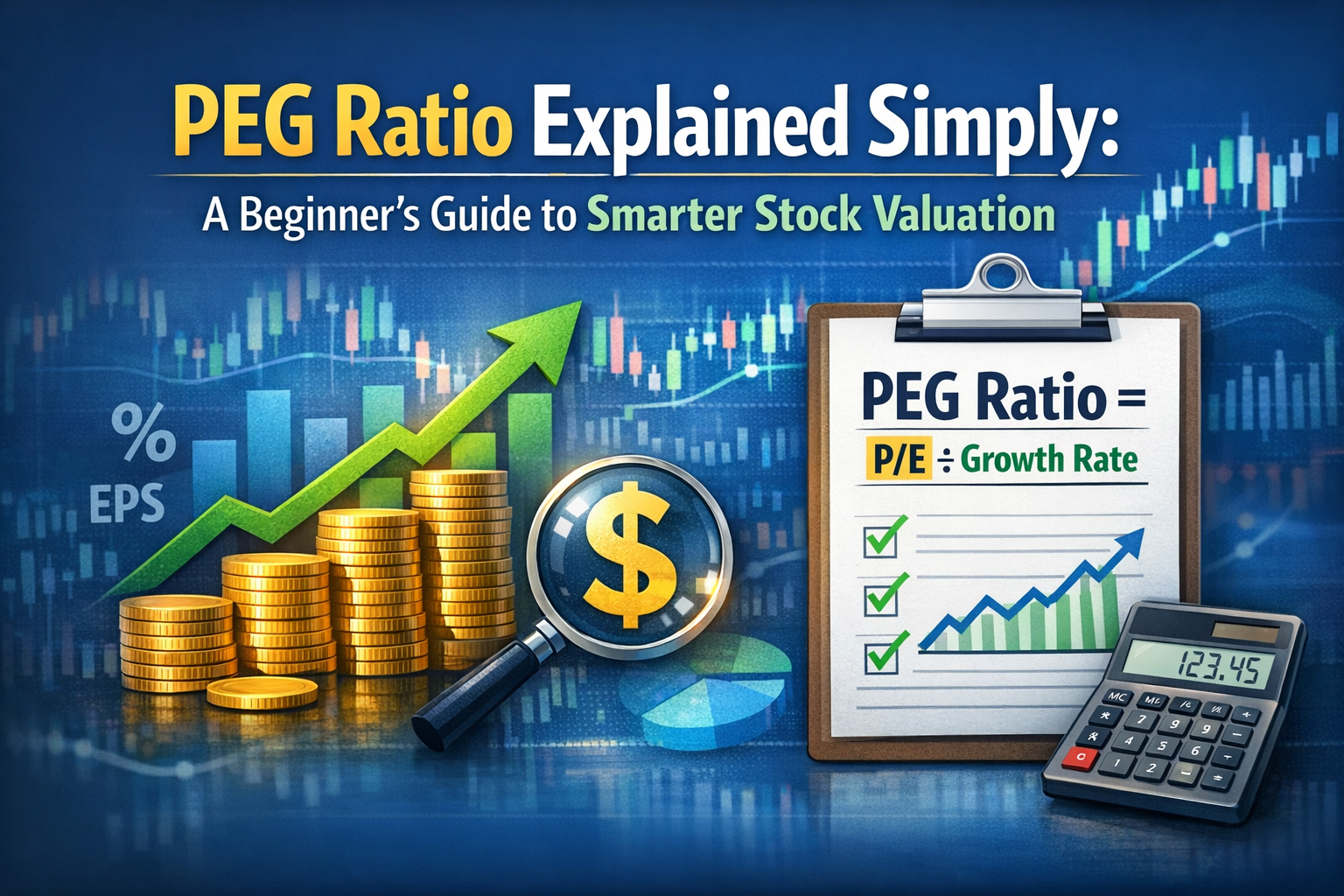
The PEG ratio (Price-to-Earnings-to-Growth) improves on the P/E ratio by factoring in a company’s earnings growth rate, giving investors a clearer picture of whether a stock’s price is justified. A PEG below 1.0 suggests potential undervaluation, 1.0 signals fair value, and above 1.0 may indicate you’re overpaying for growth.
📝 TL;DR — Quick Takeaways
- Core Definition: The PEG ratio (Price-to-Earnings-to-Growth) improves on the P/E ratio by dividing it by a company’s earnings growth rate, revealing whether a stock’s price is truly justified by its growth potential.
- Primary Breakdown: Calculate it with one formula — PEG = P/E ÷ Annual Earnings Growth Rate (%) — where below 1.0 signals potential undervaluation, 1.0 signals fair value, and above 2.0 signals you’re likely overpaying.
- Key Takeaway: The PEG ratio is a powerful first screening filter, but must always be paired with balance sheet health, free cash flow, and sector context to avoid costly misreads.
Jump to the 5-Step PEG Stock Screening Framework ↓
If you have ever stared at a stock’s PEG ratio, price-to-earnings-to-growth ratio, and P/E ratio while wondering why nobody warned you that investing would feel like trying to read ancient Egyptian hieroglyphics during a fire drill — welcome, friend. You are in exactly the right place. My name is The Trader, and I have spent years in the markets getting humbled, occasionally enlightened, and consistently entertained by the beautiful chaos that is stock valuation. Today, we are cracking open the PEG ratio like a piñata at a birthday party, and trust me, the candy inside is worth every confused swing.
😂 I showed my cousin a stock’s PEG ratio once. He looked at me dead in the eye and said, ‘So… is this like the number of legs it has?’ I said no. He said ‘But it’s under 1, right? So it’s like… a tripod?’ I had to take a walk.
The PEG ratio — short for the Price-to-Earnings-to-Growth ratio — is one of the most powerful and tragically underused tools in a stock investor’s toolkit. While beginners obsess over a stock’s price alone (‘it went up so it must be good!’), and intermediate investors graduate to the Price-to-Earnings (P/E) ratio, the truly savvy investor uses the PEG ratio to understand whether a stock’s current price actually makes sense given how fast the company is growing. It’s the difference between knowing a restaurant is expensive and knowing whether the food justifies the price. Spoiler: sometimes it does, and sometimes you’re paying $40 for a tiny bowl of pasta.
In this guide, we will cover everything you need to know about the PEG ratio: what it is, how to calculate it, how to interpret it, its limitations, how professional investors use it, and real-world case studies that prove its power. Along the way, I will be cracking jokes, because life is short, markets are wild, and you might as well laugh while you learn.
1. What Is the PEG Ratio? The Big Picture
Let’s start at the very beginning, because as someone once said in a musical I was forced to watch at my cousin’s school play, it is a very good place to start. The PEG ratio is a stock valuation metric that takes the well-known Price-to-Earnings (P/E) ratio and adds a crucial layer: the company’s expected earnings growth rate. The formula is beautifully simple:
PEG Ratio = P/E Ratio ÷ Annual Earnings Growth Rate (%)
So if a company has a P/E ratio of 20 and is expected to grow its earnings at 20% per year, its PEG ratio is 1.0. If another company has a P/E of 20 but only grows earnings at 10% per year, its PEG ratio is 2.0. Same P/E, very different story.
😂 The P/E ratio without growth context is like judging a car purely by how fast it’s going right now, ignoring the fact that one car is accelerating and the other one is coasting downhill with no engine. One of those is gonna be a problem.
The concept of the PEG ratio was originally conceived in the 1960s by British investor James D. Slater, but it was legendary fund manager Peter Lynch who truly brought it into the mainstream. Lynch, who managed the Magellan Fund at Fidelity Investments and delivered average annual returns of 29.2% between 1977 and 1990, popularised the PEG ratio through his bestselling book One Up on Wall Street (1989). Lynch argued that a stock is fairly valued when its PEG equals 1.0. Below 1.0, it could be undervalued. Above 1.0, you might be overpaying. ^[1]^
Academic research has extensively examined this claim. A landmark study by Easton (2004), published in The Accounting Review, formally investigated the relationship between PEG ratios, P/E ratios, and the implied expected rate of return on equity capital. Easton’s work demonstrated that PEG-based estimates of expected returns are substantially more accurate than those based purely on the P/E ratio. The correlation between PEG-implied returns and actual realised returns was meaningfully higher. ^[2]^
2. Why the P/E Ratio Alone Is Not Enough
Before we can truly appreciate the PEG ratio, we need to understand why the P/E ratio — as useful as it is — has a critical blind spot. Think of the P/E ratio as the price tag on a piece of art. It tells you what someone paid for it. It does not tell you whether the artist is about to blow up on the international scene or whether they are about to retire.
😂 Using only the P/E ratio to pick stocks is like swiping right on dating apps based purely on someone’s current photo. You see what’s in front of you, but you have absolutely zero idea where they’re headed. And sometimes the person with the great photo has absolutely no growth potential. I’m speaking financially, of course.
Consider two hypothetical companies: TechRocket Inc. and SlowAndSteady Corp. Both have a P/E ratio of 25. On the surface, they look identical in terms of valuation. But TechRocket is growing earnings at 25% per year, while SlowAndSteady is grinding along at 5% per year. The P/E ratio tells you nothing about this difference. The PEG ratio tells you everything.
P/E vs. PEG Comparison
Company P/E Ratio Growth Rate PEG Ratio (%)
TechRocket Inc. 25 25% 1.0
SlowAndSteady 25 5% 5.0 Corp.
TechRocket, at a PEG of 1.0, appears fairly valued. SlowAndSteady, at a PEG of 5.0, appears significantly overvalued relative to its growth. This is the insight the PEG ratio unlocks. Research published in the South African Journal of Business Management found that a PEG-based trading rule delivered annual abnormal returns of 13.7% over the study period, particularly for small-capitalisation firms with above-market growth prospects. ^[3]^
3. How to Calculate the PEG Ratio Step-by-Step
Calculating the PEG ratio is easier than parallel parking on a busy street. And unlike parallel parking, you won’t end up sweating through your shirt while seventeen people watch from the pavement.
😂 I once tried to explain PEG calculations to my barber. He listened for about 30 seconds, then said, ‘So it’s P divided by E divided by G?’ I said yes. He nodded slowly and said, ‘Like a Pegasus. Makes sense.’ And honestly? That’s as good a memory device as any. Flying horse = growth potential. I’m keeping it.
Step 1: Find the P/E Ratio
The P/E ratio equals the stock’s current price divided by its earnings per share (EPS). For example, if a stock trades at $50 and its EPS is $2.50, the P/E ratio is $50 ÷ $2.50 = 20. This is widely available on any financial data platform such as Yahoo Finance, Bloomberg, or Morningstar.
Step 2: Identify the Earnings Growth Rate
This is where it gets interesting — and where investors need to make a choice. The growth rate ‘G’ in the PEG formula can be calculated two ways:
- Trailing PEG: Uses the historical earnings growth rate over the past 12 months or five years.
- Forward PEG: Uses analyst consensus estimates for future earnings growth, typically over the next 1-5 years.
Most professional investors prefer the forward PEG because valuation is fundamentally about the future, not the past. However, forward estimates carry uncertainty. As research from Aswath Damodaran at NYU Stern notes, PEG ratios require consistency: the earnings growth must correspond to the same EPS figure used in the P/E computation, and the growth period should align with the time horizon of the P/E ratio. ^[4]^
Step 3: Divide P/E by Growth Rate
PEG = P/E ÷ Growth Rate (%) | Example: P/E of 20, Growth of 15% → PEG = 20 ÷ 15 = 1.33
That is the entire calculation. A PEG of 1.33 means investors are paying a modest premium relative to the company’s growth. Whether that premium is justified depends on context — which we will explore in depth.
😂 My friend called me at 11pm to ask what the PEG ratio of his favourite meme stock was. I said I wasn’t checking that at 11pm. He said ‘just divide the P/E by the growth rate!’ I said ‘The growth rate is negative.’ Long silence. Then: ‘So the Pegasus is… underground?’ Yes. Yes it is. The Pegasus is very underground right now.
4. Interpreting the PEG Ratio: What the Numbers Mean
Now that you can calculate it, let’s talk about reading it. The PEG ratio is not a magic number that reveals absolute truth — it is a directional indicator that must be interpreted within context. Think of it as a compass, not a GPS.
PEG < 1.0: Potentially Undervalued
A PEG below 1.0 suggests the stock may be undervalued relative to its expected growth. According to Peter Lynch’s original framework, stocks with a PEG below 0.5 are most likely undervalued, making them strong candidates for investigation. Research published by RSIS International studying mid-cap IT stocks listed on the NSE India confirmed that stocks with a PEG below 1 delivered remarkably higher returns compared to broader market returns over a five-year period. ^[5]^
😂 PEG below 1 is like finding a designer handbag at a car boot sale. You look around nervously. You pick it up. You whisper ‘Is this real?’ And then you run. You do not ask questions. You just run.
PEG = 1.0: Fairly Valued
A PEG of exactly 1.0 represents Lynch’s classic benchmark for fair value. The stock’s price is proportional to its growth. You’re paying a reasonable price for what you get. It’s the financial equivalent of a restaurant where the menu prices match the quality — you leave satisfied, not excited, not robbed.
PEG > 1.0: Potentially Overvalued
A PEG above 1.0 signals you may be paying a premium above fair value. A PEG above 2.0 is generally considered overvalued, though high-quality growth companies with durable competitive advantages (sometimes called ‘moats’) frequently trade at elevated PEG ratios because the market assigns premiums for predictability and scalability. According to the Management Science Letters study by Lajevardi (2014), if the PEG ratio exceeds 1, it indicates either that the price of stocks has been overestimated, or that the market expects a dividend growth rate much higher than currently predicted in future years. ^[6]^
😂 PEG over 2 is like paying for business class on a one-hour flight. Is it technically possible to justify? Yes. Does it make financial sense? Buddy, I need you to be honest with yourself right now.
PEG Ratio Interpretation Guide
PEG Range Signal Interpretation
< 0.5 Strongly Undervalued Potentially significant bargain — investigate further
0.5 — 1.0 Undervalued Growth not fully priced in — strong candidate
1.0 Fairly Valued Price proportional to growth — Lynch’s benchmark
1.0 — 2.0 Slightly Overvalued Modest premium — may be justified for quality stocks
> 2.0 Overvalued Paying significantly above growth value — proceed carefully
5. Real-World Case Studies: The PEG Ratio in Action
Theory is wonderful, but the market is where theory meets reality and sometimes gets absolutely humbled. Let us look at some real-world examples of how the PEG ratio has played out in practice. I will name names — company names, not the names of the analysts who got it catastrophically wrong, because I have manners.
Case Study 1: Apple Inc. (AAPL) — The Premium That Made Sense
For much of the early 2010s, Apple traded at what looked like a reasonable P/E ratio of 15-20. But its earnings growth was explosive — often exceeding 20-30% annually during its iPhone super-cycle years. This produced PEG ratios frequently below 1.0, suggesting that despite Apple’s high absolute stock price, it was actually undervalued relative to its growth. Investors who used the PEG ratio recognised this signal when the broader market was still debating whether Apple had ‘peaked.’ Between 2010 and 2020, Apple’s stock price increased by over 900%. The PEG ratio was pointing at this potential the whole time.
😂 Apple’s PEG ratio was basically screaming ‘Buy me!’ like a lonely Labrador at a shelter. Some people walked right past. Those people have a story they tell quietly at dinner parties now.
Case Study 2: Netflix (NFLX) — When High PEG Was Justified
Netflix consistently traded at PEG ratios well above 1.0 — sometimes above 3.0 or even 5.0 — during its streaming growth phase. Traditional value investors looked at these numbers and ran away faster than I run from buffet tables. But investors who understood the context — the global shift to streaming, the network effects of content libraries, international expansion — recognised that a high PEG can be justified when the competitive moat is deep and the total addressable market is vast. Netflix’s stock climbed from roughly $10 in 2010 to over $500 by 2021. The lesson: PEG ratios need to be understood in sector context.
Case Study 3: The Tech Bubble of 2000 — When PEG Ratios Were Ignored
Here is the cautionary tale. During the dot-com bubble of the late 1990s, investors broadly abandoned valuation discipline. Companies with no earnings — let alone earnings growth — were being valued at astronomical levels. The PEG ratio, which requires both a P/E and a meaningful growth rate, couldn’t even be calculated for many of these firms. When the bubble burst in 2000-2002, the NASDAQ lost approximately 78% of its value. This remains one of history’s most compelling arguments for maintaining valuation discipline using tools like the PEG ratio. Academic research published in the arxiv.org paper on growth-adjusted price-earnings ratios (2020) specifically highlighted how the PEG ratio’s very simplicity can be a limitation but also its primary strength as a heuristic discipline tool. ^[7]^
😂 The dot-com bubble era investor walked into a stock screener, saw a company with no revenue, no growth, and no earnings, and said ‘Yeah I’ll take 10,000 shares.’ The PEG ratio would have said ‘Sir this is undefined. This is mathematically undefined. I can’t help you.’ And yet. And yet.
Case Study 4: Indian Mid-Cap IT Stocks — PEG Beats the Market
A rigorous empirical study published in the RSIS International Journal of Research in Science analysed mid-cap IT stocks listed on the NSE India. Researchers calculated PEG ratios based on EPS Compound Annual Growth Rate (CAGR) and P/E ratios, then tracked performance over five years. The results were compelling: stocks with PEG ratios below 1.0 delivered significantly higher returns compared to market benchmarks consistently over the study period, validating Peter Lynch’s original thesis in the Indian market context. This cross-market validation is significant — it suggests the PEG ratio’s utility is not culturally or geographically limited. ^[5]^
6. The Limitations of the PEG Ratio
I would be doing you a profound disservice if I presented the PEG ratio as a flawless oracle that will make you rich while you sleep. No single metric does that — and if someone is trying to sell you one, please exit the conversation immediately and check your wallet.
😂 The PEG ratio is an excellent tool. It is also just a tool. A hammer is a great tool. You can build a house with a hammer. You can also accidentally hit your thumb with it. Know your tools, respect your tools, and maybe wear protective equipment.
Limitation 1: Growth Estimates Are Guesses
The ‘G’ in PEG depends entirely on earnings growth forecasts, which are predictions. Analyst forecasts have a mixed track record. Research by Bradshaw (2006), cited in the South African Journal of Business Management study, found that analysts’ growth estimates can be optimistic. When applied to PEG ratios, overly optimistic growth estimates artificially reduce the PEG ratio and send buy signals that may not materialise. ^[3]^
Limitation 2: It Doesn’t Work With Negative Earnings or Growth
The PEG ratio is mathematically undefined — or meaningless — when either earnings or growth is negative. Early-stage companies, cyclical businesses in downturns, or firms undergoing restructuring cannot be meaningfully evaluated using PEG. As Damodaran of NYU Stern explains in his valuation frameworks, alternative metrics such as EV/EBITDA or Price-to-Sales ratios are better suited for firms in these conditions. ^[4]^
😂 Negative earnings and a PEG ratio? That’s like asking Google Maps for directions and entering your destination as ‘somewhere over the rainbow.’ It’ll try. It’ll really try. But you’re both going to end up confused.
Limitation 3: It Ignores Risk, Dividends, and Debt
A company with a PEG of 0.8 but a debt-to-equity ratio of 5.0 and no dividend is a very different investment from a company with a PEG of 0.8, zero debt, and a healthy dividend yield. The PEG ratio simply does not capture these dimensions. Estrada (2004) at IESE Business School, whose work is widely cited in PEG ratio literature, argued for a PERG (Price-Earnings-to-Risk-and-Growth) ratio that adjusts for market beta and risk — acknowledging that raw PEG ratios can be misleading for higher-risk stocks. ^[8]^
This is precisely why the PEGY ratio — which adds dividend yield to the denominator — was developed. The PEGY formula is: P/E ÷ (Earnings Growth Rate + Dividend Yield). This makes it particularly useful for mature, dividend-paying companies where the raw PEG might overstate overvaluation. Research published in the Journal of Contemporary Issues in Business and Government (2021) tested PEGY ratios in the Indian Banking sector and found superior explanatory power over raw PEG for mature, dividend-heavy stocks. ^[9]^
Limitation 4: PEG Is a Heuristic, Not a Valuation Model
Perhaps the most important caveat: the PEG ratio, as highlighted in the ArXiv paper on growth-adjusted price-earnings (2020), lacks intrinsic valuation significance. Unlike a discounted cash flow (DCF) model, the PEG ratio does not embed the time value of money, discount rates, or terminal values. Two stocks can have identical PEG ratios while offering materially different investment opportunities because of these unobserved factors. ^[7]^
7. How Professional Investors Actually Use the PEG Ratio
The PEG ratio is not used in isolation by serious investors. It is one instrument in an orchestra. Played alone, it can give you a tune. Played with others, you get a symphony. Let me show you how the professionals layer it.
😂 My finance professor once said ‘no single metric should drive an investment decision.’ I wrote that down. Then I watched a friend buy a stock because the number was low and it had a cool logo. I thought about my professor. I said nothing. I watched. It went down 60%. The logo was still cool though.
The GARP Strategy: Growth at a Reasonable Price
The GARP (Growth at a Reasonable Price) investment strategy — championed by Peter Lynch and Warren Buffett’s philosophy of buying wonderful companies at fair prices — uses the PEG ratio as its central filtering tool. GARP investors seek stocks with PEG ratios below 1.0 or close to it, combining growth potential with valuation discipline. Research by Hodnett and Hsieh (2012), cited in the CIBGP study (2021), found that GARP strategies using PEG ratios as valuation filters produced superior returns compared to pure growth stock portfolios over extended examination periods. ^[9]^
Using PEG Alongside Other Metrics
Professional analysts typically screen stocks using PEG as a first filter, then layer in additional criteria:
- Return on Equity (ROE): Is the company efficiently generating profits from shareholder equity?
- Free Cash Flow (FCF): Is earnings growth backed by real cash generation, not accounting manoeuvres?
- Debt-to-Equity Ratio: How leveraged is the company? High debt amplifies both gains and losses.
- Industry PEG comparisons: Comparing a tech company’s PEG to other tech companies, not to utilities.
- Earnings quality: Are EPS figures based on core operations, or inflated by one-time items?
This multi-factor approach addresses the PEG ratio’s known limitations. The Potential Payback Period (PPP) framework introduced by Sam (2025) in a recent SSRN paper specifically extends PEG analysis by integrating earnings growth, discount rates, and risk into a unified time-based framework, offering a Stock Internal Rate of Return (SIRR) that quantifies what the PEG ratio implies about total expected returns. This is the cutting edge of PEG-based valuation methodology. ^[1]^
Sector-Specific PEG Benchmarks
Different sectors have different growth profiles, and therefore different ‘normal’ PEG ranges. Technology companies, which often grow at 15-30% annually, naturally attract higher PEG ratios than utility companies growing at 3-5% annually. Here are rough sector benchmarks that experienced investors use as guideposts:
- Technology: PEG of 1.5-2.5 may be reasonable given growth potential and scalability.
- Healthcare & Biotech: PEG of 1.0-2.0 typical, adjusted for pipeline risk.
- Consumer Staples: PEG of 1.0-1.5, reflecting lower growth but higher predictability.
- Utilities: PEG of 1.0-2.0, with PEGY (dividend-adjusted) often more meaningful.
- Financials: PEG is less useful; EV/Book and ROE comparisons are preferred.
😂 A banker once told me PEG ratios don’t apply to banking stocks. I said ‘Why not?’ He looked at me like I asked why fish don’t climb trees. ‘Because,’ he said carefully, ‘the metrics are different.’ I nodded. I still don’t fully understand banking valuations. Neither does anyone else. That’s a separate article.
Stock Screening Framework
Let’s get practical. Here is a step-by-step framework for using the PEG ratio as part of a disciplined stock screening process. This is how you go from theory to actually making investment decisions — still always with appropriate caution and, ideally, advice from a qualified financial professional.
😂 I am legally required to remind you that nothing in this article is financial advice. I’m a trader, not your financial advisor. Please do not email me asking whether to put your retirement savings into a stock because it has a low PEG. I cannot help you. I will not help you. I will, however, laugh quietly to myself.
Step 1: Use a Stock Screener
Free and paid stock screening tools such as [Finviz], [Zacks], Yahoo Finance, and Morningstar allow you to filter stocks by PEG ratio. Start by screening for PEG ratios between 0 and 1 in your target sector.
Step 2: Verify the Growth Estimate Source
Check whether the PEG uses trailing (historical) or forward (analyst-projected) growth. Understand the consensus number — is it based on 5 analysts or 50? A consensus from a larger analyst pool is generally more reliable.
Step 3: Cross-Reference with Fundamental Health
For each stock that passes your PEG screen, review: the balance sheet (especially debt levels), free cash flow trends, ROE over three-to-five years, and whether the company has consistently met or beaten earnings estimates. Consistent earnings beats suggest conservative guidance, which is a positive signal.
Step 4: Compare PEG Within the Sector
Never evaluate a PEG ratio in isolation from sector peers. A software company with a PEG of 1.8 might be a bargain compared to sector peers trading at 3.0. Context is everything.
Step 5: Consider the Margin of Safety
Benjamin Graham — the grandfather of value investing — always insisted on a margin of safety: buying at a price significantly below intrinsic value to protect against errors in estimation. Even when a stock screens well on PEG, look for a margin of safety in case your growth estimate proves too optimistic. A PEG of 0.7 gives you more margin for error than a PEG of 0.95.
9. The PEG Ratio and the Behavioural Finance Dimension
Here is something that does not get discussed enough: the PEG ratio is not just a mathematical tool. It is a behavioural anchor. Markets are driven by human emotion — fear, greed, narrative, and herd behaviour. The PEG ratio is a systematic counterweight to irrational exuberance and irrational despair.
😂 The stock market is basically a room full of very smart people who occasionally all panic at the same time and start selling everything like someone just yelled ‘FIRE!’ in the building. And then they all feel embarrassed about it six months later when everything recovered. The PEG ratio is the friend who grabs your arm and says ‘wait — is this actually on fire? Let me check the fundamentals first.’
During market downturns, high-quality companies often see their PEG ratios compress dramatically as prices fall faster than earnings estimates adjust. This creates genuine buying opportunities for disciplined investors. During market euphoria, PEG ratios expand as prices race ahead of growth. This is when the PEG ratio serves as a warning signal. Research across multiple markets — from the NYSE and NASDAQ to the NSE India and the Thai Stock Exchange — consistently finds that PEG-based strategies outperform over full market cycles precisely because they force investors to pay attention to growth relative to price, not just price momentum alone. The Thai Stock Market study cited in the CIBGP paper found that PEG ratio-based investing yielded higher returns than the market from 1999 to 2010 — a period that included two major crashes. ^[9]^
10. Advanced PEG Concepts for the Serious Beginner
If you’ve made it this far, congratulations. You are no longer a beginner. You are a well-informed intermediate investor who knows enough to ask better questions. Let’s tackle a few advanced concepts that will sharpen your PEG-based analysis even further.
😂 I call this section ‘Advanced Beginner’ the same way gyms call their third-hardest class ‘Intermediate Fitness.’ You think you’re not ready. You are more ready than you think. It’s going to hurt a little. You’ll be fine.
The Forward PEG vs. Trailing PEG Debate
Academically, the forward PEG is preferred for prospective investment decisions because valuation is inherently forward-looking. However, Easton (2004) in his seminal Accounting Review paper demonstrated that PEG ratios derived from analyst consensus forecasts provide substantially better estimates of the implied expected rate of return compared to P/E ratios alone, but cautioned that forecast quality is paramount. When analyst coverage is thin or the company operates in a rapidly changing environment, trailing growth rates with a conservative discount may actually be more reliable. ^[2]^
The PERG Ratio: Adjusting for Risk
Professor Javier Estrada at IESE Business School proposed the PERG (Price-Earnings-to-Risk-and-Growth) ratio as a more sophisticated alternative that incorporates market beta (a measure of systematic risk) alongside growth. His research found that adjusting PEG for risk produced more accurate relative valuations, particularly when comparing companies across different risk profiles. The formula adjusts the denominator to include both growth and a risk premium, ensuring that a high-beta growth company is not directly compared to a low-beta value stock using the same PEG benchmark. ^[8]^
The PEG Payback Period
Building on Lynch’s framework, some analysts use the PEG Payback Period — the estimated number of years it would take for a company’s cumulative earnings to equal its current price, assuming constant growth. This concept, discussed in the ArXiv growth-adjusted P/E paper (2020), provides a time-based intuition for valuation: a PEG of 1.0 growing at 15% implies a payback period of roughly seven years; a PEG of 2.0 at the same growth rate implies approximately fourteen years. This gives investors a tangible sense of how long their patience must endure. ^[7]^
😂 Seven years for a payback period sounds long. But some of y’all have been waiting seven years for your situationship to become something real. You can wait seven years for a quality stock. At least the stock sends quarterly earnings reports. That’s more communication than most people get.
11. Common Mistakes Beginners Make with the PEG Ratio
Let me close the educational arc of this guide by highlighting the most common mistakes I see beginners — and honestly, some experienced investors — make with the PEG ratio. Learn from these mistakes. They are free, secondhand lessons. The originals cost a lot of money.
Mistake 1: Using PEG in Isolation
The PEG ratio is a screening tool, not a buy signal. A low PEG is an invitation to investigate further, not an instruction to immediately send money. Always cross-reference with balance sheet health, cash flow, and qualitative factors like management quality and competitive position.
Mistake 2: Comparing PEG Ratios Across Sectors
A technology company with a PEG of 1.8 and a utility company with a PEG of 1.8 are in completely different universes. Comparing their PEG ratios directly is like comparing sprint times between a marathon runner and a sprinter. The number is the same; the context is entirely different.
Mistake 3: Accepting Growth Estimates Uncritically
When a company’s management provides guidance of 40% earnings growth, scrutinise it. When analysts project 35% growth for a company that has historically grown at 10%, ask why. Blind acceptance of growth estimates is one of the most expensive mistakes in investing.
😂 I once met a guy who invested purely based on a company’s own press release growth projections. He said they promised ‘explosive growth.’ I asked if he verified this. He said ‘They used the word explosive, man. That’s serious.’ Reader, it was not serious.
Mistake 4: Ignoring the Dividend Dimension
For dividend-paying stocks, the PEGY ratio (which adds dividend yield to the denominator) is almost always more appropriate than the raw PEG. Using raw PEG for a 5% dividend-yielding utility stock will systematically overstate its overvaluation. Always adjust your tool for the context.
Mistake 5: Applying PEG to Unprofitable or Negative-Growth Companies
If earnings are negative or growth is negative, the PEG ratio is either undefined or produces a negative number that is meaningless for valuation purposes. In these cases, switch to alternative metrics appropriate for the company’s stage: EV/Revenue, EV/Gross Profit, or Price-to-Book, depending on the situation.
12. Conclusion: The PEG Ratio as Your Valuation North Star
The PEG ratio — the Price-to-Earnings-to-Growth ratio — is one of the most elegant and accessible tools in stock valuation for both beginners and experienced investors. By combining the price you pay (P/E ratio) with the growth you get (earnings growth rate), it gives you a single number that captures the relationship between valuation and value creation.
Peter Lynch’s foundational thesis — that a fairly valued stock has a PEG of 1.0, undervalued stocks below 1.0, and overvalued stocks above 1.0 — has been validated across multiple academic studies, stock markets, and time periods. From the NSE India to the NYSE, from 1990s technology stocks to the 2020s emerging market boom, the PEG ratio consistently provides directional accuracy as a valuation screen. At the same time, the research is equally clear that the PEG ratio is a heuristic, not a valuation model. It must be used alongside qualitative analysis, risk assessment, and complementary quantitative metrics to be truly effective.
😂 Investing is not easy. Anyone who tells you it is either has a product to sell you, extraordinary luck they are mistaking for skill, or has not experienced a bear market yet. The PEG ratio will not make investing easy. But it will make you ask better questions. And better questions are where better returns begin.
As The Trader, I have spent years learning — the hard way, the expensive way, occasionally the embarrassing way — that discipline and process beat emotion and impulse every single time in investing. The PEG ratio is a discipline. It forces you to ask: ‘Am I paying a fair price for this company’s growth?’ That question alone, asked consistently and honestly, will put you ahead of the majority of retail investors who are buying on vibes and ticker symbols.
So go forth. Calculate some PEG ratios. Question the growth estimates. Compare within sectors. Add the dividend yield. Look at the balance sheet. And remember: the market rewards those who are patient, rigorous, and humble enough to know that every tool — including the PEG ratio — has its limits.
😂 And if you ever feel lost, just remember: somewhere out there, an investor bought a stock purely because it had a ‘clean chart pattern,’ no earnings, and a catchy name. You, with your PEG ratio knowledge, are already winning. Go eat something. You’ve earned it.
Frequently Asked Questions
What does PEG stand for in investing?
PEG stands for Price-to-Earnings-to-Growth, a valuation metric that divides a stock’s P/E ratio by its expected earnings growth rate.
What is a good PEG ratio?
According to Peter Lynch’s framework, a PEG of 1.0 represents fair value, below 1.0 suggests undervaluation, and above 2.0 is generally considered overvalued.
Who invented the PEG ratio?
The PEG ratio was originally conceived by British investor James D. Slater in the 1960s and later popularised by fund manager Peter Lynch in his 1989 book One Up on Wall Street.
How do you calculate the PEG ratio?
Divide the stock’s P/E ratio by its annual earnings growth rate percentage — for example, a P/E of 20 with 15% growth produces a PEG of 1.33.
What is the difference between trailing and forward PEG?
Trailing PEG uses historical earnings growth, while forward PEG uses analyst-projected future growth, which most professionals prefer since valuation is inherently forward-looking.
Can the PEG ratio be used for all stocks?
No — the PEG ratio is meaningless or undefined when a company has negative earnings or negative growth, making alternative metrics like EV/Revenue more appropriate in those cases.
What is the PEGY ratio?
The PEGY ratio adds dividend yield to the PEG denominator (P/E ÷ (Growth Rate + Dividend Yield)), making it more accurate for mature, dividend-paying stocks where raw PEG overstates overvaluation.
Why is the PEG ratio better than the P/E ratio alone?
The P/E ratio ignores growth, so two companies with the same P/E can have vastly different valuations once their earnings growth rates are factored in via PEG.
What are the main limitations of the PEG ratio?
The PEG ratio relies on growth estimates that may prove inaccurate, ignores debt, dividends, and risk, and is a heuristic rather than a full valuation model like discounted cash flow analysis.
Do professional investors actually use the PEG ratio?
Yes — professional investors typically use PEG as a first screening filter within a GARP (Growth at a Reasonable Price) strategy, then layer in metrics like ROE, free cash flow, and debt levels before making decisions.
References
[1] Sam, R. (2025). Extending the P/E and PEG Ratios: The Role of the Potential Payback Period (PPP) in Modern Equity Valuation. SSRN. [https://papers.ssrn.com/sol3/papers.cfm?abstract_id=5240458]
[2] Easton, P. D. (2004). PE Ratios, PEG Ratios, and Estimating the Implied Expected Rate of Return on Equity Capital. The Accounting Review, 79(1), 73–95. [https://papers.ssrn.com/sol3/Delivery.cfm/SSRN_ID423601_code030811670.pdf?abstractid=423601]
[3] Anderson, K. & Brooks, C. (2009). The use of price-to-earnings-to-growth (PEG) ratios to predict portfolio returns. South African Journal of Business Management. [https://sajbm.org/index.php/sajbm/article/download/179/186]
[4] Damodaran, A. (2021). Valuation: Session 18 — Relative Valuation. NYU Stern. [https://pages.stern.nyu.edu/~adamodar/podcasts/valspr21/session18slides.pdf]
[5] Rao, S. & Ravindra, K. (2019). Price Earning Growth Ratio as an Effective Tool in Selecting Stocks for Investment. RSIS International Journal. [https://rsisinternational.org/journals/ijriss/Digital-Library/volume-3-issue-1/81-83.pdf]
[6] Lajevardi, S. A. (2014). A Study on the Effect of P/E and PEG Ratios on Stock Returns. Management Science Letters, 4. [https://www.growingscience.com/msl/Vol4/msl_2014_185.pdf]
[7] Various Authors (2020). A Growth-Adjusted Price-Earnings Ratio. ArXiv.org. [https://arxiv.org/pdf/2001.08240]
[8] Estrada, J. (2004). Adjusting P/E Ratios by Growth and Risk: A Note (PERG Ratio). IESE Business School. [https://blog.iese.edu/jestrada/files/2012/06/PERG-Note.pdf]
[9] Thenmozhi, M. & Kumar, M. (2021). Is the PEGY Ratio Better than the PEG Ratio to Measure Return in the Indian Banking Sector? Journal of Contemporary Issues in Business and Government, 27(1). [https://cibgp.com/index.php/1323-6903/article/download/697/666/1312]
Disclaimer: This article is for educational purposes only and does not constitute financial advice. Always consult a qualified financial professional before making investment decisions.
Further Reading:
Leave a Reply
You must be logged in to post a comment.