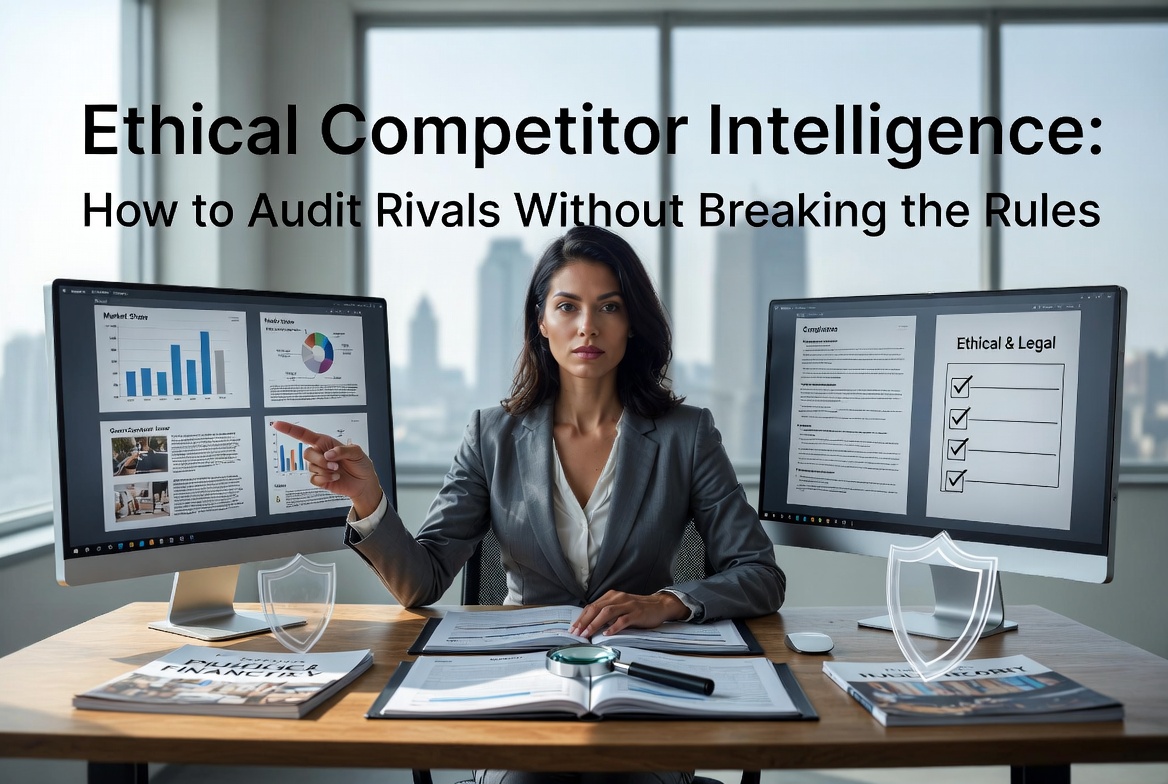
Mastering ethical competitor intelligence is essential for staying ahead while auditing rivals without breaking the rules. Companies of all sizes want to understand their competitors’ strategies, strengths, weaknesses, and market moves — but crossing into unethical or illegal territory can lead to severe reputational damage, fines, or even lawsuits.
This guide delivers practical, fully compliant methods for conducting thorough and effective competitor audits using only publicly available information and legitimate tools. Whether you’re a startup founder, marketing professional, or business strategist, you’ll learn how to gather actionable insights responsibly — without resorting to corporate espionage or shady tactics.
Discover proven frameworks, the best legal data sources, smart analysis techniques, and real-world examples that will help you build a sustainable competitive advantage while maintaining the highest ethical standards.
What Is Ethical Competitor Intelligence, Anyway?
Competitive Intelligence (CI) is, at its core, the systematic and ethical process of gathering, analysing, and acting on information about your competitors, your market, and the broader business environment. The Strategic and Competitive Intelligence Professionals (SCIP) organisation defines it as “a systematic and ethical programme for collecting, analysing, and managing external information that can influence a company’s plans, decisions, and operations” (Sassi et al., 2022).
Notice the word “ethical” in there? That’s not decoration. That’s load-bearing.
As a trader, you are constantly trying to anticipate market movements, understand competitor positioning, and identify opportunities before the crowd does. Competitive intelligence is how you do that without calling your competitor’s CEO pretending to be a headhunter. (Yes. People do that. No. It doesn’t end well.)
The line between smart intelligence gathering and outright corporate espionage is thinner than people think. One side of that line has Forbes profiles and speaking invitations. The other side has lawyers, litigation, and that special kind of silence on a Zoom call when HR suddenly joins unexpectedly.
Why This Matters More Than Ever in 2025
Let me paint you a picture. You’re a mid-size trading firm. Your competitor just launched a product that undercut your pricing by 15%. Your clients are asking questions. Your boss is asking louder questions. And you’re sitting there thinking: how did I not see this coming?
The answer, my friend, is that you didn’t have a proper CI programme. You were flying blind with one eye closed and the other eye on LinkedIn, and that is no way to run a business.
Research published in Competitive Intelligence Review found that organisations engaging in high CI activities showed 36% higher levels of quality in strategic planning (Jaworski & Wee, 1993, as cited in Maluleka & Chummun, 2023). That’s not a marginal edge. That’s a whole different league.
A 2023 literature review by Maluleka and Chummun, published through AOSIS, found that CI played a vital role in developing company strategies and practices across multiple industries (Maluleka & Chummun, 2023). Meanwhile, Ranjan and Foropon (2021) showed in the International Journal of Information Management that big-data-augmented CI significantly strengthens organisational competitive position (Ranjan & Foropon, 2021).
The data is clear: companies that do CI well, win more. Companies that do CI badly, sue each other. And companies that don’t do CI at all? They’re usually surprised on earnings day. Every single quarter. Like clockwork. Like they just found out gravity exists again.
The Legal Landscape: What You Can and Cannot Do
Right. Let’s talk about the rules, because this is where traders get into trouble. You’d be shocked how many smart people — genuinely intelligent, highly educated professionals — do something catastrophically stupid in the name of “market research.”
What Is Legal and Ethical
Here is the golden rule of ethical CI: if the information is publicly available and you obtained it honestly, you’re almost certainly fine. Legal and ethical CI sources include:
- Public filings and regulatory documents — Annual reports, 10-K and 10-Q filings, FCA disclosures, Companies House filings, patent applications. This is a goldmine. And it’s all sitting there, free, waiting for you. Like a buffet nobody told your competitors about.
- Competitor websites, press releases, and marketing materials — Everything they put out in public is fair game. If your rival posts a job listing for 15 data scientists, congratulations: you just learned their strategic direction. You’re welcome.
- Trade journals, news coverage, and industry reports — Paid or free, these are legitimate intelligence sources that your compliance team will love.
- Social media monitoring — LinkedIn, Twitter/X, Instagram. If their Head of Product is suddenly posting about “exciting new developments in Southeast Asia,” that’s a signal. A publicly broadcast one.
- Customer and supplier feedback — Talking to people who interact with your competitors is entirely legitimate. Trade shows, industry conferences, customer surveys — all fair game.
- Pricing intelligence from mystery shopping — Visiting a competitor’s store, website, or service as a regular customer to assess pricing and service quality is standard industry practice. The SCIP code of ethics permits this, provided you don’t misrepresent your identity in a material way (SCIP Code of Ethics, 2022).
What Is Unethical (And Often Illegal)
Now buckle up, because here’s where people get themselves into serious trouble — and where I, your friendly neighbourhood trader-narrator, must get briefly but firmly serious.
Industrial espionage is a crime. Hacking competitor systems, bribing employees, stealing proprietary documents, installing surveillance equipment — these are not aggressive business tactics. These are federal offences in the United States, criminal acts under the UK’s Computer Misuse Act 1990, and prosecuted with the enthusiasm that only comes from a prosecutor who has something to prove.
The Waymo vs. Uber case is the most prominent recent cautionary tale. In 2016, Anthony Levandowski departed Google’s self-driving car division (Waymo) and, before leaving, downloaded over 14,000 confidential files relating to autonomous vehicle technology. He took these to Uber. Waymo sued for trade secret theft and ultimately settled for $245 million in damages (Octopus Intelligence, 2024). Levandowski himself was later sentenced to 18 months in prison.
Let me translate that into trader language: $245 million and 18 months. That is an extremely bad trade. The risk-reward ratio on that one is catastrophic. You would not touch that position with a 40-foot pole.
Other clearly unethical practices include:
- Conducting fake job interviews to extract proprietary information from competitors’ employees
- Misrepresenting your identity or your organisation during research interviews
- Using information that was clearly not intended for public consumption, even if you technically accessed it legally
- Pressuring employees to bring trade secrets from former employers
That last point, by the way, is something a lot of firms do accidentally. They hire someone from a rival, and in the onboarding interviews they go: “So, what was their pricing strategy? What were the margins? Who were the key clients?” And the new employee — eager to impress — starts talking.
You just exposed yourself to litigation, friend. And you look like you planned the whole thing. Which, legally speaking, is even worse.
The SCIP Framework: Your Ethical Guardrails
The Strategic and Competitive Intelligence Professionals (SCIP) organisation provides the industry’s most widely recognised ethical framework. Think of it as the Highway Code of competitive intelligence: not everyone follows it perfectly, but it’s what the court looks at when things go wrong (SCIP, 2022).
The SCIP Code of Ethics requires practitioners to:
- Comply with all applicable laws, domestic and international
- Accurately disclose their identity and organisation prior to all interviews
- Avoid conflicts of interest in fulfilling their duties
- Provide honest and realistic recommendations and conclusions
- Promote the Code of Ethics within their own company and with third-party contractors
The simplest test in the SCIP world is what practitioners call the “Front Page Test”: Would you be comfortable if your intelligence-gathering actions were reported on the front page of a major newspaper?
If you hesitate even slightly — if there’s even a moment of “well, it depends on how they framed it” — then you should not be doing it. Full stop.
There’s also the “Reciprocity Test”: Would you consider it fair if your competitors used this exact same method against your organisation?
If the answer is no, put the method down. Walk away. Maybe go get some tea. Come back when you can think of a better idea.
Building Your Ethical CI Audit Framework
Alright. Now we’re getting to the practical stuff. Here’s how you actually build a competitive intelligence audit process that your legal team, your compliance officer, and your mother would all be proud of.
Step 1: Define Your Intelligence Requirements
Before you gather a single data point, you need to know what question you’re actually trying to answer. This sounds obvious. It is not, apparently, obvious to everyone.
Common intelligence questions for traders and financial firms include:
- What is our competitor’s pricing structure and how does it compare to ours?
- What new products or services are they planning to launch?
- How are they positioning themselves with institutional clients versus retail clients?
- What talent are they hiring, and what does that tell us about their strategic direction?
- What is their technology infrastructure, and are they ahead of us or behind us?
Getting specific about your requirements prevents the kind of unfocused intelligence gathering that leads to wasted resources — and, crucially, it reduces the temptation to venture into ethically murky territory because you’ll know exactly what you need and where to find it legitimately.
Step 2: Map Your Sources
Once you know what you’re looking for, map the legitimate sources available to you:
Tier 1 — Public Record Sources (Zero ethical risk):
- Companies House / SEC EDGAR / FCA Register
- Patent offices (UK IPO, USPTO, EPO)
- Planning applications and property records
- Court records (public litigation filings)
- Parliamentary/Congressional testimony
Tier 2 — Published Intelligence (Very low ethical risk):
- Annual reports and investor presentations
- Press releases and news coverage
- Trade publication articles
- Conference presentations and webinars
- Academic and industry research
Tier 3 — Market and Customer Intelligence (Low ethical risk with proper protocols):
- Customer surveys (where customers voluntarily share perceptions of competitors)
- Mystery shopping (disclosing you are a buyer, not misrepresenting your identity)
- Trade show observation and networking
- Supplier conversations (without inducing breach of confidence)
Tier 4 — Human Intelligence (Requires careful ethical protocols):
- Competitor employee interviews (honest representation of identity required)
- Former competitor employees (with strict protocols against soliciting confidential information)
- Industry analysts and consultants (ensuring no conflicts of interest)
The key is that as you move down the tiers, the ethical scrutiny required increases. And if you find yourself inventing a Tier 5 that involves any form of deception, hacking, bribery, or “it’s technically not illegal in that jurisdiction” reasoning — that is your cue to stop, close the laptop, and call your lawyer. Or maybe just go for a walk. A long one.
Step 3: Establish Your Collection Protocols
This is where most companies fail. They have good intentions and terrible systems. They tell their analysts “be ethical” and then leave them to figure out what that means at 11pm when a deadline is looming.
Your collection protocols should clearly specify:
- Who is authorised to conduct CI research and at what level of seniority
- What sources are pre-approved versus require sign-off
- How analysts must identify themselves in research interactions
- What to do when they accidentally access information that appears confidential
- How to document their sources and methods for legal defensibility
That last point is critical. If you end up in litigation, the process you followed matters enormously. A well-documented, ethically structured CI programme is evidence of good faith. A chaotic, undocumented one is evidence of… well, chaos, at best. Deliberate wrongdoing, at worst.
Step 4: Analyse Ethically
The analysis phase has its own ethical dimensions. When you analyse competitor intelligence, you must:
- Avoid confirmation bias — Only using intelligence that confirms what you already believe, while dismissing contradictory signals, leads to bad strategy. And I mean genuinely bad strategy, not metaphorically bad. You’ll make decisions based on a fictional competitor.
- Attribute uncertainty appropriately — If you don’t know something, say you don’t know it. Presenting uncertain intelligence as confirmed fact to your leadership team is how strategies fail spectacularly and publicly.
- Separate intelligence from speculation — “Our competitor filed 17 patents in quantum computing last year” is intelligence. “Therefore they will definitely launch a quantum product by Q3” is speculation. Both have value, but they need to be clearly labelled.
Step 5: Disseminate With Discretion
Intelligence that isn’t shared with the people who need it is useless. Intelligence that’s shared too widely creates legal and competitive exposure. The CI reports you produce should have:
- Clear classification levels (internal use, restricted, confidential)
- Named distribution lists that are reviewed regularly
- Explicit instructions about what can and cannot be shared externally
- Retention schedules aligned with your legal obligations
Case Study 1: The Right Way — How a Global Investment Bank Built Its CI Programme
Let me tell you about a major investment bank (we’ll call them “Bank A” because naming conventions are the least of our worries right now) that built one of the most effective and ethical CI programmes in financial services.
Facing intense competition from fintech challengers in their retail investment products division, Bank A recognised they were consistently reacting to competitor moves rather than anticipating them. Their CI function consisted of one analyst with a Google Alerts subscription and a vague mandate. That’s not a CI programme. That’s a person with a very stressful inbox.
They restructured their CI capability around three pillars:
Pillar 1 — Systematic Public Source Monitoring: They invested in licensed data services (Bloomberg, Refinitiv, PitchBook) and built automated dashboards monitoring competitor filings, patent applications, job postings, and press mentions. The job postings analysis alone revealed two competitors’ plans to expand into algorithmic trading 8 months before either announcement was made publicly.
Pillar 2 — Structured Primary Research: Bank A established a formal protocol for industry conference attendance, requiring analysts to complete a structured debrief template after every event. They also ran quarterly “voice of the customer” surveys that included questions about competitors. All of this was documented, approved, and legally reviewed.
Pillar 3 — Ethics Training and Compliance: Every member of the CI function completed annual ethics training specifically tailored to competitive intelligence. The programme included scenario-based exercises (including one charmingly titled “Don’t Be Levandowski”) and was formally signed off by the General Counsel.
The result? Within 18 months, Bank A’s time-to-insight on competitor moves dropped from an average of 6 weeks to under 5 days. Their strategy team reported significantly higher confidence in decision-making, and not a single legal challenge arose from their CI activities.
That, my friends, is what we call a good trade.
Case Study 2: The Wrong Way — When “Aggressive” Becomes Criminal
Now let me tell you about a situation that should have been a Harvard Business School case study but instead became a cautionary podcast episode and a settlement agreement with multiple non-disclosure clauses.
A mid-sized commodities firm — let’s call them “Firm B” — decided their competitive intelligence programme needed to be “more aggressive.” This is a phrase that should set off alarm bells the size of Big Ben whenever you hear it in the context of CI.
Their “more aggressive” approach included:
- Hiring a private investigator to follow a senior competitor executive
- Submitting fake RFPs (requests for proposal) to competitors to obtain pricing information under false pretences
- Encouraging a newly hired analyst to bring client lists from his former employer
All three of these activities were, in varying degrees, illegal. The fake RFPs constituted fraud. The private investigator surveillance raised serious questions under UK GDPR and the Regulation of Investigatory Powers Act. And soliciting the use of confidential client data from a new hire exposed Firm B to a trade secrets claim that cost them north of £4 million in legal fees and settlement — before you count the reputational damage.
The really painful irony? The intelligence they actually obtained this way was barely more useful than what they could have gathered from public sources. They just didn’t know what public sources were available, because nobody had bothered to map them properly.
The lesson: ethical CI isn’t just morally correct. It’s economically rational. The risk-adjusted return on illegal intelligence gathering is terrible. I say this as a trader. The expected value calculation does not work in your favour.
Technology Tools for Ethical Competitor Intelligence
The good news for 2025 is that the gap between what you can find ethically and what you might be tempted to find unethically has narrowed dramatically. There are now extraordinary legitimate tools available that would have seemed like science fiction to CI practitioners a decade ago.
AI-Powered Monitoring Platforms
Tools like Crayon, Klue, and Kompyte aggregate competitor data from hundreds of public sources — websites, review platforms, job boards, social media, news — and use AI to surface the signals that matter. These platforms are entirely legal, entirely ethical, and frankly better at pattern recognition than most human analysts.
They’ll catch things like:
- A competitor quietly updating their pricing page at 2am on a Sunday
- A sudden spike in negative reviews suggesting a product quality issue
- A cluster of senior hires from a specific technical discipline, signalling a strategic pivot
None of this involves any access to non-public information. It’s all out there. The competitive advantage comes from monitoring it systematically rather than sporadically.
Patent Intelligence Platforms
For traders in technology, pharma, or any IP-intensive sector, patent monitoring is extraordinarily powerful ethical CI. Services like PatSnap, Derwent Innovation, and the free EPO Espacenet database allow you to monitor competitor patent filings in near-real time.
A patent application is, by definition, a public document that your competitor has chosen to file — it’s literally an invitation to read about their innovation pipeline. Companies file patents because they want protection, not secrecy. That means their R&D roadmap is sitting there, indexed and searchable, waiting for you.
Research by Lin et al. (2023) in a competitive intelligence acquisition framework demonstrated that user-generated and public domain content mining provides strategically rich intelligence with zero ethical compromise (Lin et al., 2023, as cited in ResearchGate, 2024).
Financial Data and Public Filings
For publicly listed competitors, the intelligence goldmine is the regulatory filings. An annual report isn’t just an accounting document — it’s a strategic confession. The MD&A (Management Discussion and Analysis) section alone, properly analysed, will tell you:
- What management considers their biggest risks
- Where they’re investing capital
- Which business lines are underperforming (read between the lines of the language)
- How they’re thinking about the competitive environment
And here’s the beautiful part: this information is not just ethically obtained — it’s legally required to be disclosed. Your competitor’s lawyers and accountants worked overtime to put this in the public domain. The least you can do is read it.
Building an Ethical CI Culture in Your Organisation
Individual analysts following ethical guidelines are important. But the real protection — for your firm, your career, and your night’s sleep — comes from building an ethical CI culture at the organisational level.
This means:
Leadership Tone: If senior leaders treat competitive intelligence as something that only produces results if it’s “aggressive” or “grey area,” that attitude will cascade through the organisation. When your MD jokes about “whatever it takes to find out what Goldman is doing,” people hear permission. Make sure leadership explicitly and repeatedly models and endorses ethical boundaries.
Clear Written Policies: Document your CI ethics policy. Make it specific. Not “be ethical” — that’s meaningless. “Do not conduct interviews without disclosing your identity and employer” — that’s specific. The Futures Group, cited in Trevino and Weaver’s foundational research on CI ethics, had a written policy stating that employees may not conduct fake job interviews of competitors’ employees to collect intelligence (Trevino & Weaver, as cited in OSINT PBWorks). That level of specificity protects people by removing the grey areas.
Regular Training: Ethics training for CI practitioners should happen at least annually, and it should be scenario-based. Hypothetical case studies are far more effective than abstract principles. “What would you do if a contact offered to email you their employer’s confidential pricing model?” is a better training question than “describe the principles of ethical CI.” People learn by doing (or simulating doing), not by reading bullet points.
Anonymous Reporting Mechanisms: Create a safe channel for analysts to flag situations where they feel pressure to cross ethical lines. CI practitioners sometimes face explicit or implicit pressure from business units desperate for competitive intelligence. They need a clear, safe path to escalate without career consequences.
The Future of Ethical CI: AI, ESG, and the New Competitive Frontier
The competitive intelligence landscape of 2025 is almost unrecognisable from 2015. Two developments are reshaping it faster than anything else: artificial intelligence and the ESG agenda.
AI and Competitive Intelligence: AI tools have democratised CI in ways that are simultaneously exciting and alarming. On the ethical side, AI dramatically increases the volume and sophistication of public source intelligence, allowing even small firms to monitor hundreds of signals across dozens of competitors in real time. This is wonderful.
On the less ethical side, AI also makes certain unethical activities easier — deepfake audio for social engineering, AI-powered scraping of data that was technically public but not intended for mass aggregation, and increasingly sophisticated phishing attempts targeting competitor employees. The technology arms race in CI is accelerating, and the ethical frameworks need to keep pace.
Research published in the International Journal of Business Ecosystem & Strategy found that post-COVID competitive intelligence has increasingly incorporated ESG materiality as a core dimension, with CI professionals using sustainability disclosures as strategic signals (El Chaarani et al., 2022; Ranjan & Foropon, 2021, as cited in IJBES, 2025).
ESG as Intelligence: Here’s something most traders haven’t fully absorbed yet: your competitor’s ESG disclosures are a goldmine of strategic intelligence. Sustainability reports, climate risk assessments, supply chain disclosures — these documents reveal operational vulnerabilities, supplier relationships, regulatory exposure, and strategic priorities in extraordinary detail. And they’re public. And they’re mandatory for an increasing number of large firms.
The trader who is reading ESG reports for competitive intelligence signals while their competitors are ignoring them is going to have a significant informational edge — entirely legally obtained — for at least the next five years. I am genuinely telling you: read the ESG reports. Don’t tell me I didn’t try to help you.
The ROI of Ethical CI: Making the Business Case
Let’s be honest. In most organisations, CI competes for budget with things that feel more tangible — sales, marketing, technology. Making the ROI case for a proper, ethical CI programme is a skill in itself.
Here’s the framework:
Opportunity Cost of Missing Intelligence: What did it cost your firm the last time you were blindsided by a competitor move? Calculate the lost revenue, the emergency response costs, the reputational impact. That number — whatever it is — is the floor value of a CI programme that would have caught the signal.
Decision Quality Premium: Research consistently shows that intelligence-informed decisions outperform intuition-driven ones in competitive markets. A 2021 study in the International Journal of Information Management by Ranjan and Foropon found that big data CI creates measurable competitive advantage in organisational decision-making (Ranjan & Foropon, 2021). Quantify even a 5% improvement in decision quality across your major strategic choices — the number gets very large, very quickly.
Legal Risk Avoidance: Price in the expected value of the legal costs you won’t incur by doing CI properly. The Waymo/Uber settlement was $245 million. Firm B’s mess cost over £4 million. Even small-scale trade secret litigation routinely runs into six figures before lunch. An ethical CI programme with proper training, policies, and oversight costs a fraction of this. The ROI is not subtle.
Talent and Culture Value: Ethical business practices attract and retain better talent. This is increasingly true as a younger generation of traders, analysts, and professionals actively seek employers whose values align with their own. Your ethical CI programme is a talent proposition as much as it is a risk management tool.
Your Ethical CI Audit Checklist
Before we close, here’s your practical audit checklist. Go through this quarterly. Print it out. Put it on the wall. Share it with your team. Tattoo it somewhere discreet if that’s what it takes.
Legal Compliance:
- [ ] All CI activities reviewed against applicable domestic and international law
- [ ] Written legal guidance obtained for any novel or ambiguous collection methods
- [ ] Staff training completed on relevant laws (Economic Espionage Act, UK Trade Secrets Regulations, GDPR, etc.)
Source Ethics:
- [ ] All sources catalogued and categorised by ethical risk tier
- [ ] Pre-approved source list maintained and reviewed regularly
- [ ] No use of deception, misrepresentation, or false identity in research interactions
Process Integrity:
- [ ] CI collection methods documented and defensible
- [ ] Analysis clearly distinguishes confirmed intelligence from inference and speculation
- [ ] Intelligence reports classified appropriately with controlled distribution
Organisational Culture:
- [ ] Written CI ethics policy in place and communicated to all relevant staff
- [ ] Annual ethics training conducted with scenario-based exercises
- [ ] Anonymous escalation mechanism available for ethical concerns
- [ ] Leadership actively models and endorses ethical standards
Governance:
- [ ] CI programme reviewed by Legal/Compliance at least annually
- [ ] Third-party CI vendors vetted for ethical compliance
- [ ] No CI activities initiated in response to pressure without proper oversight
Conclusion: Intelligence That Lets You Sleep at Night
Here’s the truth about competitive intelligence, and I want you to hear this as a trader speaking to other traders: the best CI is the kind you can defend completely.
Not just legally — although yes, definitely legally. But also in front of your board, your clients, your regulator, and if necessary, a jury of your peers. The ethical CI practitioner never has to remember a cover story, never has to explain an anomalous line item to their legal team, and never has to have that 2am conversation where someone asks “but how did we actually get this?”
The research is consistent: ethical CI, done systematically, produces strategic advantage. It improves decision quality. It reduces risk. It builds the kind of organisational intelligence that compounds over time, because you’re building systems and culture, not relying on one-off lucky strikes of questionable provenance.
The traders and firms that dominate their sectors in the next decade will not be the ones who know secrets. They will be the ones who are better at reading what’s already public — faster, deeper, with better analysis and cleaner hands.
That’s the game. Now go play it properly.
References
- Jaworski, B.J. & Wee, L.C. (1993). Competitive intelligence and bottom-line performance. Competitive Intelligence Review, 4(3-4), pp. 23–43. Cited in: Maluleka, M.L. & Chummun, B.Z. (2023). https://www.researchgate.net/publication/374460937
- Maluleka, M.L. & Chummun, B.Z. (2023). Competitive intelligence and strategy implementation: Critical examination of present literature review. SA Journal of Information Management, 25(1). Published 07 Sept. 2023. https://doi.org/10.4102/sajim.v25i1.1650
- Ranjan, J. & Foropon, C. (2021). Big data analytics in building the competitive intelligence of organisations. International Journal of Information Management, 56, 102231. https://doi.org/10.1016/j.ijinfomgt.2020.102231
- Sassi, D.B., Frini, A., Chaieb, M. & Karaa, W.B.A. (2022). A rough set approach for competitive intelligence. Expert Systems with Applications. Cited in: ResearchGate Literature Review (2024). https://doi.org/10.1016/j.eswa.2022.117864
- Lin, J., Jiang, X., Li, Q. & Wang, C. (2023). A competitive intelligence acquisition framework for mining user perception from user generated content. Cited in: ResearchGate (2024). https://www.researchgate.net/publication/385429102
- El Chaarani, H., Vrontis, D., El Nemar, S. & El Abiad, Z. (2022). The impact of strategic competitive innovation on the financial performance of SMEs during COVID-19. Competitiveness Review: An International Business Journal, 32(3), pp. 282–301. https://doi.org/10.1108/CR-02-2021-0024
- Köseoglu, M.A., Yick, M.Y.Y. & Okumus, F. (2021). Coopetition strategies for competitive intelligence practices — evidence from full-service hotels. International Journal of Hospitality Management, 99, 103049. https://doi.org/10.1016/j.ijhm.2021.103049
- Paine, L.S. (1991). Corporate policy and the ethics of competitor intelligence gathering. Journal of Business Ethics, 10(6), pp. 423–436. https://doi.org/10.1007/BF00382825
- Trevino, L.K. & Weaver, G.R. Ethical Issues in Competitive Intelligence Practice. SCIP / OSINT PBWorks. https://osint.pbworks.com/f/Trevino.pdf
- SCIP — Strategic and Competitive Intelligence Professionals. (2022). Competitive Intelligence Ethics — Navigating the Gray Zone. https://www.scip.org/page/competitive-intelligence-ethics
- Octopus Intelligence. (2024). Keeping Competitive Intelligence Ethical and Legal for Peace of Mind. https://www.octopusintelligence.com/keeping-competitive-intelligence-ethical-and-legal-for-peace-of-mind/
- PorterIQ. (2025). The Ethics of Competitive Intelligence: Best Practices. https://www.porteriq.com/blog/ethics-of-competitive-intelligence
- IJBES. (2025). Competitive Intelligence Evolution During and After COVID-19. International Journal of Business Ecosystem & Strategy, 7(4), pp. 330–349. https://bussecon.com/ojs/index.php/ijbes/article/view/907
- Aqute Intelligence. (2023). Ethics of Researching Your Competitors. https://www.aqute.com/blog/is-competitive-intelligence-ethical
Disclaimer: This article was written for informational purposes. Nothing herein constitutes legal advice. For specific legal guidance on competitive intelligence practices in your jurisdiction, consult qualified legal counsel. And please — for the love of all that is profitable — do not download 14,000 files from your employer before you leave.
Leave a Reply
You must be logged in to post a comment.