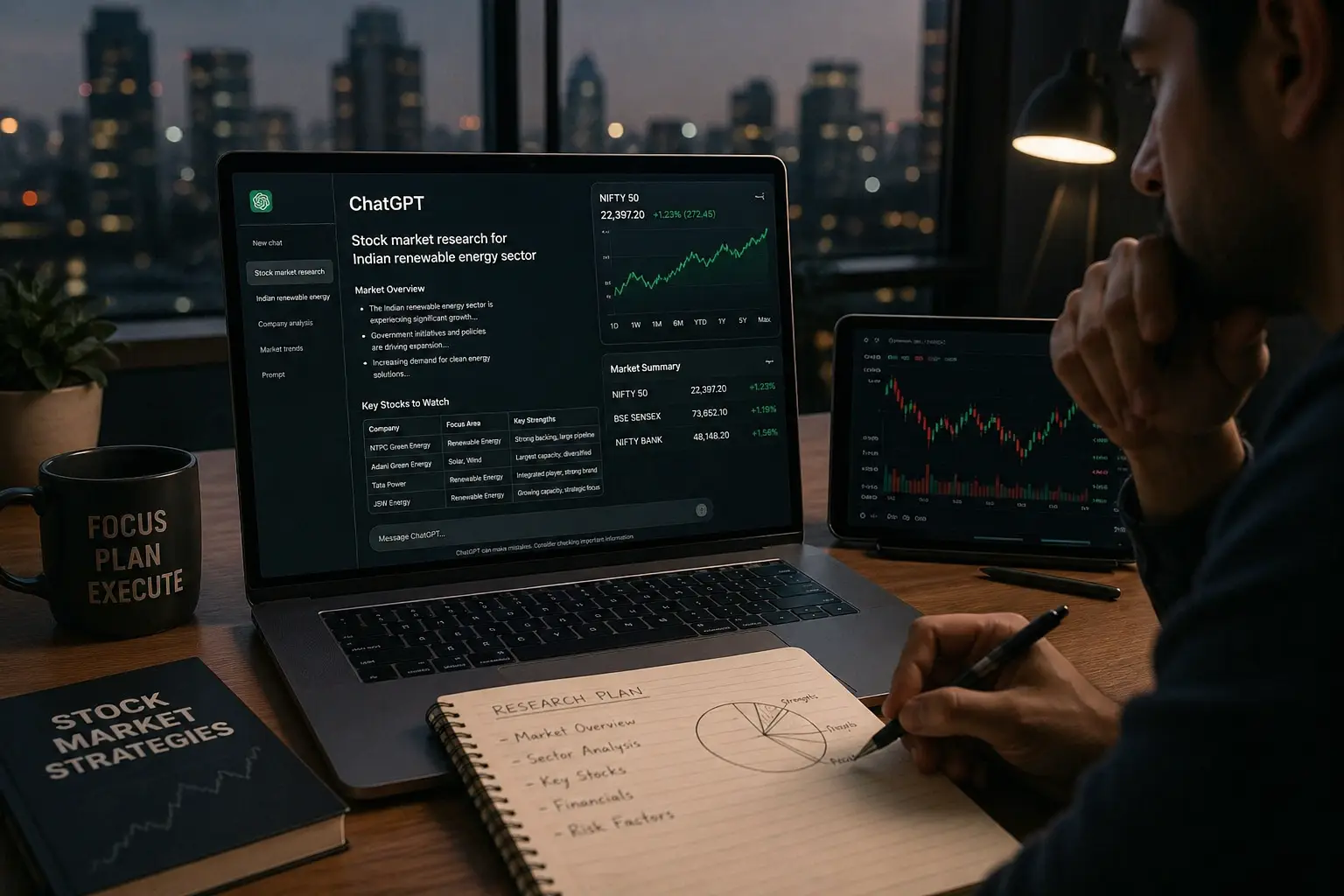
If you are not using ChatGPT for stock market research right now, you are literally leaving money on the table — and somebody else’s hand is already reaching for it. Welcome, fellow market warriors. I am your guide today — a trader who has stared at more red candles than a haunted birthday party. I have rage-quit terminals, argued with spreadsheets, and once threw a protein bar at my monitor during a margin call. But none of that prepared me for the moment I typed my first stock research prompt into ChatGPT and watched this AI break down an earnings report faster than I can find my car keys in the morning. That day changed everything.
Grab your coffee. Or your tea if you are British and insist on being different. Because we are about to go deep — real deep — into exactly how to use ChatGPT for stock market research, fundamental analysis, sentiment tracking, portfolio building, risk assessment, and a whole lot more. By the time you are done reading this, you will know more about AI-powered trading research than 90% of the people in your trading group chat who keep sending memes instead of actual stock picks.
Why ChatGPT Is the Research Partner You Never Had (But Always Needed)
Let me paint you a picture. It is 11:47 PM. Earnings season. You have seventeen browser tabs open, two financial news subscriptions you barely use, a cold coffee, and the unsettling feeling that you have already missed the move. Sound familiar? That is the old way of doing stock research. It is exhausting, inefficient, and frankly, it does not even work that well unless you are one of those people who actually enjoys reading 90-page 10-K filings for fun. And if that is you — respect, but we need to talk about your weekends.
ChatGPT changes this entire game. It is like having a financial analyst, a research assistant, a sentiment reader, and a coding helper all in one tool — except this one does not charge $300 an hour, does not take lunch breaks, and definitely does not send you passive-aggressive emails about your deadline.
The academic research backs this up in a serious way. A landmark study by Lopez-Lira and Tang (2023) titled “Can ChatGPT Forecast Stock Price Movements? Return Predictability and Large Language Models” found that ChatGPT-based sentiment analysis of news headlines demonstrated meaningful return predictability in the stock market — particularly in cases where the AI was asked to classify whether headlines were positive, negative, or uncertain for specific stocks. The research showed that more complex large language models (LLMs) demonstrated stronger predictive performance compared to older, simpler models. [Read the paper on arXiv →]
Look, I am not saying ChatGPT is going to hand you a portfolio of 10-baggers while you sleep. That would be a lie, and I respect you too much for that. But used correctly — and that is the magic word, correctly — it is one of the most powerful research acceleration tools available to retail traders today. And in a market where institutional players have entire data science departments, you need every edge you can get.
Understanding What ChatGPT Actually Is (And What It Is Not)
Before we get into the practical stuff, let me be very clear about something: ChatGPT is not a crystal ball. It cannot tell you that Tesla will hit $400 next Tuesday. It does not have insider information. It is not your personal Warren Buffett. And it absolutely, positively, cannot guarantee returns. If anyone tells you otherwise, that person is trying to sell you something — probably an overpriced course with a fire emoji in the title.
What ChatGPT actually is: a large language model (LLM) trained on vast amounts of text data, capable of natural language understanding, summarisation, pattern recognition, sentiment analysis, code generation, and contextual reasoning. In plain English — it reads, processes, synthesises, and communicates information at extraordinary speed and scale.
For stock market research, this means ChatGPT can help you:
- Summarise earnings call transcripts in seconds
- Explain financial ratios clearly
- Build SWOT analyses for companies
- Analyse sentiment from news and filings
- Generate Python or Excel code for backtesting
- Compare competitors side-by-side
- Draft investment theses
- Identify risks buried in regulatory filings
The Financial Innovation journal published a comprehensive review titled “Unleashing the power of ChatGPT in finance research: opportunities and challenges” which documented ChatGPT’s growing applications across corporate finance, monetary policy analysis, stock price movement prediction, sentiment analysis, and financial modelling. By April 2024, there were already over 141,000 articles indexed on Google Scholar with the keyword “ChatGPT,” reflecting the explosive academic interest in its financial applications. [Access the full review →]
That is not a fad. That is a structural shift. Get comfortable with it or get left behind — those are genuinely the only two options.
Step 1: Getting Your Prompts Right (Because Bad Prompts Are Like Bad Trade Setups)
Here is where most people fail. They open ChatGPT, type something like “tell me good stocks to buy,” and then get mad when it gives them a generic answer. My friend, that is the equivalent of walking into a doctor’s office and saying “fix me” and then being upset when they ask you what hurts.
The quality of your output from ChatGPT is entirely determined by the quality of your input — your prompt. This is called prompt engineering, and it is a genuine skill that separates serious researchers from casual clickers.
Researchers at Warwick Business School found that ChatGPT works best with “keywords, phrases, and bullet points, as well as well-ordered follow-up questions.” The study also noted that ChatGPT excels at quickly and precisely summarising earnings transcripts and other long-form text about companies, sectors, and products, which should free up time for human analysts to focus on higher-level tasks like strategic interpretation. [Read Warwick’s analysis →]
Here are prompt frameworks that actually work:
The Fundamental Breakdown Prompt
“Act as a professional equity analyst. Analyse the following financial data for [Company Name]. Identify the key trends in revenue, margins, debt levels, and cash flow. Highlight any red flags and give me a summary investment thesis with potential risks. Data: [paste financial data here].”
This prompt is specific, role-assigned, structured, and asks for exactly what you need. Compare that to “is Apple a good stock” — which is like asking someone “is food good?” without telling them you are trying to lose weight and you are lactose intolerant.
The Earnings Call Decoder Prompt
“Here is the transcript from [Company]’s Q[X] 2024 earnings call. Please: (1) Summarise the key financial results, (2) List the top 5 management commentary highlights, (3) Identify 10 potential negatives or risks mentioned or implied, (4) Assess the tone — is management confident, cautious, or evasive?”
Why ask for the negatives specifically? Because, as Warwick Business School researchers pointed out, official company communications tend to be upbeat and positive. Asking ChatGPT to actively seek out negatives creates a more balanced and revealing analysis. That is a life tip right there. Free of charge.
The Competitor Comparison Prompt
“Compare [Company A] and [Company B] across the following dimensions: revenue growth, profit margins, debt-to-equity ratio, P/E ratio, competitive moat, and key risks. Present this as a structured table followed by a narrative analysis of which company represents a stronger long-term investment opportunity and why.”
I used a version of this to compare two semiconductor companies last year, and the structured output ChatGPT produced saved me about four hours of manual research. Four hours. That is four hours I can spend watching my positions do absolutely nothing, which is what happens when I try to be patient.
Step 2: Sentiment Analysis — Reading the Room at Scale
One of ChatGPT’s most powerful — and most underutilised — capabilities for stock research is sentiment analysis. In markets, sentiment is everything. Fear and greed do not show up on a balance sheet, but they absolutely move stock prices.
Here is a wild truth: a research paper published in China Finance Review International found that sentiment indicators built using ChatGPT-4o and ChatGPT-3.5 from Twitter (now X) data significantly influenced asset returns even after accounting for traditional control variables and pre-existing sentiment indicators. The researchers found that ChatGPT could extract sentiment information from social media that earlier models had completely missed. [Read the Emerald Publishing study →]
What does this mean for you practically? It means you can feed ChatGPT a batch of recent news headlines, earnings call excerpts, social media commentary, or analyst reports about a company, and ask it to assess the overall sentiment. Is the market warming up to this company? Is management communication becoming more defensive? Are analysts subtly downgrading their enthusiasm?
Here is a prompt for this:
“Here are 20 recent news headlines about [Company Name] from the past 30 days: [paste headlines]. Rate the overall sentiment as Bullish, Bearish, or Neutral. Identify the 3 most significant narrative shifts and explain what they might mean for the stock price in the near term.”
Now, let me be honest with you — and I say this as someone who once got extremely confident about a biotech stock based on vibes and a Reddit thread — sentiment analysis is a support tool, not a standalone strategy. You still need fundamentals. You still need price action. You still need your brain. ChatGPT is the research associate who does the reading; you are still the portfolio manager making the call.
Step 3: Financial Statement Analysis — Making Friends With Numbers (Even When They Are Ugly)
Earnings season. Just saying those words makes half of traders excited and the other half immediately reach for something stronger than coffee. It does not have to be that dramatic.
A groundbreaking study from the University of Chicago by Kim, Muhn, and Nikolaev tested whether GPT-4 could analyse financial statements as effectively as professional human analysts. They fed the AI thousands of standardised and anonymised financial statements from over 15,000 companies spanning 1968 to 2021 and asked it to predict the direction of future earnings. The results? GPT-4’s forecasts were accurate 60.4% of the time, compared to just 52.7% accuracy for professional human analysts reviewing statements one month after release. ChatGPT even outperformed analysts who had the benefit of six additional months of market information. [Explore this research at Finimize →]
Let that settle in. This AI called earnings better than Wall Street professionals. You know what I say to that? I say that retail traders who get good at prompting this tool are going to have an absolutely unfair advantage over those who do not. Unfair in the best possible way.
How to Do It: The Earnings Analysis Workflow
Step 1: Download the company’s latest 10-Q or 10-K from the SEC’s EDGAR database (it is free and public at sec.gov/edgar).
Step 2: Copy the key financial tables — income statement, balance sheet, cash flow statement.
Step 3: Paste into ChatGPT with this prompt:
“Act as a CFA-level financial analyst. Here are the financial statements for [Company Name] for [period]. Please: (1) Calculate and interpret the following ratios: gross margin, operating margin, current ratio, debt-to-equity, return on equity, and free cash flow yield. (2) Identify any year-over-year deterioration. (3) Highlight one red flag and one green flag. (4) Give me your assessment of earnings trajectory for the next two quarters.”
Step 4: Follow up with targeted questions based on the output. ChatGPT handles multi-turn conversations beautifully. Ask it to dig deeper into any number that caught your attention.
Step 5: Cross-check. ChatGPT can be wrong. It can also “hallucinate” — which is a fancy word for confidently making things up. Always verify key numbers against the actual source documents. That is not a knock on the tool; that is just responsible research.
Step 4: Portfolio Construction and Risk Assessment
Now this is where it gets really interesting. Several academic studies have explored ChatGPT’s ability to help build diversified investment portfolios — and the results are genuinely impressive.
Ko and Lee (2023) used ChatGPT to generate diversified portfolios within a Markowitz mean-variance framework, both maximising the Sharpe ratio and minimising portfolio variance. They found generally greater diversification, higher returns, higher risk-adjusted returns, and lower standard deviations in the ChatGPT selections compared to randomly determined portfolios. The AI approach produced more efficient portfolios than most human-assembled benchmarks. [See the cited study →]
You can leverage this for your own research with prompts like:
“I have a £50,000 portfolio and I am a moderately risk-tolerant investor with a 10-year horizon. I currently hold positions in technology (40%), consumer staples (20%), and cash (40%). Based on current market conditions, what sectors and asset classes should I consider for diversification? What are the key risk factors I should be monitoring? Please provide a structured analysis.”
You can also use ChatGPT for risk scenario modelling:
“Describe three macro scenarios — base case, bear case, and bull case — for [sector or company] over the next 12 months. For each scenario, outline the key catalysts, the likely price range, and what early warning signals I should watch for.”
This kind of forward-looking scenario work used to require expensive research platforms or a well-paid analyst. Now you can run it at midnight in your dressing gown. The democratisation of financial research is real, and it is right in front of you.
Case Study 1: Using ChatGPT to Analyse a Tesla Earnings Call
Let us make this real. A trader — let us call her Maya — was preparing for Tesla’s Q1 2024 earnings season. She found the full transcript of Tesla’s earnings call online, copied it into GPT-4o, and submitted the following prompt:
“Here is the earnings call transcript for Tesla. Please summarise the key financial results, operational highlights, future guidance, and main points from the Q&A session. Then list 10 potential concerns or negatives from this call that a sell-side analyst might flag.”
The result? In under 30 seconds, ChatGPT delivered a structured summary covering:
- Revenue and margin compression details
- Elon Musk’s commentary on FSD (Full Self-Driving) timelines
- Management’s somewhat evasive responses on volume guidance
- A clear list of 10 analyst-level concerns including margin headwinds, competitive pressure from Chinese EVs, and the dependency on energy storage for growth
As Finimize noted in their analysis of this use case, GPT-4o proved to be one of the most efficient tools available for this kind of earnings call breakdown, with the caveat that it struggles with smaller, lesser-known companies where training data is thin. [Read Finimize’s walkthrough →]
Maya’s takeaway from the ChatGPT analysis aligned closely with what the market priced in — the stock dipped after earnings on margin concerns. She had done her research faster and more thoroughly than she ever had manually. That is the power of this tool used well.
Case Study 2: Retail Trader Uses ChatGPT for Competitor Analysis — Nvidia vs AMD
Another trader — let us call him Jamil — was trying to decide between NVIDIA and AMD going into a major AI infrastructure spending cycle. He fed both companies’ latest quarterly financials into ChatGPT and asked for a head-to-head comparison across eight financial and strategic dimensions.
ChatGPT produced a comparative table in seconds, then wrote a narrative analysis identifying NVIDIA’s dominant data centre revenue as a structural advantage, AMD’s improving gross margins as an encouraging sign, and the key risk for both — potential overcapacity in AI chip demand following a capex supercycle.
Jamil also asked ChatGPT to generate a Python script to pull historical price data for both stocks and visualise their correlation. It did it. Flawlessly. That is a tool for retail investors that, five years ago, only quantitative funds could access. Now it lives in a chat box.
The researchers at StocksToTrade noted that using ChatGPT with prompts like “List stocks with consistent revenue growth over the past five years” or “Summarise the financial position of [company] based on its last two 10-Q filings” creates genuine trading edges when combined with human judgment. [See StocksToTrade’s guide →]
Step 5: Macroeconomic Research and Sector Analysis
I want to talk about something that many retail traders completely overlook: macro context. You can do all the company-level research in the world, but if you are loading up on consumer discretionary stocks into a rate-hiking cycle, you are bringing a knife to a monetary policy fight.
ChatGPT is exceptional at helping you understand the macro environment and how it affects individual sectors. Here are prompts that I use regularly:
“Explain the relationship between Federal Reserve interest rate decisions and the performance of [sector]. How have previous rate cycles historically affected valuations and earnings in this sector? What should I be monitoring?”
“Analyse the current macroeconomic environment — inflation trends, employment data, and central bank policy direction — and identify which sectors are likely to outperform and underperform in the next 6–12 months. Give me your reasoning.”
“What are the top 5 geopolitical and regulatory risks that could materially impact [company or sector] in 2025–2026? For each risk, assess the probability as low, medium, or high, and describe the potential market impact.”
Research published in ScienceDirect found that ChatGPT outperformed robo-advisors in financial advice for one-time investments while considering investors’ individual risk appetite, positioning generative AI as a significant advancement in financial guidance. However, the same research emphasised that raw LLM technology cannot yet satisfy the duty-of-care obligations intrinsic to professional investment management — meaning you should treat it as a powerful co-pilot, not the pilot. [Access the ScienceDirect study →]
Step 6: Building a Personal Trading Research System With ChatGPT
This is the level where you stop using ChatGPT as a novelty and start using it as infrastructure. Here is a complete research system you can build around the tool:
The Weekly Research Routine
Monday — Macro Check-in: Prompt: “Summarise the major economic events, central bank statements, and geopolitical developments from last week that are likely to influence market direction this week. Which sectors are most exposed?”
Tuesday–Wednesday — Individual Stock Deep Dives: Pull financial data from SEC EDGAR or Yahoo Finance. Paste into ChatGPT with your structured fundamental analysis prompt. Focus on two or three positions or watchlist names per session.
Thursday — Earnings Preview: Prompt: “[Company] reports earnings [date]. Based on the most recent public information, what are the key things analysts are watching? What would constitute a positive surprise versus a negative surprise? What is the options market pricing as an implied move?”
Friday — Portfolio Risk Review: Prompt: “Here is my current portfolio: [list positions and weights]. Identify my top three concentration risks, my correlation exposure, and any sector or macro vulnerabilities I should be aware of heading into next week.”
This system takes roughly 90 minutes per week to execute properly. Ninety minutes. That is one episode of your favourite series that you are willing to spend on something far less profitable. Trade the episode. Keep the trading.
The Limitations You Must Respect (Because Arrogance Is Expensive)
I am not here to oversell this tool. I have lost money in markets enough times to know that humility is not optional — it is a survival skill. So let me be straight with you about ChatGPT’s limitations for stock research.
1. Knowledge Cutoff ChatGPT’s training data has a cutoff date. It does not have real-time stock quotes, live earnings data, or today’s breaking news. For current information, you need to paste it in yourself — which you now know how to do.
2. Hallucinations ChatGPT can fabricate financial figures, cite non-existent studies, or state incorrect company facts with complete confidence. It does not know what it does not know. Always verify specific numbers against primary sources like SEC filings, Bloomberg, or Reuters.
3. No Quantitative Reasoning With Raw Numbers Researchers at the University of Chicago found that while ChatGPT excels at textual financial analysis, it struggles with purely numerical prediction tasks when working with raw historical price data. It is a text genius, not a quant model. Do not ask it to predict price targets from chart data.
4. Regulatory and Legal Limitations Warwick Business School researchers specifically noted that raw LLM technology cannot satisfy the duty of care obligations intrinsic to professional investment management. This is not a tool for regulated financial advice — it is a research acceleration tool.
5. Overconfidence Bias There is a real psychological risk here. ChatGPT sounds authoritative even when it is wrong. That smooth, confident tone can make you forget to verify. Do not let eloquence substitute for accuracy. The market does not care how well-written your thesis is if the numbers are wrong.
Advanced Techniques: Where the Real Edge Lives
Let us talk about the stuff that separates the serious users from the casual ones.
Chain-of-Thought Prompting
This technique, validated in the University of Chicago research study, involves instructing ChatGPT to reason step-by-step rather than jumping directly to conclusions. The approach improved earnings prediction accuracy from 52.7% (human analysts) to 60.4% (AI with chain-of-thought). [Full methodology at Finimize →]
Prompt structure:
“Before reaching a conclusion, I want you to reason through this step by step. First, identify the key financial metrics. Second, analyse the year-over-year trends. Third, consider macro context. Fourth, evaluate management credibility based on commentary. Only then give me your assessment.”
The Devil’s Advocate Prompt
This is one of my personal favourites. After ChatGPT gives you a bullish analysis of a company, immediately follow up with:
“Now play devil’s advocate. Give me the strongest possible bear case for this company. What would have to go wrong for this thesis to fail completely? What are the bearish investors getting right?”
This forces balanced thinking and prevents you from falling in love with a position based on one-sided analysis. Falling in love with a stock is like falling in love with someone who owes you money — emotionally complicated and financially dangerous.
ESG and Alternative Data Analysis
ChatGPT has strong capability in ESG (Environmental, Social, and Governance) analysis. Warwick Business School researchers found that for ESG applications, ChatGPT shows great potential for quickly identifying controversies and building initial ESG profiles for companies. Feed it ESG reports, sustainability disclosures, or news about corporate governance issues, and ask it to assess reputational and regulatory risk.
Code Generation for Backtesting
If you have basic Python knowledge — or even if you do not — ChatGPT can write scripts for you to backtest trading strategies using libraries like pandas, yfinance, and matplotlib. Prompt:
“Write a Python script using yfinance and pandas that backtests a simple moving average crossover strategy on [ticker] from 2019 to 2024. The strategy goes long when the 50-day MA crosses above the 200-day MA and exits when it crosses back below. Display the cumulative returns chart and calculate the Sharpe ratio and maximum drawdown.”
That script would take an experienced programmer 30–60 minutes to write. ChatGPT delivers it in about 20 seconds. And then you spend 45 minutes debugging it anyway because that is just the nature of trading code. Progress is progress.
Case Study 3: A Hedge Fund Use Case — Sentiment at Scale
It is not just retail traders benefiting from AI-powered research. A research project published in ScienceDirect described a methodology where a programme iterated through all S&P 500 stocks, using ChatGPT to assess earnings surprises and stock attractiveness by pulling real-time summaries from the top ten Yahoo Finance search results for each company, then synthesising those summaries into actionable insights. [See the full ScienceDirect paper →]
The results showed that ChatGPT outperformed analyst benchmarks in identifying earnings surprises — particularly when given access to recent news alongside financial data. This is the kind of systematic, scaled research that used to require a quant team. The fact that it can now be replicated by any motivated retail trader with a good prompting strategy is genuinely democratising. And slightly terrifying for sell-side analysts, but that is a different article.
The Future of ChatGPT in Stock Market Research
The trajectory here is clear. The global AI in finance market was valued at approximately $38.36 billion in 2024 and is projected to reach $190.33 billion by 2030 — a compound annual growth rate of 30.6%. AI is not an experiment in financial services; it is now infrastructure.
As these tools evolve, we will see tighter integration with real-time data feeds, better multi-modal analysis (combining news text, financial charts, and audio from earnings calls), and more specialised financial LLMs trained specifically on market data. There are already purpose-built models like BloombergGPT and FinGPT emerging, trained specifically on financial datasets.
But here is the thing: the fundamentals of good research do not change. Whether you are using a Bloomberg terminal or ChatGPT, you still need to ask the right questions, verify your data, understand your own risk tolerance, and make final decisions with your own judgment. The tool changes. The discipline does not.
Researchers at Modern Finance who conducted one of the most comprehensive retrospective tests of ChatGPT’s stock-picking ability — going back to 1985 with GPT-4 — found that the model averaged approximately 1% alpha per month for two-year holding periods under controlled conditions. However, they also noted that individual portfolio alphas were only positive and significant about one out of four years, emphasising the inconsistency of AI-led stock selection in isolation. [Read the full Modern Finance study →]
Consistency comes from the combination of AI-powered research and disciplined human decision-making. Not one or the other.
Your ChatGPT Stock Research Toolkit: The Quick Reference
Here is your go-to reference list of the most valuable prompts covered in this article:
Company Overview:
“Give me a comprehensive overview of [Company Name] including its business model, key revenue streams, competitive position, main risks, and recent strategic developments.”
Earnings Summary:
“Summarise the key financial results from [Company]’s latest earnings. List 10 negatives and 5 positives from the management commentary.”
Competitor Analysis:
“Compare [Company A] and [Company B] across revenue growth, margins, debt levels, P/E ratio, and competitive positioning. Which represents the stronger investment case and why?”
Sentiment Check:
“Here are 15 recent news headlines about [Company]. Rate overall sentiment and identify the three biggest narrative shifts.”
Risk Assessment:
“What are the top 5 macro and company-specific risks for [Company] over the next 12 months? For each, assess probability and potential impact.”
Scenario Planning:
“Describe a bull case, base case, and bear case for [Company/Sector] over the next year. Include key catalysts and warning signs for each.”
Portfolio Review:
“Here is my portfolio: [positions]. Identify my top 3 concentration risks, sector exposures, and any correlation vulnerabilities.”
Final Word: ChatGPT Is the Research Assistant You Deserve
Look — I started my trading career with a notebook, a stock screener that took four minutes to load, and an unhealthy obsession with the MACD indicator. I have watched the tools available to retail traders evolve dramatically. And I can tell you with complete sincerity that the emergence of ChatGPT as a research tool is the biggest democratisation of market research I have ever seen.
It does not guarantee profits. Nothing does. Anyone who tells you they have a guaranteed system is either delusional, lying, or both — and usually both. But ChatGPT, used with discipline, good prompting, and healthy scepticism, will make you a faster, better-informed, more organised researcher. And in a market full of emotional, reactive, headline-chasing participants, being more organised and better-informed is genuinely worth something.
The academic evidence says it can beat professional analysts at earnings forecasting. The practical evidence from traders using it daily says it saves hours of research time per week. And my own experience says it has made me a calmer, more structured researcher — which is remarkable given that I once tried to trade commodities based on a dream I had about wheat.
Start simple. Try one prompt from this article today. Run it on a company you already know. Compare the output to what you already believe. See if ChatGPT surfaces something you missed, frames something more clearly, or challenges your thesis in a useful way.
And then build from there. Because the future of stock market research is already here. The only question is whether you are going to be the one using it — or the one competing against the people who are.
Now close this article and go make some money. Responsibly. With proper risk management. And maybe some sleep.
References
- Lopez-Lira, A. & Tang, Y. (2023). Can ChatGPT Forecast Stock Price Movements? Return Predictability and Large Language Models. arXiv:2304.07619. [Access paper →]
- Kim, A.G., Muhn, M. & Nikolaev, V. (2023). Financial Statement Analysis with Large Language Models. University of Chicago. [Research summary →]
- Pelster, M. & Val, J. (2024). Can ChatGPT Assist in Picking Stocks? Finance Research Letters. [ScienceDirect →]
- Lograsso, M.F. (2025). Could ChatGPT Have Earned Abnormal Returns? A Retrospective Test from the U.S. Stock Market. Modern Finance. [Access study →]
- Fatouros, G., et al. (2024). Decoding Market Sentiment: The Power of ChatGPT in Explaining Bitcoin Returns from X Data. China Finance Review International, Emerald Publishing. [Read paper →]
- Cheng, X. & Zhang, Y. (2025). Unleashing the Power of ChatGPT in Finance Research: Opportunities and Challenges. Financial Innovation, Springer Nature. [Full article →]
- Ko, H. & Lee, J. (2023). Can ChatGPT Improve Investment Portfolios? Evidence from ChatGPT-Based Mean-Variance Optimisation. Cited in Modern Finance retrospective study. [Access via Modern Finance →]
- Warwick Business School (2023). What Prompts Stock Analysts Should Use for ChatGPT. WBS Research and Insights. [Read article →]
- University of Chicago MACSS (2024). A Research of API-Enhanced ChatGPT in Stock Prediction. UChicago Knowledge Repository. [Access paper →]
- StocksToTrade Editorial (2025). Can ChatGPT Help with Stock Analysis? StocksToTrade. [Read guide →]
Disclaimer: This article is for educational and informational purposes only. Nothing in this article constitutes financial advice. Trading and investing involve significant risk of loss. Always conduct your own research and consult a qualified financial professional before making investment decisions. Past performance of any strategy — AI-assisted or otherwise — is not indicative of future results.
Leave a Reply
You must be logged in to post a comment.