Every single day, traders lose money not because the market is cruel, but because they walked into it armed with bad market research, faulty assumptions, confirmation bias thicker than a Sunday roast, and the confidence of someone who just watched three YouTube videos and now thinks they’re Warren Buffett. If you’re making costly market research mistakes, you’re not just leaving money on the table — you’re handing it over with a bow on top, a thank-you note, and a warm hug.
I’m a trader. I’ve been doing this long enough to have made every single one of these mistakes myself, some of them twice, a few of them embarrassingly more often than that. And let me tell you — the market is not going to feel bad for you. The market doesn’t care that you stayed up until 2 AM reading charts. The market doesn’t care about your feelings. The market woke up this morning, looked at your portfolio, and said, “Not today, baby.”
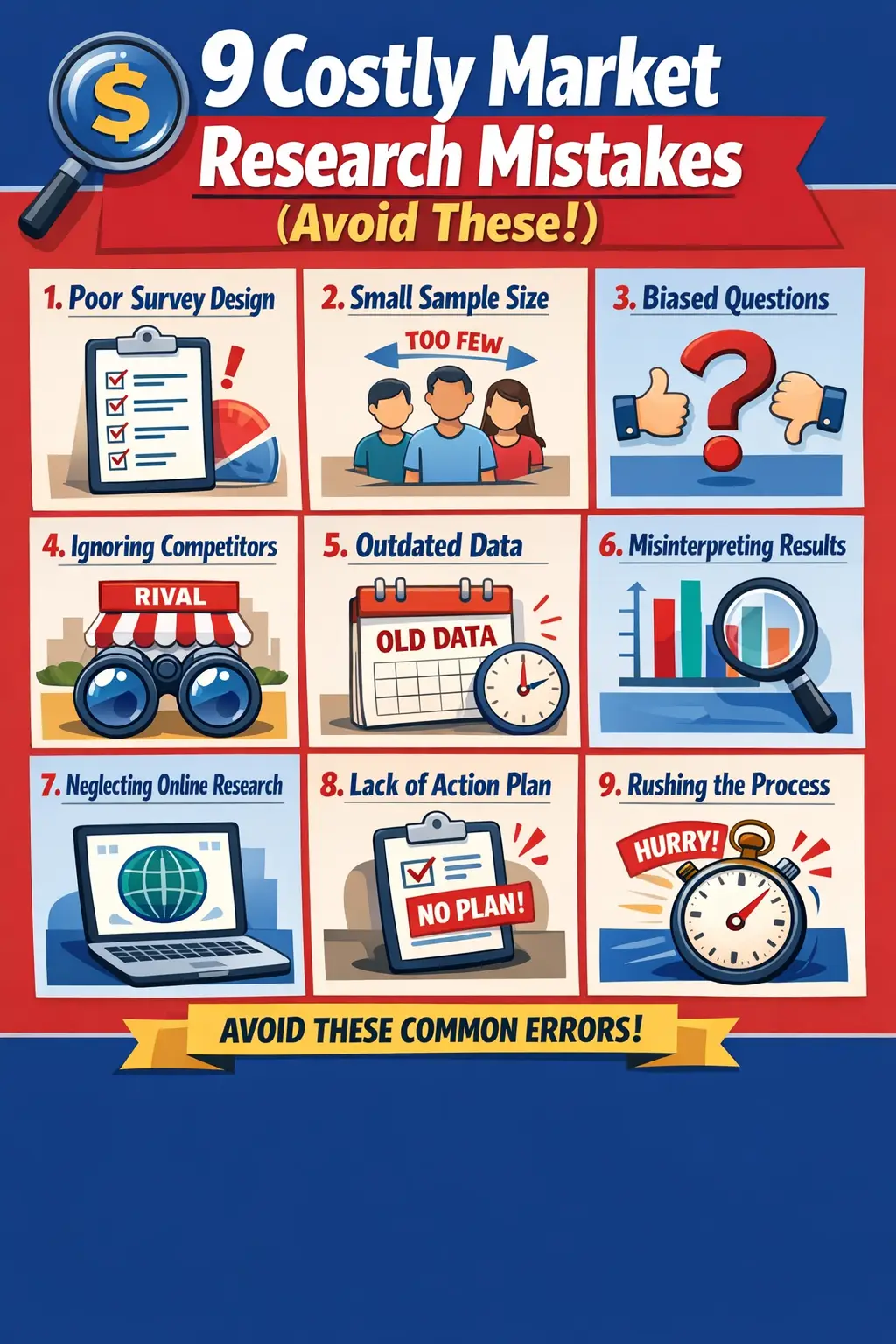
So let’s talk about the nine most costly market research mistakes that traders — beginners and veterans alike — keep making. Let’s laugh about them a little (because if you don’t laugh, you cry), and more importantly, let’s figure out how to stop making them.
Mistake #1: Overconfidence Bias — “I Got This. I Really, Really Got This.”
Ah, overconfidence. The silent assassin of trading accounts. You made two good trades last week, and now you’re walking around like you just got a finance degree from Harvard, a Ph.D. from Oxford, and a personal endorsement from George Soros. You think you can read the market. You think you have an edge. You are, my friend, dangerously delusional — and the research agrees with you.
A landmark study by Barber and Odean found that investors who trade most actively earn the lowest net returns. Their study of 10,000 brokerage accounts revealed that the stocks investors sold outperformed the stocks they bought by 3.2 percentage points in the following year. Let that sink in. The trades they were so confident about were actively destroying value compared to simply doing nothing. And a subsequent study showed that households trading most actively earned net annual returns of 11.4% while the broader market returned 17.9% — a 6.5 percentage point gap eaten up by overconfident trading decisions and associated costs.¹
¹ Barber, B. M., & Odean, T. (1999). The Courage of Misguided Convictions: The Trading Behavior of Individual Investors. Financial Analysts Journal. Available at: https://ssrn.com/abstract=219175
The case study: In the dot-com bubble of the late 1990s, retail investors piled into internet stocks with extraordinary confidence, doing almost no fundamental research. Pets.com raised $82.5 million in an IPO in February 2000 and was out of business by November of the same year. The company’s chief marketing asset was a sock puppet. A sock puppet, people. Investors were so overconfident they funded a sock puppet to the tune of tens of millions of dollars. I’m not even making this up. Go look it up. I’ll wait.
The fix: Before every trade, force yourself to answer three questions: What is my evidence? What is the contrary case? And what would prove me wrong? If you can’t answer all three, you don’t have research — you have a hunch dressed up in a spreadsheet. And honestly? At least be honest with yourself about that. A hunch by itself isn’t always wrong. A hunch you’ve labelled as research is how you end up fully invested in a sock puppet company.
Mistake #2: Confirmation Bias — Only Finding Evidence That Agrees With You
Confirmation bias is when you’ve already decided you want to buy a stock, and now you’re on the internet finding reasons to justify it. You type “Is [company name] a good investment?” and you click on every article that says yes and skip every article that says “This company is a dumpster fire in a hurricane.” You have essentially done research the way a defence attorney does research — you already know your answer, you’re just building the case.
This is one of the most well-documented biases in the behavioural finance literature. Research published in the Journal of Economics, Finance and Administrative Science found that confirmation bias, alongside overconfidence, significantly and negatively impacts investment decision-making outcomes. Investors who exhibit high confirmation bias consistently underperform because they systematically ignore disconfirming evidence.²
² Rasheed, M. H., et al. (2018). The Impact of Behavioral Biases on Investment Decisions: A Serial Mediation Analysis. Journal of Economics, Finance and Administrative Science. Emerald Publishing. Available at: https://www.emerald.com/jefas/article/30/59/5/1247033
I once spent two weeks researching a biotech company. I read every bullish analyst report I could find. I watched every positive YouTube video. I joined a Reddit thread where everyone thought the stock was going to the moon. What I did not do was read the SEC filing that mentioned the company’s lead drug had just failed Phase II trials. That SEC filing was public. I just didn’t want to see it. I bought. The stock fell 48% in a week.
The market didn’t care that I was busy. The market didn’t care that I had a mortgage. The market said, “You didn’t read the filing? That’s a personal problem, chief.”
The fix: For every piece of research that supports your thesis, force yourself to find one that challenges it. Actively seek out the bear case. If the bear case is stupid and easily disproved, great — your conviction is stronger. If the bear case makes you go quiet for a long minute… you’re welcome. Some traders formalise this by creating a “Pre-Mortem Document” — before entering a trade, they write a paragraph describing exactly how and why this trade could fail. It sounds morbid. It is morbid. It also saves you from catastrophic losses, which is the whole point. Write the failure story before you live it.
Mistake #3: Ignoring Macroeconomic Context — Trading Like the Economy Doesn’t Exist
Some traders do their market research in a little bubble. They look at a company’s financials, they study the chart, maybe they read a few earnings call transcripts, and then they make their move — completely ignoring the fact that the central bank just raised interest rates by 75 basis points, inflation is at a 40-year high, and the yield curve is inverted like a yoga instructor doing a backbend.
This is like going to a barbecue and spending all your time deciding which potato salad to eat, while completely ignoring that the house is on fire.
Macroeconomic factors are not background noise — they are the stage on which every trade performs. Research by Kumar and Goyal (2015), reviewed in a systematic literature review on behavioural biases in investment decision-making, confirmed that investors who fail to account for macroeconomic variables are significantly more prone to loss in high-volatility periods.³
³ Kumar, A., & Goyal, N. (2015). Cited in: Systematic Literature Review on the Impact of Behavioral Biases on Investment Decision-Making. Journal of Marketing & Social Research. Available at: https://jmsr-online.com/article/systematic-literature-review-on-the-impact-of-behavioral-biases-on-investment-decision-making-81/
The case study: In 2022, many growth stock investors had done exceptional company-level research. Their fundamental analysis was technically solid. But they had completely ignored that the Federal Reserve was entering an aggressive rate-hiking cycle, which would demolish the valuations of long-duration growth stocks. The Nasdaq 100 fell over 30% that year. The research wasn’t wrong — it was incomplete. They studied the trees and ignored the hurricane season.
The fix: Every trade thesis needs a macro layer. Ask yourself: what is the interest rate environment doing to this sector? What is inflation doing to margins? What is the dollar doing to international revenues? These aren’t optional extras — they’re the foundation. A great company in a terrible macro environment is like a brilliant performer in a burning theatre. The show may be excellent. The building is still on fire. You need to know about the building. Build a simple macro checklist: rate direction, inflation trend, dollar strength, credit conditions, and the overall risk-on vs risk-off sentiment. Tick those boxes before you do anything else.
Mistake #4: Herding Behaviour — “Everyone Else Is Doing It So It Must Be Right”
You know the scene. You’re scrolling through Twitter — I’m sorry, X — and everyone is buying the same thing. Reddit is going wild. Your group chat is lit. Your barber mentioned it. Your barber’s cousin is already in. And now you’re convinced this trade is destiny.
This, my friend, is called herding bias, and it is basically the financial equivalent of jumping off a bridge because your friends did it. Except in this version, your friends also lose money.
The research on herding behaviour is extensive. A study published in the Biases in Behavioral Finance review in the World Scholars Review found that herding bias was a significant contributor to the dot-com bubble and is now exhibiting similar patterns in cryptocurrency markets. The research noted that when individual investors follow crowds, asset prices deviate dangerously from their intrinsic values — meaning you are buying something not because it’s worth it, but because other confused people are also buying it and that made you feel better.⁴
⁴ Dewan, P., et al. (2019). Cited in: Biases in Behavioral Finance. World Scholars Review. Available at: https://www.worldscholarsreview.org/article/biases-in-behavioral-finance
The case study: GameStop. January 2021. A Reddit community collectively decided to short-squeeze a brick-and-mortar video game retailer whose fundamental business model had been struggling for years. At its peak, GameStop shares hit $483. Most retail investors who bought during the hype — because everyone was doing it — bought at prices wildly disconnected from any rational valuation. When the squeeze unwound, the late entrants took massive losses. The research here was essentially just “everyone in my group chat bought it.” That is not research. That is group psychology with a brokerage account.
The fix: Ask yourself this one powerful question before every “hot tip” trade: If nobody else was talking about this, would I still want to buy it based on the fundamentals alone? If the answer is no, you’re following a crowd, not making a decision. And here’s a corollary thought that has saved me money more than once: the more people telling you about a trade, the less you should trust the setup. By the time the barbershop knows about it, the smart money figured it out three months ago and is already looking at the exit. The crowd doesn’t discover opportunities. The crowd arrives at the end of them. Be early, be informed, or be out. Those are the only three positions worth having.
Mistake #5: Anchoring Bias — Getting Stuck on a Number That No Longer Matters
Anchoring bias is when you get emotionally attached to a specific price point — usually the price you paid — and make every subsequent decision based on that number instead of the current reality. You bought a stock at £100. It’s now at £60. You won’t sell because in your head, it’s still a “£100 stock.” You are waiting for it to “come back.” It might. Or the company might be in a death spiral and you’re on the Titanic humming a sea shanty.
This is one of the classic cognitive traps identified in Kahneman and Tversky’s foundational 1979 Prospect Theory paper, which introduced the concept that investors feel the pain of losses approximately twice as intensely as the pleasure of equivalent gains — meaning you are physiologically biased toward holding losers because selling them would force you to feel that disproportionate pain.⁵
⁵ Kahneman, D., & Tversky, A. (1979). Prospect Theory: An Analysis of Decision Under Risk. Econometrica, 47(2), 263–291. Referenced in: Systematic Literature Review on Behavioural Biases. Journal of Marketing & Social Research. Available at: https://jmsr-online.com/article/systematic-literature-review-on-the-impact-of-behavioral-biases-on-investment-decision-making-81/
I once held a retail stock for fourteen months waiting for it to return to my entry price, while the company issued three profit warnings and its CEO resigned. I kept saying, “It’ll bounce back.” Meanwhile the stock lost 70% of its value and I eventually sold at a horrifying loss, all because I couldn’t detach from a number I paid over a year earlier. That number — my purchase price — had absolutely zero influence on the company’s future performance. The market didn’t know what I paid. The market didn’t care. The market was out here just doing market things.
The fix: When evaluating whether to hold or sell, pretend you don’t own the stock. Ask: “If I had no position, would I buy this at the current price?” If the honest answer is no — sell it. Your entry price is irrelevant to the future. The stock doesn’t know what you paid. The company doesn’t know what you paid. The other investors in the market do not know what you paid and would not care if they did. Your entry price is a private fact with zero predictive value. Treat every decision as if you’re starting fresh, because in terms of future outcomes, you always are.
Mistake #6: Survivorship Bias — Only Learning From the Winners
Here’s a trap that catches even experienced traders. You study the greatest trades ever made. You study Warren Buffett’s letters. You read about George Soros breaking the Bank of England. You read about every hedge fund that returned 40% last year. And you think to yourself, “I see the pattern — I can replicate this.”
What you are not reading about are the thousands of traders who used similar strategies and lost everything. They don’t write bestselling books. They don’t do TED talks. They’re out here driving Ubers and pretending they voluntarily changed careers.
Survivorship bias in market research means you are building your strategy on an incomplete dataset — specifically, a dataset that has quietly removed everyone who failed from the sample. This creates a wildly distorted picture of what works.
Research by Andriamahery and Qamruzzaman (2022), cited in a comprehensive PMC behavioural finance study, highlights that investors routinely misread market history because they unconsciously filter their evidence base toward successful outcomes, leading to systematic overestimation of the probability of success when replicating popular strategies.⁶
⁶ Andriamahery, A., & Qamruzzaman, M. (2022). Cited in: An Empirical Assessment of Financial Literacy and Behavioral Biases on Investment Decision. PMC / NCBI. Available at: https://pmc.ncbi.nlm.nih.gov/articles/PMC9549276/
The case study: Countless retail traders in the 2000s tried to replicate the options strategies they read about from traders who had made millions. What they weren’t reading about was the far larger cohort who blew up their accounts executing the exact same trades at the exact same time. One famous options strategy — selling naked puts — sounds straightforward and profitable until the market crashes 20% in a week and the strategy wipes out months of gains overnight. The traders you see on podcasts are the ones who survived. The others are not on podcasts.
The fix: When studying successful strategies, actively seek out failure case studies too. Ask: what percentage of people who tried this strategy failed? What were the conditions under which it failed? This is not pessimism — it’s complete research. Try this exercise: for every trading book on your shelf written by a successful trader, find a documented account of a trader who used an identical approach and lost. They exist. They’re everywhere. They’re just not writing books about it. Seek them out. Their stories will teach you more than the success stories, because success often involves timing, luck, and survivorship factors that the author genuinely cannot separate from skill.
Mistake #7: Neglecting Qualitative Research — Reading Numbers But Not the Room
You’ve read the balance sheet. You’ve analysed the P/E ratio. You’ve built a discounted cash flow model in Excel that took you three hours and which you are very proud of. But you haven’t read a single interview with the CEO. You haven’t looked at Glassdoor to see if the employees hate it there. You haven’t checked whether the company’s biggest customer just quietly ended their contract. You, my friend, have read the recipe but tasted nothing.
Qualitative market research is not soft and sentimental — it is decisive. Management quality, corporate culture, brand moat, regulatory environment, competitive dynamics — none of these appear as a clean number in a spreadsheet, but all of them drive long-term share price performance. A quantitatively perfect company with a dishonest management team is not a good investment. It’s a time bomb with a nice valuation.
Research published in a 2023 Qualitative Research in Financial Markets study on measuring behavioural biases in individual investors found that over-reliance on quantitative metrics — at the expense of qualitative factors — consistently leads to mispriced risk assessments, particularly in sectors where intangible assets and management execution represent the dominant value drivers.⁷
⁷ Cardoso, N. O. (2023). Measuring Behavioural Biases in Individual Investors’ Decision-Making and Sociodemographic Correlations: A Systematic Review. Qualitative Research in Financial Markets. Emerald Publishing. Referenced at: https://www.emerald.com/jefas/article/30/59/5/1247033
The case study: Enron had beautiful numbers right up until it didn’t. Analysts who went purely on the quantitative data were buying and holding while the company was cooking its books with the enthusiasm of a Michelin-starred chef. The investors who sensed something was wrong often got there through qualitative signals: former employees speaking vaguely, a CFO who resigned suddenly, executives selling large personal stock positions, an annual report that was deliberately impenetrable. Numbers lie. Context usually doesn’t.
The fix: For every position, do a “qualitative audit.” Read CEO interviews and earnings call transcripts. Check Glassdoor reviews. Study insider buying and selling. Research major customer relationships. Look for what the numbers are not telling you.
Mistake #8: Recency Bias — Assuming Whatever Just Happened Will Keep Happening
Recency bias is when your entire forward-looking model is basically just the recent past, extended. The market has been going up for three years, so you assume it will keep going up. Volatility has been low for six months, so you stop hedging. A sector has been outperforming for two years, so you rotate your entire portfolio into it.
This is how people buy the top of every bull market, every time, forever, without fail, across generations of investors who absolutely should have known better by now.
I once had a period where every tech position I opened went up. I mean everything. Cloud, AI, semiconductors — all of it. I started thinking I had a gift. I started thinking I understood the market on a deep, almost spiritual level. I opened bigger and bigger positions. And then the rate environment changed, tech valuations compressed, and my “gift” turned out to be a bull market doing what bull markets do, which is make everyone look like a genius until it doesn’t.
Recency bias is extensively documented in behavioural finance. A study on behavioural biases across the Pakistan Stock Exchange, published in a Taylor & Francis peer-reviewed journal, found that recency-driven framing effects — where recent market performance disproportionately shapes investor expectations — had a statistically significant positive relationship with poor investment decision-making outcomes.⁸
⁸ Camilli, B., et al. (2024). Cited in: Understanding Behavioural Biases in Investment Decisions: Empirical Insights from an Emerging Market. Taylor & Francis / Cogent Economics & Finance. Available at: https://www.tandfonline.com/doi/full/10.1080/23322039.2025.2567499
The case study: In 2006 and 2007, US housing had been appreciating for years. The prevailing assumption — baked into models at major financial institutions — was that house prices nationally could not decline. This assumption was based almost entirely on recent history. The result was the 2008 global financial crisis, one of the most catastrophic economic events in modern history. The research was not wrong about what had happened. It was fatally wrong about using that as a template for what would happen next.
The fix: When building any market thesis, explicitly ask: “What would have to change for this trend to reverse?” Then assess how likely those conditions are. Do not assume continuation — prove it. Another useful technique: look at your thesis through a historical lens. Has this trend happened before? How did it end? Every bull market feels different in the moment and ends the same way in retrospect. Low volatility regimes always end. Every “this time it’s different” story in financial history has ended with the embarrassing discovery that it was not, in fact, different. The bones of the market are old. The outfits change. Study the bones.
Mistake #9: Automation Bias — Trusting Your Algorithm More Than Your Brain (And Also Your Brain More Than Your Algorithm)
We’ve reached the final mistake, and it is the most modern, most sneaky, most 21st-century mistake of all. It has two flavours, and both of them will get you.
Flavour one: You get an AI-generated signal, a backtested algorithm, or a “quant model” from some newsletter you subscribe to, and you follow it blindly without applying any independent judgement. The algorithm says buy — you buy. The algorithm says sell — you sell. You have outsourced your brain to a machine, and that machine does not know about the news event that broke after markets closed, the geopolitical crisis unfolding over the weekend, or the fact that the backtested model was optimised on data from a completely different market regime. This is called automation bias.
Flavour two: You have a perfectly good quantitative signal — a screener, a model, a technical setup — and you override it constantly because your gut says something different. Your gut, frankly, has no idea what it’s talking about. Your gut is just your emotions wearing a blazer and calling themselves intuition.
A systematic literature review covering 30 peer-reviewed studies from 2020 to 2025, published in F1000Research, found that automation bias is an emerging and growing concern in retail investing, particularly given the explosion of AI-driven fintech platforms. The study found that automation bias — excessive dependency on AI and computer-generated signals for investment decisions — had a strong and statistically significant negative impact on investor outcomes.⁹
⁹ Katenova, M., et al. (2025). Behavioral Finance in the Sphere of Investment: Systematic Review of Literature Between 2020 and 2025. F1000Research. Available at: https://f1000research.com/articles/14-949
The case study: In August 2012, Knight Capital Group — one of the largest US market makers — deployed a new trading algorithm that had a bug in it. The algorithm began executing erroneous trades at extraordinary speed. In 45 minutes, the firm lost $440 million. Within days, Knight Capital had to be rescued in an emergency sale. The company had trusted the machine completely. The machine, in turn, had a bad day. Nobody caught it in time because the culture was to trust the system.
On the other side of this: in 2020, many quantitative models were overwhelmed by the speed and nature of the COVID market crash, because the data underlying those models had never seen anything like it. Traders who supplemented their quant signals with genuine human judgement — understanding why markets were moving — navigated the volatility far better than those who hid behind models.
The fix: Use automation as a tool, not a brain replacement. Let your models narrow the universe and surface ideas. Then apply genuine qualitative judgement. And when you do have a well-designed quantitative process — respect it. Don’t override it every time your feelings disagree with the output.
Bringing It All Together: The Research Framework That Actually Works
Look. I’ve been in this game long enough to have made all nine of these mistakes, some of them in the same week. The market has taken my overconfidence, my herding, my anchoring, my survivorship bias, my recency bias, my automation worship, and my confirmation-biased Excel models, and it has calmly, systematically, and with zero apology turned them into losses.
But here’s the thing — and this is important — the market doesn’t hate you. The market doesn’t know you exist. The market is just the aggregate of millions of decisions made by millions of people, and if your research is worse than the average, you lose to the average. It’s mathematical. It’s not personal. It’s not a punishment. It’s just arithmetic.
The research consensus — across decades of peer-reviewed behavioural finance literature — is remarkably consistent. A meta-analysis published in PMC covering 63 empirical studies found that overconfidence, herding, anchoring, and loss aversion remain the dominant drivers of poor investment outcomes across both developed and emerging markets.¹⁰ These biases are not quirks of weak-minded investors — they are systematic, near-universal features of human psychology that affect professionals and amateurs alike.
¹⁰ Unpacking Investor Psychology: A Systematic Review and Meta-Analysis of Behavioural Biases Shaping Investment Decisions. F1000Research / PMC. Available at: https://pmc.ncbi.nlm.nih.gov/articles/PMC12576316/
What separates profitable traders from unprofitable ones, over the long run, is not intelligence. It is not access to better information. It is not even experience — experience can actually make some biases worse, because success teaches you the wrong lessons if you’re not careful. What separates them is process discipline. The willingness to build a research framework that forces you to confront your own biases, deliberately seek disconfirming evidence, situate every trade in its macroeconomic context, and apply genuine human judgement without letting emotion or overconfidence override the signals.
Quick-Reference: The 9 Mistakes and How to Avoid Them
Here is your cheat sheet. Print it. Pin it above your trading terminal. Read it every single morning before you open a position.
| # | Mistake | The Trap | The Fix |
|---|---|---|---|
| 1 | Overconfidence Bias | Believing your recent wins prove skill | Ask: what’s my evidence for AND against? |
| 2 | Confirmation Bias | Only finding research that agrees with you | Actively seek the bear case for every trade |
| 3 | Ignoring Macro Context | Studying companies in an economic vacuum | Add a macro layer to every thesis |
| 4 | Herding Behaviour | Buying because everyone else is buying | Ask: would I buy this based on fundamentals alone? |
| 5 | Anchoring Bias | Getting stuck on your entry price | Pretend you have no position — would you buy now? |
| 6 | Survivorship Bias | Only studying successful strategies | Actively research the failures too |
| 7 | Neglecting Qualitative Research | Trusting numbers over context | Do a qualitative audit: management, culture, customers |
| 8 | Recency Bias | Assuming recent trends will continue | Identify the conditions that would break the trend |
| 9 | Automation Bias | Outsourcing your brain or overriding your models | Use algorithms as tools, not replacements for judgement |
Final Word: The Market Doesn’t Owe You Anything
The market has existed before you, will exist after you, and on any given day does not have your name in its calendar. It is not waiting to validate your thesis. It is not going to eventually recognise that you were right. It is not going to feel bad about the losses. It is just going to keep doing what it does — pricing information, discounting futures, punishing the underprepared, and occasionally rewarding the disciplined.
Your job — if you want to stay in this game long enough to be one of the people it rewards — is to do better research. Complete research. Humble research. Research that asks hard questions about your own assumptions and doesn’t stop until it finds the honest answers.
Because the market already knows what you’re going to do. It’s been watching traders make these same nine mistakes for over a century. The only question is whether you’re going to be one of them.
I say you’re not. But that’s up to you to prove — one well-researched trade at a time.
Bonus Thought: The Most Expensive Mistake of All
There’s a tenth mistake I almost didn’t include because it’s not really about research technique — it’s about character. And that mistake is failing to act on good research because you’re afraid to be wrong in public.
Some traders do thorough research. They identify the right opportunity. They build the correct thesis. And then they don’t do the trade because what if they’re wrong? What if someone finds out? What if they have to sit with a loss for a few weeks and feel bad about it?
This is fear of regret — a cousin of loss aversion documented extensively in the behavioural finance literature — and it is the reason why some people can read every book about trading, absorb every lesson, do everything right intellectually, and still not make money. Because making money in the market requires not just being right but acting on being right. With conviction. Under uncertainty. Without the comfort of knowing the outcome in advance.
Research should reduce uncertainty. It will never eliminate it. The goal is to put the probabilities in your favour, manage your risk intelligently, and execute with discipline. That is all you can do. That is, it turns out, enough.
Good luck out there. Do your research. Manage your ego. And remember — the market has been here longer than all of us, and it will be here long after. Respect it accordingly.
- Barber, B. M., & Odean, T. (1999). The Courage of Misguided Convictions: The Trading Behavior of Individual Investors. Financial Analysts Journal, 55(6), 41–55. SSRN. https://ssrn.com/abstract=219175
- Rasheed, M. H., et al. (2018). The Impact of Behavioral Biases on Investment Decisions: A Serial Mediation Analysis. Journal of Economics, Finance and Administrative Science. Emerald Publishing. https://www.emerald.com/jefas/article/30/59/5/1247033
- Kumar, A., & Goyal, N. (2015). Cited in: Systematic Literature Review on the Impact of Behavioral Biases on Investment Decision-Making. Journal of Marketing & Social Research. https://jmsr-online.com/article/systematic-literature-review-on-the-impact-of-behavioral-biases-on-investment-decision-making-81/
- Dewan, P., et al. (2019). Cited in: Biases in Behavioral Finance. World Scholars Review. https://www.worldscholarsreview.org/article/biases-in-behavioral-finance
- Kahneman, D., & Tversky, A. (1979). Prospect Theory: An Analysis of Decision Under Risk. Econometrica, 47(2), 263–291. Referenced in: Systematic Literature Review on Behavioural Biases. Journal of Marketing & Social Research. https://jmsr-online.com/article/systematic-literature-review-on-the-impact-of-behavioral-biases-on-investment-decision-making-81/
- Andriamahery, A., & Qamruzzaman, M. (2022). Cited in: An Empirical Assessment of Financial Literacy and Behavioral Biases on Investment Decision. PMC / NCBI. https://pmc.ncbi.nlm.nih.gov/articles/PMC9549276/
- Cardoso, N. O. (2023). Measuring Behavioural Biases in Individual Investors’ Decision-Making and Sociodemographic Correlations: A Systematic Review. Qualitative Research in Financial Markets. Emerald Publishing. https://www.emerald.com/jefas/article/30/59/5/1247033
- Camilli, B., et al. (2024). Cited in: Understanding Behavioural Biases in Investment Decisions: Empirical Insights from an Emerging Market. Cogent Economics & Finance, Taylor & Francis. https://www.tandfonline.com/doi/full/10.1080/23322039.2025.2567499
- Katenova, M., et al. (2025). Behavioral Finance in the Sphere of Investment: Systematic Review of Literature Between 2020 and 2025. F1000Research. https://f1000research.com/articles/14-949
- Unpacking Investor Psychology: A Systematic Review and Meta-Analysis of Behavioural Biases Shaping Investment Decisions. F1000Research / PMC. https://pmc.ncbi.nlm.nih.gov/articles/PMC12576316/
Disclaimer: This article is for educational purposes only and does not constitute financial or trading advice. Always conduct your own research before making investment decisions.
Leave a Reply
You must be logged in to post a comment.