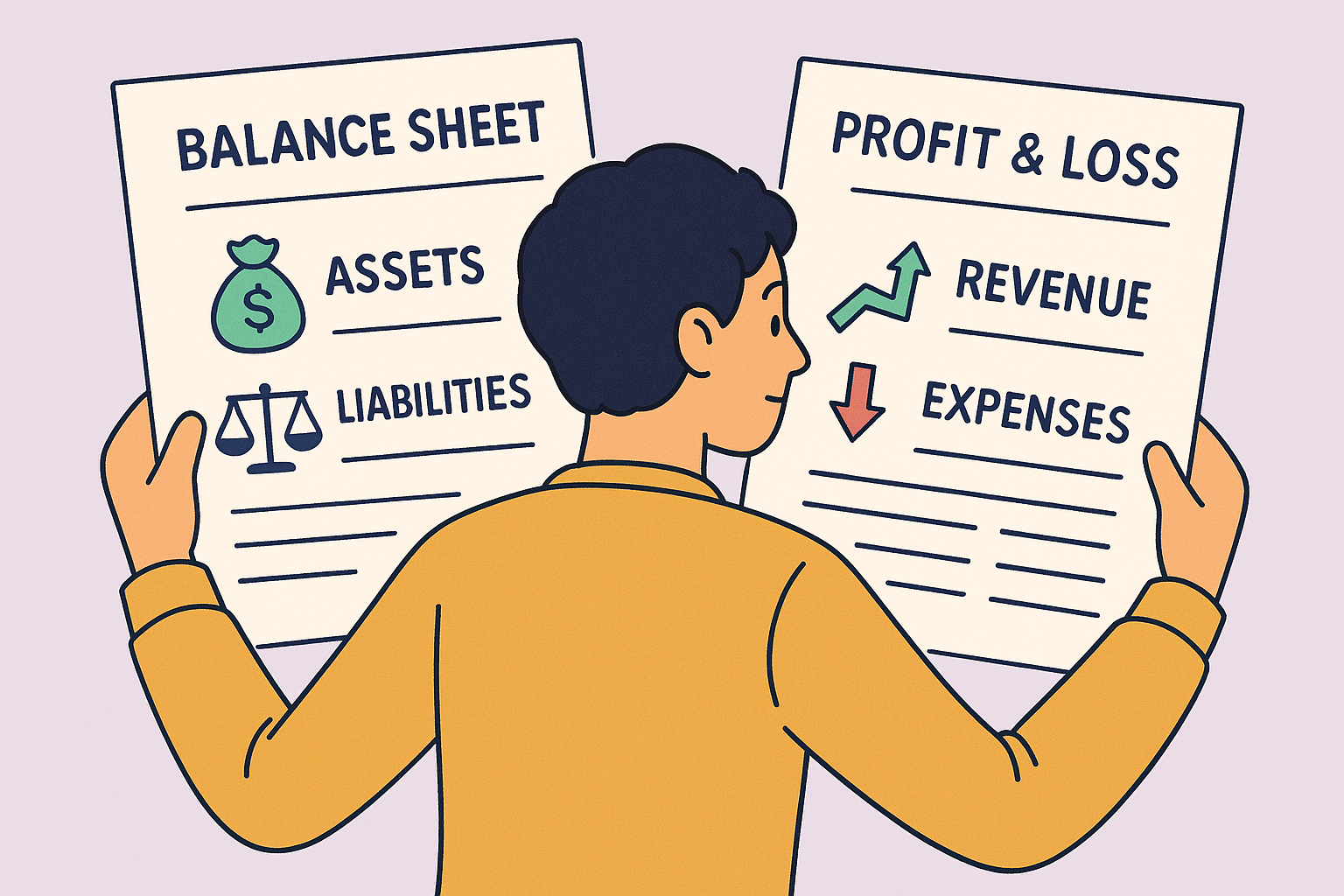
Reading a balance sheet and a profit and loss statement (also called an income statement or P&L) is the single most important financial skill any business owner, investor, or trader can develop — and most people are walking around completely clueless about both of them.
Let me be real with you. When I first started trading and investing, I looked at a balance sheet and my brain went completely offline. Like, the kind of offline where you press the power button and nothing happens. My accountant slid those papers across the desk, looked at me with that “this man has no idea” face, and I smiled back like I understood every word. I did not. I understood zero words. I was just sitting there looking confident like I had ordered something at a restaurant and didn’t understand the menu but refused to ask questions.
But here’s the thing — once someone explains these two documents in plain English, everything changes. You stop making blind decisions. You stop celebrating a big revenue month only to realise your cash account is dryer than a Tuesday afternoon in the Sahara. And you stop being the person in the board meeting nodding along to numbers you don’t understand.
This article is for every entrepreneur, small business owner, aspiring investor, and financially curious human being who has ever looked at a set of financial statements and felt like they were reading a foreign language. By the end, you will understand the difference between a balance sheet and a profit and loss statement, why they both matter, how they connect, and how to use them to make smarter decisions.
According to research published on ResearchGate examining financial statement analysis as a business management tool, financial statement analysis is a crucial aspect of successful management — it enables companies to assess financial strength, determine optimal development strategies, and make informed decisions in a changing market environment. In other words, this is not optional reading. This is survival.
Let’s get into it.
2. What Is a Balance Sheet? (And Why It’s Not as Scary as Your Tax Return)
The balance sheet is a financial snapshot — a photograph of your business at one specific moment in time. Think of it like this: your profit and loss is a whole movie, and your balance sheet is a pause at a particular scene. It shows you exactly what you own, what you owe, and what’s left over for the owners.
The balance sheet is built on one fundamental equation:
Assets = Liabilities + Owner’s Equity
That’s it. That’s the whole thing. Everything on a balance sheet is just different ways of expressing this one equation.
Now, I know what you’re thinking. “That sounds simple. Why did my accountant make it look like NASA launch code?” Because accountants, God love them, have a gift for making simple things look complicated. It’s a superpower they’re born with. Imagine if someone described a sandwich as “layered alimentary assemblages featuring protein and carbohydrate components bound by condiment adhesives.” That’s accounting for you.
Let me break it down:
Assets are everything your business OWNS or is OWED. Cash in the bank, your equipment, your inventory, what customers owe you — that’s all an asset.
Liabilities are everything your business OWES to others. Loans, credit card balances, unpaid invoices — that’s your liabilities.
Owner’s Equity (also called shareholders’ equity or net worth) is what’s left after you subtract liabilities from assets. It represents the owners’ stake in the business.
According to PricewaterhouseCoopers’ foundational guide to understanding company financials, the balance sheet is a snapshot at a point in time, with assets and liabilities typically listed in order of liquidity — meaning how quickly they can be converted to cash.
That last point is important. Not all assets are equal. Cash is immediately available. A building? You might need months to sell it. That’s why the balance sheet organises assets from most liquid (cash) to least liquid (long-term property and equipment).
The balance sheet is also critically important to investors. As highlighted in EBSCO’s Financial Statement Analysis research, balance sheets can tell investors whether or not a company is a good investment based on its financial condition. So yeah — this document isn’t just for accountants. It’s for anyone who wants to put money into something and not lose their shirt.
3. What Is a Profit and Loss Statement? (Your Business Report Card)
The Profit and Loss statement — also called the income statement or P&L — is the movie to the balance sheet’s photograph. It shows you what happened in your business over a period of time. Usually a month, quarter, or year.
It answers one burning question: Did you make money or lose money during this period?
The P&L is structured like this:
Revenue (all the money that came IN)
- Cost of Goods Sold (what it cost to make or deliver what you sold)
= Gross Profit
- Operating Expenses (rent, salaries, marketing, etc.)
= Operating Profit (EBIT - Earnings Before Interest and Taxes)
- Interest and Taxes
= Net Profit (or Net Loss)
That net profit number at the bottom — that’s your bottom line. That’s the number everyone cares about. It tells you whether your business is making money or burning through it like a lottery winner who just discovered online shopping.
Now, here’s where people get confused. A business can SHOW a profit on the P&L and still run out of cash. How? Because of the difference between revenue recognition and actual cash collection. You might invoice a client for £50,000 in December, record it as revenue in December, but not receive the cash until February. Your P&L in December looks great. Your bank account in January? Not so much.
This is why reading the P&L alone — without the balance sheet — is like watching only the first half of a game and thinking you know who won.
According to indinero’s guide on consistent financial reporting, the P&L is the best view into your business’s bottom line, and it’s typically what is used to show lenders and investors whether your company has made or lost money during a given period. Your net income is also what determines your taxable income — so yes, Uncle Sam cares about this document too.
4. The Big Difference: Snapshot vs. Movie
Let me put this in the clearest possible terms.
The Balance Sheet = A Photograph It shows you what your business looks like at ONE moment. Like if someone photographed your kitchen right now. You’d see the dishes in the sink (liabilities), the food in the fridge (assets), and whether the kitchen is generally well-stocked or running on fumes (equity).
The P&L = A Documentary It shows you what happened over a PERIOD of time. It’s the film of your business’s year — all the revenue earned, all the expenses paid, all the drama in between. Did you sell a lot? Did your costs spiral out of control? Did you accidentally hire someone whose salary was eating 40% of your revenue? The P&L will tell you.
Here’s my favourite way to think about it as a trader: the balance sheet tells you what you ARE, and the P&L tells you what you DID.
You could have a great P&L — massive revenue, healthy profits — but look at your balance sheet and discover you’re sitting on a mountain of debt that could bury the business in eighteen months. I’ve seen traders and investors focus entirely on earnings growth, completely ignore the balance sheet, and then act surprised when the company goes under. Bro. The balance sheet was RIGHT THERE. It was literally telling you the whole time.
According to research from Charles Schwab’s financial education resources, while the income statement records funds flowing in and out of a company over a period, the balance sheet is a snapshot of a company’s financial position at a point in time — showing what it owns, what it owes, and the difference between the two.
These two documents are designed to work together. Neither is complete without the other. They’re like peanut butter and jelly. You can have one alone, but together they make something significantly better — and significantly more useful for understanding the full financial picture.
5. Breaking Down the Balance Sheet — Line by Line
Let’s get into the actual anatomy of a balance sheet so you know exactly what you’re looking at when you open one.
Current Assets
These are assets that can be converted to cash within twelve months. They include:
Cash and Cash Equivalents — Your most liquid asset. The actual money in your accounts. If this number is chronically low, you have a cash flow problem regardless of what the P&L says.
Accounts Receivable — Money that customers OWE you but haven’t paid yet. This is technically an asset because you’re owed the money. But here’s the kicker — a high accounts receivable number relative to your revenue could mean you’re slow at collecting payments. That’s a problem dressed up in asset clothing.
Inventory — The goods you have on hand ready to sell. For a manufacturing company or retailer, inventory is a big deal. For a service business, inventory might not exist at all.
Prepaid Expenses — Things you’ve paid for in advance, like insurance premiums or annual software subscriptions. Still an asset because you’re yet to use what you’ve paid for.
Non-Current Assets (Long-Term Assets)
These stick around for more than a year. Things like property, plant, equipment (PP&E), long-term investments, and intangible assets like patents or goodwill.
If your business has a massive amount of property and equipment on the books, you better make sure that equipment is actually generating revenue. Otherwise, you’re just hauling around dead weight on your balance sheet like someone who keeps gym equipment in their bedroom but never uses it.
Current Liabilities
What you owe that’s due within twelve months. Accounts payable (what you owe suppliers), short-term loans, accrued expenses, and deferred revenue (money you’ve received but haven’t earned yet — yes, that’s a liability).
Non-Current Liabilities
Long-term debt — like mortgages, bonds, or bank loans with repayment terms beyond twelve months.
Owner’s Equity / Shareholders’ Equity
This is the residual — what’s left after subtracting all liabilities from all assets. It includes share capital, retained earnings (profits that have been reinvested back into the business), and any other equity contributions.
When retained earnings are growing year over year, that’s a great sign. It means the business is generating profits AND holding onto them. When retained earnings are declining — or negative — that means accumulated losses are eating into the business’s net worth. That’s the financial equivalent of your savings account going backwards every month.
6. Breaking Down the P&L — Line by Line
Now let’s walk through the income statement in detail.
Revenue (Top Line)
This is the total amount earned from selling goods or services before any expenses are deducted. Sometimes called “turnover” or “gross revenue.” This is the number that gets people excited at company announcements. “We had £10 million in revenue!” Sounds amazing. But revenue without context is meaningless.
I have seen businesses brag about their revenue like it’s the only number that matters, and then their expenses are so sky-high they’re actually losing money. That’s like bragging that you made £10,000 at the casino but not mentioning you spent £12,000 to do it. Congratulations. You played yourself.
Cost of Goods Sold (COGS)
The direct costs of producing what you sell. If you’re a baker, this is your flour, eggs, sugar, and packaging. If you’re a software company, this might be hosting costs and developer time directly linked to building the product.
Gross Profit and Gross Margin
Gross Profit = Revenue – COGS. Gross Margin = Gross Profit ÷ Revenue × 100.
This tells you how efficiently you’re producing your product or delivering your service. A high gross margin means there’s room to cover operating expenses and still make money. A low gross margin means you need to sell an enormous volume just to break even.
For context: software companies often have gross margins above 70%. Retailers might sit at 30-50%. Manufacturers might be 20-40%. If your gross margin is way below your industry average, you’ve got a pricing or production cost problem.
Operating Expenses
Everything it costs to run the business that isn’t directly tied to production. This includes salaries, rent, marketing, utilities, insurance, and administrative costs. These are sometimes called “overheads.”
EBITDA
Earnings Before Interest, Taxes, Depreciation, and Amortisation. This is a popular metric because it gives a cleaner view of operational profitability. It strips out financing costs (interest), non-cash expenses (depreciation and amortisation), and tax implications so you can compare businesses more fairly.
Net Profit (Bottom Line)
After you’ve taken revenue, subtracted COGS, subtracted operating expenses, paid your interest, and handled taxes — what’s left is net profit. This is the definitive answer to “did the business make money?”
The OpenStax Financial Accounting textbook — a peer-reviewed educational resource notes that financial statement analysis enables companies to assess performance across multiple dimensions including margins and capital utilisation, forming the basis for many detailed metrics. In other words, the P&L is your starting point, but the ratios you derive from it are where the real insights live.
7. How the Two Statements Talk to Each Other
This is where things get really interesting, and where most non-accountants completely lose the plot.
The balance sheet and P&L are not independent documents. They are deeply, intimately connected. Net profit from the P&L flows directly into the balance sheet as an increase in retained earnings under owner’s equity. In other words, when your business makes money, it shows up BOTH in the P&L (as net profit) AND in the balance sheet (as increased retained earnings).
Here’s a simplified chain of events:
- Your business earns £100,000 in revenue and spends £80,000 in costs.
- The P&L shows £20,000 net profit.
- That £20,000 (assuming no dividends are paid out) increases retained earnings on the balance sheet by £20,000.
- Meanwhile, the £100,000 revenue that came in as cash increases your cash balance (an asset on the balance sheet).
- The £80,000 in expenses that went out as cash decreases your cash balance.
Net result on the balance sheet: cash went up by £20,000, retained earnings went up by £20,000. Both sides balance. The equation holds.
This is why if someone shows you a P&L with £500,000 in profit but the balance sheet shows cash has barely moved, you need to start asking questions. Where’s the profit? Is it locked up in accounts receivable? Did it get eaten by inventory? The balance sheet will tell you.
As the CFA Institute’s research on financial statement benchmarking published in The Accounting Review demonstrates, income statement benchmarking predicts the accuracy of earnings forecasts, while balance sheet benchmarking predicts the accuracy of net debt forecasts — confirming that each statement plays a uniquely different but complementary role in financial analysis.
8. Case Study 1: The Café That Looked Profitable But Was Broke
Let me tell you about a café. We’ll call it Bean There Coffee (because I enjoy a good pun and I earned it).
The Situation
Bean There Coffee’s P&L for the year looked like this:
| Item | Amount |
|---|---|
| Revenue | £480,000 |
| Cost of Goods Sold | £168,000 |
| Gross Profit | £312,000 |
| Operating Expenses | £264,000 |
| Net Profit | £48,000 |
Beautiful. £48,000 net profit. The owner is celebrating. She’s telling her family the café is doing well. She’s thinking about opening a second location.
Then her accountant pulls out the balance sheet.
The Balance Sheet Reality
| Item | Amount |
|---|---|
| Cash | £3,200 |
| Accounts Receivable | £12,000 |
| Inventory | £4,500 |
| Equipment | £85,000 |
| Total Assets | £104,700 |
| Accounts Payable | £31,000 |
| Short-term Loans | £28,500 |
| Long-term Debt | £55,000 |
| Total Liabilities | £114,500 |
| Owner’s Equity | -£9,800 |
Owner’s equity is NEGATIVE. She owes more than she owns. Her cash position — £3,200 — cannot cover even a month’s rent. The £12,000 in accounts receivable? That’s from a corporate catering contract where payment is 90 days out.
So what happened? The café IS profitable on paper. But she’d been:
- Taking out loans to buy new equipment
- Extending credit to corporate clients
- Not collecting debts fast enough
- Paying suppliers slowly (hence the high accounts payable)
The P&L said success. The balance sheet said danger. Without reading BOTH, she would have walked straight into a cash flow crisis.
This scenario reflects findings from NetSuite’s analysis of small business financial health, which notes that analysing balance sheets can indicate how well a company is using its capital, why it may be borrowing money, and whether that borrowing is justified — insights the income statement simply cannot provide alone.
The Lesson: Profit ≠ Cash. Never make a major business decision based on the P&L alone. Always check the balance sheet to see what’s really going on under the hood.
9. Case Study 2: The Manufacturing Company With a Gorgeous Balance Sheet
Now let’s flip it. Meet SteelCraft Ltd., a mid-sized steel fabrication company.
The Balance Sheet (Impressive)
| Item | Amount |
|---|---|
| Cash | £1,200,000 |
| Accounts Receivable | £340,000 |
| Inventory | £890,000 |
| Property & Equipment | £4,500,000 |
| Total Assets | £6,930,000 |
| Total Liabilities | £1,800,000 |
| Owner’s Equity | £5,130,000 |
Rock solid. The company owns significantly more than it owes. Equity is strong. Cash is healthy. Any bank would lend to this company. Any investor looking at the balance sheet would think, “Now that’s a stable operation.”
But then you open the P&L.
The P&L (Concerning)
| Item | Amount |
|---|---|
| Revenue | £3,200,000 |
| COGS | £2,560,000 |
| Gross Profit | £640,000 |
| Operating Expenses | £580,000 |
| Interest Expense | £90,000 |
| Net Loss | -£30,000 |
The company lost £30,000 this year. Not catastrophic — but with a strong balance sheet, it’s a warning sign. The assets accumulated over many profitable years are now masking the fact that the CURRENT operation is generating a loss.
If you only read the balance sheet, you’d think this was a great company. If you only read the P&L, you might overreact to a £30,000 loss for a company with £5 million in equity. Together, they tell a nuanced story: a fundamentally strong business that is currently underperforming operationally, perhaps due to rising material costs or declining demand.
The Action: Don’t panic-sell. Don’t blindly buy more. Ask WHY the margins deteriorated. Was it raw material costs? Pricing strategy? Overhead bloat? The answer determines whether this is a blip or the beginning of a decline.
This is precisely why, as researchers publishing in the International Journal of Research in Finance and Management found, analysing both the balance sheet and income statement together provides a more complete picture of business performance — neither document alone is sufficient.
10. Key Ratios Every Non-Accountant Should Know
Once you understand the two statements, you can start using ratios to draw even deeper insights. Here are the most important ones, explained without jargon:
Current Ratio (Liquidity)
Current Ratio = Current Assets ÷ Current Liabilities
This tells you whether the business can pay its short-term debts with its short-term assets. A ratio above 1.0 means you can cover what you owe. A ratio below 1.0 means you might be in trouble.
A current ratio of 2.0 is generally considered healthy. Think of it as: for every £1 you owe in the next twelve months, you have £2 available to cover it. That’s comfort. That’s breathing room.
Quick Ratio (Acid Test)
Quick Ratio = (Current Assets – Inventory) ÷ Current Liabilities
This is a stricter version of the current ratio. It strips out inventory because inventory might not sell quickly in a crisis. If your quick ratio is below 1.0, you’re relying on inventory sales to stay solvent. That’s a risky position.
Gross Profit Margin
Gross Margin = Gross Profit ÷ Revenue × 100
This shows how efficiently you’re producing what you sell. A 60% gross margin means for every £100 of revenue, £60 is left after direct costs to cover everything else and generate profit.
Net Profit Margin
Net Margin = Net Profit ÷ Revenue × 100
Your ultimate profitability metric. It tells you how many pence of profit you keep for every pound of revenue earned. A 10% net margin is generally considered good across most industries.
Return on Assets (ROA)
ROA = Net Profit ÷ Total Assets × 100
This bridges the P&L and the balance sheet beautifully. It tells you how efficiently the business is using its assets to generate profit. If you have £1 million in assets and only make £5,000 in profit, your assets are working very hard for very little. That’s a problem.
As NetSuite’s financial analysis guide explains, return on assets is found by dividing profit after tax by total assets and multiplying by 100 — it tells you how many pence of profit the business earns for every pound invested in assets. Industry comparisons make this metric especially powerful.
Debt-to-Equity Ratio
D/E Ratio = Total Liabilities ÷ Owner’s Equity
This tells you how leveraged the business is — how much of the company is financed by debt versus the owners’ own investment. A high D/E ratio means the business is heavily financed by debt, which increases risk. This is fine in stable, predictable industries but dangerous in volatile ones.
11. Common Mistakes Non-Accountants Make
Let me put on my trader hat for a moment and walk you through the most common mistakes I see people make when reading financial statements.
Mistake 1: Celebrating Revenue Without Checking Profit
This is the most common one. People see a big revenue number and immediately think the business is thriving. Revenue without profit is like running a marathon in the wrong direction. You’re working really hard and going nowhere useful.
I’ve met business owners who genuinely believed they were doing well because they were making £500,000 a year in revenue — only to discover their expenses were £520,000. You’re not making money. You’re spending money with extra steps.
Mistake 2: Ignoring Accounts Receivable Ageing
A high accounts receivable balance looks great on the balance sheet — it’s technically an asset. But if customers are taking 120 days to pay you, that “asset” is slowly becoming a liability. Money that’s owed to you but stuck in collections limbo isn’t paying your rent.
Mistake 3: Confusing Profit with Cash
We covered this in Case Study 1, but it’s worth repeating. Profit is an accounting concept. Cash is reality. You can be profitable and still not be able to make payroll. This is the single most dangerous blind spot for business owners.
Mistake 4: Only Looking at One Period
A single period’s financial statements are a starting point, not a conclusion. You need to compare multiple periods — at minimum three years — to identify trends. Is revenue growing? Are margins improving or declining? Is debt increasing faster than equity? These are trend questions, and you can only answer them by comparing statements over time.
The Financial Professionals.org guide on financial statement analysis fundamentals reinforces this — experienced analysts always begin with trend and common-size analysis across multiple historical periods to understand how key figures like revenue and margins have evolved, before diving into ratios.
Mistake 5: Not Comparing Against Industry Benchmarks
A 5% net profit margin sounds terrible in software (where 20%+ is normal) but would be excellent in grocery retail (where 2-3% is typical). Without knowing your industry benchmarks, you have no frame of reference for what your numbers actually mean.
12. Practical Tips for Reading Financial Statements
Right. Let me give you the actual playbook — what to look at first, what questions to ask, and how to get maximum insight in minimum time.
Step 1: Start With the P&L — Top to Bottom
Read revenue first, then COGS, then gross margin. Is the gross margin stable? Growing? Declining? A declining gross margin is usually one of the first warning signs that something is going wrong — either pricing is under pressure or costs are rising faster than revenue.
Then look at operating expenses. Are they proportionate to revenue? If revenue grows 20% but operating expenses grow 40%, you’ve got a scaling problem. The business is getting bigger but less efficient.
Finally, land on net profit. Positive or negative? And critically — HOW positive or negative, relative to revenue?
Step 2: Move to the Balance Sheet
Check the current ratio immediately. Can the business cover its short-term obligations? Then look at the cash position. Is it healthy? Has it grown from the prior year?
Look at the debt picture. How much long-term debt does the company carry? Has it grown significantly? Debt taken to fund growth in a healthy business is fine. Debt taken just to keep the lights on is a red flag dressed in a suit.
Check retained earnings. Are they growing? A business that consistently retains earnings is building intrinsic value. One that is seeing retained earnings decline is consuming its own net worth.
Step 3: Ask the Connecting Questions
- Is the profit showing on the P&L reflected in the cash position on the balance sheet? If not, where did the cash go?
- Is accounts receivable growing faster than revenue? (Could indicate collection problems)
- Is inventory growing faster than COGS? (Could indicate slow-moving stock)
- Is debt growing faster than equity? (Could indicate the business is over-leveraging)
Step 4: Compare Year Over Year
Look at the same numbers from last year. Calculate the percentage change. Revenue up 15% year-over-year is growth. Operating expenses up 30% is a problem. Net profit down 20% while revenue is up requires a serious explanation.
Step 5: Use Ratios to Summarise
Calculate the five or six ratios we discussed earlier. They give you a quick summary score of the business’s health across multiple dimensions — liquidity, profitability, leverage, and efficiency.
As PricewaterhouseCoopers’ financial guidance notes, ratio analysis is a cornerstone of fundamental equity analysis — and it’s the fastest way to derive meaningful conclusions from a set of financial statements without getting lost in the raw numbers.
13. A Side-by-Side Comparison Table
Here’s a clean, quick-reference comparison of the two statements:
| Feature | Balance Sheet | Profit & Loss (P&L) |
|---|---|---|
| Time Frame | A specific date (snapshot) | A period of time (e.g., full year) |
| Purpose | Shows what you OWN and OWE | Shows what you EARNED and SPENT |
| Key Questions | Are you solvent? What’s your net worth? | Are you profitable? What are your margins? |
| Main Components | Assets, Liabilities, Equity | Revenue, COGS, Expenses, Net Profit |
| Primary Users | Banks, investors, creditors | Management, HMRC, investors |
| Tells You | Financial position | Financial performance |
| Key Risk Sign | Negative equity, high debt | Declining margins, net losses |
| Key Metric | Current Ratio, Debt-to-Equity | Net Margin, Gross Margin |
Both documents are legally required for most companies, particularly publicly traded ones. Post-1929 financial reforms mandated that publicly traded companies regularly disclose financial statements — including the income statement, balance sheet, and cash flow statement — to protect investors and the economy, as noted by Charles Schwab’s financial education resources.
14. Conclusion: You’re Not an Accountant — But You Can Think Like One
Look, I’m not going to stand here and tell you that after reading this article you’ll be able to audit a FTSE 100 company. You won’t. And honestly, you don’t need to. That’s what accountants are for — and they deserve every penny of what they charge, because they are doing the Lord’s work in a language most people don’t speak.
But you CAN — and you absolutely SHOULD — understand the two most important financial documents that govern every business on the planet.
The balance sheet tells you WHERE you are. It’s your financial position right now — your assets, your debts, your net worth. It’s the reality check that no P&L can substitute.
The profit and loss statement tells you HOW you got here. It’s your financial journey over a period — your revenue, your costs, your ultimate profitability. It tells the story of your business’s performance.
Together, they give you the full picture. Read one without the other and you’re working with half the information. You’re making decisions on incomplete evidence. And in business — like in trading, like in life — incomplete information is how people lose money.
The good news? You now understand the fundamentals. You know what assets, liabilities, revenue, COGS, and net profit mean. You know the difference between a snapshot and a movie. You know the key ratios to calculate. You know the warning signs to watch for.
From here, the next step is practice. Get your hands on some actual financial statements — yours, a competitor’s, a public company’s — and start reading them using the framework in this article. The more you read, the faster your instincts develop.
Because here’s the truth that every experienced trader and investor knows: financial literacy isn’t a talent. It’s a habit. And like any habit, it gets easier and more natural the more consistently you practise it.
Now go read a balance sheet. I promise — it won’t bite. Your bank account, on the other hand, will absolutely bite back if you keep ignoring it.
References
- Panchenko, L. et al. (2024). Analysis of Financial Statements as a Business Management Tool. ResearchGate. Available at: https://www.researchgate.net/publication/378091300_ANALYSIS_OF_FINANCIAL_STATEMENTS_AS_A_BUSINESS_MANAGEMENT_TOOL
- PricewaterhouseCoopers Jamaica (2020). Basic Understanding of a Company’s Financial Statements. PwC. Available at: https://www.pwc.com/jm/en/research-publications/pdf/basic-understanding-of-a-companys-financials.pdf
- OpenStax (2019). Financial Statement Analysis — Principles of Accounting, Volume 1: Financial Accounting. OpenStax. Available at: https://openstax.org/books/principles-financial-accounting/pages/a-financial-statement-analysis
- EBSCO Research Starters. Financial Statement Analysis. EBSCO. Available at: https://www.ebsco.com/research-starters/business-and-management/financial-statement-analysis
- Allfinancejournal.com. How Analysing Financial Statements Can Assess Business Performance. International Journal of Research in Finance and Management. Available at: https://www.allfinancejournal.com/article/view/351/7-2-17
- Hoitash, U. & Hoitash, R. (2024). Peer Benchmarking Methods to Improve Earnings Forecasts. CFA Institute Enterprising Investor (based on research in The Accounting Review). Available at: https://blogs.cfainstitute.org/investor/2024/05/21/for-the-analyst-peer-benchmarking-methods-to-improve-earnings-forecasts/
- NetSuite (2023). Know Your Finances: Financial Analysis for Small Businesses. Oracle NetSuite. Available at: https://www.netsuite.com/portal/resource/articles/small-business/small-business-financial-analysis.shtml
- indinero (2025). Consistent Financial Reporting for Small Businesses. indinero. Available at: https://www.indinero.com/blog/top-3-financial-reports-for-small-business-bookkeeping/
- Charles Schwab (n.d.). 3 Financial Statements to Measure Strength of a Company. Schwab. Available at: https://www.schwab.com/learn/story/3-financial-statements-to-measure-companys-strength
- Financial Professionals.org. Fundamentals of Financial Statement Analysis. Available at: https://www.financialprofessionals.org/training-resources/resources/articles/Details/fundamentals-of-financial-statement-analysis
Disclaimer: This article was written by The Trader for educational purposes. It does not constitute financial or legal advice. Always consult a qualified accountant or financial adviser before making business or investment decisions based on financial statements.
Further Reading:
Leave a Reply
You must be logged in to post a comment.