Founder bias and leading market research questions are silently killing startups — and if you are sitting there right now absolutely convinced your product idea is the greatest thing since sliced bread, this article was written specifically, and lovingly, for you.
Let me paint you a picture. You have spent six months building your startup. You have told your mum, your cousin, your barber, and three people at a networking event about your idea. Every single one of them said it sounded great. You are basically the next Steve Jobs. You run a quick survey asking customers, “Don’t you think our product solves a massive problem in your life?” Ninety-two percent say yes. You pop a bottle of something fizzy, call your investors, and start planning your launch.
Six months later, you are sitting in a coffee shop, staring at your laptop, wondering why nobody is buying anything, and Googling “is it too late to become an accountant.”
This is the founder’s bias at work, and it is one of the most expensive cognitive mistakes in modern business.
What Is the Founder’s Bias?
The founder’s bias — sometimes called confirmation bias in entrepreneurship — is the deeply human tendency to seek out, interpret, and remember information that confirms what you already believe, while quietly ignoring evidence that threatens your thesis. Think of it like having a hype man living rent-free in your brain. He agrees with everything you say, nods at every idea, and boos anyone who offers a different opinion. The problem is, unlike a real hype man, this one is invisible. You do not even know he is there.
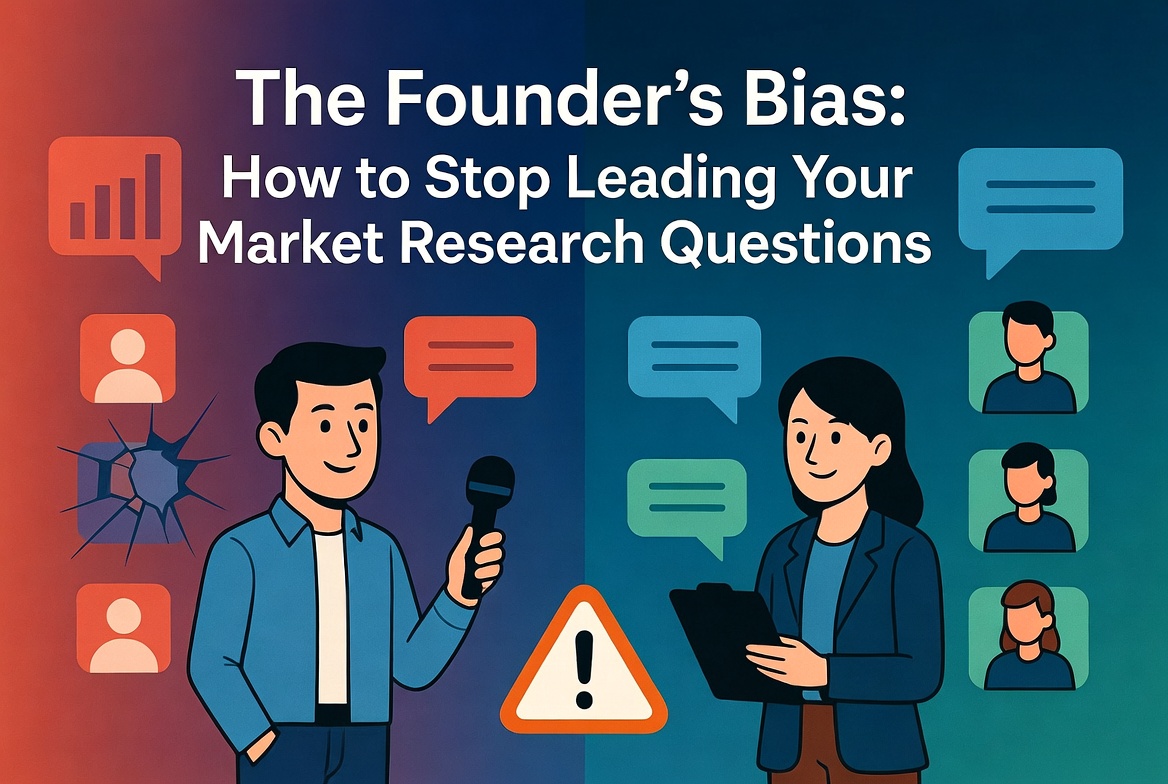
In market research, this bias shows up most vividly in the design of survey questions, customer interviews, and focus groups. A founder who believes their product is necessary will — usually without realising it — phrase their questions in ways that essentially beg respondents to agree with them. These are called leading questions, and they are the research equivalent of asking someone, “You love me, right?” while staring at them with desperate, pleading eyes.
According to Von Bergen and Bressler’s widely cited research paper “Confirmation Bias in Entrepreneurship” published on ResearchGate, the confirmation bias causes founders to seek and analyse information in ways that systematically underestimate competition, overstate product-market fit, and undercount the resources required to succeed — all because the brain is working overtime to protect the founder’s emotional investment in their idea. [1]
The Numbers Are Not Lying to You (Even If Your Survey Is)
Here is where we get into the brutal, unfiltered mathematics of founder self-delusion.
According to CB Insights’ analysis of 431 failed VC-backed startups, 43% of startup failures are attributable to poor product-market fit — meaning the founders built something the market did not actually want or need at the scale they assumed. [2] This figure has remained remarkably consistent across CB Insights’ studies dating back to 2014, when 42% of over 100 startup post-mortems cited “no market need” as the primary cause of death. [3]
Let that sink in for a second. Nearly half of all VC-backed startups that died — companies that raised millions of dollars from supposedly sophisticated investors — failed because nobody wanted what they were selling. Not because they ran out of money first. That is the final symptom. The root cause was a product that was never actually validated in the first place.
CB Insights themselves note that “running out of capital” affected 70% of failures, but explicitly flag it as the final cause of death, not the root problem. The root causes were poor product-market fit (43%), bad timing (29%), and unsustainable unit economics (19%). [2]
Now, you might be thinking: “But I did market research! I ran surveys!”
Sir. Ma’am. With the greatest possible respect — did you, though?
How Founders Accidentally Rig Their Own Research
There is a particular brand of self-deception that is unique to founders, and it is not the dramatic, mustache-twirling kind you see in movies. It is quiet, well-intentioned, and catastrophically expensive. Here is how it plays out in the real world of market research.
The Leading Question Problem
A leading question is one that is phrased in a way that subtly — or not so subtly — nudges the respondent toward a particular answer. Research published in Quality & Quantity: International Journal of Methodology (Springer, 2024) found empirical evidence that negatively or positively framed questions directly influence respondents’ stated opinions, creating artificial consensus where none truly exists. [4]
For a founder, a leading question might look like this:
“Given how frustrating it is to manage invoices manually, would you use our automated invoicing tool?”
Versus the neutral version:
“How do you currently manage your invoices, and what, if anything, do you find challenging about the process?”
The first question tells the respondent that invoices are frustrating and then asks if they want a solution. Of course they will say yes. You have basically written their answer for them. You have also learned precisely nothing about whether they would actually pay for, use, or recommend your product. But you feel great about it. You pull out your spreadsheet, highlight the 87% positive response rate in green, and go make another coffee.
This is the trap.
A 2020 study published in Publications (MDPI) that examined factors causing bias in marketing-related publications found that leading questions and poorly specified research criteria were among the most significant sources of bias in market-facing research, alongside sampling errors and non-responsiveness. [5] In other words: the problem is not just that bad research happens. It is that bad research looks exactly like good research if you do not know what to look for.
The Mom Test Failure
Here is a case study that will feel embarrassingly familiar to anyone who has ever launched a product.
Juicero — yes, the famous Wi-Fi-connected juice press that raised $120 million in VC funding — is arguably the most luxurious example of founder bias in modern entrepreneurial history. The founders built a machine that pressed proprietary juice packs at a retail price of $699, later reduced to $399. The pitch was compelling: fresh, cold-press juice at home with no mess.
The research? Presumably, it pointed to a massive and growing market for premium wellness products. The focus groups likely loved the concept of fresh juice. The surveys probably showed that health-conscious consumers valued convenience.
What the research almost certainly never established: “Would you actually pay $399 for this machine, when you can just squeeze the juice pack with your hands?” Because when Bloomberg reporters demonstrated in 2017 that you could achieve the exact same result by squeezing the packets manually, the company’s $120 million proposition effectively disintegrated in real time. Juicero shut down three months later.
The right market research question was never asked. Or if it was, it was asked in a way that guaranteed the “right” answer.
The Psychology Behind Why Founders Do This
It is tempting to laugh at the Juicero story — and honestly, feel free, we have all got enough stress in our lives — but the cognitive mechanisms behind it are serious, well-documented, and apply to almost every founder, at every level, in every industry.
Confirmation bias is not a character flaw. It is a fundamental feature of human cognition. The human brain processes approximately 11 million bits of information per second but consciously handles only about 40-50 bits. [6] To cope with this overwhelming information gap, the brain develops mental shortcuts — heuristics — that help us filter and prioritise. One of the most common of these shortcuts is to trust information that is consistent with our existing beliefs and discount information that is not.
For founders, this tendency is amplified by the enormous emotional and financial investment they have made in their idea. According to Tom Eisenmann, Professor at Harvard Business School and author of Why Startups Fail, there are recurring cognitive patterns that explain why so many startup founders make systematically poor decisions about market validation — patterns that centre on the emotional need to protect the idea from disconfirming evidence. [7]
Add to this the false consensus effect — the cognitive tendency to overestimate how much other people share your own beliefs and preferences — and you have a lethal cocktail. A founder who loves their product assumes, on some deep psychological level, that other people must also love it. Their survey questions are written by someone who already believes the answer. Their interviews are conducted by someone who smiles slightly wider when the respondent says something positive.
I am going to stop you right here and be very real with you. You know that feeling when you ask someone “how do I look?” right before you go out — and what you are genuinely, truly asking is “please tell me I look great because I already left the house and there is nothing you can say that would make me change”? That is exactly what most founders are doing when they run market research on their own product. You have already left the house. You just want someone to validate the outfit.
Case Study: The Fitness App That Worked Out Too Hard
Let us consider a more recent and instructive case.
A technology entrepreneur — we will call her Alicia, because that is more interesting than “a founder” — raised a pre-seed round to build a fitness accountability app targeting young professionals in their late 20s. She ran surveys. She conducted interviews. She built an impressive research deck. Her research showed that 79% of respondents said they “struggled to maintain a consistent fitness routine” and that 68% said they would “value a tool that helped them stay accountable.”
She spent $180,000 building the app and launched to an eager initial user base. Within four months, her Day-30 retention rate sat at 4%. Users were signing up and disappearing. Nobody was staying.
When she brought in an outside researcher to re-examine her original surveys, the problem was immediately apparent. Every single question had been leading:
- “How often do you find it hard to stay motivated with your fitness goals?” (not “Tell me about your relationship with fitness”)
- “Would you find it helpful to have a system that kept you accountable?” (not “How do you currently stay accountable — and does that work for you?”)
- “Would you pay for a tool that solved this problem?” (not “What have you tried before, and why did you stop?”)
She had collected 87% “positive intent” responses without ever establishing whether users had urgency, whether they had already tried similar tools and abandoned them, or whether accountability was even the real barrier. The market research had been a confidence-building exercise dressed up in the language of validation.
This pattern is replicated across thousands of startups every year. As a Harvard Business School study cited by a Journal of Economic Growth and Entrepreneurship analysis (2023) noted, 3 out of 4 venture-backed startups fail — and a dominant cluster of failure factors relate to product-market misfit and flawed business models that trace directly back to faulty early-stage validation. [8]
The Druski Principle: When You Are Playing Yourself
Here is the thing about confidence — and I mean this sincerely, with the energy of someone who has watched someone walk confidently in the wrong direction for a very long time — confidence is not the problem. Confidence without calibration is the problem.
There is a classic comedy archetype: the person who is so certain they are right that they refuse to acknowledge any evidence to the contrary, even as the evidence stacks up around them in increasingly dramatic fashion. The joke is not on them because they are stupid. The joke is on them because they are smart enough to construct an entire narrative that protects them from the truth.
That is a lot of founders in market research mode. They are not asking questions. They are delivering closing arguments. Their surveys are less “help me understand your life” and more “please confirm that my product is necessary and that I am a visionary.”
The market will eventually deliver its verdict regardless. And unlike a polite survey respondent, the market does not smile and say “yes” to make you feel better.
What Good Market Research Actually Looks Like
Enough diagnosis. Let us get into prescription.
1. Start With Curiosity, Not a Hypothesis to Prove
The foundational shift required in unbiased market research is moving from hypothesis confirmation to genuine discovery. The goal is not to find evidence that your product works. The goal is to understand your potential customer’s world so deeply that you can determine — without attachment — whether your solution actually fits into it.
The Jobs-to-Be-Done (JTBD) framework, developed by Clayton Christensen at Harvard Business School, is one of the most robust methodological approaches to unbiased customer research. Rather than asking “do you want my product?”, JTBD asks: “What job are you trying to get done, and what are you currently using to do it?”
This shifts the conversation from your solution to their problem — which is where all genuine market intelligence lives.
2. Audit Your Questions for Leading Language
Before you send a single survey, run every question through what researchers call a neutrality test. Ask yourself:
- Does this question contain the answer embedded in it?
- Does this question assume a problem exists, rather than asking whether it does?
- Does this question use emotionally loaded words (“frustrating,” “difficult,” “struggle”) that prime the respondent toward a particular emotional state?
- Does this question offer only positive or affirmative response options?
A study published in The Journal of Applied Behavioral Science (2022) by Cairns-Lee, Lawley, and Tosey, examining researcher reflexivity in qualitative interviews, found that leading question structures are significantly underestimated by researchers in terms of their influence on respondent answers — particularly when the researcher has an emotional stake in the outcome. [9] Even experienced researchers unconsciously frame questions toward their expected answers when they care about the results.
The fix is simple but requires discipline: have someone with no stake in your product review every survey question and every interview script. Their job is to find every question that could be made more neutral. If you cannot afford a professional researcher, a well-briefed friend with a ruthless streak will do.
3. Seek Disconfirming Evidence Deliberately
This is the one that founders genuinely struggle with, because it requires asking yourself to actively try to prove that your idea is wrong.
Pre-mortems — a technique popularised by psychologist Gary Klein and widely adopted in business settings — involve imagining that your product has already failed and working backwards to identify why. Applied to market research, this means explicitly designing research that tests the most threatening hypotheses about your product’s viability.
“What would have to be true for this product to have no market?” “What evidence would suggest that the problem we are solving is not actually painful enough to drive purchase?” “Who would our early positive responses be coming from — and are those the people we actually need?”
The startup community’s beloved concept of “fake door testing” — putting up a landing page for a product that does not yet exist and measuring actual click-through and sign-up rates — is one of the most honest forms of market research available because it removes the social desirability bias from the equation entirely. People are not telling you they like your product. They are showing you — with their actual attention and email address — whether they are interested. [10]
4. Understand Stated Versus Revealed Preferences
One of the most important distinctions in market research is the gap between what people say they will do and what they actually do.
Economists distinguish between stated preferences (what people tell you in surveys) and revealed preferences (what people demonstrate through actual behaviour). In consumer research, this gap is notoriously wide. A 2018 NBER working paper on sampling bias in entrepreneurial experiments found that demographic and preference biases in early-stage product testing often produced systematically skewed signals about demand — particularly when founders were surveying people in their own social networks, who were far more likely to give encouraging responses than the genuine target market. [11]
If you cannot get your potential customers to put down even a small amount of money — a deposit, a pre-order, a subscription signup — your “positive survey responses” are not market validation. They are good manners.
Case Study: How Dropbox Did It Right
Not every story ends in a coffee shop and an existential crisis. Some founders get this right.
Dropbox, now one of the most successful SaaS companies in the world, famously validated its product before writing a single line of code. Founder Drew Houston created a simple explainer video demonstrating what the product would do. He posted it online and measured sign-ups.
The waiting list went from 5,000 to 75,000 overnight. [12]
Houston did not ask people “Would you use a tool that simplified file syncing across your devices?” That question is a leading question. It describes the solution and then invites agreement.
He showed people what the product would do and asked them implicitly: “Does this solve a problem you have?” The response was people voting with their email addresses, their attention, and eventually their wallets.
This is the difference between asking for validation and earning it.
The Specific Language Patterns to Eliminate From Your Research
Here is your practical toolkit. These are the specific question constructions that introduce founder bias into market research. Print this out. Put it on your wall. Read it every time you sit down to design a survey.
❌ Presupposition questions — Questions that assume a particular state of affairs:
- “How often does X frustrate you?” → assumes X is frustrating
- “How much time do you waste on Y?” → assumes Y wastes time
✅ Replace with open-ended discovery questions:
- “How do you currently handle X?”
- “What does your process for Y look like on a typical day?”
❌ Loaded emotional language:
- “painful,” “struggle,” “difficult,” “frustrating” embedded in questions
✅ Replace with neutral descriptors or no descriptors:
- “Tell me about your experience with X”
- “Walk me through the last time you dealt with Y”
❌ Binary positive-skewed responses:
- “Would this be somewhat useful or very useful?” (no neutral or negative option)
✅ Replace with full-spectrum response scales including:
- “Not at all useful / Slightly useful / Neutral / Quite useful / Very useful”
❌ Hypothetical willingness questions:
- “Would you pay for a solution to this problem?”
✅ Replace with specific commitment tests:
- “Sign up here for early access” (measures revealed, not stated, preference)
How to Structure an Unbiased Customer Discovery Interview
The gold standard for early-stage market research remains the one-on-one customer discovery interview — but only when it is conducted with genuine openness. Here is a structure that strips out founder bias:
Opening (5 minutes): “Tell me about your role and how you typically spend your time on [relevant domain]. I am not going to pitch anything today — I am just trying to understand how things actually work.”
Present-state exploration (15 minutes): “Walk me through the last time you dealt with [the broad problem area]. What happened? What did you do? How did it turn out?” — Note: Do NOT mention your product category.
Pain excavation (10 minutes): “What about that process bothers you, if anything? How important is solving that to you compared to other things on your list?” — Note: You are testing whether the pain is real AND whether it is a priority.
Existing solutions (10 minutes): “What have you tried? What worked, what did not? What are you using now?” — Note: Understanding the competitive landscape from the customer’s perspective is invaluable.
Closing (5 minutes): “Is there anything about this area that I have not asked about that you think is important?” — Note: Open endings catch what your questions missed.
What you will notice is that your product is never mentioned. You are not trying to sell. You are trying to understand. And the truth is: the information you get from an interview like this is ten times more valuable than any survey, because you hear the exact words your customers use, you notice where they pause, where they lean forward, and where they shrug.
The Investor Problem: When Bias Gets Funded
There is a particularly expensive variant of founder bias that deserves its own section, and that is the case where biased market research gets validated by investors — because investors, it turns out, are not immune to confirmation bias either.
Tom Eisenmann’s research at Harvard Business School documents a pattern he calls the “false start trap” — where early, enthusiastic adoption from a narrow group of early adopters convinces both the founder and their investors that product-market fit has been achieved, triggering premature scaling that burns through capital before the mainstream market can be properly assessed. [7]
The Fab.com story is perhaps the clearest modern example. The design-focused e-commerce site raised over $336 million and reached a $1 billion valuation based on explosive initial growth from a niche community of design enthusiasts. The founder and investors extrapolated from that enthusiastic early base to assumptions about mainstream adoption. Those assumptions were never properly tested with neutral, unbiased research methods. The company eventually sold for less than $30 million. [13]
When your market research is biased, your investor pitch deck is biased. When your pitch deck is biased, your funding decisions are biased. When your funding decisions are biased, your burn rate does not care — it keeps climbing regardless of whether the market materialises.
Structural Solutions: Building Anti-Bias Into Your Research Process
Individual discipline is important, but the most effective way to eliminate founder bias from market research is to build structural safeguards that make bias mechanically difficult.
Separate the Researcher from the Founder
Wherever possible, the person who designed your product should not be the one conducting market research about it. This is not because founders are incompetent researchers. It is because even the most disciplined, self-aware founder cannot fully suppress the micro-expressions, tonal inflections, and unconscious follow-up question patterns that signal to respondents what answers are “welcome.”
If budget allows, commission independent research. If it does not, brief a team member or advisor who was not involved in the product’s conception to conduct interviews.
Pre-register Your Research Questions
Pre-registration — publishing your research questions and hypotheses before you collect data — is a technique borrowed from academic science that forces researchers to commit to their methodology before they know the results. It prevents the post-hoc rationalization of findings and makes it much harder to selectively report only the positive outcomes.
For founders, a lightweight version of this might mean: write down the specific conditions under which you would not proceed with your product, based on the research you are about to conduct. “If fewer than 40% of respondents independently identify this problem without prompting, I will reconsider the product.” Then actually hold yourself to it.
Use Jobs-to-Be-Done Surveys at Scale
For larger samples, the JTBD framework can be operationalised into quantitative surveys that measure existing behaviours and current spending — rather than hypothetical future preferences. Questions like:
- “In the last 30 days, have you paid for anything to help you with [general problem area]? If so, what?”
- “On a scale of 1-10, how urgent is solving [specific problem] relative to other priorities in your life or business this quarter?”
These questions reveal revealed preferences and real prioritisation data — information that is far more predictive of actual purchasing behaviour than hypothetical willingness-to-pay questions.
The Market Research Mindset Shift
Let us close by reframing the entire enterprise.
Most founders approach market research as a ritual of confirmation — a series of steps they must complete before they are “allowed” to build the thing they already want to build. This is the wrong frame. Market research conducted in this spirit will always, to some degree, find what it is looking for. It is like going to the doctor with a self-diagnosis already printed out and a pen ready to get it signed. The appointment was never really about finding the truth. It was about getting the stamp.
The founders who build things people actually want approach market research as a process of genuine discovery — an opportunity to understand a world they do not yet fully know, to have their assumptions challenged, and to learn something surprising. They are comfortable with the possibility that the research will tell them they are wrong, because they are more interested in building something that works than in defending something they invented.
This is not a personality trait. It is a discipline. It is a practice. And like all practices, it gets easier with repetition. The first time you deliberately design a research question to challenge your own assumptions rather than validate them, it will feel uncomfortable. That discomfort is the sound of real information entering your business strategy for the first time.
Think about what is actually at stake here. On one side of the scale, you have the discomfort of finding out that your idea needs significant rethinking — a blow to the ego, yes, but a cheap lesson at the survey design stage. On the other side, you have six, twelve, or eighteen months of your life, a significant portion of your savings or investor capital, the stress on your relationships, and the professional cost of a very public failure. The founders who protect their egos during market research are the ones who pay for it later with far more than their pride.
The best question a founder can ask at the start of any research process is not “How do I prove this works?” It is “What would I need to find out to be confident this is worth building?”
And then, crucially: “What if the answer to that question is ‘no’?”
The market is going to answer that question one way or another. The only variable is whether you ask it early, on your terms, with cheap research — or late, on the market’s terms, with expensive consequences. The data is not your enemy. Your fear of the data is.
Summary: Your Anti-Founder-Bias Market Research Checklist
Before your next research project, run through this checklist. Every “yes” is a potential source of bias that will cost you time, money, and sanity. And unlike your current survey, this checklist does not have a “yes, this is fine” option that makes you feel better about ticking everything. It is a diagnostic, not a comfort blanket.
- [ ] Did I write all the research questions myself, without an independent review?
- [ ] Do any questions embed the assumption that a problem exists?
- [ ] Do any questions mention my product category before the respondent does?
- [ ] Am I relying primarily on stated preferences rather than revealed behaviours?
- [ ] Are my positive response options more numerous or specific than my negative ones?
- [ ] Am I conducting interviews personally, with full knowledge of the product’s design?
- [ ] Have I defined in advance the results that would lead me to change course?
- [ ] Am I surveying primarily people I know personally or who know my startup?
If you ticked more than two of those, your research is currently more about making you feel good than about making your product work. And the market, as I said, does not care about your feelings. It only cares whether you built something worth paying for.
The founder’s bias does not mean you have a bad idea. It means you are human. But in business, “human” is not an excuse for avoidable failure — especially when the tools to counteract it are this accessible, this affordable, this well-evidenced, and this clearly signposted by the wreckage of startups that came before you.
Stop leading your market research questions. Start listening to the actual market. Ask harder questions earlier, build the habit of genuine curiosity, and let the data challenge you rather than console you.
Your bank account, your investors, and your future customers will thank you.
References
[1] Von Bergen, C.W. & Bressler, M.S. (2018). Confirmation Bias in Entrepreneurship. ResearchGate. Available at: https://www.researchgate.net/publication/327823193_Confirmation_Bias_in_Entrepreneurship
[2] CB Insights (2024). Why Startups Fail: Top 9 Reasons. CB Insights Research. Available at: https://www.cbinsights.com/research/report/startup-failure-reasons-top/
[3] CB Insights (2021). The Top 12 Reasons Startups Fail. CB Insights Research. Available at: https://www.cbinsights.com/research/report/startup-failure-reasons-top/
[4] Springer Nature (2024). Swayed by Leading Questions. Quality & Quantity: International Journal of Methodology. Available at: https://link.springer.com/article/10.1007/s11135-024-01934-6
[5] Krasonikolakis, I. et al. (2020). Assessment of Factors Causing Bias in Marketing-Related Publications. Publications, 8(4), 45. MDPI. https://doi.org/10.3390/publications8040045
[6] Wilson, T.D. (2002). Strangers to Ourselves: Discovering the Adaptive Unconscious. Harvard University Press. ISBN: 9780674013827.
[7] Eisenmann, T. (2021). Why Startups Fail: A New Roadmap for Entrepreneurial Success. Currency / Harvard Business School. ISBN: 9780593137024. Referenced in: https://developmentcorporate.com/startups/why-90-of-startups-fail-the-4-hidden-traps-beyond-running-out-of-money/
[8] Hammouda, I. et al. (2023). Analysing Startups Failure Factors: Evidence from CB Insights Tech Market Intelligence Platform. Journal of Economic Growth and Entrepreneurship, Vol. 6, No. 1, pp. 10–30. Available at: https://www.researchgate.net/publication/369335102
[9] Cairns-Lee, H., Lawley, J. & Tosey, P. (2022). Enhancing Researcher Reflexivity About the Influence of Leading Questions in Interviews. The Journal of Applied Behavioral Science. https://doi.org/10.1177/00218863211037446
[10] Valid Spark (2026). The Confirmation Bias Trap: 7 Biases Killing Your Startup (And How to Beat Them). Available at: https://validspark.com/blog/confirmation-bias-trap-startup
[11] Gompers, P. et al. (2021). Sampling Bias in Entrepreneurial Experiments. NBER Working Paper Series. Available at: https://www.nber.org/system/files/working_papers/w28882/w28882.pdf
[12] Houston, D. (2010). Dropbox startup lessons learned. Cited in multiple entrepreneurship curricula. Reference overview available at: https://techcrunch.com/2011/10/19/dropbox-minimal-viable-product/
[13] NFX (2022). The False Positive Trap in Startup Validation. Referenced in: https://developmentcorporate.com/startups/why-90-of-startups-fail-the-4-hidden-traps-beyond-running-out-of-money/
Disclaimer: This article is intended for educational and informational purposes. Statistics cited reflect findings available at time of publication.
Leave a Reply
You must be logged in to post a comment.